Insulation errors rarely look dramatic. They look ordinary: a hatch left unsealed, batts squeezed around wiring, a vent buried under loose-fill, a crawlspace detail skipped because the attic felt like the “main job.” Yet small breaks in the thermal boundary can keep conditioned air moving the wrong way, leaving a house a little too hot, a little too cold, and more expensive to run month after month. The risk is not just a higher bill. It is the slow habit of paying for comfort that never fully arrives.
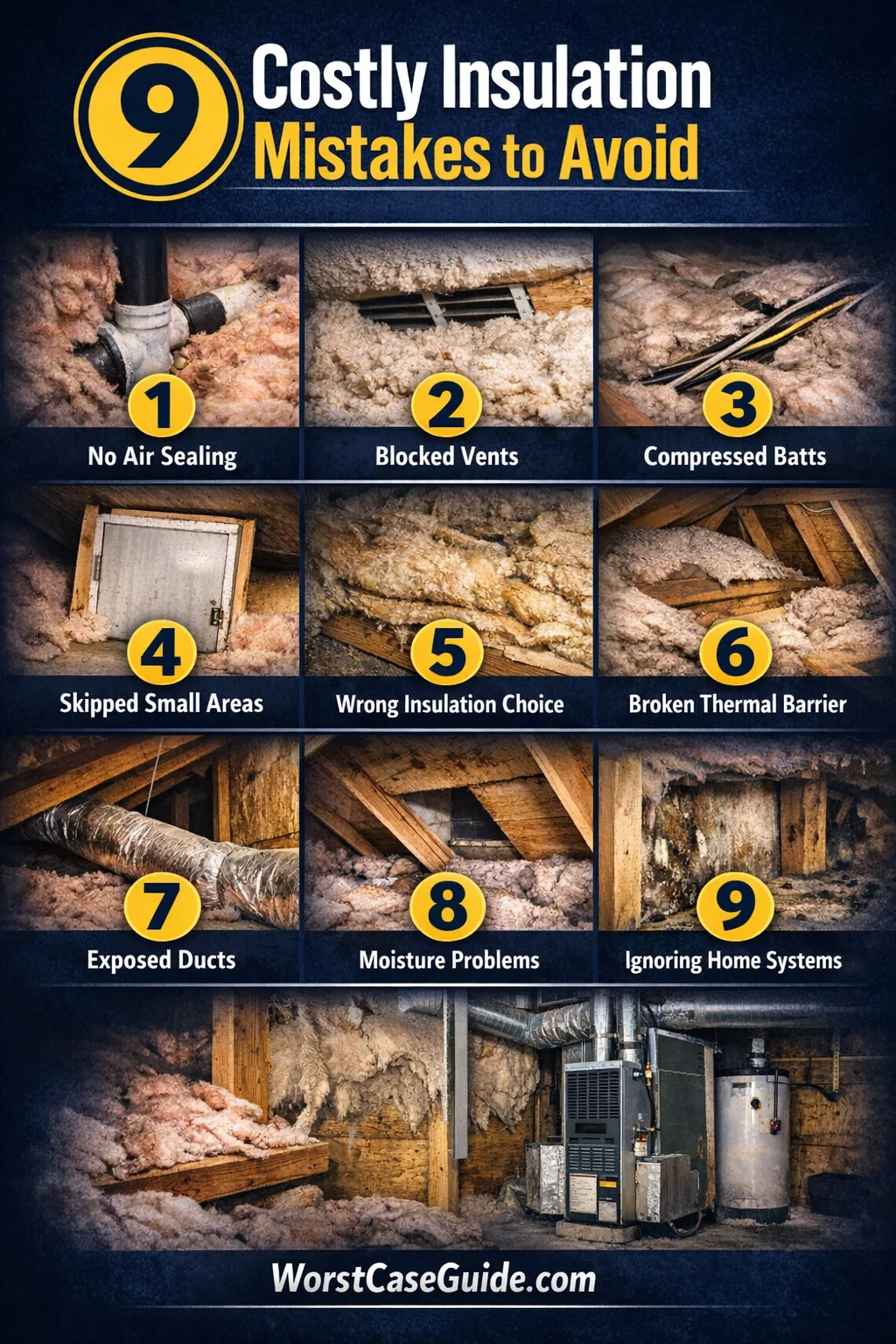
Insulation mistakes that waste heating and cooling costs usually come from one false idea: that insulation is a single product decision. In real houses, it behaves more like a chain. If one link is weak—air leakage, moisture, ducts, access panels, vent paths, rim joists—the whole job can underperform, even when the insulation itself looks thick and finished.
Where The Waste Usually Hides
- Attic floor transitions, especially around penetrations, eaves, and access openings
- Wall and floor edges where continuity breaks at rim joists, kneewalls, and bonus rooms
- Ducts and boots sitting outside the conditioned envelope
- Moisture-prone assemblies where wet, compressed, or misapplied insulation loses practical value
Why This Topic Creates Hidden Cost Risk
Heating and cooling costs rise for a simple reason: the house keeps trading indoor air and indoor temperature with places that were never meant to share them. An attic in summer, a vented crawlspace in winter, a garage ceiling, a rim joist, a leaky duct chase—each one can act like an opening in a winter coat with the buttons half done.
That is why many insulation projects disappoint. The material may be present, yet the assembly is incomplete. If the home feels uneven room to room, if the HVAC system runs longer than expected, or if utility bills do not settle after “more insulation,” the problem is often not the idea of insulation. It is the missing continuity around it.
Common Assumptions That Lead To Waste
- “More insulation will cover up air leaks.” Bulk insulation slows heat flow, but it does not automatically stop air moving through gaps and joints.
- “The attic is the whole story.” The attic matters, still rim joists, crawlspaces, duct runs, hatches, and knee walls often keep the losses alive.
- “Thicker always means better.” Thickness without fit, dryness, and continuity can deliver less than expected.
- “Ventilation and insulation are separate issues.” In many assemblies, airflow, vent channels, and moisture control directly affect how well insulation performs.
- “If the house feels mostly fine, the insulation must be fine.” Some failures show up first as slow cost creep, dusty drafts, hot upstairs rooms, or short comfort cycles.
| Mistake | What Gets Missed | Where The Cost Shows Up |
|---|---|---|
| Insulating without air sealing | Penetrations, top plates, chases, framing joints | Drafts, longer HVAC run time, uneven rooms |
| Blocking attic vent paths | Soffit vents and airflow channels | Heat buildup, moisture trouble, summer AC strain |
| Compression and gaps | Batts around wiring, pipes, tight cavities | Lower real-world thermal resistance |
| Skipping small transition areas | Attic hatches, pull-down stairs, rim joists | Localized leaks that affect the whole house |
| Wrong material or assembly choice | Climate, location, moisture exposure, cavity depth | Underperformance despite visible insulation |
| Broken thermal boundary | Wrong insulation plane or partial enclosure | Persistent hot and cold zones |
| Ignoring ducts outside the envelope | Leaky boots, attic or crawlspace duct losses | Comfort complaints and avoidable energy use |
| Moisture-blind installation | Wet insulation, trapped vapor, poor drying path | Reduced insulation value and repair costs |
| House-as-a-system blind spot | Combustion safety, basement air, pressure balance | Costly fixes after a “successful” insulation job |
9 Insulation Mistakes That Waste Heating And Cooling Costs
Mistake 1: Treating Insulation As If It Seals Air Leaks
This is the error that sits underneath many others. Insulation and air sealing are related, but not identical. A cavity can be filled and still leak around its edges, joints, penetrations, and transitions.
Why It Happens
- Air leaks are hidden inside ordinary-looking gaps.
- Loose-fill or batts create a visual sense of completion.
- Many people focus on the insulation layer and not the air barrier layer.
Early Warning Signs
- Rooms feel drafty even after new insulation is added.
- Dust collects near trim, outlets, attic hatches, or baseboards.
- Upper floors stay harder to heat in winter or cool in summer.
Worst-Case Outcome
The house still leaks conditioned air into the attic, basement, wall cavities, or crawlspace, so the HVAC system runs longer with only partial comfort gains. In older homes, this can also pull moisture through hidden openings and make a simple energy project turn into a repair project later.
A Safer Approach
If the project is small, the safer path usually starts with the large leakage points first: plumbing and wiring penetrations, open chases, top plates, flue gaps with proper materials, attic hatches, rim joists, and duct boots. In larger systems, it helps to think in layers: air control first, insulation second.
Mistake 2: Blocking Soffit Vents Or Attic Air Paths
A lot of attic jobs fail at the perimeter. Insulation is pushed all the way to the eaves without preserving an airflow channel, or soffit vents are covered because the installer is trying to get full coverage quickly.
Why It Happens
- The edge of the attic is tight and awkward to reach.
- Loose-fill can drift and bury vents over time.
- “More coverage everywhere” sounds sensible until ventilation paths disappear.
Early Warning Signs
- Attic feels very hot in summer and damp in colder months.
- Dark staining, condensation, or a musty smell near roof sheathing.
- Ice dam history in cold climates or stubborn upstairs overheating in warm ones.
Worst-Case Outcome
Instead of improving efficiency, the attic becomes a heat trap or moisture trap. That can raise summer cooling demand, shorten roof life, and push moisture damage into sheathing and framing. The insulation is technically “there,” but the assembly is working against itself.
A Safer Approach
When the attic floor is the chosen thermal boundary, the safer version keeps insulation coverage and maintains vent channels with baffles where needed. If you are in a house with very low eaves, this detail matters more than it first appears.
Mistake 3: Compressing Insulation Or Leaving Gaps And Voids
Insulation loses practical value when it is crushed, cut short, stuffed around obstacles, or installed with pockets of missing coverage. This is common with fiberglass batts, awkward framing bays, and retrofit jobs around pipes, wires, and recessed features.
Why It Happens
- Cavities are irregular, but the insulation piece is not.
- Installers try to force one product into every condition.
- Obstacle-heavy areas take longer, so “good enough” starts to creep in.
Early Warning Signs
- Visible thin spots or slumped sections.
- Batts bulging in some areas and pinched flat in others.
- One wall or ceiling area feeling noticeably different from the surfaces around it.
Worst-Case Outcome
The rated product and the real result drift apart. That means money gets spent for thermal resistance that never fully shows up in daily use. In isolated cavities this may look minor. Across an attic, bonus room, or many wall sections, the loss adds up quietly.
A Safer Approach
In smaller projects, careful cutting and fitting often matters more than adding another layer later. In harder assemblies—rim joists, narrow bays, irregular rooflines, mechanical-heavy zones—a product that conforms to the space without compression can reduce the risk of patchwork performance.
Mistake 4: Skipping The “Small” Areas That Leak Like Big Ones
Many energy losses come from places that are small in size but large in effect: attic access panels, pull-down stairs, kneewall doors, rim joists, band joists, cantilevered floors, garage-to-house transitions, and short exposed sections around mechanical penetrations. These are often treated as side details. They rarely behave like side details.
Why It Happens
- Main open areas get attention first and consume the budget.
- Transition details feel fiddly and slow.
- The visual payoff is low, so they are postponed or forgotten.
Early Warning Signs
- Drafts near attic stairs or access panels.
- Cold floors over basements, crawlspaces, garages, or bump-outs.
- One room stays uncomfortable although the rest of the house is acceptable.
Worst-Case Outcome
The house performs like a system with one window slightly open all year. Not dramatic. Just expensive. These weak spots can also distort pressure and airflow enough that people keep chasing the symptom with thermostat changes rather than fixing the leak path itself.
A Safer Approach
If the budget is tight, it often makes sense to protect the transitions before adding more material to already-covered open areas. An insulated, weatherstripped attic hatch, sealed rim joists, and well-detailed kneewalls can change comfort faster than another blanket of insulation in the easiest parts of the attic.
Mistake 5: Choosing Insulation By Price Or Thickness Alone
Insulation is not interchangeable just because two products look bulky or advertise a similar number. Location, climate, moisture exposure, available depth, and assembly type all affect whether a material choice makes sense.
Why It Happens
- People compare products as if the cavity, dryness, and fit are already solved.
- Retail packaging makes selection feel simpler than it is.
- The cheapest visible option can look reasonable when long-term loss is harder to picture.
Early Warning Signs
- Insulation installed in places where it stays damp, settles badly, or fits poorly.
- Performance complaints start even though the installed depth looked “good.”
- Rooms over garages, under roofs, or near crawlspaces stay troublesome after the job.
Worst-Case Outcome
The project underdelivers from day one. In some cases the wrong choice also complicates later repairs because the assembly now has to be opened, dried, reworked, or upgraded in stages rather than once.
A Safer Approach
A safer decision usually matches the material to the location, not just the advertised thickness. If you are dealing with a basement, crawlspace, low-slope roofline, or tricky bonus room, the real question is often how the whole assembly dries, seals, and stays continuous, not which product looks fullest on installation day.
Mistake 6: Breaking The Thermal Boundary
The thermal boundary only works when it is continuous. Problems start when one part of the envelope is insulated at the attic floor, another part at the roofline, and a third part not really at all. Partial conversions and half-finished storage areas are common examples.
Why It Happens
- Renovations happen in phases.
- Attics and bonus rooms change use over time.
- People insulate what is visible without deciding where the conditioned envelope truly begins and ends.
Early Warning Signs
- One upstairs room is hot almost every summer afternoon.
- Closets, side attics, or kneewall zones feel far more extreme than adjacent rooms.
- Different parts of the same floor behave like separate climates.
Worst-Case Outcome
You keep paying to condition spaces that are only partly inside the envelope, while other spaces that should be protected stay exposed. This is where a house starts acting confused: longer system run times, uneven comfort, and repeated “small fixes” that never settle the pattern.
A Safer Approach
In smaller projects, it helps to define one clear boundary and keep it continuous. In larger systems, especially with finished attics or complex rooflines, the safer route is to decide the enclosure strategy first and install every part to support that same line. Mixed intentions are expensive.
Mistake 7: Ignoring Ducts And Boots In Unconditioned Space
Some insulation projects try to tighten the house while leaving leaky ducts, poorly sealed boots, or underinsulated runs in a hot attic or cold crawlspace. That is like patching the coat and leaving the sleeve seam open.
Why It Happens
- Ductwork is treated as an HVAC issue, not an enclosure issue.
- It sits out of sight, so it gets ignored during envelope upgrades.
- People assume room comfort problems come only from wall or attic insulation.
Early Warning Signs
- One or two rooms are hard to cool or heat even after insulation work.
- Dusty air, noisy registers, or temperature swings near ceiling boots.
- High attic heat and long cooling cycles in summer.
Worst-Case Outcome
The HVAC system keeps pushing conditioned air through hostile space and losing part of it before it reaches the room. Bills stay stubborn, comfort stays uneven, and the insulation project gets blamed for losses that were partly happening in the duct path all along.
A Safer Approach
If ducts are outside the conditioned envelope, a safer approach usually looks at the full route: ducts, joints, boots, chases, and surrounding boundary details. If you are planning a larger remodel, bringing ducts into conditioned space can change the risk picture more than another isolated insulation upgrade.
Mistake 8: Ignoring Moisture, Drying Paths, And Wet Insulation
Insulation and moisture are tied together more tightly than many people expect. A damp assembly can lose performance, stay colder or hotter than intended, and create odors or material damage that keep the comfort problem alive.
Why It Happens
- Leaks, condensation, and air movement are treated as separate issues.
- Old insulation is left in place even when it is dirty, settled, or damp.
- Vapor control decisions are copied from other houses without matching the actual assembly.
Early Warning Signs
- Musty attic, basement, or crawlspace odors.
- Staining on sheathing, joists, or insulation surfaces.
- Performance that changes by season, with more discomfort during humid months.
Worst-Case Outcome
The job becomes a cycle of energy waste plus material decline. A house can end up paying twice: once through higher heating and cooling demand, then again through mold cleanup, damaged finishes, or framing repairs. This is one of the points where “cheap now” ages badly.
A Safer Approach
If you are seeing signs of moisture, the safer path usually starts with the source—bulk water, humid air leaks, condensation surfaces, blocked ventilation paths, or basement/crawlspace dampness—before more insulation is layered in. Dry, continuous, and correctly detailed insulation tends to outperform thicker insulation installed over an unresolved moisture pattern.
Mistake 9: Forgetting That The House Works As One System
Insulation changes pressure, airflow, and temperature relationships inside the whole house. That matters in older homes, basements with combustion appliances, mixed-use spaces, and retrofits that tighten one part of the envelope while leaving another part untouched.
Why It Happens
- The project is framed as “just insulation.”
- Basement, crawlspace, attic, HVAC, and combustion details are handled by different people.
- Short-term comfort goals hide longer-term interactions.
Early Warning Signs
- A basement or mechanical room behaves differently after air sealing work.
- Doors begin to close differently or room pressure feels odd.
- Fresh comfort problems appear in spaces that were not part of the original job.
Worst-Case Outcome
A project that looked tidy on paper creates follow-up costs because one part of the house was improved in isolation. In older or more complex homes, this can mean new moisture issues, pressure imbalances, or the need to revisit basement and mechanical details that were left outside the first scope.
A Safer Approach
In straightforward homes, this may simply mean checking the attic, basement, crawlspace, and ducts as connected parts of one enclosure story. In larger systems, especially with combustion appliances or layered renovations, the safer move is to treat insulation as one part of whole-house performance, not a stand-alone patch.
General Risk Patterns Behind Costly Insulation Work
- The visible area gets finished; the transition areas do not. Energy loss often survives in edges, seams, hatches, joists, and chases.
- People add material before fixing movement. Air and moisture travel first. Insulation performs better once those paths are under control.
- The attic gets all the attention. Many homes also leak at basement rims, crawlspaces, ducts, and garage transitions.
- One symptom gets chased at a time. A hot room, a cold floor, and a high bill may all trace back to the same broken boundary.
- “Looks finished” gets confused with “works well.” Insulation is one of those jobs where neat appearance can hide weak performance.
Practical Reading Of The Risk
If a house has drafts, uneven rooms, long HVAC cycles, attic heat, cold floors, or a utility bill that never quite matches the work already done, the odds rise that the issue is not “lack of insulation” in the simple sense. It is more often misplaced insulation, interrupted insulation, damp insulation, or insulation asked to do the air-sealing job.
FAQ
Does insulation reduce both heating and cooling costs?
Yes, when the insulation is part of a continuous enclosure. It slows heat flow in both directions, so it can reduce winter heat loss and summer heat gain. The savings tend to disappoint when air leakage, duct losses, moisture, or broken boundary details are left in place.
Is air sealing more important than adding more insulation?
In many retrofit situations, air sealing the larger leakage paths changes performance faster than simply adding more insulation. That does not make insulation less important. It means the two work better together, and the order often matters.
Why does attic insulation sometimes fail to fix one hot or cold room?
Because the room may be affected by more than attic depth alone. Duct losses, kneewalls, rim joists, garage ceilings, recessed transitions, or an interrupted thermal boundary can keep that room out of step with the rest of the house.
Can too much insulation create problems?
The larger risk is usually not “too much” by itself. It is adding insulation in a way that blocks vent paths, traps moisture, compresses existing layers, or hides unresolved leakage and assembly issues. More material does not automatically mean better performance.
What insulation areas are most often missed during home upgrades?
Attic hatches, pull-down stairs, soffit-edge details, rim joists, kneewalls, cantilevers, garage transitions, and ducts or boots in unconditioned spaces are missed often. These are small enough to overlook and large enough to matter.