Bathroom plumbing often looks calm and tidy once the tile is set and the vanity is in place. That clean finish can be misleading. A remodel changes a chain of hidden parts—supply lines, drain lines, vents, shut-off points, seals, waterproof layers—and one weak link can turn a polished room into a repair job behind new walls. A bathroom is a little like a watch: from the front it looks simple, but one part out of place changes how the whole thing runs.
That is why plumbing mistakes in bathroom remodels tend to be expensive in a very specific way. The first cost is rarely the full cost. The real bill often appears later, when leaks stain the ceiling below, drains start gurgling, shower performance feels wrong, or finished tile has to come off so someone can reach a joint that should have been accessible from the start.
Why This Topic Is Risky
In a bathroom remodel, hidden work drives visible results. A sink that drains slowly, a shower that feels weak, or a toilet that smells “slightly off” often points to something buried behind finishes, not something sitting in plain sight.
Common Wrong Assumptions
- “If the old pipes are not leaking today, they are fine for the new remodel.” Age, corrosion, poor material transitions, and worn valves often stay quiet until the system is disturbed.
- “Moving a toilet or shower is mostly a layout decision.” It is also a drain path, vent path, slope, and access decision.
- “Waterproofing will cover small plumbing flaws.” Waterproofing helps manage surface moisture. It does not fix bad joints, poor venting, or the wrong drain pitch.
- “If water comes out and goes down, the rough-in is done right.” Many failures show up only after repeated use, pressure changes, or closed walls.
- “The expensive fixture is the important part.” In many remodels, the risky part is the cheap hidden fitting, the reused stop valve, or the missed test.
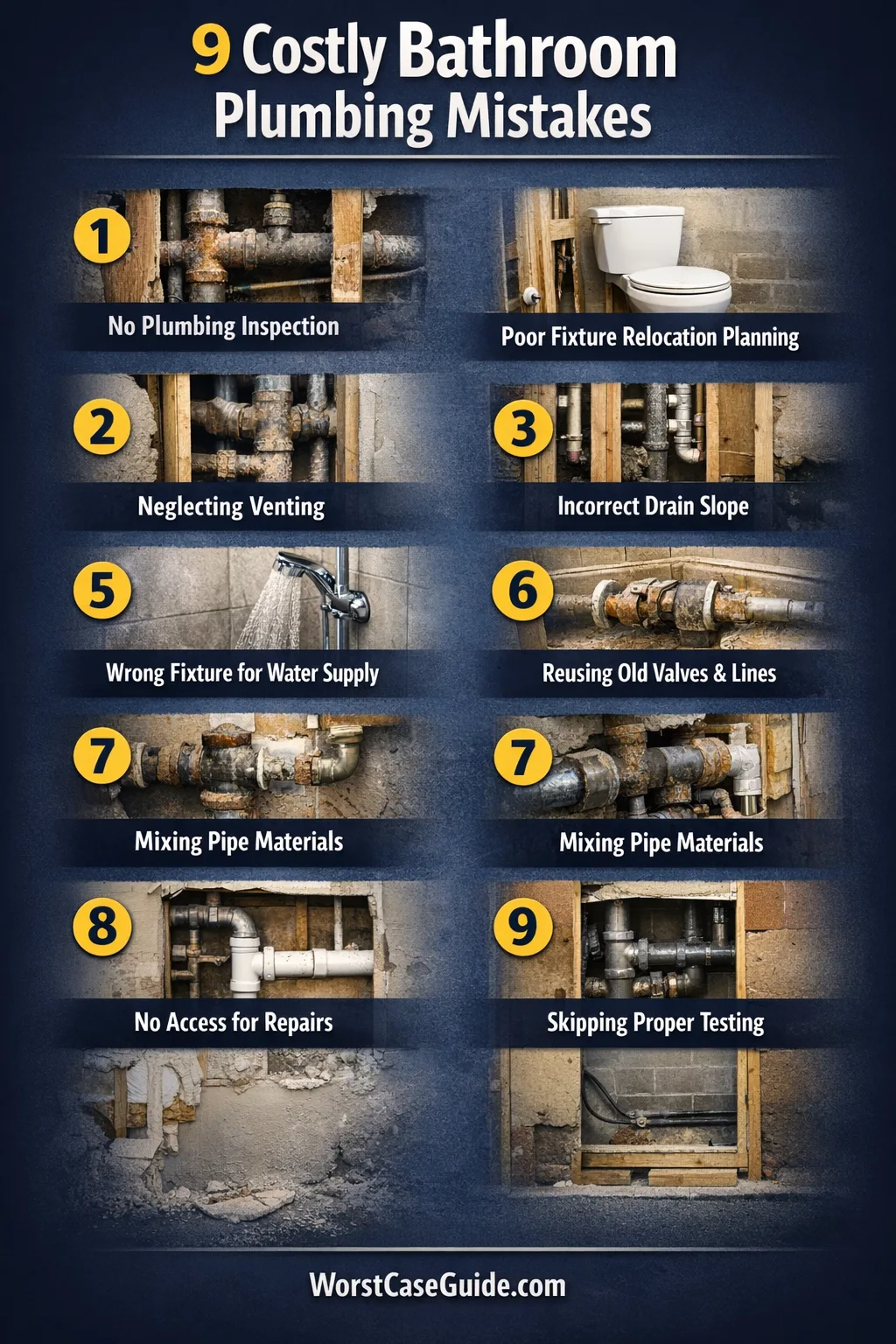
9 Plumbing Mistakes In Bathroom Remodels
| Mistake | What It Disrupts | Early Visible Clue | What Rework Often Touches |
|---|---|---|---|
| Skipping a plumbing survey | Material compatibility, pipe condition, layout feasibility | Surprises during demolition | Budget, schedule, wall openings |
| Treating layout changes as cosmetic | Drain routing, vent routing, clearances | Last-minute reroutes | Floor, framing, subfloor |
| Ignoring venting | Drain speed, trap seal protection, odor control | Gurgling, sewer smell, slow drainage | Walls, roof or stack access |
| Getting drain slope wrong | Waste movement | Standing water, repeat clogs | Tile, shower base, floor sections |
| Choosing fixtures before checking supply conditions | Pressure, flow, hot-water performance | Weak shower or temperature swings | Valve changes, line sizing, water-heating setup |
| Reusing old hidden parts | Long-term reliability | Minor drips or stuck valves | Cabinets, escutcheons, finished walls |
| Mixing materials carelessly | Joint integrity, corrosion control | Small leaks or noisy lines | Fittings, transitions, sections of pipe |
| Leaving no access or isolation points | Repair speed, damage control | Whole-house shutoff needed for minor work | Tile, drywall, trim |
| Closing walls before real testing | Leak detection, drain performance | Problems appear after handover | Fresh finishes |
Mistake 1: Skipping A Plumbing Survey Before Design Decisions
Why It Happens
Many remodels start with finishes, mood boards, and fixture shopping. The hidden system gets checked later. In older homes, that order can be expensive. Galvanized sections, tired shut-off valves, corroded traps, patched repairs, odd pipe transitions, and past DIY work may only become obvious after demolition has already started.
Early Warning Signs
- Water pressure already feels uneven between fixtures.
- Valves are stiff, frozen, or look heavily aged.
- Drains are slow even before the remodel begins.
- There are stains, soft drywall, or old repair patches near wet areas.
Worst-Case Outcome
The remodel plan is built around pipework that cannot support it. Then the layout, budget, and sequence all shift at once. In smaller projects, that may mean a few days of delay. In larger systems, it can mean reopening walls, changing fixture choices, and paying twice for work that looked “finished” a week earlier.
Safer Approach
A bathroom plan tends to age better when the existing plumbing is treated as part of the design brief, not as an afterthought. If the home is older, even a simple fixture swap may deserve a closer look behind the wall before final selections are locked in.
Mistake 2: Treating Fixture Relocation As A Simple Cosmetic Change
Why It Happens
A new layout often looks clean on paper. A toilet on the other wall, a longer vanity, a bigger shower. It feels like a design move. It is also a plumbing move. Toilets, showers, and tubs are tied to drain runs, vent routes, floor structure, and usable slope. A Pinterest-ready plan can run into very unglamorous limits once the rough-in starts.
Early Warning Signs
- The proposed fixture position is far from the current drain stack or wet wall.
- The floor needs deeper cutting or framing changes than expected.
- New pipe routes start competing with joists, ducts, or adjacent walls.
- The design keeps changing during demolition.
Worst-Case Outcome
The new room looks better but performs worse. Slow drains, awkward maintenance access, noise in the walls, recurring clogs, or odors can follow. A more expensive version of the same problem, really.
Safer Approach
If a remodel involves moving the toilet, tub, or shower, the plumbing path deserves the same attention as the visual layout. Shorter, cleaner routes often lower risk. If you are in this situation, it may help to compare the design gain with the hidden work it creates, not just the floor plan image.
Mistake 3: Ignoring Venting Until Gurgling And Odors Show Up
Why It Happens
People think about drains because they are easy to picture. Vents are quieter and less visible, so they get less attention. Yet bathroom drains need air movement to work well. Without proper venting, water struggles to flow cleanly and trap seals can be disturbed.
Early Warning Signs
- Gurgling sounds after a sink or shower drains.
- A new sewer smell that appears off and on.
- One fixture affects another when draining.
- Water in a trap seems to disappear too quickly.
Worst-Case Outcome
A newly remodeled bathroom starts behaving like a room with a hidden breathing problem. Odors return, drains slow down, and the fix may sit behind finished tile or inside a wall cavity that was just closed.
Safer Approach
Drain planning works better when waste and venting are treated as one system. Many articles list venting as a side note. It is not a side note. In practice, it is one of the parts that separates a bathroom that merely looks finished from one that actually works day after day.
Mistake 4: Getting Drain Slope Wrong
Why It Happens
Drain slope sounds simple, so it is often trusted to “close enough.” That assumption can fail both ways. Too little fall and waste moves slowly. Too much fall and water can outrun solids. That sounds almost backwards at first, which is one reason people miss it.
Early Warning Signs
- Water lingers in the shower or tub after use.
- Clogs return even though the line is new.
- Drain performance seems fine at first, then gets worse with regular use.
- The floor build-up or joist path forces awkward pipe angles.
Worst-Case Outcome
The bathroom becomes a repeat-maintenance room. Hair, soap residue, and ordinary waste find the weak point and keep collecting there. When the slope issue sits under a shower base or tiled floor, the repair can be frustratingly invasive.
Safer Approach
Bathrooms tend to age better when the drain path is planned around gravity, structure, and finish thickness together. That is especially true in remodels where the existing floor leaves little room for error.
Mistake 5: Choosing Fixtures Before Checking Pressure, Flow, And Hot-Water Capacity
Why It Happens
A fixture is easy to buy and easy to imagine in the room. The supply conditions behind it are harder to picture. Rain heads, body sprays, thermostatic valves, double vanities, and fast-fill tubs can all ask more from the system than the current lines or hot-water setup can comfortably provide.
Early Warning Signs
- The current shower already feels weak.
- Hot water takes a long time to arrive.
- Temperature shifts when another fixture runs.
- The remodel adds more demand without changing supply lines or water-heating support.
Worst-Case Outcome
The new bathroom looks better than the old one but feels worse to use. The shower is underwhelming, the tub fills slowly, and “luxury” hardware ends up exposing the limits of the hidden system instead of improving it.

Safer Approach
Fixture choices tend to work better when they follow the real supply conditions of the house. If the remodel aims for a higher-performance shower or adds simultaneous use, the plumbing plan may need to change before the finish schedule does.
Mistake 6: Reusing Old Stop Valves, Supply Lines, And Hidden Fittings To Save Money
Why It Happens
Renovation budgets tighten fast. Small hidden parts look like an easy place to save. A remodel may get a new faucet, new tile, and a new vanity while the old stop valves and aging connectors remain behind it all. That is a quiet gamble.
Early Warning Signs
- Valves are hard to turn or do not fully shut off.
- Flexible lines show age or minor corrosion at ends.
- Previous patchwork is visible near joints.
- The plumbing behind the wall is clearly older than the room being built around it.
Worst-Case Outcome
A very small part fails in a very expensive room. Then the savings disappear. Leaks from stops, connectors, and older fittings are especially frustrating because they often damage new work, not old work.
Safer Approach
Hidden parts usually deserve a stricter standard than visible ones. A bathroom remodel is one of the few moments when those pieces are exposed without extra demolition, so many low-cost shortcuts stop being low-cost once that timing is gone.
Mistake 7: Mixing Pipe Materials And Connection Methods Carelessly
Why It Happens
Remodels often blend old and new systems. Copper meets PEX. Older plastic meets newer fittings. Repairs from different decades show up in the same wall. None of that is automatically wrong. The problem starts when transitions are made casually, with the wrong fittings, poor support, or no thought for long-term compatibility.
Early Warning Signs
- One wall contains several pipe types and several repair styles.
- Transitions appear improvised rather than planned.
- Pipes are not well supported near fittings.
- Noisy movement starts when water is turned on or off.
Worst-Case Outcome
Joints become the weak point. Small leaks, line movement, premature wear, or corrosion trouble can show up long after the project is signed off. It is the plumbing version of putting new tires on a car with loose wheel bolts—everything looks updated until the hidden connection matters.
Safer Approach
Mixed-material plumbing can work well when the transitions are chosen deliberately and supported properly. The larger risk is not “old meets new.” The larger risk is old meets new without a clear plan.
Mistake 8: Forgetting Shut-Off Valves, Cleanouts, And Access Panels
Why It Happens
Access is not glamorous. It does not appear in the final styling photos. So it gets trimmed away when the room is being simplified visually. The result can look neat and still be hard to live with.
Early Warning Signs
- A single minor repair would require shutting off water to the whole house.
- Tub or shower plumbing is fully buried with no practical service path.
- Direction changes in drain lines have no useful maintenance access nearby.
- Design revisions keep removing “ugly” service points.
Worst-Case Outcome
A tiny service job turns into finish damage. Drywall is opened from the other side. Tile is cut. Cabinets are removed. The bathroom still works, technically, but every future repair starts from a bad position.
Safer Approach
Good bathroom planning includes damage control, not just installation. In smaller remodels, that may mean updating local shut-offs. In larger or more custom rooms, it may also mean planning hidden-but-reachable access from an adjacent closet, hall wall, or utility area.
Mistake 9: Closing Walls Before Pressure Testing, Leak Testing, And Real Drain Testing
Why It Happens
Schedule pressure is real. Once the room starts taking shape, everyone wants the walls closed and the tile moving. A fast visual check can be mistaken for a full test. That is where hidden defects survive handover.
Early Warning Signs
- Testing is discussed loosely rather than as a planned step.
- The rough-in is approved by appearance, not by performance.
- There is no documented sequence for checking leaks, drainage, and fixture behavior.
- Tile or wallboard is scheduled immediately after plumbing changes.
Worst-Case Outcome
The bathroom passes its photo moment and fails its first month of real use. A slight leak, a poorly seated connection, a weak drain run, or an airflow issue appears only after the room is finished. That is the kind of miss that makes people say, “But it looked perfect.”
Safer Approach
A remodel tends to be safer when testing is treated as part of the build, not as a box to tick at the end. The hidden system needs a chance to behave like a system before the finishes make access painful.
General Risk Patterns That Show Up Again And Again
Bathroom plumbing mistakes rarely come from one dramatic error. More often, they come from a pattern:
- Design outruns reality. The layout is approved before the plumbing path is understood.
- Visible choices beat hidden work. Money and attention go to tile, lighting, and fixtures first.
- Small parts are undervalued. Stops, traps, transitions, seals, and access points look minor until one fails.
- Testing happens too late. Problems are discovered after the expensive surfaces arrive.
- Code is treated as paperwork. Local rules on vents, drains, fixture placement, and permits are really about performance and safety, not just inspection language.
That pattern matters because a bathroom is compact. Everything is close together. When one decision is off, the effect spreads quickly to adjacent layers—plumbing, waterproofing, framing, finishes, and maintenance access. It does not take a disaster to create an expensive correction.
A Useful Reality Check
If the remodel changes drain location, vent path, wet-wall depth, shower valve type, or hidden pipe material, the plumbing work is no longer a background detail. It is one of the main drivers of risk in the whole project.
FAQ
Can a bathroom remodel keep the old plumbing if nothing is leaking?
Sometimes, yes. Sometimes, no. A quiet system is not always a healthy one. If the remodel opens the walls anyway, older valves, worn connectors, corroded sections, or odd material transitions often deserve a closer look before they are buried again.
Why does a newly remodeled bathroom smell like sewer gas?
A sewer smell after a remodel often points to a venting issue, a trap problem, a poor seal, or a drain connection that is not behaving as expected. Odor problems are easy to dismiss as “new construction smell” at first, but they usually deserve prompt checking.
Is waterproofing the same as getting the plumbing right?
No. Waterproofing helps manage surface moisture around wet zones. Plumbing performance depends on proper drains, vents, sealed connections, suitable materials, and good testing. The two layers work together, but one does not replace the other.
Should shut-off valves be replaced during a bathroom remodel?
In many remodels, that is worth considering, especially when the existing valves are old, stiff, unreliable, or already exposed during the work. A bathroom usually becomes easier to service when local isolation points are dependable.
Why do slow drains appear after a remodel that looked fine at handover?
Slow drains that appear after handover can come from poor slope, vent trouble, awkward routing, partial blockages created during the job, or tests that were too limited before the walls were closed. Some drainage problems need repeated real use before they reveal themselves.