A business contract can look polished and still leave the parties with different versions of the deal. The risk usually appears when work begins: one side expects extra revisions, an invoice is challenged, a delivery slips, or a cancellation notice arrives too late. By then, a drafting gap has become an operational dispute.
Contracts are not merely records of agreement. They act as an operating map for pricing, performance, approvals, ownership, changes, delays, and exit. If the map leaves two possible routes, each party may choose the one that favors its own position.
Scope of this article: The discussion covers general contract risk and business processes. Contract interpretation, enforceability, notice rules, remedies, and required wording vary by jurisdiction and agreement type. A qualified local professional may be needed where the financial exposure, regulation, intellectual property, or liability is substantial.
Why Business Contracts Become Dispute Triggers
Many contract disputes are not caused by deliberate wrongdoing. They grow from unrecorded assumptions, copied clauses, conflicting documents, or obligations that nobody could measure. Friendly negotiations can hide these weaknesses because both sides believe cooperation will solve any later problem.
That belief often holds until money, timing, ownership, or responsibility is questioned. Smaller projects may encounter an argument over unpaid revisions. In larger systems, the same pattern can interrupt supply, delay customer delivery, expose confidential data, or consume months of management attention.
Common Assumptions That Leave Contract Gaps
| Assumption | Hidden Gap | Possible Dispute |
|---|---|---|
| “We both know what the project includes.” | Deliverables, exclusions, or revision limits are missing. | Scope creep and extra-fee claims |
| “The invoice terms are obvious.” | The payment clock, approval trigger, taxes, or disputed amounts are undefined. | Late payment and cash-flow conflict |
| “Emails will cover any changes.” | No authorized approver or change procedure is identified. | Arguments over whether a change was approved |
| “We can end the relationship if it stops working.” | Termination grounds, notice periods, and exit duties are unclear. | Early-termination fees or unwanted renewal |
| “The standard template covers everything.” | The wording belongs to another deal, industry, or jurisdiction. | Unworkable duties and unexpected exposure |
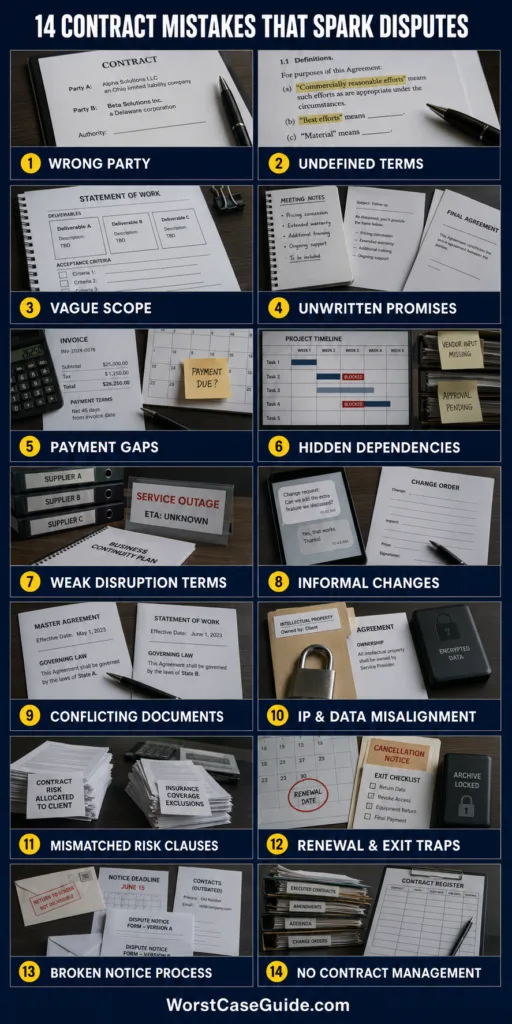
14 Contract Mistakes That Create Business Disputes
Mistake 1: Naming the Wrong Party or Ignoring Signing Authority
Why It Happens
A familiar brand, trading name, subsidiary, or abbreviated company name is inserted without confirming the legal contracting entity. The person signing may also lack authority to bind that entity. Informal partnerships face a related problem when the contract never explains whether obligations belong to an individual, a company, or several participants.
Early Warning Signs
- The legal name differs between the proposal, invoice, and signature page.
- Registration details and business addresses are absent.
- The signer uses a personal email or an unclear job title.
- “Affiliates” may receive services, but their rights and duties are not defined.
Worst-Case Result
A party may pursue payment or performance against an entity that never accepted the obligation. Enforcement can become slower and more expensive while assets, licenses, data, or invoices sit with another company in the same corporate group.
A Safer Approach
A safer review may compare the legal name, registration information, address, signature capacity, invoicing entity, and performing entity. Where affiliates participate, the contract can explain which party owes what and whether any rights extend beyond the named signatories.
Mistake 2: Using Important Terms Without Defining Them
Why It Happens
Words such as “promptly,” “material,” “complete,” “acceptable,” and “industry standard” sound familiar. Yet they may support several reasonable interpretations. Defined terms can create the same problem when a capitalized word is used inconsistently or its definition is broader than the commercial discussion.
Early Warning Signs
- A deadline depends on “reasonable time” without an outside limit.
- “Business Day” is used across countries with different holidays.
- “Written notice” does not say whether email qualifies.
- Terms such as customer data, deliverable, acceptance, or breach change meaning between sections.
Worst-Case Result
The parties may perform under incompatible interpretations for months. A dispute then centers on what the words meant rather than whether the promised work was completed.
A Safer Approach
Measurable terms usually reduce interpretation risk. Dates, quantities, response periods, calculation methods, locations, technical standards, and named approval roles can replace language that depends entirely on opinion. Definitions also benefit from a consistency review across the full agreement.
Mistake 3: Leaving Scope, Deliverables, and Acceptance Open to Interpretation
Why It Happens
Commercial discussions focus on the desired outcome, while the contract records only a broad service description. What does “done” mean? Without deliverable specifications, exclusions, revision limits, dependencies, and acceptance criteria, each side may picture a different finish line.
Early Warning Signs
- The scope relies on phrases such as “support as needed.”
- There is no list of included and excluded work.
- Acceptance depends on general satisfaction.
- No review period or rejection procedure exists.
- Service levels lack a measurement source or reporting period.
Worst-Case Result
One party may withhold acceptance and payment while requesting continued work. The other may suspend performance or charge additional fees. In a connected project, that disagreement can delay downstream suppliers, launches, or customer commitments.
A Safer Approach
A workable statement of work may identify deliverables, formats, quantities, milestones, dependencies, exclusions, revision rounds, testing methods, and objective acceptance standards. In smaller projects, a short schedule may be enough. Larger engagements often need separate technical specifications and service-level measures.
Mistake 4: Assuming Proposals, Demonstrations, and Verbal Promises Are Part of the Deal
Why It Happens
Sales calls, presentations, proposals, and email exchanges shape expectations before signing. The final contract may omit those promises or contain an entire-agreement clause that changes their role. Nobody notices because the negotiators remember the conversation rather than the final wording.
Early Warning Signs
- A promised feature appears in a demo but not in the specifications.
- Commercial concessions remain in email threads.
- The contract refers to a proposal without its date or version.
- The final text conflicts with a sales presentation.
Worst-Case Result
The buyer may claim that a purchasing decision relied on a promise, while the supplier relies on narrower written obligations. Evidence becomes scattered across meeting notes, messages, recordings, and earlier drafts.
A Safer Approach
Material commercial promises can be reconciled with the final contract and placed in the correct schedule. Referenced proposals are clearer when identified by title, date, and version. Statements that were illustrative rather than binding may also need an accurate distinction.
Mistake 5: Writing Incomplete Price and Payment Terms
Why It Happens
A price is agreed, but the mechanics around it receive less attention. “Net 30” does not reveal whether the clock begins on the invoice date, receipt, delivery, acceptance, or internal approval. Taxes, expenses, deposits, currency conversion, usage charges, price adjustments, and set-off rights can create further uncertainty.
Early Warning Signs
- Payment depends on an undefined approval process.
- Milestone amounts do not add up to the total price.
- Usage or variable fees lack a data source and calculation method.
- No process exists for challenging part of an invoice.
- Late charges or suspension rights conflict across documents.
Worst-Case Result
An invoice dispute can become a performance dispute. The supplier may suspend services, the customer may withhold the full invoice, and both sides may claim the other breached first.
A Safer Approach
Payment language may specify the amount, currency, tax treatment, invoice requirements, payment trigger, due date, approved expenses, price-change method, and treatment of disputed and undisputed sums. The commercial team can then test the clause against a sample invoice before signing.
Mistake 6: Setting Deadlines Without Recording Dependencies
Why It Happens
A delivery date is treated as an isolated promise even though performance depends on access, customer feedback, data, equipment, permits, third-party systems, or earlier milestones. Optimistic schedules can conceal these links.
Early Warning Signs
- One party controls an input but has no deadline for providing it.
- Approval delays do not affect the delivery schedule.
- Several milestones share the same final date without sequencing.
- No escalation path exists for blocked work.
Worst-Case Result
A missed date may trigger service credits, damages, cancellation, or lost revenue even when the delay began with an unrecorded dependency. Project records then become a contest over who caused each lost day.
A Safer Approach
A more reliable schedule can connect each milestone to its required inputs, responsible party, review period, and delay consequence. For larger systems, dependency logs and notice procedures may support the written terms without replacing them.
Mistake 7: Treating Disruption Clauses as Untouchable Boilerplate
Why It Happens
Force majeure, supply interruption, security incidents, utility failure, and third-party outages are often covered with inherited wording. The clause may excuse delay without explaining notice, mitigation, payment, allocation, recovery, or the point at which either party may leave.
Early Warning Signs
- The event list does not match the service or supply chain.
- Ordinary cost increases are mixed with genuine inability to perform.
- No maximum suspension period is stated.
- Business continuity and disaster recovery promises sit outside the contract.
Worst-Case Result
A party may remain tied to an unusable arrangement while performance is suspended indefinitely. The other side may continue incurring reserved-capacity or subcontractor costs without knowing whether those costs are recoverable.
A Safer Approach
Disruption wording can distinguish delayed performance from impossible performance and address notice, reasonable mitigation, service restoration, payment treatment, alternative supply, and long-stop termination. The allocation may differ between a short consulting task and a service supporting daily operations.
Mistake 8: Allowing Informal Changes Without a Change Process
Why It Happens
Projects change through calls, chat messages, tickets, and meetings. Teams begin the extra work to preserve momentum, while documentation is postponed. Later, the parties disagree about whether the request was included, authorized, or priced.
Early Warning Signs
- Anyone on either team appears able to request extra work.
- Change requests do not show cost or schedule effects.
- Work begins before approval is recorded.
- The contract says changes must be signed, but daily practice relies on chat.
Worst-Case Result
The supplier may complete unpaid work while the customer receives a delayed or altered result it did not formally authorize. A collection dispute can follow, supported by an uneven trail of tickets and messages.
A Safer Approach
A practical change process may identify authorized approvers, required information, acceptable approval methods, and the effect on fees, scope, assumptions, and dates. Small projects can use a brief written confirmation. Larger programs may need numbered change orders and a live change register.
Mistake 9: Letting Contract Documents Contradict One Another
Why It Happens
A master agreement, statement of work, order form, purchase order, pricing schedule, data addendum, and online terms may all govern one relationship. They are often prepared by different teams and revised at different times.
Early Warning Signs
- Payment is due in 30 days in one document and 60 days in another.
- A statement of work expands liability beyond the master agreement.
- An attachment is referenced by the wrong title or version.
- Online terms may change without a controlled copy.
- No order-of-precedence clause explains which document controls.
Worst-Case Result
Both parties can point to signed language supporting their position. Work may pause while they argue over which document governs, and negotiated protections may be displaced by overlooked standard terms.
A Safer Approach
The contract set can be reviewed as one connected record. An order-of-precedence provision may rank amendments, the main agreement, statements of work, schedules, purchase orders, and incorporated policies. Attachments benefit from exact titles, dates, revision numbers, and confirmed inclusion.
Mistake 10: Leaving Intellectual Property, Data, and Confidentiality Misaligned
Why It Happens
The parties agree that work will be created or data exchanged but do not separate pre-existing materials from new work. Ownership, license scope, permitted users, third-party components, confidentiality exceptions, security duties, and post-termination data handling may be spread across unrelated sections.
Early Warning Signs
- “All intellectual property” is assigned without identifying background tools.
- A license lacks territory, duration, user, or transfer limits.
- Third-party or open-source materials are not addressed.
- Security promises are vague or inconsistent with actual controls.
- No process covers data return, export, retention, or deletion.
Worst-Case Result
A customer may pay for work it cannot lawfully reuse, modify, transfer, or access after termination. A supplier may unintentionally surrender reusable tools or accept duties its systems cannot meet. Confidential material may remain stored without a clear purpose or deletion date.
A Safer Approach
The wording can distinguish background materials, newly created deliverables, customer content, operational data, and third-party components. Ownership and licensing terms may then align with the intended use, while confidentiality, security, incident reporting, retention, and exit duties remain consistent.
Mistake 11: Accepting Risk Clauses That Do Not Match the Deal
Why It Happens
Warranties, indemnities, liability exclusions, damage waivers, insurance requirements, and liability caps are often negotiated separately. A copied clause may allocate far more exposure than the contract price or exclude the very loss the service is meant to prevent.
Early Warning Signs
- Liability is unlimited for broad or undefined events.
- The cap uses an unclear fee period or excludes prepaid charges.
- An indemnity covers matters outside the party’s control.
- Insurance limits do not align with contractual exposure.
- Warranty remedies conflict with service credits or termination rights.
Worst-Case Result
A moderate failure can create exposure far beyond the revenue earned from the contract. On the other side, an overly narrow remedy may leave a customer paying for replacement work, investigation, interruption, or third-party claims with little recovery.
A Safer Approach
Risk clauses are more useful when assessed together and compared with the deal value, control over the risk, available insurance, realistic loss scenarios, and intended remedies. Different caps or treatments may be appropriate for different categories, subject to local law.
Mistake 12: Overlooking Renewal, Termination, and Exit Work
Why It Happens
Attention stays on starting the relationship. Automatic renewal, non-renewal windows, cure periods, termination fees, survival clauses, transition support, final invoices, equipment return, and data migration receive less scrutiny.
Early Warning Signs
- A missed notice date triggers another long term.
- Termination for cause lacks a defined breach or cure procedure.
- Termination for convenience has unclear fees.
- No owner tracks renewal and notice dates.
- Data export or transition assistance is absent or unpriced.
Worst-Case Result
A business may pay for another term of an unwanted service or lose access before replacement systems are ready. Stored data, work in progress, prepaid fees, customer records, and reusable materials can remain trapped in an unresolved exit.
A Safer Approach
Term and exit provisions can be read as a complete sequence: renewal, notice, breach, cure, termination, final payment, return of property, data export, deletion, transition, and surviving obligations. Calendar ownership matters as much as wording once the agreement is active.
Mistake 13: Creating Dispute and Notice Procedures That Do Not Work in Practice
Why It Happens
Dispute resolution, governing law, jurisdiction, escalation, and notice clauses are inserted from templates without testing how they interact. A contract may require notice by an outdated method or name an expensive forum unrelated to either party.
Early Warning Signs
- Operational emails do not qualify as formal notice.
- Notice addresses belong to former employees or offices.
- Arbitration language conflicts with court jurisdiction language.
- No route exists for urgent or protective relief.
- Executive escalation has no deadline or named role.
Worst-Case Result
A valid commercial complaint may become tangled in arguments about notice, timing, location, or procedure before the underlying issue is considered. Smaller claims may cost more to pursue than their value.
A Safer Approach
A usable process may identify notice recipients, delivery methods, deemed-receipt rules, escalation stages, time limits, and the chosen dispute forum. Governing law, court jurisdiction, mediation, and arbitration language can then be checked for internal consistency and practical cost.
Mistake 14: Treating Signature as the End of Contract Management
Why It Happens
Once signed, the agreement is stored and daily work moves to email, project software, and invoices. Teams may not know which version is final, what deadlines must be tracked, or which amendments changed the original terms.
Early Warning Signs
- Different departments hold different executed copies.
- Signature pages are separated from attachments.
- Contract owners leave without transferring renewal or notice dates.
- Amendments are not linked to the original agreement.
- Performance records do not match contractual measures.
Worst-Case Result
The business may miss a renewal window, breach a reporting duty, rely on superseded pricing, or lose evidence of approval. When a dispute begins, reconstructing the contract history can become almost as difficult as resolving the dispute itself.
A Safer Approach
Active agreements benefit from a controlled executed copy, linked amendments, named business ownership, obligation tracking, renewal reminders, and retained performance records. Larger portfolios may use contract-management software; smaller businesses can apply the same discipline through a maintained register.
Risk Patterns Behind Repeated Contract Disputes
- Ambiguity: Duties depend on words that cannot be measured consistently.
- Document mismatch: The agreement, schedules, orders, and daily communications describe different deals.
- Silent dependencies: One party promises an outcome that depends on action controlled by the other.
- Unbalanced control and exposure: A party accepts responsibility for events it cannot prevent or manage.
- Missing evidence: Changes, acceptance, notices, and approvals occur without a reliable record.
- Lifecycle neglect: The contract is reviewed at signature but not during performance, renewal, or exit.
A useful contract test: A person who did not attend the negotiations should be able to identify the parties, work, price, deadlines, approvals, change process, ownership, remedies, renewal date, and exit duties from the signed contract set. If that person must guess, the operating teams may eventually guess differently too.
Frequently Asked Questions
What contract mistake causes the most business disputes?
Unclear scope is one of the most repeated causes because it affects price, timing, acceptance, and responsibility at once. Payment ambiguity, undocumented changes, and conflicting documents often turn the original scope gap into a wider dispute.
Can an email change a business contract?
The answer depends on the contract wording, the sender’s authority, applicable law, and the content of the email. Some agreements require signed amendments, while others permit approval through specified electronic methods. Daily practice that conflicts with the written change clause creates avoidable uncertainty.
Why are verbal agreements risky in business projects?
Verbal discussions can leave no shared record of the exact promise, conditions, price, or authority involved. Memories also change. Recording material decisions in the contract or an approved change document can reduce later disagreement about what was said.
What should a contract say about scope changes?
A workable change provision may identify who can request and approve a change, what information is required, which approval methods count, and how the change affects price, deliverables, assumptions, and deadlines.
How can automatic renewal create a dispute?
A contract may renew for another term unless notice is delivered within a stated window and through an approved method. A business that misses the deadline may believe it cancelled, while the other party treats the renewed fees as payable.
Does a signed contract still need ongoing management?
Yes. Renewal dates, milestones, approvals, reporting duties, price adjustments, insurance records, amendments, and exit obligations continue after signature. Without ownership and reminders, clear wording can still be undermined by missed actions.