A refund policy becomes part of the customer experience before anyone requests money back. Shoppers use it to judge whether a purchase feels reversible, whether unexpected costs may appear, and whether the business will remain helpful after payment. When the written terms are hard to find, vague, or different from the process customers actually face, the damage reaches beyond one refund. It weakens confidence in every promise the business makes.
Refund terms also affect customer support, payment disputes, return shipping, subscription cancellations, fraud controls, inventory decisions, and repeat purchases. A policy may appear clear to the person who wrote it while still leaving a customer with a basic question: What will happen to my money if something goes wrong?
Why Refund Policies Become a Trust Test
A customer usually reads a refund policy at one of two sensitive moments: immediately before buying or after a disappointing experience. In both cases, uncertainty carries more weight than friendly branding.
The policy is only one layer of the experience. Product pages, checkout notices, order confirmation emails, support replies, return portals, payment processors, and warehouse procedures must all tell the same story. A polished policy cannot protect trust when the operational process contradicts it.
Important distinction: A return concerns the movement or acceptance of a product. A refund concerns the repayment of money. The two processes are connected, but their eligibility rules, deadlines, status updates, and completion dates may differ.
Common Assumptions That Create Trouble
- A footer link means every customer has seen and accepted the policy.
- “Refund issued” means the money will appear in the customer’s account immediately.
- A no-refund statement overrides every consumer protection rule.
- The same conditions work equally well for physical goods, digital products, subscriptions, services, and custom orders.
- Support agents can make informal exceptions without recording them.
- Customers understand when a return window begins and which days count.
- Changing the live policy updates the terms attached to earlier purchases.
These assumptions often survive until a disputed order exposes them. By then, the business may be reconstructing checkout screens, emails, timestamps, and support messages while the customer is already questioning its honesty.
| Policy Area | Question the Customer Needs Answered | Trust Risk When Missing |
|---|---|---|
| Eligibility | Which purchases, reasons, and product conditions qualify? | Rules appear arbitrary after payment. |
| Time Window | When does the request period begin and end? | Customers may believe a valid request was unfairly rejected. |
| Costs | Who pays shipping, handling, or restocking charges? | The final refund may feel smaller than promised. |
| Method | Will money return to the original payment method or become store credit? | Store credit may be perceived as a withheld refund. |
| Processing | What must happen before approval, and how long can each stage take? | Silence may look like deliberate delay. |
| Exceptions | Are sale, personalized, perishable, opened, digital, or subscription purchases treated differently? | Important exclusions arrive as a surprise. |
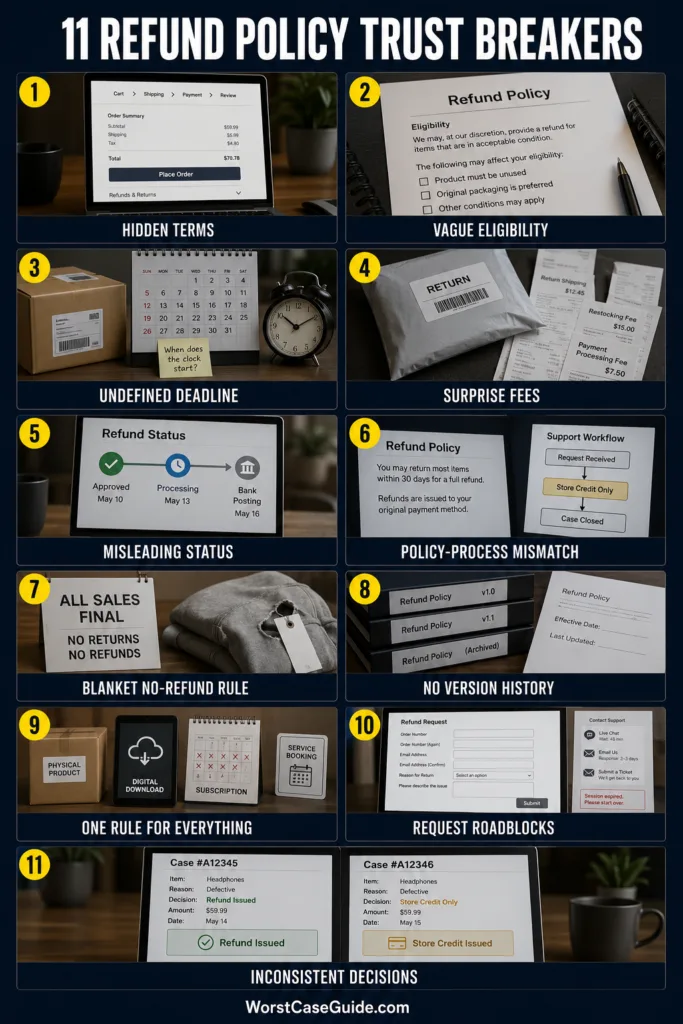
11 Refund Policy Mistakes That Damage Customer Trust
Mistake 1: Hiding the Policy Until Checkout or After Purchase
A refund policy buried in a footer, account menu, or lengthy terms page is technically present but practically absent. Customers evaluating an unfamiliar business may interpret difficult access as an attempt to conceal restrictive conditions.
Risk Profile
- Why it happens: The policy is treated as administrative text instead of purchase information.
- Early warning signs: Support receives repeated pre-sale questions about returns, or customers leave checkout to search for refund terms.
- Worst-case result: A customer discovers an exclusion after paying, disputes the transaction, and publicly describes the terms as hidden.
- Safer approach: A short policy summary can appear near the purchase decision, with the full terms accessible from product pages, checkout, order emails, and the site footer.
Mistake 2: Using Vague Eligibility Language
Phrases such as “returns may be accepted,” “unused condition,” or “refunds are available in certain cases” leave the deciding criteria unstated. The business retains flexibility, but the customer receives no dependable expectation.
Risk Profile
- Why it happens: Broad wording seems easier than listing product conditions, request reasons, exclusions, and evidence requirements.
- Early warning signs: Different support agents interpret “unused,” “damaged,” or “eligible” differently.
- Worst-case result: Two similar customers receive different decisions, creating claims of unfair or selective treatment.
- Safer approach: Eligibility can be described through observable conditions, such as packaging status, activation, download activity, delivery damage, service completion, or days since delivery.
Mistake 3: Leaving the Refund Clock Undefined
“Refunds within 30 days” sounds precise until someone asks what starts the clock. It could mean the order date, shipment date, delivery date, cancellation date, return authorization date, or the day the warehouse receives the item.
Risk Profile
- Why it happens: A familiar time window is added without mapping it to the real order process.
- Early warning signs: Customers and staff calculate different deadlines from the same order.
- Worst-case result: A request is rejected under an internal calculation that the customer could not have predicted.
- Safer approach: The terms can identify the triggering event, time zone where relevant, whether calendar or business days apply, and what happens when delivery is delayed or split across packages.
Mistake 4: Revealing Fees Only After a Return Begins
Return postage, restocking deductions, original delivery charges, international duties, inspection fees, and packaging costs directly affect the amount recovered. Hiding them behind “additional charges may apply” turns a nominal refund into a smaller and less predictable payment.
Risk Profile
- Why it happens: Cost details vary by product or destination, so the policy postpones the explanation.
- Early warning signs: Customers ask for a refund estimate only after receiving a return authorization.
- Worst-case result: The cost of returning the item approaches its value, making the advertised refund feel unusable.
- Safer approach: Known charges can be disclosed before purchase. Variable charges can be explained with their calculation method, responsible party, and any conditions that remove or reduce them.
Mistake 5: Treating Approval, Processing, and Bank Posting as One Event
A business may approve a refund today, submit it to a payment processor tomorrow, and see the customer’s bank post it several days later. Calling every stage “completed” creates avoidable confusion.
Risk Profile
- Why it happens: Internal systems mark the case closed as soon as the refund request reaches the processor.
- Early warning signs: Customers reply to completion emails saying that no money has arrived.
- Worst-case result: The customer suspects a false confirmation and opens a payment dispute while the refund is still moving through the payment system.
- Safer approach: Status messages can separate request received, approved, submitted, and posted. Estimated processing ranges should distinguish business handling time from bank or card-network time.
Mistake 6: Publishing Terms That Staff and Systems Do Not Follow
A policy may promise email requests while support redirects customers to a portal. It may offer refunds to the original payment method while the system issues store credit by default. These contradictions make a written promise look decorative.
Risk Profile
- Why it happens: Policy ownership is separated from customer support, finance, fulfillment, and payment operations.
- Early warning signs: Agents rely on private templates that contain conditions missing from the public page.
- Worst-case result: Screenshots of the policy conflict with support messages, weakening the business’s position during complaints or payment disputes.
- Safer approach: Policy changes can be tested against the actual return portal, refund permissions, warehouse inspection steps, email templates, and staff procedures before publication.
Mistake 7: Using a Blanket No-Refund Statement
“All sales are final” may describe a commercial preference, but it does not automatically remove rights that apply to faulty, misdescribed, undelivered, or otherwise protected purchases. Applicable rights vary by location, sales channel, and product type.
Risk Profile
- Why it happens: The business wants a short deterrent against change-of-mind returns or refund abuse.
- Early warning signs: Staff reject every request by quoting one sentence without examining the reason for the claim.
- Worst-case result: Legitimate complaints are refused, customers escalate outside the business, and the policy is viewed as misleading.
- Safer approach: Non-returnable categories can be identified narrowly, while the policy separately acknowledges remedies that may apply when goods or services are defective, incorrectly described, or not supplied.
Jurisdiction matters: Consumer rights and required disclosures differ across countries and regions. A commercial policy should be reviewed for the places where the business sells rather than copied unchanged from another store.
Mistake 8: Changing Terms Without Dates or Version Records
Editing a live page replaces the visible wording, but it does not explain which version applied when an earlier customer purchased. Quiet changes are especially damaging when a dispute has already begun.
Risk Profile
- Why it happens: The refund page is managed like ordinary website copy rather than a record connected to transactions.
- Early warning signs: Staff cannot retrieve the policy shown on a past order date.
- Worst-case result: A customer produces an older screenshot that conflicts with the current page, making the business appear to have rewritten the rules after purchase.
- Safer approach: Each version can display an effective date. Archived copies, change notes, and the policy version associated with an order create a clearer record for both sides.
Mistake 9: Applying One Process to Every Purchase Type
A physical return can be inspected after delivery to a warehouse. A downloaded file, activated license, completed consultation, recurring subscription, made-to-order item, event booking, or marketplace purchase follows a different path. One generic paragraph rarely explains all of them well.
Risk Profile
- Why it happens: A single policy page is easier to maintain than separate rules for each transaction category.
- Early warning signs: The policy repeatedly says “item” even though the business also sells services, digital access, or subscriptions.
- Worst-case result: Customers infer rights or exclusions intended for another product category, while support improvises an answer after payment.
- Safer approach: A shared policy can use clearly labeled sections for physical goods, digital products, services, subscriptions, custom orders, promotional items, and third-party marketplace purchases.
Mistake 10: Making the Request Process Needlessly Difficult
A reasonable policy can still fail when customers cannot locate the correct form, must repeat order details, wait for manual authorization, or move between support channels. Friction starts to resemble obstruction when no one explains the next step.
Risk Profile
- Why it happens: The process grows through separate tools and approval layers without being reviewed as one customer journey.
- Early warning signs: Customers send duplicate messages, ask whether their request was received, or contact their bank before support replies.
- Worst-case result: A valid request misses its deadline because the customer was waiting for instructions or authorization.
- Safer approach: The policy can state the request channel, required information, confirmation method, response range, return authorization steps, address responsibility, and escalation route.
Mistake 11: Enforcing the Policy Inconsistently
Reasonable exceptions can preserve a customer relationship. Unrecorded exceptions can do the opposite. When decisions depend on the agent, customer visibility, order value, or persistence, the policy stops functioning as a predictable standard.
Risk Profile
- Why it happens: Staff are told to “use judgment” without defined authority, exception reasons, or approval limits.
- Early warning signs: Similar cases receive different refunds, or a rejected request is approved only after a public complaint.
- Worst-case result: Customers conclude that the stated rules apply only to people who do not argue, escalate, or attract attention.
- Safer approach: Exception categories, approval levels, decision notes, and periodic case reviews can preserve flexibility while reducing arbitrary outcomes.
Patterns Behind Refund Policy Failures
Most refund disputes do not begin with one badly chosen sentence. They develop when policy language, system behavior, and staff decisions drift apart. The written page promises one route, the software permits another, and the support team follows a third.
Uncertainty Is Transferred to the Customer
When the business has not decided who pays return shipping, how damage is assessed, or when the refund clock begins, the customer carries that uncertainty. Each new answer can feel like a newly invented condition.
Internal Status Is Mistaken for Customer Outcome
A case marked “closed” may still involve a parcel in transit or funds waiting to appear. Operational labels should not replace customer-facing explanations. The customer cares about the outcome, not the internal ticket state.
Fraud Controls Affect Honest Customers
Inspection, identity checks, return tracking, and manual review may reduce abuse. If these controls are undisclosed or applied without updates, honest customers experience them as unexplained delay. A safer balance describes the review stage without exposing methods that would make abuse easier.
Exceptions Reveal Weak Policy Design
A high exception rate can mean the published rule is too strict, unclear, or poorly matched to actual customer situations. Exceptions are therefore useful operational data, not merely isolated acts of goodwill.
A Practical Policy Alignment Check
| Review Point | Evidence to Compare | Possible Warning |
|---|---|---|
| Before Purchase | Product pages, checkout notices, promotions, and policy links | An exclusion appears only on the full policy page. |
| Request Intake | Forms, email addresses, portal fields, and confirmation messages | The published request method is no longer monitored. |
| Eligibility Decision | Agent instructions, inspection criteria, and exception records | Terms depend on undocumented staff judgment. |
| Money Movement | Payment method, refund status, deductions, and processing notices | “Completed” is sent before the processor accepts the refund. |
| Historical Record | Effective dates, archived versions, and order records | No one can prove which policy applied to an older sale. |
| Outcome Review | Complaints, chargebacks, repeat contacts, and exception rates | The same unclear clause produces recurring disputes. |
Useful measures may include the time to acknowledge a request, time to make an eligibility decision, time to submit an approved refund, repeat-contact rate, exception rate, policy-related complaint themes, and disputes opened while a refund was already pending. These measures reveal where confidence is being lost.
Questions Customers Should Not Have to Ask
- Does the request window begin at purchase, shipment, delivery, or activation?
- Which products or services are excluded, and why?
- What condition must a returned item be in?
- Who pays return shipping and other charges?
- Will the customer receive money, store credit, an exchange, or a repair?
- Which payment method will receive the refund?
- What evidence or order information is required?
- How will the customer know the request was received?
- What happens if the parcel is lost during return shipping?
- How are damaged, faulty, incorrect, or undelivered orders handled?
- Which policy version applies to the purchase?
If these answers are available before payment and remain consistent afterward, the refund policy works as more than a defensive page. It becomes a clear account of what the business will do when a transaction does not go as planned.
Frequently Asked Questions
What should a clear refund policy include?
It should explain eligibility, request deadlines, product condition rules, exclusions, return costs, refund method, processing stages, required information, and contact options. Separate terms may be needed for physical goods, digital products, services, and subscriptions.
Can a business use a no-refund policy?
A business may restrict voluntary refunds in some situations, but a commercial no-refund statement may not remove rights that apply under local consumer rules. The answer depends on the location, sales channel, purchase type, and reason for the request.
How long should a refund take?
The policy should state the business’s handling range and distinguish it from the additional time a bank, card issuer, payment service, or marketplace may need to post the funds. Approval, submission, and account posting are separate stages.
Should return and refund terms appear on the same page?
They may appear together when the difference is clear. Customers should be able to distinguish the process for sending an item back from the process for approving, calculating, and delivering the repayment.
Do restocking fees reduce customer trust?
They can when the amount, calculation, or reason is hidden until after the purchase. Clear pre-purchase disclosure and narrow, consistently applied conditions reduce the risk of the fee being perceived as a surprise deduction.
Why should a refund policy have an effective date?
An effective date helps identify which terms applied to a transaction. Archived versions and order-level policy records are also useful when a return or dispute begins after the public page has changed.
How often should a refund policy be reviewed?
A review is useful whenever products, payment methods, fulfillment partners, return charges, customer support tools, sales regions, or legal obligations change. Recurring complaints and frequent exceptions may also show that an earlier review is needed.