Approval processes are meant to protect delivery, not freeze it. A good approval step catches risk, confirms ownership, and lets the next person move with confidence. A weak one does the opposite: work waits in inboxes, teams chase signatures, versions drift, and deadlines become harder to trust. The risk is rarely one dramatic failure. It is more often a slow leak in the delivery system.
For a small team, a slow approval may look like one person waiting two days for a yes. In a larger company, that same pattern can affect product launches, client work, procurement, legal review, marketing campaigns, software releases, construction handoffs, vendor onboarding, and internal operations. The delay feels administrative, but the cost lands inside delivery.
Plain risk view: approval delays usually come from unclear decision rights, too many handoffs, missing context, weak escalation paths, and tools that hide pending work. The safer approach is not “approve everything faster.” It is to make each approval step necessary, visible, owned, and time-bound.
Why Approval Processes Slow Down Delivery
An approval process becomes risky when it is treated as a checkpoint without a delivery design. The team may know that something needs approval, but not who owns the decision, what information is needed, how long review should take, or what happens if the approver is unavailable.
That creates a quiet delivery problem. Work is “almost done,” but not released. A document is “ready,” but not signed off. A task is “waiting,” but nobody knows whether the blocker is legal, finance, leadership, security, procurement, brand, quality control, or a missing file.
Approval is like a gate in a corridor. If the gate is clear, marked, and staffed, people pass through safely. If nobody knows who holds the key, the corridor fills up.
Common Wrong Assumptions About Approval Processes
Many approval delays begin with assumptions that sound reasonable during planning. They become expensive during delivery.
- “The approver will know what to do.” Not always. A request without context creates review anxiety.
- “More approval steps mean lower risk.” Extra reviewers can reduce risk in some cases, but they can also create ownership confusion.
- “Email is enough.” Email can work for a tiny team. It breaks down when versions, deadlines, and accountability matter.
- “The process is slow because people are slow.” Often, the process is slow because queues, handoffs, and decision rules are poorly designed.
- “Urgent work will naturally move faster.” Without an escalation path, urgent work may only create louder follow-ups.
- “Approval means readiness.” A signed approval does not always mean the team has capacity, materials, access, budget, or final requirements.
Approval Process Risk Map
| Risk Area | What It Looks Like | Delivery Impact | Safer Check |
|---|---|---|---|
| Ownership | No one knows who can make the final decision. | Work waits while people ask around. | Assign one decision owner and one backup. |
| Context | Requests arrive without scope, deadline, risk level, or supporting files. | Reviewers ask basic questions late. | Use a short approval brief before review starts. |
| Routing | Every request follows the same path. | Low-risk items move too slowly. | Route by value, risk, cost, customer impact, and reversibility. |
| Visibility | Pending approvals live in email, chat, or private spreadsheets. | Managers notice delays after the deadline is already under pressure. | Track status, owner, due date, and next action in one shared place. |
| Escalation | There is no rule for silence, absence, or disagreement. | Follow-up becomes personal and inconsistent. | Define what happens after 24, 48, or 72 hours without movement. |
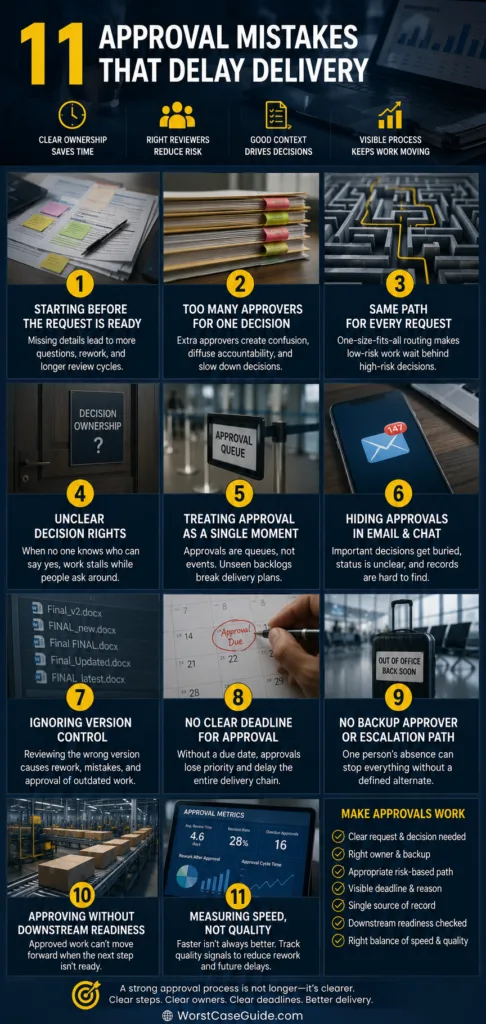
11 Approval Process Mistakes That Slow Down Delivery
Mistake 1: Starting Approval Before The Request Is Ready
Many teams send work for approval as soon as it feels “mostly finished.” The missing pieces are expected to be handled during review. That sounds efficient. It usually creates rework.
Why It Happens
This mistake often comes from deadline pressure. A team wants to show movement, so it sends a draft, estimate, design, contract, change request, or release plan before the approval packet is complete.
In smaller projects, this may be a missing attachment or unclear note. In larger systems, it may be a missing business case, risk rating, budget code, technical dependency, compliance note, vendor quote, or customer impact statement.
Early Warning Signs
- Reviewers ask questions that should have been answered before submission.
- The same request moves back and forth more than once.
- Attachments are added after review has already started.
- The approver says, “I can’t approve this yet.”
- Different reviewers seem to be reviewing different versions.
Worst-Case Result
The approval step becomes a second planning phase. Delivery slows down because the team is still defining the work while pretending it is ready for a decision. In customer-facing work, this can lead to late launch dates, rushed fixes, and credibility loss.
Safer Approach
A safer approval request has a small but complete decision packet. It can include the requested decision, owner, deadline, scope, cost or effort, known risks, dependencies, version number, and what happens after approval.
Useful approval check: before asking for approval, the team can ask, “Could a busy reviewer make a safe decision from this information without hunting through old messages?” If the answer is no, the request is not ready yet.
Mistake 2: Having Too Many Approvers For One Decision
Approval chains often grow slowly. One person asks to be included. Then another team wants visibility. Later, leadership wants a final look. Over time, the process becomes a line of people who can slow the work down but may not add a clear decision.
Why It Happens
Teams add approvers to avoid blame. They may also confuse being informed with being responsible. This is common in finance approvals, brand review, legal review, software release gates, procurement, and cross-functional project delivery.
Early Warning Signs
- Several people approve the same thing without adding different expertise.
- Reviewers give style comments after the decision should already be final.
- People are included “just in case.”
- No one can explain what each approver is responsible for checking.
- The final approval depends on people who are not affected by the outcome.
Worst-Case Result
The team loses decision speed without gaining better control. Worse, every approver assumes another person caught the risk. The process looks safer on paper, but actual accountability becomes thinner.
Safer Approach
Approval roles can be separated into three groups: decision maker, specialist reviewer, and informed stakeholder. Not everyone needs approval power. Some people only need visibility.
If you are in a regulated, legal, financial, or safety-sensitive workflow, additional review may be necessary. Even there, each step should have a clear reason. A review without a defined purpose is friction with a badge.
Mistake 3: Using The Same Approval Path For Every Request
A $200 purchase, a customer-facing policy change, a production release, and a high-risk vendor contract should not move through the same approval path. Yet many teams use one rigid process for everything.
Why It Happens
One approval path is easy to explain. It feels fair. It also avoids arguments about which work deserves a lighter review. The problem is that equal routing does not always mean sensible routing.
Early Warning Signs
- Low-risk requests wait behind complex decisions.
- Approvers spend time reviewing work they usually approve without change.
- Teams create informal shortcuts because the official path feels too slow.
- Small tasks need senior approval even when the impact is limited.
- Urgent work skips the process entirely.
Worst-Case Result
The formal process becomes less trusted. People start bypassing it, using private messages, verbal approvals, or after-the-fact sign-offs. Delivery may speed up for a moment, but auditability, consistency, and quality control get weaker.
Safer Approach
A better process can use approval tiers. Simple requests may need one owner. Medium-risk requests may need functional review. High-risk requests may need cross-functional approval and a documented decision record.
Good tiering often considers:
- Risk level: What happens if the decision is wrong?
- Reversibility: Can the team undo it without much cost?
- Customer impact: Will customers, users, clients, or vendors notice?
- Cost or effort: Does the decision commit budget, time, or people?
- Compliance or policy exposure: Does it require specialist review?
Mistake 4: Leaving Decision Rights Unclear
A slow approval is not always caused by an absent approver. Sometimes the real issue is that nobody knows who has authority to say yes.
Why It Happens
Decision rights are often implied rather than written down. The project manager thinks the department lead owns the decision. The department lead thinks finance owns it. Finance thinks leadership already agreed. The work sits in the middle.
Early Warning Signs
- People say, “I’m fine with it, but someone else needs to approve.”
- Approval requests are forwarded instead of decided.
- The same decision is discussed in several meetings.
- Work pauses because two teams interpret ownership differently.
- Approval depends on hierarchy rather than expertise.
Worst-Case Result
Delivery slows while responsibility floats. In larger projects, this can create missed milestone dates, delayed procurement, blocked engineering work, late campaign launches, or contract delays. It also creates frustration because nobody feels fully in control.
Safer Approach
Each approval step can name one decision owner. That person may consult others, but the final yes, no, or revise decision should not be vague.
For recurring work, a simple decision-rights note can help:
- Who can approve?
- Who can reject?
- Who can request changes?
- Who is only informed?
- Who handles disputes?
Mistake 5: Treating Approval As A Single Moment Instead Of A Queue
Teams often think of approval as a yes-or-no moment. In reality, approval is a queue. Requests wait behind other requests, meetings, inboxes, travel, holidays, client calls, and daily work.
Why It Happens
Planning tools may show the approval step as one small task. The schedule says “approval: one day.” It does not show how much work is already waiting for the approver.
Early Warning Signs
- One approver is responsible for many unrelated decisions.
- Requests wait several days before being opened.
- Teams keep asking, “Has anyone heard back?”
- Approval timelines vary wildly from request to request.
- Delivery plans assume instant review once the work is submitted.
Worst-Case Result
The project plan becomes unrealistic. Teams finish their work on time but still miss delivery because approval capacity was never planned. This creates a painful pattern: the work looks late even when the production team did its part.
Safer Approach
Approval capacity can be planned like any other delivery constraint. If one person approves all contracts, releases, invoices, content, designs, or change requests, their queue should be visible.
In smaller teams, a shared tracker may be enough. In larger systems, approval dashboards, workload views, backup approvers, and service-level targets can help prevent silent buildup.
Mistake 6: Hiding Approvals In Email And Chat Threads
Email and chat are useful for discussion. They are weak places to manage approval status when delivery depends on traceability.
Why It Happens
Email feels natural. Chat feels fast. A person sends a message, tags someone, and assumes the request is moving. Then the request gets buried under newer messages, side conversations, attachments, reactions, and follow-ups.
Early Warning Signs
- People search old threads to find the latest decision.
- Approvals happen with short replies like “looks good” or “fine by me.”
- No one knows whether the message was a comment, review, or final approval.
- Important context is split across chat, email, spreadsheets, and project tools.
- A team member has to manually remind everyone.
Worst-Case Result
The team ships, publishes, orders, pays, or starts work based on unclear approval evidence. If something goes wrong, people cannot easily reconstruct what was approved, by whom, when, and under what conditions.
Safer Approach
Approval requests benefit from one visible system of record. That does not always mean buying new software. It can mean a shared project board, ticket, document workflow, procurement tool, contract system, content calendar, or release checklist.
The main point is simple: the decision should live somewhere stable, not only inside a scrolling conversation.
Mistake 7: Ignoring Version Control During Review
Approval delays often come from people reviewing the wrong thing. This happens with documents, designs, technical specs, budgets, contracts, marketing assets, product requirements, and construction drawings.
Why It Happens
When files are renamed, downloaded, reattached, edited offline, or shared in separate threads, reviewers may not know which version is final. A small mismatch can create a large delay.
Early Warning Signs
- Several files have names like “final,” “final revised,” or “final latest.”
- Review comments refer to content that has already changed.
- Approvers ask whether they are looking at the right version.
- The team compares documents manually before submission.
- Changes are made after approval without a new review step.
Worst-Case Result
The team approves one version and delivers another. That can lead to rework, customer confusion, budget mismatch, incorrect implementation, or internal disputes about what was actually agreed.
Safer Approach
A safer process uses visible version naming, change notes, access control, and a clear “approval candidate” version. When a material change is made after approval, the team can decide whether a fresh review is needed.
Small detail, large effect: an approval request should point to one exact version. “Please approve the latest file” is weaker than “Please approve Version 4 dated May 6, with changes listed in the review note.”
Mistake 8: Asking For Approval Without A Clear Deadline
An approval request without a due date is not really scheduled work. It is a hope placed inside someone else’s workload.
Why It Happens
Teams may avoid deadlines because they do not want to pressure senior people or specialist reviewers. Sometimes they assume urgency is obvious. It rarely is.
Early Warning Signs
- Requests say “when you have a chance.”
- Reviewers do not know which approvals are urgent.
- Delivery dates exist, but approval due dates do not.
- Follow-ups sound apologetic rather than process-based.
- Approvers respond after the delivery team has already lost time.
Worst-Case Result
The approval delay pushes pressure downstream. The team may still try to meet the original delivery date, but now testing, review, quality checks, customer communication, or implementation time gets squeezed.
Safer Approach
A useful approval request includes a clear response date and the reason behind it. For example, a review may be needed by Tuesday because procurement starts Wednesday, a client demo is scheduled Thursday, or a release window closes Friday.
Deadlines should not be used as threats. They are coordination tools.
Mistake 9: Having No Backup Approver Or Escalation Path
One-person approval systems work until that person is unavailable. Vacation, sick leave, travel, workload, meetings, time zones, or role changes can turn a normal approval into a delivery blocker.
Why It Happens
Some organizations rely heavily on trusted individuals. That can feel efficient when the person is available. It becomes fragile when the process depends on memory, availability, and personal follow-up.
Early Warning Signs
- Only one person can approve a category of work.
- Teams wait for someone to return before moving forward.
- There is no rule for silence after a set number of days.
- Approvals depend on informal relationships.
- People are unsure whether a delegate has authority.
Worst-Case Result
Delivery stops for reasons unrelated to the actual work. A campaign, purchase order, release, contract, hiring step, customer request, or internal change may sit idle because the organization designed no safe alternate path.
Safer Approach
Approval systems can define backup approvers, delegation rules, absence coverage, and escalation timing. The backup should have real authority, not just the ability to “look at it.”
In high-risk cases, escalation may need a second-level review. In routine cases, a backup approver may be enough. The difference should be written down before the delay happens.
Mistake 10: Approving Work Without Checking Downstream Readiness
Approval is not delivery. A project can be approved and still be unable to move because the next team lacks capacity, access, materials, budget release, technical readiness, vendor confirmation, or customer availability.
Why It Happens
Teams sometimes treat approval as the finish line. Once the decision is made, they assume execution will naturally follow. This is especially risky in cross-functional work where one approval triggers several operational steps.
Early Warning Signs
- The team celebrates approval but has no next-step owner.
- Procurement, implementation, QA, legal, finance, or operations are surprised by the handoff.
- Approved work waits for access, budget, staffing, or scheduling.
- Dependencies are discovered after approval.
- The delivery date was promised before readiness was checked.
Worst-Case Result
The organization creates false momentum. Stakeholders believe delivery is moving, but the work is still blocked. This can damage trust because the delay appears after people were told the decision was complete.
Safer Approach
For approvals that trigger delivery, the request can include a downstream readiness check. That may cover owner, start date, resources, dependencies, handoff notes, required access, communication plan, and any condition that must be true before execution begins.
A useful question is: “If this is approved today, can the next team safely act tomorrow?”
Mistake 11: Measuring Approval Speed But Not Approval Quality
Some teams try to fix slow approvals by pushing for faster sign-off. Speed matters, but speed alone can create careless decisions, skipped review, weak documentation, and more rework later.
Why It Happens
Approval delay is easy to feel. Approval quality is harder to measure. A team can count how many days a request waited, but may not track whether approved work later caused rework, defects, customer issues, budget changes, or emergency follow-up.
Early Warning Signs
- Teams praise fast approvals even when approved work keeps coming back.
- Rework is treated as a delivery issue, not an approval issue.
- Approvers are rushed without better context.
- Metrics focus only on turnaround time.
- Rejected or revised requests are not reviewed for patterns.
Worst-Case Result
The team fixes the waiting time but increases downstream errors. Delivery may look faster for a short period, then slow down again through defects, re-approval, customer changes, missed requirements, or avoidable disputes.
Safer Approach
Approval health can be measured with both speed and outcome signals. Useful signals may include average review time, number of revision cycles, rejected requests by reason, overdue approvals, rework after approval, blocked delivery days, and how often emergency escalation is used.
The goal is not to create a reporting burden. It is to notice where the process is teaching people to wait, guess, or bypass.
General Risk Patterns Behind Slow Approval Delivery
When approval processes slow down delivery, the same patterns often appear across different industries and team sizes.
Pattern 1: Control Is Added Without Removing Friction
More review steps can feel safer, especially after a mistake. Yet adding control without improving routing, ownership, and context usually creates a heavier process rather than a safer one.
Pattern 2: The Process Depends On Memory
If approvals move only because someone remembers to follow up, the process is fragile. People get busy. Notifications get missed. The workflow should not depend on heroic reminders.
Pattern 3: Urgency Is Handled Informally
When there is no formal escalation path, urgent work moves through side channels. This may solve the immediate delay, but it weakens the record of what was approved.
Pattern 4: Reviewers Receive Work Too Late
Specialist reviewers are often blamed for slowing delivery, but they may be pulled in after the main decisions have already been made. Legal, security, finance, compliance, operations, QA, brand, and procurement reviews work better when their constraints are known earlier.
Pattern 5: Approval Debt Builds Quietly
Approval debt is the pile of delayed decisions, unclear sign-offs, missing records, and informal exceptions that gather over time. It does not always break the system at once. It makes every new request slower.
How To Make Approval Processes Safer Without Making Them Heavier
A safer approval process is usually clearer, not longer. The aim is to reduce guessing.
- Name the decision: What exactly needs approval?
- Name the owner: Who can make the decision?
- Name the backup: Who decides if the owner is unavailable?
- Name the deadline: When is the response needed, and why?
- Name the risk tier: Is this low, medium, or high risk?
- Name the record: Where will the final decision live?
- Name the next step: What happens after approval?
In smaller projects, this can be a short checklist. In larger systems, it may become part of a workflow tool, ticket template, release process, procurement form, document control process, or project governance routine.
Safer wording for requests: “Please approve Version 3 of the vendor scope by Thursday 3 p.m. so procurement can issue the order Friday. The decision needed is budget approval only. Legal terms were reviewed on Monday.”
Approval Process Checklist Before Delivery Starts
This checklist can help teams spot approval risk before the delay becomes visible.
- The request explains the decision needed in one or two clear sentences.
- The approval owner is named.
- A backup approver or escalation path is defined.
- The deadline is visible and tied to a delivery need.
- The latest version is easy to identify.
- Supporting files are attached or linked in one place.
- Reviewers know whether they are approving, commenting, or only being informed.
- Low-risk and high-risk work do not follow the same route.
- Downstream teams know what happens after approval.
- The final decision will be recorded somewhere stable.
FAQ
What Is An Approval Process In Project Delivery?
An approval process is the set of steps used to review and authorize work before it moves forward. It may apply to budgets, contracts, designs, content, software releases, purchases, policy changes, client deliverables, hiring steps, or operational changes. In delivery work, the process should clarify who decides, what they review, when they respond, and what happens next.
Why Do Approval Processes Often Slow Down Delivery?
Approval processes often slow delivery because decision rights are unclear, requests lack context, too many people are involved, deadlines are missing, or pending work is hidden in email and chat. The delay may look like a people problem, but it is often a workflow design problem.
How Many Approvers Should A Process Have?
The right number depends on risk, cost, reversibility, customer impact, and policy exposure. A low-risk request may need one owner. A high-risk request may need specialist review. The safer question is not “How many approvers can we add?” but “What distinct risk does each approver reduce?”
What Is The Difference Between A Reviewer And An Approver?
A reviewer gives input, checks details, or flags risk. An approver has authority to make the decision. Mixing these roles can slow delivery because people may assume that every comment is a required approval condition.
How Can A Team Reduce Approval Bottlenecks Without Skipping Control?
A team can reduce bottlenecks by using clearer request templates, risk-based approval tiers, backup approvers, visible status tracking, version control, response deadlines, and escalation rules. The goal is not to remove every review step. The goal is to remove avoidable waiting and confusion.
What Is A Good Approval Deadline?
A good approval deadline is tied to the next delivery step. For example, the review may be needed before a release window, client presentation, procurement order, vendor start date, or production handoff. The deadline should be visible before the request enters the queue.
When Should An Approval Process Be Automated?
Automation can help when requests are frequent, repetitive, time-sensitive, or easy to route by rule. It may also help when teams lose track of status, versions, or overdue approvals. Automation is less useful if the underlying decision rules are unclear; unclear logic simply moves into the tool.