Shift scheduling looks simple when it is only a grid of names, dates, and hours. In real workplaces, it also controls sleep, recovery time, commute pressure, family routines, skill coverage, overtime risk, and the feeling of whether work is being shared fairly. A schedule that “technically covers the shift” can still create staff burnout if it hides fatigue, gives people too little notice, or treats every employee as interchangeable.
The risk is not only that one person feels tired. Poor shift planning can slowly turn a stable team into a stressed one: more call-outs, more errors, more resentment, more turnover, and managers spending their week repairing the schedule instead of running the operation. It is like a small leak behind a wall; the first sign may be minor, but the damage grows quietly.
Plain Risk View: The worst shift schedules do not fail all at once. They usually fail through small repeated choices: too many last-minute changes, uneven weekend work, short rest gaps, weak backup coverage, and no honest review of who is carrying the hardest hours.
Why Shift Scheduling Can Burn Out Staff
Shift work affects more than attendance. It affects sleep timing, alertness, recovery, childcare planning, transportation, meals, and the ability to keep a normal rhythm outside work. In smaller teams, one bad roster can overload the same two reliable people. In larger systems, the problem may hide inside software rules, department silos, and unclear manager habits.
Burnout usually builds when staff feel they have low control, uneven treatment, and no reliable way to recover between demanding shifts. A schedule can be legal and still be rough. It can also look fair on paper while still placing the hardest shifts on the same people week after week.
Common Wrong Assumptions About Shift Scheduling
Many scheduling mistakes begin with assumptions that feel harmless at the time. They save a few minutes today and cost many hours later.
- “If the shift is filled, the schedule is fine.” Coverage is only one part of scheduling. Fatigue, skill mix, fairness, and recovery matter too.
- “Reliable employees can handle extra hours.” Reliability is not an unlimited resource. Overusing dependable staff can turn strength into exhaustion.
- “Everyone understands last-minute changes.” Some do for a while. Repeated changes break trust, especially for staff with care duties, classes, long commutes, or second jobs.
- “A spreadsheet is enough.” It may be enough for a very small team. Once swaps, leave, overtime, skills, and multiple locations enter the picture, version confusion becomes more likely.
- “Fair means everyone gets the same schedule.” Fairness is often about transparent rules, balanced load, and clear rotation, not identical hours.
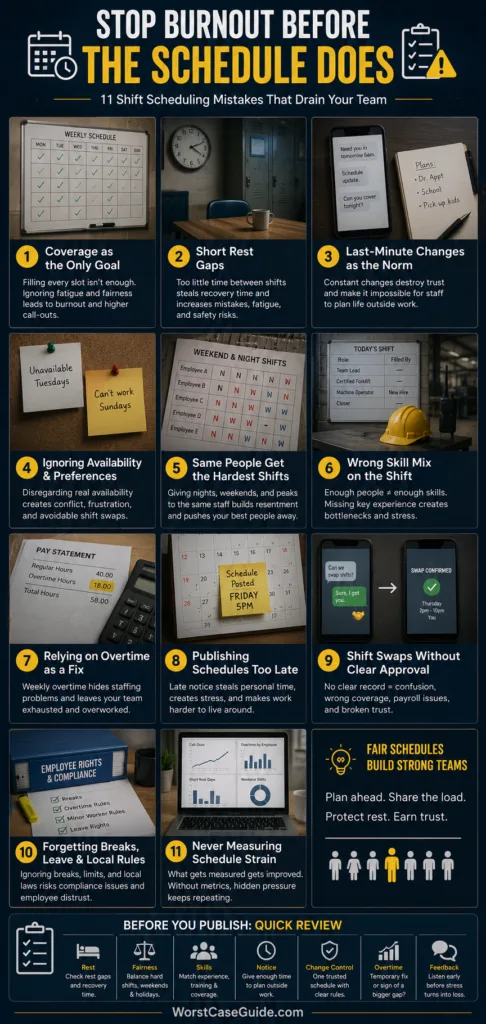
11 Shift Scheduling Mistakes That Burn Out Staff
Mistake 1: Treating Coverage As the Only Goal
A schedule can cover every hour and still be unsafe for morale. This happens when managers focus on filling boxes rather than asking whether the plan is workable for the people inside those boxes.
Why It Happens
Coverage is visible. Fatigue is not. A manager can see an empty shift right away, but emotional load, commute strain, and recovery debt are harder to notice.
Early Warning Signs
- Staff say the roster “looks fine” but sound tired or flat.
- The same employees keep accepting extra shifts because others cannot.
- Service quality dips near the end of long or awkward shift patterns.
- People stop volunteering for swaps because they feel used.
Worst-Case Result
The team appears covered until several people pull back at once. Call-outs rise, experienced staff leave, and the manager has fewer trusted people to rely on. The schedule becomes a weekly rescue job.
Safer Approach
Coverage can be treated as the first test, not the final test. A safer schedule also reviews rest gaps, hard-shift rotation, skill balance, overtime exposure, and whether the same people are repeatedly absorbing pressure.
Mistake 2: Repeating Short Rest Gaps Between Shifts
Short rest gaps are one of the easiest burnout triggers to miss. They happen when someone closes late and returns early, works a night shift followed by a day shift, or receives too little time between demanding shifts.
Why It Happens
Managers often solve an immediate coverage gap without looking at the full recovery window. The shift may be acceptable on the roster, yet the employee’s real time is reduced by commuting, eating, showering, family duties, and the struggle to fall asleep after work.
Early Warning Signs
- Employees mention being unable to sleep properly between shifts.
- Minor mistakes rise after back-to-back schedule changes.
- People arrive on time but look drained before the shift begins.
- Staff ask to avoid “clopen” patterns or quick returns.
Worst-Case Result
Fatigue becomes normal. In safety-sensitive work, that can raise the risk of errors. In customer-facing work, it can lead to irritability, slower service, and damaged team tone. The employee may not quit immediately; they may simply stop caring as much. That is a quieter loss.
Safer Approach
A schedule can include a recovery check before it is shared. In smaller projects, this may be a simple manager review. In larger systems, scheduling tools can flag short rest gaps, quick returns, and repeated late-to-early patterns before they reach staff.
Mistake 3: Making Last-Minute Changes the Normal Process
Every workplace has surprises. The problem begins when surprise becomes the default scheduling method.
Why It Happens
Last-minute changes often come from weak demand planning, slow leave approval, late rota publishing, or no backup pool. Managers may also delay difficult decisions until the schedule is almost live.
Early Warning Signs
- Staff check the schedule several times a day because they do not trust it.
- Shift swaps happen through scattered texts, screenshots, and side conversations.
- Employees say they cannot plan appointments, childcare, transport, or study time.
- People ask, “Is this the final version?” more than once.
Worst-Case Result
Employees begin to treat the workplace as unpredictable. Stress rises before the shift even begins, and the best staff may look for work with steadier notice. The cost is not only turnover; it is the loss of trust.
Safer Approach
Schedule changes can be handled through a clear change rule: who can change the roster, how staff are notified, how confirmation is recorded, and when a change is considered final. A schedule should not feel like a live document that can move under someone’s feet at any moment.
Mistake 4: Ignoring Availability And Treating Preferences As Noise
Availability is not the same as preference. Availability means when someone can reasonably work. Preference means what they would rather work. Confusing the two creates friction.
Why It Happens
Managers may collect availability once during hiring and never update it. In busy periods, they may also assume that staff will “make it work” if the business need is strong enough.
Early Warning Signs
- Employees repeatedly remind managers about the same unavailable days.
- Staff trade away assigned shifts almost as soon as the schedule is posted.
- People with school, childcare, transport, or second-job limits become frustrated.
- Managers say, “I forgot you could not do Tuesdays” more than once.
Worst-Case Result
The schedule creates avoidable conflict. Staff may feel ignored, even when the mistake was not personal. Over time, they may share less information, refuse flexibility, or leave for a workplace that respects known constraints.
Safer Approach
A safer process separates fixed availability from preferred shifts. Fixed limits should be easy to see while planning. Preferences can be balanced where possible, with clear rules when not everyone can get what they want.
Mistake 5: Giving the Hardest Shifts to the Same People
Some shifts carry more strain: late nights, weekends, split shifts, peak traffic hours, holiday coverage, isolated closing duties, or high-volume periods. Burnout grows when these shifts land on the same people too often.
Why It Happens
Managers may lean on employees who complain less, have fewer visible constraints, or perform well under pressure. This can feel efficient in the short run. It also punishes reliability.
Early Warning Signs
- The same names appear on weekends, nights, or peak periods.
- Quiet employees carry more hard shifts because they rarely push back.
- Team members joke that some people always get the “bad end” of the roster.
- High performers become less warm, less flexible, or more withdrawn.
Worst-Case Result
Resentment becomes part of the team culture. Strong employees may decide that doing a good job only brings more burden. Once that belief forms, it is hard to undo.
Safer Approach
Hard shifts can be tracked as a separate scheduling load, not hidden inside total hours. A rotation record helps show who has taken late shifts, weekend shifts, short-notice shifts, and high-demand periods. Fairness becomes visible.
Practical Note: Equal hours do not always mean equal load. Ten hours on calm weekday mornings may not feel the same as ten hours across late nights, rush periods, or repeated weekends.
Mistake 6: Building Schedules Without the Right Skill Mix
A shift with enough people can still fail if the wrong mix of skills is present. This is common in retail, hospitality, healthcare support roles, logistics, call centers, field service, security, maintenance, and any operation where experience levels matter.
Why It Happens
Some schedules count heads instead of capabilities. A team may have five people present, but no trainer, no opener, no certified worker, no experienced closer, or no one who can handle a known customer, machine, system, or process.
Early Warning Signs
- Newer staff are left together without enough support.
- One skilled person becomes the answer to every problem.
- Employees call off-duty staff for help because the shift lacks knowledge.
- Tasks pile up until a specific person arrives.
Worst-Case Result
Skilled staff become bottlenecks. New staff feel exposed. Customers or internal teams receive slower service. The schedule may look staffed, but the work is fragile.
Safer Approach
Schedules can include skill tags or role coverage checks. In a small team, this may be a simple note beside each name. In a larger system, it may require planned coverage for seniority, certifications, language needs, equipment access, opening and closing duties, and escalation support.
Mistake 7: Relying on Overtime As a Standing Solution
Overtime can help during a short spike. It becomes risky when it quietly replaces proper staffing, cross-training, or demand planning.
Why It Happens
Overtime often feels cheaper than hiring, faster than training, and easier than changing the staffing model. It may also be hidden across departments, so no one sees the full load on one person.
Early Warning Signs
- The same employees appear above their usual hours each week.
- Managers assume certain people will always say yes.
- Overtime is used to cover predictable demand, not only unusual spikes.
- Employees earn more but look more tired and less engaged.
Worst-Case Result
The business becomes dependent on exhausted people. If one or two overtime-heavy staff leave, the whole schedule may lose its safety net. Costs rise, patience falls, and training gaps become visible at the worst time.
Safer Approach
Overtime can be treated as a warning signal. If the same role, location, or shift needs extra hours every week, the safer question is not only “Who can cover?” but “Why does this gap keep returning?”
Mistake 8: Publishing Schedules Too Late
Late schedules make work feel unstable. Even when the final roster is reasonable, poor notice can make it hard for staff to plan normal life.
Why It Happens
Managers may wait for sales forecasts, leave requests, budget approval, or staffing decisions. Sometimes the schedule is late because one person owns the whole process and has no backup.
Early Warning Signs
- Staff ask when next week’s rota will be posted.
- Employees delay personal plans because they do not know their hours.
- Leave requests pile up near the same deadline.
- People become less flexible because they receive little notice themselves.
Worst-Case Result
The workplace feels hard to live around. Employees may accept the job at first, then leave once the scheduling stress affects family routines, transport, study, health habits, or another income source.
Safer Approach
A regular publishing rhythm helps. Even if minor edits happen later, staff benefit from knowing when the draft schedule appears, when requests are due, and when the roster becomes final.
Mistake 9: Managing Shift Swaps Without a Clear Approval Trail
Shift swaps can reduce pressure when handled well. Without a clear process, they create confusion about who is working, who approved the change, and whether the replacement has the right skills.
Why It Happens
Swaps often begin informally because staff want speed. A message thread seems easy until there are three versions of the same shift and no one knows which one counts.
Early Warning Signs
- Managers hear about swaps after they happen.
- People rely on screenshots instead of the active schedule.
- A shift gets covered by someone who cannot perform all required tasks.
- Two employees believe different things about the same time slot.
Worst-Case Result
A missed shift, wrong-skill coverage, or payroll dispute can follow. Even if the immediate issue is small, trust in the schedule drops. Staff may blame each other for a process problem.
Safer Approach
A safer swap process answers four questions: who requested the swap, who accepted it, who approved it, and where the final schedule is recorded. The active roster should be the source everyone trusts.
Mistake 10: Forgetting About Breaks, Leave, And Local Rules
Scheduling is not only an operational task. It also touches rest periods, breaks, overtime limits, minor worker rules, leave rights, union agreements, contracts, and local labor requirements. These vary by location and industry, so guessing is risky.
Why It Happens
Managers may copy last month’s schedule, use old habits, or rely on a tool without checking whether its settings match the workplace. In multi-location teams, one rule may not fit every site.
Early Warning Signs
- Breaks are planned informally rather than built into the shift flow.
- Employees regularly work through rest periods to keep up.
- Managers are unsure which rules apply to overtime, minors, or local scheduling notice.
- Payroll, HR, and operations interpret the same schedule differently.
Worst-Case Result
The business may face complaints, payroll corrections, staff distrust, or formal review. Staff may also feel that the company protects coverage more than basic rest and fair treatment.
Safer Approach
A schedule can include a periodic compliance review by the right internal owner or qualified professional. This is not legal advice; it is a reminder that shift planning should match the actual rules that apply to the workplace.
Mistake 11: Never Measuring Schedule Strain
Many teams measure attendance, sales, output, or labor cost. Fewer measure whether the schedule itself is causing stress.
Why It Happens
Schedule strain is often treated as a mood issue rather than a planning signal. Managers may hear complaints but lack a simple way to connect them with patterns in the roster.
Early Warning Signs
- Call-outs rise after certain shift patterns.
- Turnover is higher in one location, role, or time block.
- Overtime clusters around a few employees.
- Staff feedback mentions fairness, notice, rest, or constant changes.
Worst-Case Result
The same problems repeat because no one can see the pattern. The team keeps fixing symptoms: one swap, one absence, one complaint, one late change. The root cause remains in the schedule.
Safer Approach
Schedule quality can be reviewed through simple metrics: late changes, overtime concentration, weekend distribution, short rest gaps, swap volume, absence trends, and hard-shift rotation. The goal is not to turn people into numbers. It is to make hidden pressure visible enough to discuss.
Shift Scheduling Risk Table
| Scheduling Choice | Hidden Risk | Early Signal | Safer Check |
|---|---|---|---|
| Filling every slot without reviewing recovery | Fatigue builds even when coverage looks complete | People arrive tired before the shift starts | Review rest gaps and hard-shift clusters |
| Changing schedules at short notice | Staff lose control over personal planning | Repeated questions about whether the roster is final | Use a clear change and confirmation process |
| Giving difficult shifts to quiet employees | Reliable staff feel punished for being dependable | Less volunteering, colder team tone, private complaints | Track weekends, nights, peaks, and late changes by person |
| Counting heads instead of skills | Shifts are staffed but not properly supported | New staff ask off-duty employees for help | Check role coverage, seniority, certifications, and escalation needs |
| Using overtime every week | The team depends on people who may be near exhaustion | Same names carry extra hours repeatedly | Review recurring demand gaps and cross-training needs |
General Risk Patterns Behind Burnout Schedules
Most burnout schedules are not caused by one terrible decision. They come from patterns that repeat until staff lose patience.
Pattern 1: The Same People Absorb the Mess
Every workplace has employees who are flexible, skilled, and calm under pressure. If the schedule leans on them too often, the workplace may accidentally train them to say no, care less, or leave.
Pattern 2: The Schedule Changes Faster Than People Can Plan
Some change is normal. Constant change is different. When staff cannot trust their hours, they may feel as if work is occupying days they are not even scheduled to work.
Pattern 3: Fairness Is Discussed Only After Complaints
If fairness is not tracked, it becomes a feeling contest. One person remembers last weekend. Another remembers the last holiday. A simple rotation record can reduce that tension.
Pattern 4: Recovery Time Is Treated As Empty Time
Time away from work is not always rest. Commutes, family duties, meals, sleep timing, and personal errands take space too. A schedule that ignores this can create tired people even without extreme hours.
Pattern 5: Managers Fix Today By Borrowing From Next Week
A rushed fix may solve one shift and damage the next one. Repeated overtime, delayed schedules, and weak swap rules all borrow energy from the future. The bill arrives later.
How to Review a Shift Schedule Before It Burns People Out
A safer review does not need to be complicated. It needs to be honest. Before publishing a roster, the person responsible for scheduling can look for practical stress points.
- Rest: Are there short gaps, late-to-early patterns, or repeated night shifts?
- Fairness: Are weekends, holidays, hard shifts, and short-notice cover shared in a visible way?
- Skills: Does each shift have the right mix of experience, training, and authority?
- Notice: Are staff receiving enough time to plan outside work?
- Change Control: Is there one trusted version of the schedule?
- Overtime: Is extra work spread fairly, and is it solving a temporary need or hiding a staffing problem?
- Feedback: Do staff have a safe way to flag schedule strain before it becomes absence or resignation?
Small-Team Note: In a small shop, clinic, warehouse crew, or support team, the review may be a short weekly checklist. In a larger operation, the same logic may need scheduling software, HR review, and location-level reporting.
What a Less Risky Shift Scheduling Process Looks Like
A less risky process usually has four plain habits: collect real availability, plan demand before assigning people, publish the schedule with enough notice, and review strain after the week ends.
Before the Schedule Is Built
- Update employee availability and known constraints.
- Review demand by day, hour, location, and role.
- Check leave, training, certifications, and coverage rules.
- Identify shifts that are likely to be hard or unpopular.
While the Schedule Is Being Built
- Balance hard shifts rather than only total hours.
- Protect reasonable recovery time between shifts.
- Match skill levels to real workload.
- Avoid using one reliable person as the hidden backup plan.
After the Schedule Is Published
- Use one official roster location.
- Record approvals for swaps and changes.
- Watch for call-outs, late arrivals, and repeated fatigue signals.
- Ask whether the same problem is repeating in a specific shift, role, or site.
FAQ
What Is the Most Common Shift Scheduling Mistake That Leads to Burnout?
One common mistake is treating coverage as the only goal. A shift may have enough people assigned, but still create burnout if the same staff get difficult hours, short rest gaps, last-minute changes, or too much overtime.
How Do Last-Minute Schedule Changes Affect Employees?
Repeated last-minute changes make it harder for employees to plan childcare, transport, appointments, classes, meals, sleep, and second jobs. Over time, this can make work feel unpredictable even when the total number of hours is not high.
Are Rotating Shifts Always Bad for Staff?
Not always. The risk depends on how the rotation is designed, how much recovery time exists, how predictable the pattern is, and whether employees receive enough notice. Fast or poorly planned rotations are more likely to create fatigue.
Why Do Reliable Employees Burn Out in Shift-Based Work?
Reliable employees are often asked to cover gaps, take extra hours, train others, work peak periods, or accept short-notice changes. If this pattern is not tracked, dependable staff may carry more load than the schedule shows.
How Can Managers Make Shift Scheduling Feel Fairer?
Fairness improves when the rules are visible. Managers can track difficult shifts, weekend work, overtime, late changes, and holiday assignments. Staff may not always get the schedule they prefer, but clear rotation reduces suspicion.
Is Employee Scheduling Software Enough to Prevent Burnout?
Software can help by flagging conflicts, rest gaps, overtime, availability issues, and skill coverage. It does not replace good judgment. The schedule still needs human review, clear communication, and honest feedback from the team.
What Should Be Reviewed Before Publishing a Shift Schedule?
A useful review checks coverage, rest time, hard-shift rotation, skill mix, overtime exposure, availability conflicts, leave, breaks, swap rules, and whether staff receive enough notice to plan their lives outside work.