Cash flow mistakes can sink a small business even when sales look healthy, customers seem interested, and the owner is working hard every day. The risk usually starts quietly: one late invoice, one rushed equipment purchase, one tax payment that was “handled later,” one month where the bank balance feels thinner than expected. Then the business begins operating like a car with a leaking fuel tank. It may still move, but the distance gets shorter each week.
Small business cash flow is not only about how much money comes in. It is about when money arrives, when money leaves, and whether the business can cover payroll, rent, inventory, supplier bills, loan payments, taxes, owner draws, software subscriptions, repairs, refunds, slow seasons, and delayed customer payments without panic decisions.
For many owners, the hardest part is that cash flow problems do not always look like failure at first. They can look like growth. A busy shop, a full calendar, rising revenue, or a large order can still create a cash shortage if the timing is wrong.
Reader note: This article is for general business education only. It is not accounting, tax, legal, lending, or financial advice. Small businesses can have very different cash cycles, so owners often benefit from reviewing their numbers with a qualified accountant or business adviser before making major decisions.
Why Cash Flow Is Risky for Small Businesses
A small business usually has less room for delay than a large company. A larger company may have reserves, credit lines, finance teams, purchasing controls, and several revenue streams. A small business may depend on a few customers, a few employees, one busy season, or one owner who knows where every bill is buried.
That is why a cash flow mistake can become a chain reaction. A late customer payment can delay a supplier payment. A delayed supplier payment can block new inventory. Missing inventory can reduce sales. Lower sales can make next month’s payroll harder. The business starts solving yesterday’s problem with tomorrow’s money.
The risk grows when the owner only watches profit, revenue, or the accounting report without checking the actual cash position. Profit is useful. Revenue matters. Cash decides what can be paid this week.
Common Wrong Assumptions About Small Business Cash Flow
Cash flow trouble often begins with a reasonable assumption that turns out to be incomplete. The owner is not careless. They are usually busy, optimistic, and trying to keep the business moving.
- “If we are profitable, we are safe.” Profit can sit on paper while cash is still trapped in unpaid invoices, inventory, deposits, or long payment terms.
- “Growth will fix the problem.” Growth can create a bigger cash gap when hiring, stock, equipment, software, marketing, and supplier payments happen before customer cash arrives.
- “The customer will pay soon.” Soon is not a date. Payroll, rent, taxes, and loan payments are dates.
- “I know my business by feel.” Owner instinct helps, but cash timing can shift fast when several small delays land in the same week.
- “A line of credit will cover it.” Borrowed money can help with timing, but it can also hide weak pricing, late collections, or poor spending control.
- “Taxes are separate from cash flow.” Tax obligations are cash outflows. If they are not planned, they can surprise the business at the worst time.
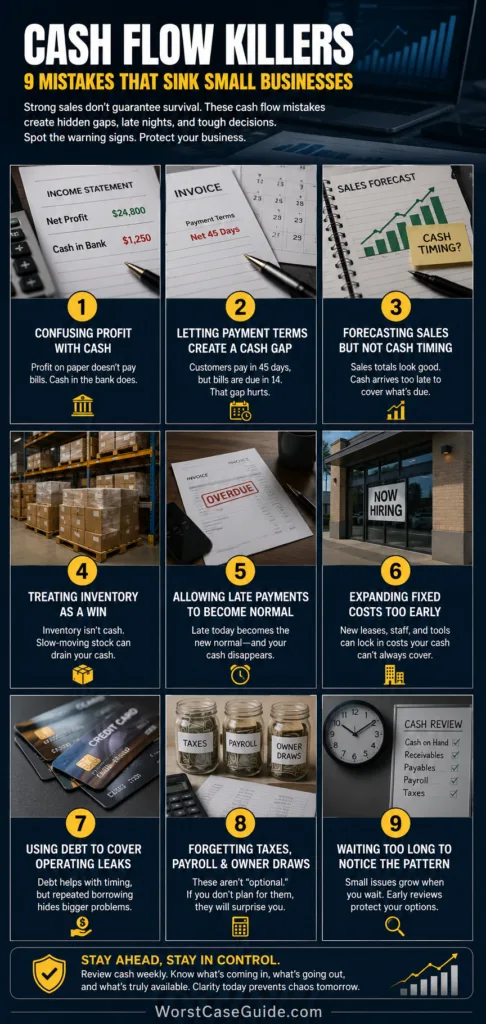
9 Cash Flow Mistakes That Sink Small Businesses
The mistakes below are ordered by how often they create a cash squeeze that feels confusing at first. Each one includes why it happens, early warning signs, the worst-case result, and a safer approach.
Mistake 1: Confusing Profit With Cash in the Bank
Why It Happens
This mistake happens when the owner treats an income statement as if it shows spendable money. A business can record revenue before the money is collected. It can also show profit while cash is tied up in receivables, stock, deposits, prepaid expenses, or equipment.
In service businesses, the gap may come from invoices due in 30, 45, or 60 days. In retail or product businesses, the gap may come from inventory bought before the sale happens. In project-based work, the gap may come from labor paid weekly while the client pays after milestones.
Early Warning Signs
- Revenue is rising, but the bank balance is flat or falling.
- The owner feels surprised by payroll even during a good sales month.
- Accounts receivable grows faster than collected cash.
- The business needs credit cards or short-term borrowing despite “good numbers.”
Worst-Case Result
The business may look successful on reports but still miss payroll, delay vendor payments, lose supplier trust, or take expensive emergency debt. This is one of the most uncomfortable cash flow failures because the owner may feel, “How can we be busy and still broke?”
A Safer Approach
A safer approach is to review profit and cash separately. The business can track cash collected, cash due soon, cash already committed, and cash needed before the next major payment date. In smaller projects, a simple weekly cash view may be enough. In larger systems, a rolling 13-week cash forecast can make the timing clearer.
Mistake 2: Letting Customer Payment Terms Create a Cash Gap
Why It Happens
Many small businesses accept customer payment terms without comparing them to supplier terms, payroll dates, rent, loan payments, and tax deadlines. A client may pay in 45 days while the business pays workers every week and suppliers within 14 days. The sale is real, but the timing is painful.
This is common in B2B services, contractors, agencies, wholesalers, manufacturers, and businesses that work with larger companies. The larger customer may set the payment rhythm. The smaller business absorbs the wait.
Early Warning Signs
- Invoices are not overdue yet, but cash is already tight.
- The business keeps saying, “We are waiting on payments.”
- Large orders feel stressful instead of helpful.
- Suppliers are paid before customers pay the business.
Worst-Case Result
The business may grow into a cash shortage. More sales require more labor, supplies, packaging, shipping, subcontractors, or inventory before cash arrives. If several customers delay payment at once, the company may be forced to pause work, refuse new orders, or borrow under pressure.
A Safer Approach
The safer path is to match payment timing as closely as possible. Some businesses use deposits, progress billing, shorter invoice terms, automated reminders, card or bank transfer options, or partial upfront payment for custom work. If a large customer requires long terms, the margin should be strong enough to carry the wait.
Practical check: If customers pay in 45 days and suppliers require payment in 14 days, the business has a 31-day cash gap before overhead is even considered. That gap needs a plan, not hope.
Mistake 3: Forecasting Sales but Not Cash Timing
Why It Happens
Sales forecasts often show what the owner hopes to sell. Cash forecasts show when money is expected to land and leave. The difference matters. A business can forecast a strong month and still run short if most cash arrives after payroll, rent, or a tax payment.
This mistake is common when the owner builds plans around monthly revenue targets but does not map payment dates. The calendar gets ignored. The bank balance does not ignore it.
Early Warning Signs
- The forecast shows sales totals but no collection dates.
- Expenses are listed monthly, not by actual due date.
- The business has no view of the next 8 to 13 weeks.
- Cash feels fine at the start of the month and tight near payroll.
Worst-Case Result
The owner may approve spending based on expected sales, then discover that the cash arrives too late. This can lead to missed discounts, late fees, strained vendor calls, or a rushed loan application when the business has less negotiating power.
A Safer Approach
A cash forecast should include expected receipts, likely collection dates, payroll, rent, loan payments, taxes, insurance, subscriptions, inventory purchases, supplier payments, owner draws, and a buffer for surprises. In smaller businesses, this can be a spreadsheet. In larger operations, it may need accounting software, approval rules, and weekly review.
| Cash Flow Signal | Likely Risk | Safer Review Question |
|---|---|---|
| Revenue is growing but cash is shrinking | Profit is being confused with collected cash | Which sales have actually been paid? |
| Invoices are paid late every month | Weak collections process or unclear terms | When does follow-up begin, and who owns it? |
| Inventory is full but bills are hard to pay | Cash is trapped in slow-moving stock | Which items turn slowly or need discounting? |
| Payroll feels stressful during busy periods | Labor is paid before customer cash arrives | Do deposits or milestone payments need review? |
| Taxes feel like a surprise | Tax cash was not reserved as money came in | What amount should be set aside regularly? |
Mistake 4: Treating Inventory as a Win Before It Turns Into Cash
Why It Happens
Inventory can make a business feel prepared. Shelves look full. The back room looks ready. The owner may feel more secure because the product is physically there. The problem is simple: inventory is not cash until it sells and the money is collected.
This mistake can appear in retail, food, ecommerce, manufacturing, parts businesses, seasonal shops, and any company that buys stock before demand is certain. A good purchase price can still be a bad cash decision if the product moves slowly.
Early Warning Signs
- Stock rooms are full while the bank balance is low.
- The business keeps buying “just in case.”
- Older products are discounted late, after cash is already tight.
- Fast-moving items run out while slow-moving items take up cash and space.
Worst-Case Result
Cash becomes frozen in products that sell too slowly, expire, become outdated, get damaged, or require storage. The business may then lack money for payroll, supplier payments, or the next batch of items that customers actually want.
A Safer Approach
A safer approach is to review inventory by cash speed, not only by quantity. Owners can compare sell-through, reorder points, gross margin, seasonality, storage costs, returns, spoilage, and supplier lead time. If you are in a seasonal business, the question is not only “Can we buy it?” but also “Can we survive if it sells two months later than planned?”
Mistake 5: Allowing Late Payments to Become Normal
Why It Happens
Late payments become normal when the business wants to avoid awkward conversations. The owner may value the customer relationship, assume the client is good for it, or feel too busy to follow up. Invoices are sent, then attention moves to the next job.
After a while, the customer learns the real payment term: not what the invoice says, but what the business tolerates.
Early Warning Signs
- Several invoices are unpaid past due.
- The business has no set follow-up schedule.
- Payment reminders are sent only when cash gets tight.
- Customers ask for more work while older invoices remain unpaid.
Worst-Case Result
The business becomes an unpaid lender to its customers. If the customer later disputes the work, delays further, or cannot pay, the business absorbs labor, materials, and overhead without cash recovery. One large unpaid invoice can hurt. Several small late invoices can do the same damage more quietly.
A Safer Approach
The safer approach is to make collections routine rather than emotional. Clear terms, clean invoices, correct contact details, early reminders, payment links, deposit rules, pause points for overdue accounts, and written approval for changes can reduce the chance that collections becomes a monthly scramble.
Mistake 6: Expanding Fixed Costs Too Early
Why It Happens
When sales improve, it is natural to think about a larger space, more staff, new equipment, better software, a delivery vehicle, a bigger warehouse, or a wider marketing push. Some of these moves may be useful. The risk is locking the business into fixed costs before cash flow is stable enough to carry them.
Fixed costs are like turning up the volume on the business. If revenue dips, the noise does not get quieter by itself.
Early Warning Signs
- New monthly commitments are added after one good period.
- The business cannot explain the cash payback period for a purchase.
- Hiring happens before workload and collections are predictable.
- Subscriptions, tools, and small recurring costs are rarely reviewed.
Worst-Case Result
The business becomes expensive to keep open. If sales soften, margins shrink, or customers pay late, fixed obligations keep draining cash. The owner may cut useful spending, delay payables, reduce service quality, or take on debt to support costs that were added too soon.
A Safer Approach
A safer approach is to separate spending that creates repeatable cash from spending that only creates a better-looking operation. Before adding fixed costs, the business can test demand, review break-even levels, check worst-month cash, compare lease terms, and model what happens if sales come in lower or slower than expected.
Mistake 7: Using Debt to Cover Operating Leaks
Why It Happens
Debt can be useful when it supports a planned cash timing need, a tested expansion, equipment with clear use, or a temporary gap that the business can repay. The danger starts when borrowed money covers the same operating shortfall again and again.
This can happen with credit cards, merchant cash advances, short-term loans, overdrafts, supplier credit, or owner-funded transfers. The first use feels like relief. The repeated use becomes a warning.
Early Warning Signs
- Borrowing fills the same cash gap every month.
- Debt payments are now part of the cash problem.
- The business pays old bills with new credit.
- The owner avoids calculating the true cost of short-term funding.
Worst-Case Result
The business can enter a debt loop. Cash that should support operations is used for repayment, fees, or interest. Then the next shortage arrives sooner. In a bad case, the business loses access to affordable credit exactly when it needs flexibility.
A Safer Approach
A safer approach is to identify whether the need is a timing gap or a business model problem. If the issue is timing, better terms, faster collections, or a planned credit facility may help. If the issue is low pricing, weak margins, high overhead, slow inventory, or owner draws above cash capacity, debt only delays the repair.
Mistake 8: Forgetting Taxes, Payroll Costs, and Owner Draws in the Cash Plan
Why It Happens
Taxes, payroll-related costs, and owner draws can be emotionally easy to separate from “business expenses.” They may not feel like a vendor bill. Yet they still take cash. If they are not built into the cash plan, the business may treat money as available when part of it already belongs to future obligations.
This mistake is common when the owner checks the bank balance and spends based on what is visible, not what is committed.
Early Warning Signs
- Tax payments feel like sudden events.
- Owner draws change based on bank balance, not cash forecast.
- Payroll taxes, sales taxes, or estimated taxes are not set aside regularly.
- The business has no separate view of money collected but not truly available.
Worst-Case Result
The business may face penalties, rushed borrowing, unpaid bills, or owner stress because cash was used before obligations were funded. Even if the business recovers, trust can be damaged with employees, vendors, lenders, or public agencies.
A Safer Approach
A safer approach is to treat tax reserves, payroll-related costs, and owner compensation as planned cash movements. Some owners use separate accounts or scheduled transfers. Others review them weekly with their bookkeeper. The exact method can vary, but the principle is steady: committed cash should not be mistaken for free cash.
Mistake 9: Waiting Too Long to Notice the Pattern
Why It Happens
Small business owners often work inside the pressure. They answer customers, handle staff issues, manage suppliers, fix mistakes, and keep the doors open. Because of that, they may only study cash flow when something feels wrong. By then, the pattern has been active for weeks or months.
The business may not need a complex finance department. It does need a rhythm for looking at cash before stress makes decisions smaller.
Early Warning Signs
- The owner checks cash only when a bill is due.
- Bookkeeping is always behind.
- No one reviews receivables, payables, inventory, and payroll together.
- The same cash shortage returns at the same point each month.
Worst-Case Result
The business loses options. Problems that could have been handled with small changes may require large cuts, rushed borrowing, staff reductions, delayed vendor payments, or a pause in operations. Waiting turns a leak into a flood.
A Safer Approach
A safer approach is to use a regular cash review rhythm. Weekly is often practical for small businesses with tight cash, many invoices, payroll, inventory, or supplier payments. The review can be simple: cash on hand, expected cash in, required cash out, overdue invoices, tax reserves, inventory needs, and any decision that would add a recurring cost.
Cash Flow Risk Patterns That Show Up Across These Mistakes
The mistakes above look different on the surface, but they usually follow a few repeat patterns. Recognizing the pattern helps the owner avoid chasing symptoms.
Pattern 1: Money Is Counted Before It Is Collected
This pattern appears when revenue, contracts, invoices, purchase orders, or expected sales are treated like cash. They may become cash later, but they cannot pay today’s bill until collected.
Pattern 2: Growth Is Funded With Hope Instead of Timing
Growth can be good, but it often asks for cash first. More orders may require more labor, more inventory, more packaging, more delivery costs, more software, and more management time before customer payments arrive.
Pattern 3: Fixed Costs Rise Faster Than Cash Certainty
Some costs are easy to add and hard to remove. Leases, salaries, subscriptions, loans, vehicles, and long-term service contracts can put pressure on the business even when sales are uneven.
Pattern 4: The Bank Balance Is Used as the Main Decision Tool
The bank balance is useful, but it is incomplete. It does not show unpaid bills, tax reserves, upcoming payroll, customer delays, seasonal dips, supplier deposits, or the cash needed for next month’s work.
A Safer Cash Flow Review for Small Businesses
A cash review does not need to be fancy. It needs to be honest. The goal is to see the next few weeks clearly enough to avoid surprise decisions.
- Cash on hand: What is truly available after committed reserves?
- Expected inflows: Which payments are expected, from whom, and on what date?
- Required outflows: Which bills, payroll amounts, taxes, loan payments, and supplier payments must be covered?
- Overdue receivables: Which invoices need follow-up before they become a larger problem?
- Inventory cash: Which stock is moving, which stock is slow, and which purchases can wait?
- Recurring costs: Which costs repeat every month, even if sales drop?
- Decision check: Which new commitment would still make sense if sales arrive late?
Useful rule of thumb: A cash flow review should answer one plain question: “Can the business safely meet its next obligations without depending on money that has no firm arrival date?”
When Cash Flow Problems Need Faster Attention
Some cash flow pressure is temporary. A large customer pays late, a machine needs repair, or a slow season arrives. Other signs suggest the business may need faster help from an accountant, bookkeeper, business adviser, lender, or restructuring professional.
- Payroll is difficult more than once.
- Tax money has already been spent on operating bills.
- Vendors are delaying shipments because of unpaid balances.
- Credit cards or short-term loans are used for regular expenses.
- The owner does not know which products, services, or customers are actually cash-positive.
- Sales are growing, but each month feels tighter.
- Bookkeeping is too far behind to support decisions.
If you are in this situation, the safer move is usually not to guess from memory. Clear books, current receivables, payables, inventory data, payroll timing, tax obligations, and a short cash forecast can make the next decision less emotional.
FAQ
What is the biggest cash flow mistake small businesses make?
One of the most common mistakes is confusing profit with available cash. A business can show profit while money is still tied up in unpaid invoices, inventory, deposits, or future obligations. That is why cash timing needs its own review.
Can a profitable small business still run out of cash?
Yes. A profitable business can run short when customers pay late, inventory moves slowly, payroll comes before client payments, taxes are not reserved, or growth requires spending before cash arrives.
How often should a small business review cash flow?
For a small business with tight cash, payroll, inventory, supplier payments, or many invoices, a weekly review is often useful. A more stable business may review less often, but cash should be checked before large commitments.
Why does growth sometimes create cash flow problems?
Growth often requires cash before it creates cash. More sales may require more labor, materials, stock, delivery, software, or credit terms. If customer payments arrive later, the business can grow into a shortage.
What should be included in a simple cash flow forecast?
A simple forecast can include cash on hand, expected customer payments, payroll, rent, supplier bills, loan payments, taxes, owner draws, inventory purchases, subscriptions, and a buffer for delays or repairs.
Is borrowing money a bad way to fix cash flow?
Borrowing is not always bad. It can help with planned timing gaps or tested growth. It becomes risky when debt covers the same operating leak repeatedly, especially if repayment creates the next shortage.
How can late customer payments hurt a small business?
Late payments can force the business to cover labor, materials, rent, taxes, and supplier bills before revenue is collected. Over time, the business may become an unpaid lender to its customers.
Why is inventory a cash flow risk?
Inventory uses cash before it produces cash. If products sell slowly, expire, become outdated, or need discounting, the business may lack money for faster-moving items or required payments.