Customer retention mistakes rarely look dangerous at first. A slow onboarding reply, a vague renewal plan, a missed support pattern, or a sales promise that never reaches the customer success team may feel like small operational noise. Over time, those gaps create customer churn, lower customer lifetime value, weaken trust, and make every new sale work harder than it should.
The risk is not only that a customer leaves. The larger risk is that the business keeps replacing lost customers without understanding why they left. It becomes a leaky bucket: marketing pours more in, but the bottom keeps dripping.
Safe Reading Note: This article is written for business planning and operational risk awareness. It does not give legal, financial, or investment advice. The aim is to help teams see retention risks earlier and make more careful decisions.
Why Customer Retention Gets Risky So Quietly
Churn often builds before a cancellation email appears. A customer may still be paying, still opening emails, and still attending the occasional call, while their real commitment is fading. That quiet gap is where many retention problems start.
In smaller companies, retention risk often comes from informal processes. The founder knows the customer. The support person remembers the issue. The sales rep keeps context in their head. That works until the team grows.
In larger systems, the risk shifts. There may be a CRM, onboarding checklist, ticketing system, product analytics dashboard, NPS survey, renewal calendar, and account plan. Yet the customer can still feel ignored if those tools do not lead to timely action.
Common Wrong Assumptions That Lead To Churn
Many customer retention problems begin with assumptions that sound reasonable in meetings but fail in real customer behavior.
- “No complaint means the customer is happy.” Many unhappy customers simply go quiet.
- “A good product will retain users by itself.” Even useful products need clear onboarding, habit formation, and value reminders.
- “Support owns retention.” Retention is shaped by sales promises, pricing, billing, product reliability, training, account management, and customer success.
- “Renewal starts near the renewal date.” Renewal risk often starts months earlier, when usage drops or a champion leaves.
- “All churn is the same.” Voluntary churn, involuntary churn, downgrade risk, non-renewal, and silent disengagement need different responses.
- “Discounts fix retention.” A discount may delay a cancellation, but it rarely fixes weak product adoption or poor perceived value.
Customer Retention Risk Map
The table below shows how different retention issues usually appear before they become visible churn.
| Risk Area | Early Signal | Possible Churn Type | Safer Response |
|---|---|---|---|
| Onboarding | Low activation, missed setup steps, repeated beginner questions | Early voluntary churn | Define first-value milestones and guide the customer toward them |
| Product Usage | Fewer logins, unused core features, low adoption depth | Silent churn or downgrade risk | Track usage by segment and intervene before renewal pressure appears |
| Support | Long response times, reopened tickets, unresolved friction | Experience-driven churn | Prioritize repeat pain points, not only ticket closure speed |
| Billing | Payment failures, expired cards, invoice confusion | Involuntary churn | Use clear billing notices, payment recovery flows, and account updates |
| Renewal | Late stakeholder engagement, vague value proof, champion loss | Non-renewal | Build renewal readiness throughout the customer lifecycle |
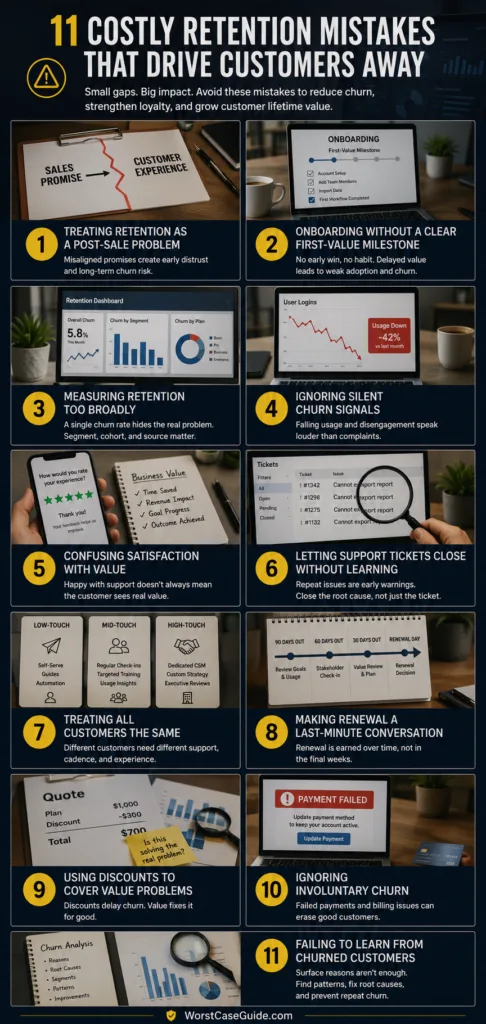
11 Customer Retention Mistakes That Increase Churn
Mistake 1: Treating Retention As A Post-Sale Problem
Retention does not begin after the customer signs. It begins when the customer first hears what the product, service, or process is supposed to do for them. If the sales message creates a picture the delivery team cannot match, churn risk starts early.
Why This Happens
Sales, marketing, onboarding, customer success, and support may each use different language. One team talks about speed. Another talks about setup effort. Another talks about advanced features. The customer hears all of it as one promise.
Early Warning Signs
- New customers ask, “I thought this was included?”
- Onboarding calls spend too much time correcting expectations.
- Support tickets mention promises made during the sales process.
- Customer success teams receive little context from sales notes.
Worst-Case Result
The customer may feel misled, even when no one intended to mislead them. In a subscription business, that can turn into fast cancellation. In a service business, it can lead to tension, lower trust, and a renewal conversation that starts from disappointment.
Safer Approach
A safer approach is to make the sales-to-success handoff more explicit. The handoff can include the customer’s goal, use case, buying reason, internal stakeholders, expected timeline, known concerns, and any limits discussed before purchase.
If you are in a smaller business, a simple handoff note may be enough. In a larger system, the same idea may need CRM fields, kickoff templates, customer success playbooks, and shared definitions of qualified fit.
Mistake 2: Onboarding Customers Without A Clear First-Value Milestone
Onboarding is not only a welcome email or a setup call. It is the customer’s first proof that they made a good decision. If that proof comes too late, doubt fills the gap.
Why This Happens
Teams often design onboarding around internal tasks: account creation, settings, permissions, training sessions, and documentation. Those tasks matter, but the customer cares more about the first useful result.
Early Warning Signs
- Customers complete setup but do not use the product deeply.
- Training attendance is high, but feature adoption is low.
- New users ask the same basic questions after onboarding.
- The team cannot clearly define what activation means.
Worst-Case Result
The customer may never build the habit needed for long-term retention. They may keep the account for a short period, then cancel because the product feels optional. The worst part: the team may call this a “bad-fit customer” when the real issue was weak activation.
Safer Approach
Define one or more first-value milestones. These should be based on the customer’s desired outcome, not only the company’s setup checklist.
- For a software product, the milestone might be the first completed workflow.
- For an agency, it might be the first approved deliverable with clear next steps.
- For a membership or community, it might be the first useful interaction.
- For a physical product subscription, it might be the first successful reorder or use routine.
Mistake 3: Measuring Retention Too Broadly
A single churn rate can hide the real problem. Overall churn may look acceptable while one customer segment is leaving fast, one pricing tier is under pressure, or one acquisition channel brings poor-fit buyers.
Why This Happens
Broad metrics feel clean. They fit nicely in a dashboard. But customer retention is shaped by customer type, use case, plan level, onboarding path, support history, payment method, region, industry, and account maturity.
Early Warning Signs
- The team knows total churn but not churn by cohort.
- High-value customers and low-value customers are mixed in one report.
- Acquisition campaigns are judged by signups, not retained customers.
- Product usage is tracked, but not tied to renewal or repeat purchase behavior.
Worst-Case Result
The business may solve the wrong problem. It may rewrite onboarding for every customer when only one segment is struggling. Or it may blame support when churn is coming from poor acquisition fit.
Safer Approach
Retention analysis becomes more useful when it includes cohort analysis, customer segmentation, acquisition source, plan type, onboarding completion, product adoption, support history, and renewal outcome.
In smaller projects, this can start in a spreadsheet. In larger systems, it may require cleaner CRM hygiene, product analytics, customer health scores, and shared reporting between revenue, product, and support teams.
Mistake 4: Ignoring Silent Churn Signals
Not every at-risk customer complains. Some customers stop logging in, stop replying, stop inviting team members, stop asking questions, or stop using the parts of the service that once mattered to them.
Why This Happens
Many teams are built around visible problems. A ticket comes in, support responds. A renewal date appears, account management prepares. Silent churn sits between those systems. It is less noisy, so it gets less attention.
Early Warning Signs
- Usage drops after the first month.
- Admin users are active, but end users are not.
- Meetings are postponed without a clear reason.
- Email engagement falls, but the account remains active.
- A main contact becomes harder to reach.
Worst-Case Result
The customer may cancel with a short explanation: “We are not using it enough.” That sentence sounds simple, but it often represents weeks or months of missed signals.
Safer Approach
A safer retention system watches for behavior changes, not only complaints. Product usage, login frequency, feature adoption, unresolved tickets, support sentiment, payment issues, and stakeholder engagement can all help reveal risk earlier.
The goal is not to over-monitor customers. The goal is to notice when the relationship is cooling down before it becomes a cancellation.
Mistake 5: Confusing Customer Satisfaction With Customer Value
A customer can be polite, satisfied with support, and still churn. Pleasant interactions do not always mean the customer is getting measurable value.
Why This Happens
Surveys such as CSAT, NPS, and post-ticket ratings are useful, but they do not tell the whole story. A customer may rate a support agent highly while questioning whether the product, service, or subscription is still worth paying for.
Early Warning Signs
- High support ratings appear alongside low renewal confidence.
- Customers praise the team but reduce usage.
- QBRs or review meetings focus on activity instead of outcomes.
- Account notes say “happy customer” without proof of business value.
Worst-Case Result
The team may be surprised by churn because the emotional tone felt positive. A friendly goodbye is still churn. It still lowers retention, revenue stability, and customer lifetime value.
Safer Approach
Pair sentiment data with value data. Customer success teams can look at product adoption, outcome progress, goal completion, support friction, expansion readiness, and the customer’s own definition of success.
A useful check is simple: Would this customer be able to explain why they should keep paying? If the answer is unclear, the account may need attention.
Mistake 6: Letting Support Tickets Close Without Learning From Them
Closing a ticket is not the same as removing the reason the ticket existed. When the same issue appears again and again, support becomes a warning system for churn.
Why This Happens
Support teams are often measured on response time, resolution time, backlog size, and customer satisfaction. Those numbers matter. Still, they can push teams toward fast closure rather than root-cause learning.
Early Warning Signs
- The same workaround is sent to many customers.
- Support labels are too vague to reveal patterns.
- Product teams receive only anecdotal feedback.
- Customers reopen tickets after the issue is marked solved.
Worst-Case Result
Customers may feel they are managing the company’s internal defects. If the issue affects daily work, the product begins to feel unreliable. Churn may come later, but the decision starts when the customer loses patience.
Safer Approach
Support data can be grouped by issue type, customer segment, product area, severity, and churn outcome. A repeated ticket from one large account may matter. A repeated ticket across many small accounts may matter even more.
For a safer process, support, product, and customer success teams can review repeat friction regularly. Not every issue can be fixed right away, but recurring pain should not stay invisible.
Mistake 7: Treating All Customers The Same
Equal treatment sounds fair, but identical treatment can increase churn. Different customers may need different onboarding depth, communication cadence, support level, training style, and renewal planning.
Why This Happens
Standard processes are easier to manage. They reduce chaos. The problem appears when a standard journey ignores customer size, technical skill, use case, contract value, risk level, and desired outcome.
Early Warning Signs
- High-touch customers receive generic lifecycle emails.
- Low-complexity customers are pushed into too many calls.
- Enterprise accounts lack stakeholder mapping.
- Small accounts churn because they feel lost in self-serve onboarding.
Worst-Case Result
The business may spend too much time where risk is low and too little where risk is high. Some customers feel neglected. Others feel over-managed. Both can weaken retention.
Safer Approach
Segment customers by practical needs. Useful segments may include account size, plan tier, use case, onboarding complexity, support needs, product usage, renewal date, and expansion potential.
Segmentation does not need to become complicated. A simple low-touch, mid-touch, and high-touch model can already reduce retention mistakes when it is based on real customer behavior.
Mistake 8: Making Renewal A Last-Minute Conversation
Renewal is often treated as a date. In practice, it is the result of many earlier experiences: onboarding, adoption, support quality, stakeholder trust, product reliability, billing clarity, and perceived value.
Why This Happens
Teams may wait until the contract is close to ending because that is when the renewal appears urgent. By then, the customer may have already compared alternatives, cut internal budget, or decided the product is not part of next year’s plan.
Early Warning Signs
- Renewal outreach starts only a few weeks before the deadline.
- The main product champion has changed or left.
- Decision-makers have not seen clear value evidence.
- Account reviews focus on usage numbers without business context.
Worst-Case Result
The company enters a renewal conversation with too little influence. The customer may ask for a discount, delay the decision, reduce seats, or leave. At that point, the team is not managing retention. It is trying to rescue it.
Safer Approach
A safer renewal process begins early. Customer success can track stakeholder changes, value milestones, open risks, adoption gaps, support history, and executive alignment long before renewal pressure arrives.
For larger accounts, renewal readiness may need a timeline. For smaller accounts, automated value reminders and usage nudges may be enough. The point is the same: renewal should not feel like a surprise inspection.
Mistake 9: Using Discounts To Cover Value Problems
Discounts can reduce short-term cancellation pressure, but they can also hide the reason a customer wanted to leave. If the customer does not see enough value, a lower price may only delay churn.
Why This Happens
Discounts are easy to offer during a tense conversation. They feel practical. They may help save an account in the moment. The risk appears when discounting becomes the default answer to weak adoption, poor fit, confusing pricing, or missing outcomes.
Early Warning Signs
- Saved accounts churn later anyway.
- Customers learn to threaten cancellation before renewing.
- Retention reports show many “saved” accounts but little usage improvement.
- Teams cannot separate price objections from value objections.
Worst-Case Result
The business may lower revenue while keeping the same churn risk. Customers stay temporarily, but the relationship becomes price-centered. If a competitor offers a similar product at a lower cost, the account may still leave.
Safer Approach
Before using a discount, it helps to identify the real objection. Is the customer underusing the product? Did they buy the wrong plan? Are they missing a feature? Is budget the true issue? Is there a stakeholder who no longer supports the purchase?
If you are in this situation, the safer move is usually to connect price discussions to fit, usage, and outcome. A discount without a value plan is like patching a pipe without checking the leak.
Mistake 10: Ignoring Involuntary Churn
Not all churn comes from dissatisfaction. Some customers leave because of failed payments, expired cards, invoice confusion, account access problems, procurement delays, or unclear billing communication.
Why This Happens
Teams often focus on voluntary churn because it feels more strategic. Product adoption, support quality, and customer experience get attention. Billing failure can look like a back-office issue, so it may receive less careful design.
Early Warning Signs
- Failed payments are handled only after cancellation risk appears.
- Billing emails are unclear or easy to miss.
- Customers are surprised by renewal charges.
- Account owners do not know when payment recovery is failing.
Worst-Case Result
A customer who wanted to stay may lose access, become frustrated, or fail to renew because the payment process broke down. This kind of churn is especially painful because it can be preventable.
Safer Approach
Payment recovery should be treated as part of retention. Clear billing notices, retry logic, updated payment methods, renewal reminders, invoice owner tracking, and respectful dunning messages can reduce avoidable loss.
For B2B accounts, billing contacts and product champions may be different people. That small detail matters. If only the user receives billing notices, procurement may never act in time.
Mistake 11: Failing To Learn From Churned Customers
Some teams collect cancellation reasons, but the data stays shallow. “Too expensive,” “not using it,” or “switched provider” may be true, but those labels are often only the surface.
Why This Happens
Exit surveys are short. Sales teams move on. Customer success teams focus on active accounts. Product teams may hear only the loudest feedback. Over time, churn becomes a number instead of a learning source.
Early Warning Signs
- Cancellation reasons are generic and rarely reviewed.
- No one compares churn reasons by segment or cohort.
- Win-back attempts repeat the same message for every former customer.
- Product and marketing teams do not see lost-customer patterns.
Worst-Case Result
The same churn loop repeats. The company keeps acquiring similar poor-fit customers, onboarding them the same way, missing the same warning signs, and losing them for similar reasons.
Safer Approach
Churn analysis works better when it separates stated reason from likely root cause. A customer may say “too expensive” when the deeper issue is low usage. They may say “missing feature” when the product was never adopted properly. They may say “switched provider” because another company explained value more clearly.
A safer process reviews churned customers by segment, plan, acquisition source, onboarding path, support history, product usage, and renewal timing. The goal is not blame. The goal is pattern recognition.
General Risk Patterns Behind Retention Mistakes
Most customer retention mistakes come from a few repeat patterns. Once those patterns are visible, individual churn events become easier to understand.
Pattern 1: The Company Reacts After The Customer Has Already Decided
Late intervention is common. A cancellation request arrives, then the team tries to save the customer. Sometimes that works. Often, the real decision was made earlier when the customer stopped seeing value.
Pattern 2: Teams Measure Activity Instead Of Progress
Emails sent, tickets closed, meetings held, and reports delivered can all look productive. The better question is whether the customer moved closer to the outcome they expected.
Pattern 3: Ownership Is Spread Too Thin
Retention touches many teams, but unclear ownership creates gaps. Sales may own expectations. Customer success may own adoption. Support may own friction. Product may own usability. Billing may own payment recovery. If no one connects the signals, churn gets room to grow.
Pattern 4: The Business Mistakes Silence For Stability
Quiet accounts may be healthy, but silence can also mean disengagement. A customer who does not complain may simply be preparing to leave without debate.
Pattern 5: The Same Playbook Is Used For Every Customer
A startup founder, a busy operations manager, a procurement-led enterprise buyer, and a self-serve user do not experience retention in the same way. One-size retention creates one-size blind spots.
A Safer Customer Retention Check Before Churn Rises
This checklist can help a team review retention risk without turning the process into a heavy internal audit.
- Expectation Fit: Are sales promises, onboarding steps, and product reality aligned?
- First Value: Does every customer segment have a clear first-value milestone?
- Usage Health: Are declining usage, low adoption, and silent accounts being noticed early?
- Support Learning: Are repeat tickets reviewed for root causes?
- Customer Segments: Are retention metrics broken down by cohort, plan, use case, and acquisition source?
- Renewal Readiness: Is renewal health checked before the final stretch?
- Billing Safety: Are failed payments, invoice contacts, and renewal notices handled carefully?
- Lost-Customer Learning: Are churn reasons reviewed beyond surface labels?
Practical Note: A retention system does not have to be large to be useful. Even a simple monthly review of churned accounts, quiet accounts, payment failures, onboarding drop-offs, and repeated support issues can reveal patterns that daily work hides.
FAQ
What Is The Most Common Customer Retention Mistake?
One of the most common mistakes is waiting until a customer complains or reaches renewal before acting. Many churn signals appear earlier through lower usage, weaker engagement, repeated support issues, missed onboarding milestones, or silence from the main contact.
Can A Happy Customer Still Churn?
Yes. A customer may like the team and still leave if they do not see enough value, cannot prove the product is worth keeping, lose internal support, or stop using the service regularly. Satisfaction and retention are related, but they are not the same thing.
Why Do Customers Churn Without Complaining?
Some customers do not want a difficult conversation. Others assume the company cannot fix the issue. Some simply disengage, compare alternatives, and cancel when the timing is easier. Silence should not always be read as loyalty.
How Can A Business Spot Churn Risk Earlier?
A business can watch for falling usage, incomplete onboarding, unresolved support patterns, fewer stakeholder replies, billing failures, poor feature adoption, low survey scores, and late renewal uncertainty. The useful part is connecting these signals instead of reviewing them separately.
Are Discounts A Good Way To Reduce Churn?
Discounts may help in some price-sensitive cases, but they can hide deeper retention problems. If the real issue is low adoption, poor fit, weak onboarding, or unclear value, a discount may delay churn rather than reduce it.
What Is The Difference Between Voluntary And Involuntary Churn?
Voluntary churn happens when a customer chooses to leave, cancel, downgrade, or stop buying. Involuntary churn happens when the customer is lost because of payment failure, expired billing details, invoice issues, or access problems even though they may not have intended to leave.
Should Small Businesses Track Customer Retention?
Yes, but the tracking can stay simple. A small business can review repeat buyers, lost customers, support complaints, payment issues, renewal timing, and customer feedback. The value comes from noticing patterns early, not from building a large reporting system too soon.