A partnership agreement can look simple on day one: two or more people agree to build something, share the work, share the money, and trust each other. The legal problems usually appear later, when the business has income, debt, customers, intellectual property, tax duties, or one partner wants out. A weak agreement works like a blurry map; everyone thinks they know the route until the road splits.
Partnership agreement mistakes rarely begin with bad intent. They often begin with friendly assumptions, rushed paperwork, copied templates, and topics that feel awkward to discuss before money is involved. The risk is not only a lawsuit. It can also be frozen bank accounts, blocked decisions, lost clients, damaged records, personal liability, or a business that cannot move without conflict.
Important: This article is general information for planning and risk awareness. It is not legal advice. Partnership law, business entity rules, tax treatment, employment rules, and enforceability of contract terms can vary by location and situation. A qualified business attorney or tax professional can review the actual agreement before partners rely on it.
Why Partnership Agreements Become Risky
A partnership agreement is not only a document about friendship or trust. It is also a document about authority, money, ownership, duties, exit rights, records, and conflict. If those areas are vague, daily business choices can slowly turn into legal disputes.
The risk grows when the business moves faster than the paperwork. One partner signs a vendor contract. Another pays for equipment personally. A third partner creates the brand assets, manages client relationships, or controls the login details for sales platforms. Nobody stops to ask: who owns what, who can approve what, and what happens if someone leaves?
Common Wrong Assumptions Before Signing
- “We trust each other, so we do not need much detail.” Trust helps relationships. Detail helps when memory, pressure, or incentives change.
- “A 50/50 split is automatically fair.” Equal ownership can be fair, but it can also create deadlock if voting rules are missing.
- “Profits and cash distributions are the same thing.” A business can show profit while still needing cash for tax, payroll, debt, inventory, or growth.
- “The template covers everything.” A template may not match the partners’ industry, location, tax structure, roles, or exit expectations.
- “We can fix it later.” Later can mean after resentment, debt, client loss, or unequal bargaining power has already appeared.
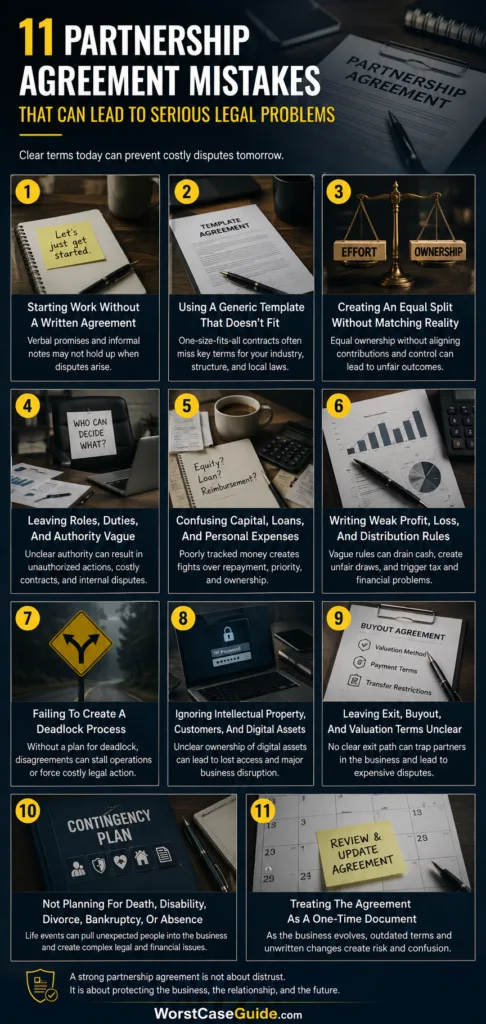
The 11 Partnership Agreement Mistakes That Create Legal Problems
The mistakes below are arranged in the order they often appear in real business life: formation, money, authority, assets, exit, and dispute control. Some issues look small in a two-person side project. In a larger partnership, the same issue can become a legal and operational knot.
| Mistake | Early Warning Sign | Possible Worst-Case Result |
|---|---|---|
| No written agreement | Partners rely on messages, memory, or casual talks. | Default rules or disputed verbal claims control the outcome. |
| Vague ownership split | Partners say “we are equal” without defining money, labor, or voting. | Disputes over equity, control, profits, and buyout rights. |
| Unclear authority | One partner signs deals without asking the others. | The business may be bound to contracts nobody planned for. |
| No exit terms | Nobody knows how a partner can leave or be bought out. | A departing partner may block operations, demand payment, or keep ownership rights. |
Mistake 1: Starting Work Before There Is a Written Agreement
Why It Happens
This mistake is common when partners are friends, family members, former coworkers, or early-stage founders. The first conversations feel clear. Everyone remembers the same lunch meeting, the same pitch deck, the same rough numbers. Then the business starts moving, and the details begin to drift.
A written agreement may feel too formal before the business earns money. That feeling is understandable. Still, the legal risk begins as soon as partners contribute cash, create assets, sign contracts, open accounts, serve customers, or represent the business to third parties.
Early Warning Signs
- Partners use phrases like “we all know the deal” without written terms.
- Important terms live only in emails, chats, spreadsheets, or voice notes.
- One partner has already paid expenses or signed contracts personally.
- The business has revenue before ownership and authority are defined.
Worst-Case Result
The worst-case result is not just disagreement. The business may face a dispute where each partner has a different version of the deal. If no usable written agreement exists, local default rules, partial records, and conduct may matter more than what anyone thought was “obvious.” That can be expensive and slow.
A Safer Approach
A safer approach is to put the main terms in writing before the business takes on customers, debt, investors, employees, or long-term commitments. The document does not need to sound dramatic. It needs to answer plain questions: who owns what, who does what, who can decide what, how money moves, and how someone exits.
Mistake 2: Using a Generic Template Without Matching the Real Business
Why It Happens
Templates are easy to find. They can also create false comfort. A restaurant partnership, a software startup, a consulting firm, a real estate project, and a family-owned trade business do not carry the same risks. Their assets, tax issues, customer relationships, licenses, insurance needs, and exit problems can be very different.
The template problem is quiet. It looks solved because a document exists. Then a conflict appears in an area the template never handled well.
Early Warning Signs
- The agreement has blank fields, mismatched terms, or references to the wrong entity type.
- No one can explain what several clauses actually mean.
- The document does not mention the business’s real assets, such as software, client lists, trade names, inventory, or online accounts.
- Partners sign without checking whether the agreement fits local rules.
Worst-Case Result
A generic agreement may fail when partners need it most. It may leave out buyout rules, voting thresholds, non-owner contributions, tax distribution language, records access, or dispute steps. The partners may then argue over missing terms rather than using the agreement to solve the problem.
A Safer Approach
A better path is to treat a template as a starting draft, not as the finished agreement. Each clause can be checked against the real business model. In smaller projects, that may mean a short but clear document. In larger systems, the agreement may need review by a business attorney, tax advisor, and sometimes an industry-specific advisor.
Mistake 3: Creating an Equal Split Without Matching Contributions, Duties, and Control
Why It Happens
A 50/50 split feels clean. It avoids uncomfortable talks about who brings more money, time, skill, reputation, equipment, customer access, or risk. It also feels fair at the start, when the business is still an idea and nobody wants to damage the relationship.
Equal ownership can work. The mistake is assuming equal ownership automatically solves fairness. It does not. It only divides ownership. It may not divide workload, debt, authority, stress, or future expectations.
Early Warning Signs
- One partner works full time while another contributes only occasionally.
- One partner contributes most of the startup cash but receives the same rights as everyone else.
- Partners use the word “equal” for ownership, voting, profits, salary, and decision power without separating those ideas.
- No one discusses what happens if contributions change after launch.
Worst-Case Result
The business can reach a point where one partner believes they are carrying the company while another still owns half. That can lead to blocked decisions, claims of unfair enrichment, refusal to approve spending, or a buyout fight. In a 50/50 structure, a deadlock can freeze the business like a locked door with two keys on opposite sides.
A Safer Approach
The agreement can separate ownership percentage, voting rights, compensation, capital accounts, workload expectations, and profit distributions. If partners choose equal ownership, the agreement can still explain what equal means and what happens when contributions become unequal over time.
Mistake 4: Leaving Roles, Duties, and Authority Too Vague
Why It Happens
Early partnerships often run on shared energy. Everyone helps with everything. That can work for a short time. Once the business has vendors, customers, employees, loans, leases, or regulated duties, “everyone helps” can turn into “nobody is clearly responsible.”
This mistake often appears in partnerships where one person handles sales, another handles operations, and another handles money. The agreement names the partners but not the boundaries of their authority.
Early Warning Signs
- Partners disagree over who can sign contracts, hire workers, approve refunds, or change prices.
- One partner controls the bank account, accounting software, or customer platform alone.
- Operational tasks are handled by habit rather than written responsibility.
- Partners use titles such as “managing partner” without defining what that role can and cannot do.
Worst-Case Result
A partner may bind the business to a contract, debt, lease, or vendor term without clear approval. Another partner may claim the action was unauthorized. Third parties may still expect the business to perform. The result can be a contract dispute, internal claim, or personal financial exposure depending on the structure and facts.
A Safer Approach
The agreement can define ordinary business authority and special approval items. For example, daily purchases under a set amount may be handled by one partner, while debt, leases, hiring, lawsuits, asset sales, new partners, or major contracts may require written approval from more than one partner.
Mistake 5: Confusing Capital Contributions, Partner Loans, and Personal Expenses
Why It Happens
Money often enters a young partnership in messy ways. One partner pays the software bill. Another buys tools. Someone covers rent for two months. Someone else uses a personal credit card because the business account is not open yet. At the time, everyone says, “We will sort it out later.”
Later is where the legal problem begins.
Early Warning Signs
- Partners do not know whether money put into the business is equity, a loan, reimbursement, or a gift.
- Receipts, invoices, and repayment promises are scattered across personal accounts.
- One partner expects repayment before profits are shared; another does not.
- Business and personal expenses are mixed without clear records.
Worst-Case Result
The worst-case result is a fight over repayment priority and ownership. A partner who contributed cash may argue for more equity or faster repayment. Others may say the contribution was part of the agreed risk. Poor records can also create tax, accounting, and creditor problems. It is hard to unwind money that was never labeled when it entered.
A Safer Approach
The agreement can define each money category: capital contribution, partner loan, reimbursable expense, guaranteed payment, draw, and distribution. It can also state whether more money can be required later, who approves it, and what happens if a partner cannot contribute.
Mistake 6: Writing Weak Profit, Loss, Draw, and Distribution Rules
Why It Happens
Partners often talk about “splitting profits” without defining what profit means. Accounting profit, taxable income, available cash, owner draws, salary-like payments, and distributions are not always the same thing. This can surprise partners when the business owes taxes, carries debt, or needs cash for inventory and payroll.
Early Warning Signs
- The agreement says profits are shared equally but does not explain timing.
- Partners take money out whenever cash is available.
- No rule explains tax distributions or retained earnings.
- One partner needs personal income from the business while another wants to reinvest.
Worst-Case Result
The business may distribute cash it later needs for taxes, debt, payroll, vendor bills, insurance, or repairs. One partner may take draws that others see as unfair. The partnership can then face unpaid obligations and internal claims at the same time.
A Safer Approach
A more stable agreement can separate compensation for work from ownership-based distributions. It can also define when distributions are considered, who approves them, whether reserves are kept, and how losses are allocated. If tax issues are involved, a tax professional can help keep the language aligned with the chosen business structure.
Mistake 7: Failing to Create a Deadlock Process
Why It Happens
Deadlock planning feels negative when partners are excited. Nobody wants to imagine a future where two reasonable people cannot agree. Yet deadlock is one of the most common legal pressure points in equal or near-equal partnerships.
The issue is not always personal. Partners may disagree about debt, hiring, prices, expansion, selling the business, bringing in investors, firing a manager, or closing a weak product line.
Early Warning Signs
- Important decisions require unanimous consent, but no backup process exists.
- Partners avoid hard topics because every discussion ends in the same split vote.
- The agreement says major decisions need approval but does not define what happens after rejection.
- One partner can block action without offering an alternative path.
Worst-Case Result
A deadlock can stop the business from paying bills, renewing contracts, selling assets, hiring staff, or responding to market changes. If the agreement offers no path out, the partners may end up in mediation, arbitration, court, forced sale talks, or dissolution.
A Safer Approach
The agreement can create a staged process: discussion, written proposal, cooling-off period, advisor review, mediation, tie-breaker, buy-sell option, or another agreed method. The right method depends on the business. A small creative agency may need a simple process. A capital-heavy company may need detailed voting rules and buyout mechanics.
Mistake 8: Ignoring Intellectual Property, Customer Relationships, and Digital Assets
Why It Happens
Many partnership agreements focus on cash and ownership but skip the assets that make the business valuable. That includes logos, domain names, software code, written content, product designs, customer lists, social media accounts, marketplace accounts, ad accounts, analytics data, passwords, and trade names.
This mistake is more common now because many businesses are partly digital even when they sell physical goods or local services.
Early Warning Signs
- The domain name, brand account, or software repository is registered under one partner’s personal email.
- One partner created the logo, website, code, content, or customer database before the agreement was signed.
- No clause explains whether work product belongs to the business or to the person who made it.
- Customer records live in private inboxes or personal devices.
Worst-Case Result
A departing partner may claim ownership of assets the business depends on. The business may lose access to its website, payment tools, customer records, ad history, or product files. Even when the legal answer is eventually resolved, the operational damage can arrive first.
A Safer Approach
The agreement can identify core business assets and state how they are owned, transferred, licensed, stored, and accessed. It can also require shared business-controlled accounts, password management, record access, and written assignments for intellectual property created before or during the partnership.
Mistake 9: Leaving Exit, Buyout, and Valuation Terms Unclear
Why It Happens
Partners tend to plan the beginning more carefully than the ending. Exit terms may feel unnecessary when everyone expects the business to last. Yet people leave for normal reasons: burnout, relocation, family duties, new opportunities, disagreement, health issues, or a need for cash.
Early Warning Signs
- The agreement does not say whether a partner can sell their interest to an outsider.
- No valuation method exists for a voluntary exit, removal, retirement, or dispute.
- There is no payment schedule for a buyout.
- Partners assume they can “just agree on a price” later.
Worst-Case Result
A partner who wants out may remain legally tied to the business because there is no clean exit path. The remaining partners may not be able to afford a lump-sum buyout. A departing partner may try to sell their interest, keep profit rights, or pressure the business through records requests and decision blocks.
A Safer Approach
The agreement can define transfer limits, buyout triggers, valuation methods, discounts, payment timing, security for payments, and what happens to voting rights during the exit process. If the business has uneven assets or irregular revenue, valuation language deserves careful attention.
Mistake 10: Not Planning for Death, Disability, Divorce, Bankruptcy, or Long Absence
Why It Happens
Some partnership risks feel too personal to discuss. Partners may avoid topics like death, disability, divorce, creditor claims, or a long period when one person cannot work. That avoidance can leave the business exposed to people who were never meant to manage it.
Early Warning Signs
- The agreement has no language for incapacity or long absence.
- No one knows what happens to a partner’s interest if they die.
- A partner’s spouse, estate, creditor, or bankruptcy issue could affect ownership.
- Insurance, buy-sell funding, and succession have never been discussed.
Worst-Case Result
The business may end up dealing with an estate, former spouse, creditor, or representative who has different goals from the original partners. Operations may slow while ownership rights, payment rights, voting rights, and buyout duties are debated.
A Safer Approach
The agreement can state what events trigger a buyout or transfer restriction. It can also explain who may receive economic rights, who may vote, how valuation works, and how payments are handled. In some businesses, insurance planning may support the buyout process.
Mistake 11: Treating the Agreement as a One-Time Document
Why It Happens
A partnership agreement may be signed once and then forgotten. The business changes. Partners add services, enter new markets, hire staff, take on debt, buy equipment, create content, open new accounts, or change how they work. The agreement stays frozen in the drawer.
Early Warning Signs
- Major business changes are handled by informal messages only.
- Old clauses no longer match how the partners actually operate.
- No amendment process exists.
- Meeting notes, approvals, distributions, and partner decisions are not recorded.
Worst-Case Result
The legal document and the real business may tell two different stories. In a dispute, that gap can create confusion over authority, consent, ownership, and money. Partners may argue not only about what the agreement says, but also whether later conduct changed the deal.
A Safer Approach
A safer system is to review the agreement when major events happen: new partner, new funding, new debt, new location, major asset purchase, tax structure change, ownership transfer, large contract, or a shift in roles. Written amendments and clear records can prevent small changes from turning into a second unwritten agreement.
General Risk Patterns Behind These Mistakes
Partnership disputes often look different on the surface, but many share the same deeper patterns. Seeing those patterns early can help partners adjust before the problem becomes formal and expensive.
Pattern 1: The Agreement Is Clear About Ownership but Silent About Behavior
An agreement may say each partner owns a certain percentage. That is not enough by itself. The harder questions are about behavior: who works, who approves spending, who keeps records, who talks to customers, who can sign, and who can stop a decision.
Pattern 2: The Business Changes Faster Than the Agreement
A small project can become a business with employees, taxes, vendors, debt, and brand value. If the agreement still reads like a first-week handshake, it may not handle the risk the business now carries.
Pattern 3: Partners Avoid Awkward Topics Until They Become Expensive
Exit, disability, unequal work, partner loans, ownership of work product, and decision blocks are not fun topics. They are still easier to discuss while everyone is calm. Once conflict starts, each clause feels like a weapon rather than a tool.
Pattern 4: Control of Information Becomes Control of the Business
Bank access, passwords, accounting files, customer data, vendor contracts, tax records, and domain registrations are not minor admin details. In a dispute, whoever controls the records may control the pace of the entire conflict.
How Different Partnership Situations Change the Risk
If the Partners Are Friends or Family
Friendly relationships can make the first stage easier. They can also make formal terms feel unnecessary. In this situation, clear writing can protect the relationship rather than weaken it. It gives everyone the same memory to return to.
If One Partner Brings Money and Another Brings Labor
This setup needs special care. The agreement can separate capital return, ownership, compensation, and decision rights. Without that separation, the money partner may feel exposed, while the working partner may feel undervalued.
If the Business Owns Digital Assets
Digital assets deserve named treatment. Domains, websites, code, customer lists, ad accounts, payment platforms, content libraries, design files, and social accounts may hold much of the business value. Access and ownership can be written down before a login dispute starts.
If the Business Has a 50/50 Ownership Structure
A 50/50 structure can work when the agreement includes deadlock rules, approval thresholds, spending limits, exit terms, and clear duties. Without those terms, equal control can become equal power to stop movement.
Pre-Signing Risk Check for a Partnership Agreement
Before partners rely on an agreement, these questions can reveal weak areas. They do not replace legal review, but they can make review more useful.
- Does the agreement identify each partner, the business entity, and the business purpose clearly?
- Does it separate ownership, voting, duties, compensation, and distributions?
- Does it define capital contributions, loans, reimbursements, and future funding needs?
- Does it state who can sign contracts, take on debt, hire people, approve expenses, and open accounts?
- Does it explain profit, loss, draw, tax distribution, and retained cash rules?
- Does it include a deadlock process for blocked decisions?
- Does it cover intellectual property, customer data, digital accounts, and pre-existing work?
- Does it define voluntary exit, forced exit, buyout triggers, valuation, and payment timing?
- Does it address death, disability, divorce, creditor claims, bankruptcy, or long absence?
- Does it include dispute steps, record access, amendment rules, and review points?
Practical Note: A partnership agreement is easier to improve before it is tested. Once money, customers, debt, or resentment enter the picture, even a small missing clause can become hard to discuss calmly.
FAQ
What Is the Most Common Partnership Agreement Mistake?
One of the most common mistakes is starting the business without a clear written agreement. Verbal promises, text messages, and informal notes may not answer ownership, authority, profit, exit, and dispute questions when the relationship becomes strained.
Can a 50/50 Partnership Agreement Cause Legal Problems?
Yes, a 50/50 structure can create problems if the agreement does not include decision rules and a deadlock process. Equal ownership may feel fair, but it can freeze the business when partners disagree on spending, hiring, debt, expansion, or exit.
Why Are Profit And Distribution Clauses So Often Misunderstood?
Partners may use “profit” and “cash” as if they mean the same thing. They may not. A business can have accounting profit while still needing money for taxes, debt, payroll, repairs, inventory, or reserves. A clear agreement can separate profit allocation, owner compensation, draws, and actual distributions.
Should A Partnership Agreement Cover Digital Assets?
Yes. Many businesses rely on domains, websites, customer lists, software, content, ad accounts, payment platforms, social media accounts, analytics data, and passwords. If the agreement does not cover ownership and access, a partner exit or dispute can disrupt the business quickly.
What Happens If A Partner Wants To Leave But The Agreement Has No Exit Terms?
The partners may have to negotiate under pressure, rely on default rules, or start a dispute over valuation and rights. A missing exit clause can make it harder to decide whether the departing partner is bought out, keeps profit rights, sells their interest, or loses voting power.
How Often Should A Partnership Agreement Be Reviewed?
Review is useful when the business changes in a real way: new partner, new funding, major debt, new location, ownership transfer, large contract, new tax structure, new product line, or a major shift in duties. Written amendments can keep the agreement aligned with the business.