Brand positioning can confuse customers when a business tries to sound clear internally but feels vague externally. A team may agree on the logo, tagline, homepage copy, product pitch, and sales deck, yet a first-time buyer still cannot answer a simple question: Why should I choose this instead of the other option? That gap is where positioning risk starts.
For most brands, the danger is not one bad sentence. It is a slow buildup of mixed signals: broad claims, shifting audience definitions, weak differentiation, inconsistent language, and promises that do not match the real customer experience. The brand becomes a hallway with too many doors. People hesitate.
Risk Editor’s Note: Brand positioning is not only a marketing issue. It affects sales conversations, product decisions, pricing confidence, website clarity, customer onboarding, and word-of-mouth. A confused position can make a good offer look weaker than it is.
Why Brand Positioning Mistakes Are Risky
A confused brand position creates friction before the customer even compares features. The buyer may understand what the company sells, but not what it stands for, who it serves best, or why its offer deserves attention.
That confusion can show up in quiet ways:
- Visitors leave the website without taking the next step.
- Sales calls start with basic clarification instead of real evaluation.
- Customers compare the brand mainly on price.
- Internal teams describe the brand differently.
- New campaigns feel disconnected from older promises.
- Good-fit buyers assume the product is meant for someone else.
In smaller projects, this may only create messy copy and uneven messaging. In larger systems, it can affect go-to-market planning, product roadmap choices, partner communication, and customer trust.
Common Wrong Assumptions About Brand Positioning
Many positioning mistakes begin with assumptions that feel reasonable inside the company. They are not always careless. They are often shortcuts.
| Wrong Assumption | Why It Feels Safe | Customer Confusion Risk |
|---|---|---|
| “Everyone can be our audience.” | A broader market feels like more opportunity. | The message becomes too general for anyone to feel directly addressed. |
| “Our features explain our value.” | Features are concrete and easy to list. | Customers may not see the outcome, use case, or reason to care. |
| “A new tagline will fix unclear positioning.” | Taglines are visible and quick to change. | The surface language changes, but the underlying choice remains unclear. |
| “Competitors sound like this, so we should too.” | Category language feels familiar. | The brand blends into the category and loses its reason to be remembered. |
| “Customers will figure it out.” | The team already understands the offer. | New visitors do not have the same context, patience, or internal history. |
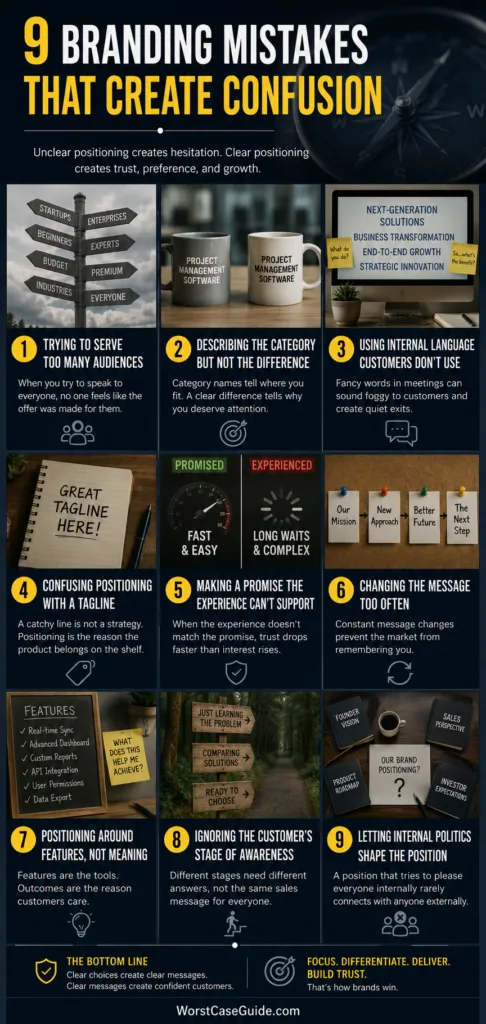
9 Brand Positioning Mistakes That Confuse Customers
The mistakes below are not isolated copywriting problems. They are decision problems. Each one can make the brand harder to understand, harder to trust, and harder to choose.
Mistake 1: Trying To Serve Too Many Audiences At Once
A brand often becomes unclear when it tries to speak to startups, enterprises, beginners, experts, budget buyers, premium buyers, and every industry at the same time. The offer may technically work for many groups, but positioning needs a clear center of gravity.
Why It Happens
- The business does not want to exclude potential customers.
- Early sales came from mixed customer types.
- Leadership confuses market size with message clarity.
- Different teams push for different segments.
Early Warning Signs
- The homepage uses broad phrases like “for every business.”
- Case studies point to very different customer types with no clear pattern.
- Sales teams keep asking which leads are actually a good fit.
- Content topics feel scattered across unrelated pain points.
Worst-Case Result
The brand becomes easy to ignore because no one feels directly seen. Good-fit customers may assume the product is too basic, too advanced, too expensive, too small, or simply not made for them.
Safer Approach
A safer position usually starts with the best-fit customer, not the widest possible customer. The brand can still serve secondary audiences, but the primary message should make one main group feel immediate relevance.
Practical Check: If a customer reads the first screen of the website, they should be able to tell whether the offer is meant for someone like them. Not perfectly. Just clearly enough to keep reading.
Mistake 2: Describing The Category But Not The Difference
Many brands explain what category they belong to but fail to show how they are different inside that category. “Project management software,” “branding agency,” “online course platform,” or “automation tool” tells the customer where to place the offer. It does not explain why the brand deserves a second look.
Why It Happens
- The team relies on industry labels instead of a distinct point of view.
- Competitor research turns into imitation.
- The brand avoids making a sharper claim because sharper claims feel risky.
- The difference exists in delivery, but not in the message.
Early Warning Signs
- The brand could swap homepage text with a competitor and still sound normal.
- Sales calls depend heavily on demos because the positioning does not carry enough weight.
- The phrase “we are different because we care” appears in internal discussions.
- Customers describe the brand by category, not by value.
Worst-Case Result
The brand becomes interchangeable. When customers cannot see the difference, they often compare based on price, convenience, popularity, or whoever appears first in search.
Safer Approach
A clearer position connects three things: customer situation, specific problem, and credible difference. For example, a brand may be faster, simpler, more specialized, more hands-on, more privacy-focused, or better suited for a narrow workflow. The difference should be real enough to survive a sales call.
Mistake 3: Using Internal Language Customers Do Not Use
Teams often build positioning around words that feel smart in meetings but feel foggy to customers. Phrases like “next-generation solutions,” “business transformation,” “end-to-end growth,” or “strategic innovation” may sound polished, yet they often fail to reduce uncertainty.
Why It Happens
- Internal teams want language that feels impressive.
- Technical teams describe the product from their own side of the table.
- The brand tries to sound larger or more mature than it is.
- Customer research is replaced with brainstorming.
Early Warning Signs
- Customers ask, “So what do you actually do?”
- The brand message needs a salesperson to translate it.
- Website copy uses abstract nouns more than concrete outcomes.
- Team members define the same phrase in different ways.
Worst-Case Result
Customers may not object. They may simply leave. Confusing language rarely creates a dramatic failure; it creates quiet exits.
Safer Approach
A safer positioning message uses the customer’s own problem language. If buyers say “we lose track of approvals,” the brand should be careful about replacing that with “workflow orchestration excellence.” Clear language does not make a brand look small. It makes the decision easier.
Mistake 4: Confusing Positioning With A Tagline Or Slogan
A tagline can express positioning, but it is not positioning by itself. A slogan is the label on the box. Positioning is the reason the box belongs on that shelf in the first place.
Why It Happens
- Teams want a visible output quickly.
- Brand work gets treated as a copywriting task.
- The business has not agreed on audience, category, promise, or proof.
- A catchy phrase gets approved before the strategy behind it is tested.
Early Warning Signs
- The tagline sounds good but cannot guide product, sales, or content choices.
- Different campaigns reinterpret the slogan in conflicting ways.
- The brand has a polished phrase but no clear reason to believe it.
- Customer-facing teams rarely use the tagline in real conversations.
Worst-Case Result
The brand looks finished from the outside but remains unclear underneath. Campaigns keep changing because the root decision was never made.
Safer Approach
A more stable approach defines the position before polishing the line. The team may first clarify:
- Who is this mainly for?
- What situation are they in?
- What category are we asking them to place us in?
- What do we help them do better, faster, safer, or with less friction?
- What proof makes that believable?
Once those answers are steady, slogans become easier to judge.
Mistake 5: Making A Promise The Customer Experience Cannot Support
Positioning becomes risky when the brand promise is sharper than the actual delivery. A company may promise simplicity, speed, expert support, premium quality, or personal service, but the customer journey tells another story.
Why It Happens
- The brand wants to own an attractive market position.
- Marketing language is created away from operations.
- Product limitations are softened in public copy.
- Support, onboarding, and delivery teams are not included early enough.
Early Warning Signs
- Customers mention a gap between the website promise and actual experience.
- Support tickets repeat the same expectation problems.
- Sales teams add verbal disclaimers after the main pitch.
- Reviews praise the product but question the promise.
Worst-Case Result
The brand may create short-term interest and long-term disappointment. That is a hard kind of confusion to repair because the customer feels misled, even if no one intended to mislead them.
Safer Approach
A safer position is ambitious but grounded. If the product is powerful but needs setup, the brand should not position itself as effortless. If the service is high-touch but slower, speed should not be the main promise. Trust improves when the message matches the experience.
Mistake 6: Changing The Message Too Often
Some brands refresh their positioning before customers have had time to remember the last version. A new homepage angle, a new tagline, a new audience, a new campaign theme, then another. Internally, this may feel like iteration. Externally, it can feel unstable.
Why It Happens
- Early results are judged too quickly.
- Leadership changes direction after every new competitor move.
- Marketing experiments are mistaken for brand decisions.
- The team does not separate campaign testing from core positioning.
Early Warning Signs
- The website, ads, sales deck, and social profiles describe the brand differently.
- Old customers use a previous description that the company no longer uses.
- New employees struggle to explain the brand in one clear way.
- Every quarter brings a new “main message.”
Worst-Case Result
The market never gets a stable memory of the brand. Recognition weakens, and the company keeps spending effort to reintroduce itself.
Safer Approach
Positioning can evolve, but the core should not swing with every campaign. A useful distinction is simple: campaigns can change faster than positioning. The brand can test offers, headlines, and proof points while keeping the main audience, category, and value promise stable enough to build recall.
Mistake 7: Positioning Around Features Instead Of Customer Meaning
Features matter. They are often the reason a product works. Yet customers rarely remember a brand only as a pile of features. They remember the job it helps them finish, the risk it lowers, the time it saves, or the identity it supports.
Why It Happens
- Product teams are proud of what they built.
- Competitor pages encourage feature-by-feature comparison.
- Technical proof feels safer than emotional or practical meaning.
- The team has not mapped features to real customer outcomes.
Early Warning Signs
- The homepage lists capabilities before explaining the problem.
- Customers need help connecting features to their own situation.
- Sales conversations become long product tours.
- The brand sounds useful but not memorable.
Worst-Case Result
The brand may be seen as capable but not necessary. Customers can understand the parts and still miss the reason to choose the whole.
Safer Approach
A clearer message links features to outcomes. Instead of only saying what the system includes, the brand can explain what it helps customers avoid, improve, simplify, or decide. The feature is the tool; the customer meaning is the reason the tool matters.
Mistake 8: Ignoring The Customer’s Stage Of Awareness
A brand can confuse customers by speaking as if every visitor is equally ready to buy. Some people know the category well. Some are only realizing they have a problem. Others are comparing vendors, checking risk, or trying to justify the purchase internally.
Why It Happens
- The website is built around what the company wants to say.
- Content is planned around keywords but not decision stages.
- Sales and marketing do not share enough customer questions.
- The brand assumes awareness that many visitors do not yet have.
Early Warning Signs
- Top-of-funnel content jumps too quickly into product claims.
- Comparison pages repeat generic benefits instead of answering real objections.
- Visitors download resources but do not move forward.
- Sales calls reveal basic misunderstandings that the website could have handled.
Worst-Case Result
The brand may attract attention but lose people during the decision journey. Early-stage customers feel rushed. Late-stage customers feel under-informed.
Safer Approach
A safer positioning system meets different awareness levels without changing the core message. In smaller projects, this may mean adding clearer homepage sections and comparison content. In larger systems, it may mean separate messaging for problem-aware, solution-aware, and vendor-aware buyers.
Mistake 9: Letting Internal Politics Shape The Position
Brand positioning can drift when the final message reflects the loudest internal voice instead of the clearest market choice. A founder, executive, sales lead, investor, agency, or product team may each pull the brand toward their own preferred story.
Why It Happens
- No shared decision criteria exist.
- Customer evidence is weaker than internal opinion.
- The brand is trying to satisfy every department.
- Disagreement is hidden behind polished wording.
Early Warning Signs
- The approved positioning includes a little bit of everyone’s idea.
- Words are chosen because they are politically safe, not because they are clear.
- Teams quietly keep using their own version of the message.
- Customer interviews are treated as optional rather than grounding evidence.
Worst-Case Result
The brand position becomes a compromise document. It may be acceptable to the room, but weak in the market.
Safer Approach
A healthier process uses customer evidence, competitor mapping, sales feedback, support patterns, and product reality to guide the choice. Internal judgment still matters, but it should be tested against what customers actually understand and value.
Careful Point: A brand position does not need to please every internal stakeholder equally. It needs to help the right customer make sense of the brand faster.
How These Mistakes Usually Connect
Positioning problems often appear as separate issues, but they tend to share a pattern. The brand has not made enough clear choices.
Pattern 1: The Brand Avoids Trade-Offs
Clear positioning usually requires saying who the brand is mainly for, what it is not trying to be, and which value it wants to be remembered for. Avoiding those trade-offs may feel safer, but it often creates a softer, blurrier message.
Pattern 2: The Message Is Built From The Inside Out
Internal teams know too much. They remember product history, business goals, feature debates, and past customer conversations. New visitors do not. A message that feels obvious inside the company can feel incomplete outside it.
Pattern 3: Proof Comes Too Late
Some brands make a claim first and support it much later, if at all. Customers may not wait. If the positioning depends on trust, proof should appear close to the promise: examples, use cases, process clarity, product evidence, customer fit, or plain explanation.
Pattern 4: The Brand Confuses Clarity With Simplicity
Clarity does not always mean fewer words. Sometimes customers need a sharper explanation, a better comparison, or a more honest boundary. Short copy can still be vague. Longer copy can be clear when every sentence lowers uncertainty.
A Safer Way To Review Brand Positioning
A practical review does not need to turn into a full rebrand. It can begin with a few grounded checks across the customer journey.
Check The First Impression
- Can a new visitor identify the category within a few seconds?
- Can they tell who the brand is mainly for?
- Can they see the main difference without reading every page?
- Does the first promise match what the product or service can actually deliver?
Check The Internal Explanation
- Do sales, support, marketing, and product teams describe the brand in the same basic way?
- Do they agree on best-fit and poor-fit customers?
- Do they use the same proof points?
- Do they know which competitor comparisons matter most?
Check The Customer’s Decision Path
- Does the content answer early-stage questions without pushing too hard?
- Does it help comparison-stage buyers understand trade-offs?
- Does it reduce common objections before sales conversations?
- Does it make the next step feel logical, not forced?
| Positioning Risk | Question To Review | Safer Signal |
|---|---|---|
| Audience too broad | Who should feel this was made for them first? | The primary customer is named clearly. |
| Weak difference | What would a buyer remember after comparing us? | The brand owns a specific, believable distinction. |
| Abstract language | Would customers use these words themselves? | The message mirrors real buyer language. |
| Unsupported promise | Where do we prove this claim? | Proof appears near the promise. |
| Message inconsistency | Do all channels repeat the same core idea? | Campaigns vary, but the position stays recognizable. |
When A Brand Should Be More Careful Before Repositioning
Repositioning can help when the current message no longer fits the market, product, or customer base. It can also create confusion if it is rushed. The risk is higher when customers already have a strong memory of the brand.
If The Brand Has Existing Customers
Current customers may need continuity. A sharp change in positioning can make them wonder whether the product is still meant for them. In this situation, a safer approach may explain the shift through clearer focus rather than sudden reinvention.
If The Brand Sells Through Sales Teams
Sales teams need time to absorb new positioning. If they do not understand the reason behind the change, they may keep using old language. That creates a split message: marketing says one thing, sales says another.
If The Brand Has Multiple Product Lines
Positioning becomes harder when one brand covers several offers. A parent brand may need a broader idea, while each product line may need a narrower message. Without that separation, every page tries to carry too much weight.
Simple Warning Signs Customers Are Confused
Customer confusion is not always stated directly. It often appears through behavior, questions, and hesitation.
- People ask for explanations that should already be clear.
- Leads compare the brand to the wrong type of competitor.
- Customers choose a lower-tier offer because they do not understand the higher-value one.
- Website visitors read several pages but do not move forward.
- Reviews praise the company but describe it in inconsistent ways.
- Referral partners struggle to explain who the brand is right for.
- Support teams hear “I thought this included…” too often.
These signals are useful because they point to specific repair areas. The issue may be audience clarity, category framing, proof, promise, pricing context, onboarding, or plain wording.
FAQ
What Is A Brand Positioning Mistake?
A brand positioning mistake is a choice that makes it harder for customers to understand who the brand serves, what it offers, how it is different, or why it should be trusted. It can appear in messaging, website copy, sales language, product framing, pricing context, or customer experience.
Why Do Customers Get Confused By Brand Positioning?
Customers get confused when the brand sends mixed signals. This can happen when the audience is too broad, the language is too abstract, the category is unclear, the promise is unsupported, or different channels describe the brand in different ways.
Is Brand Positioning The Same As A Tagline?
No. A tagline can express part of the brand position, but it is not the full position. Brand positioning defines the audience, category, difference, value promise, proof, and customer perception the brand wants to build.
How Can A Small Business Check If Its Positioning Is Clear?
A small business can review whether a new visitor can quickly understand what the business does, who it helps, why it is different, and what problem it solves. Customer calls, website behavior, sales objections, and repeated questions can also show where the message is unclear.
Can A Brand Serve Multiple Audiences Without Confusing Customers?
Yes, but the brand usually needs a clear primary audience and separate pathways for secondary audiences. If every audience receives the same broad message, the brand may feel vague. If each audience has tailored context while the core position stays stable, the message is easier to follow.
When Should A Brand Update Its Positioning?
A brand may need to update its positioning when the market changes, the product changes, customer fit becomes clearer, competitors shift, or the current message no longer matches the real value delivered. The change should be handled carefully so existing customers do not feel lost.
What Is The Worst-Case Result Of Confusing Brand Positioning?
The worst-case result is not always public failure. More often, the brand becomes forgettable, attracts poor-fit leads, loses pricing confidence, wastes marketing effort, and forces sales teams to repair confusion that could have been prevented earlier.