Inventory in a small retail store can look healthy while quietly creating cash-flow pressure, missed sales and unreliable stock records. A shelf may be full of products that barely move, while a popular item disappears before the next supplier delivery. The risk rarely comes from one dramatic decision. It develops through small, repeated inventory mistakes that make purchasing decisions less accurate over time.
Small retailers are especially exposed because inventory, working capital, shelf space and staff time are tightly connected. There may be little room for an oversized purchase order, an unrecorded delivery or a seasonal forecast based on the wrong sales period. Once the records drift from the physical stock, even sensible decisions can produce unexpected results.
Why Inventory Errors Spread So Easily
Retail inventory changes whenever an item is received, sold, returned, transferred, damaged, reserved or removed from sale. If only some of those events reach the inventory system, the recorded quantity becomes a partial version of reality. Reorder alerts, availability messages and purchasing reports then inherit the same error.
This creates a difficult question: is a low sales figure caused by weak demand, or was the product unavailable when customers wanted it? Without accurate records, the store may stop ordering an item that could have sold well. It may also keep buying a slow product because several units are missing, misplaced or incorrectly recorded.
Inventory risk is not limited to stockouts. It also includes excess stock, dead stock, expiry, shrinkage, duplicated purchases, margin erosion, unavailable cash and customer promises based on inventory that cannot be found.
Common Assumptions That Distort Stock Decisions
- “The system quantity must be correct.” A system records transactions; it does not confirm what is physically present.
- “More stock means better availability.” Extra units help only when they are the products customers actually buy.
- “Last month predicts next month.” Promotions, weather, holidays, local events and social-media attention can alter demand.
- “The supplier always delivers on time.” Promised lead time and actual lead time may differ.
- “Annual stocktaking will catch everything.” It finds discrepancies after many purchasing decisions have already used the wrong data.
- “Every SKU deserves the same attention.” A fast-moving, high-margin product carries a different risk from a low-value accessory sold twice a year.
- “Inventory software will fix the process.” Software cannot correct deliveries, returns or damages that staff never record.
Mistake 1: Treating Recorded Stock as Physical Stock
Why It Happens
Point-of-sale and inventory systems appear precise, so recorded quantities can gain more trust than they deserve. Yet a missed scan, incorrect return, damaged item or receiving error can create phantom inventory: stock that exists in the software but not on the shelf.
Early Warning Signs
- Staff regularly search for products that the system shows as available.
- Online orders are cancelled after picking begins.
- Negative stock quantities appear after sales.
- The same SKU produces repeated count adjustments.
Worst-Case Result
The system may prevent replenishment because it believes enough units remain. The product reaches zero physically, sales stop and the absence can continue unnoticed. For a dependable bestseller, that can mean repeated lost sales rather than a single missed transaction.
A Safer Approach
Recorded stock can be treated as an estimate that requires periodic confirmation. Cycle counts allow selected products to be checked throughout the year, with more frequent counts for fast-moving, high-value or discrepancy-prone items.
Mistake 2: Recording Deliveries Late or Incompletely
Why It Happens
Deliveries often arrive during busy periods. Cartons may go directly to the sales floor before quantities, variants and purchase-order details are checked. A packing slip is then mistaken for proof that every ordered unit arrived correctly.
Early Warning Signs
- Unopened cartons remain in receiving areas without a recorded status.
- Supplier invoices and received quantities frequently disagree.
- New stock is available on shelves but absent from the system.
- Incorrect sizes, colors or models appear under another SKU.
Worst-Case Result
The retailer may pay for shortages or wrong items without noticing the discrepancy within the supplier’s reporting window. The same delay can cause duplicate orders because newly arrived stock appears not to exist.
A Safer Approach
A consistent receiving step can compare the purchase order, delivered goods and supplier document before products become available for sale. If a full check is not possible immediately, the shipment can remain marked as received but not verified rather than silently entering the store.
Mistake 3: Using One Reorder Rule for Every Product
Why It Happens
A single minimum quantity is easy to remember, but products have different sales rates, margins, lead times and substitution options. Reordering every SKU when two units remain ignores how quickly those two units may sell and how long replacement stock takes to arrive.
Early Warning Signs
- Popular items repeatedly run out between deliveries.
- Slow products are reordered automatically despite weak sales.
- Staff place frequent emergency orders.
- Minimum stock settings have not changed since the products were created.
Worst-Case Result
The store can experience stockouts and overstock at the same time. Cash remains trapped in slow inventory while products that could release that cash through sales are unavailable.
A Safer Approach
A basic reorder point can reflect average demand during supplier lead time plus a measured safety allowance:
Reorder point = average daily unit sales × expected lead-time days + safety stock
This calculation can be adjusted by SKU rather than applied as a store-wide rule. In a very small shop, a few product groups may be enough. In a larger catalog, individual settings are usually more dependable.
Mistake 4: Forecasting from Averages Alone
Why It Happens
Average sales are simple to calculate, but they can hide seasonal peaks, weekday patterns, promotions and sudden changes in customer interest. A product that averages five sales per week may sell one unit for several weeks and then twenty during a local event.
Early Warning Signs
- Forecasts repeatedly fail around holidays or seasonal changes.
- A promotional week is used as normal demand.
- Recent sales are compared without checking stock availability.
- Purchasing relies mainly on what staff remember selling last year.
Worst-Case Result
A short burst of demand, perhaps triggered by a viral video or local trend, can be mistaken for a permanent shift. The store then places a large order just as interest fades, leaving trend-sensitive stock that requires markdowns.
A Safer Approach
Forecasts can separate ordinary sales, promotions, stockout periods and seasonal events. Comparing the same period across more than one year may help where history exists, while shorter-order cycles can limit exposure when demand is unstable.
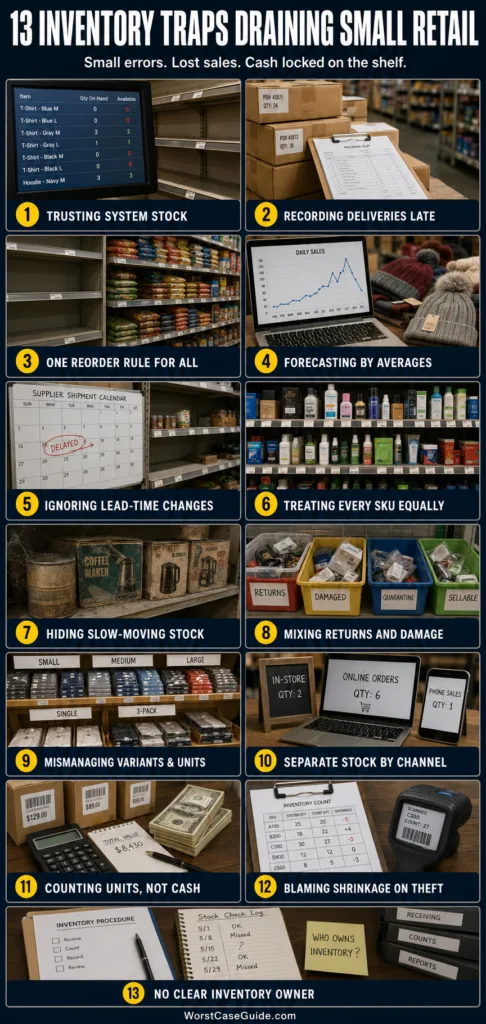
Mistake 5: Ignoring Actual Supplier Lead-Time Variation
Why It Happens
Retailers often store one promised lead time for each supplier. Real deliveries may vary because of dispatch schedules, minimum-order thresholds, transport delays or partial fulfillment. An average can also hide the occasional long delay that creates the greatest exposure.
Early Warning Signs
- Purchase orders arrive later than their expected dates.
- Suppliers frequently split one order into several deliveries.
- Safety stock is consumed before replenishment arrives.
- Reordering depends on the supplier’s quoted time rather than delivery history.
Worst-Case Result
A delayed order may create a prolonged stockout across several related products. If customers normally buy those items together, the store can lose the whole basket, not only the unavailable item.
A Safer Approach
Lead time can be measured from purchase-order approval to usable stock availability. Tracking the typical result and the slower end of recent deliveries gives a clearer basis for safety stock, especially for products without easy substitutes.
Mistake 6: Giving Every SKU Equal Attention
Why It Happens
Equal treatment appears orderly, but inventory risk is uneven. A small group of products may generate much of the sales value or margin, while many other SKUs move slowly. Counting and reviewing all items on the same schedule can spend staff time where errors matter less.
Early Warning Signs
- Bestsellers and rarely sold products share the same count schedule.
- Staff cannot identify the products that produce most gross margin.
- High-value items have no added review controls.
- Low-value discrepancies consume disproportionate investigation time.
Worst-Case Result
Critical products may remain inaccurate or unavailable while staff spend hours checking low-impact stock. The business is busy, yet the largest inventory risks remain untreated.
A Safer Approach
An ABC-style classification can group products by sales value, margin contribution, movement or business importance. “A” items may receive frequent review, while stable “C” items can be checked less often. Classification still needs judgment; a low-sales spare part may matter greatly if its absence blocks another sale.
| Product Group | Typical Characteristics | Possible Review Pattern | Main Risk |
|---|---|---|---|
| A Items | Fast-moving, high-value or high-margin | Frequent cycle counts and close reorder review | Lost sales or costly discrepancies |
| B Items | Moderate movement and value | Regular scheduled review | Gradual overstock or unnoticed shortages |
| C Items | Low movement or low unit value | Less frequent review, with exception alerts | Administrative effort exceeding product value |
| Exception Items | Perishable, regulated, theft-prone or operationally important | Controls based on the specific exposure | Expiry, shrinkage or blocked sales |
Mistake 7: Letting Slow-Moving Stock Disappear into the Shelves
Why It Happens
Unsold products do not create an obvious daily incident. They remain clean, countable and technically available, so they can look less urgent than an empty shelf. Yet every unit occupies cash and selling space.
Early Warning Signs
- Products have no recent sale date or stock-age report.
- The same items appear in repeated markdown events.
- New versions arrive before older versions sell.
- Purchase orders continue because a default reorder setting remains active.
Worst-Case Result
Slow stock can become dead stock through expiry, damage, fashion changes, packaging updates or model replacement. Margin may then disappear through clearance discounts, disposal or write-offs, while the original cash is unavailable for faster products.
A Safer Approach
Stock age and days since last sale can be reviewed alongside quantity. Possible responses depend on the product: pausing replenishment, returning eligible goods, adjusting placement, bundling without hiding the discount or planning a measured markdown before demand falls further.
Mistake 8: Recording Returns, Damages and Write-Offs as One Event
Why It Happens
A customer return does not always become sellable inventory. It may be unopened, damaged, incomplete, defective or awaiting inspection. Adding every return directly to available stock makes quantity rise without confirming the item’s saleable condition.
Early Warning Signs
- Returned goods collect behind the counter without a status.
- Damaged products remain included in available quantity.
- Write-offs use vague reasons such as “adjustment.”
- The same product has an unusual return or damage rate.
Worst-Case Result
Unsellable items may be promised to customers or counted toward the reorder point. Repeated defects can also remain hidden because returns, damages and losses are merged into one general adjustment category.
A Safer Approach
Inventory status can distinguish available, reserved, quarantined, damaged, returned and written off. Reason codes make patterns visible and help separate product-quality problems from handling errors or record mistakes.
Mistake 9: Failing to Track Variants, Bundles and Units Correctly
Why It Happens
Retail catalogs often contain products that look similar but are not interchangeable: sizes, colors, pack quantities, individual units and multipacks. Bundles add another layer because one sale may consume several component SKUs.
Early Warning Signs
- Several variants share one barcode or generic SKU.
- Cases are received but sales occur by individual unit.
- Bundle sales do not reduce component quantities.
- One color or size is overstocked while another repeatedly sells out.
Worst-Case Result
Total product quantity may appear sufficient even though the desired variant is unavailable. Incorrect unit conversion can multiply the error: a carton recorded as one unit rather than twelve can distort stock, cost and reorder calculations at once.
A Safer Approach
Each saleable variant can have a distinct SKU and barcode. Purchase units and selling units need a documented conversion, while bundles can deduct their components when sold rather than behaving like unrelated stock.
Mistake 10: Allowing Sales Channels to Maintain Separate Stock Truths
Why It Happens
A physical shop, online store, marketplace and social-selling channel may each maintain its own quantity. Manual updates can appear manageable at low volume, but timing differences become dangerous when several customers attempt to buy the last units.
Early Warning Signs
- Staff reduce online quantities at the end of the day.
- Orders are cancelled because another channel sold the same unit.
- Products remain unavailable online despite sitting in the store.
- Reserved and available quantities are not separated.
Worst-Case Result
The retailer may oversell scarce stock, issue refunds and disappoint several customers from one inventory discrepancy. At the opposite extreme, excessive channel buffers can hide saleable stock and reduce revenue unnecessarily.
A Safer Approach
A shared inventory record can update all connected channels when a sale, reservation, cancellation or return occurs. Where full integration is not practical, conservative channel allocations and frequent reconciliation may reduce the gap.
Mistake 11: Measuring Quantity Without Measuring Inventory Economics
Why It Happens
Unit counts are visible and easy to discuss. They do not show how much cash is held, how quickly products turn, what margin they produce or what it costs to store and discount them. A shelf with fifty units may be healthy for one SKU and excessive for another.
Early Warning Signs
- Purchasing reports show units but not inventory value.
- Gross margin and sell-through are absent from product reviews.
- High-revenue products are assumed to be high-profit products.
- Markdowns, freight and handling costs are excluded from performance checks.
Worst-Case Result
The store can appear busy while margin and available cash weaken. Sales volume may be supported by repeated discounting, and new inventory may then be funded while older purchases still sit unsold.
A Safer Approach
Quantity can be reviewed with inventory value, gross margin, sell-through rate, stock age and inventory turnover. The exact measures may vary by store, but combining operational and financial views makes hidden exposure easier to see.
Mistake 12: Treating Shrinkage as a Theft-Only Problem
Why It Happens
Shrinkage is the difference between recorded inventory and physical inventory. Theft can contribute, but so can receiving mistakes, incorrect scanning, unrecorded damage, supplier shortages, pricing errors and products placed under the wrong SKU.
Early Warning Signs
- Loss prevention is discussed, but transaction errors are not reviewed.
- Adjustments cluster around certain employees, shifts or suppliers.
- Small discrepancies recur in the same product categories.
- No reason is recorded when physical and system counts differ.
Worst-Case Result
The retailer may spend money on the wrong control while the main source of loss continues. Distrust can also grow inside a small team when every discrepancy is interpreted as theft without checking process errors first.
A Safer Approach
Count differences can be classified by likely cause and investigated for patterns. A combination of receiving checks, access controls, clear adjustment reasons, transaction training and targeted counts usually reveals more than one store-wide annual total.
Mistake 13: Leaving Inventory Ownership Undefined
Why It Happens
In small retail, everyone may receive deliveries, move stock and help customers. Shared effort is useful, but shared responsibility can become no clear responsibility when nobody owns count schedules, discrepancy reviews or product-data changes.
Early Warning Signs
- Stock adjustments have no named reviewer.
- Count schedules are skipped during busy weeks.
- Different employees follow different receiving methods.
- Inventory problems are discussed only when an item runs out.
Worst-Case Result
Errors remain unresolved because each person assumes someone else will investigate them. New software may reproduce the same disorder at greater speed, turning inconsistent processes into automated inconsistencies.
A Safer Approach
One person can own inventory accuracy without performing every task. The role may include reviewing exceptions, maintaining count schedules, approving sensitive adjustments and confirming that receiving, returns and transfers follow the agreed process.
How the Mistakes Reinforce One Another
Inventory failures rarely remain isolated. Late receiving produces inaccurate stock. Inaccurate stock weakens reorder points. Weak reorder points create stockouts. Stockout periods then make sales history look like weak demand, which corrupts the next forecast. One error becomes a crooked measuring tape used for every later decision.
| Observed Pattern | Possible Underlying Cause | Risk If It Continues | Useful Check |
|---|---|---|---|
| Frequent emergency orders | Late reorder points or unreliable lead times | Higher freight costs and recurring stockouts | Compare actual sales and delivery histories |
| High stock with low availability | Wrong product mix or variant imbalance | Cash tied up while customers cannot find desired items | Review stock by SKU and variant, not product family alone |
| Repeated negative inventory | Late receiving, wrong SKU use or missing channel updates | Unreliable availability and purchasing data | Trace transactions from receipt through sale |
| Large year-end adjustments | Infrequent counts and unclassified losses | Months of decisions based on inaccurate records | Introduce risk-based cycle counts |
| Heavy markdown dependence | Overbuying, weak forecasting or late slow-stock action | Margin erosion and unavailable working capital | Review sell-through and stock age earlier |
A More Controlled Inventory Rhythm
A smaller retailer does not necessarily need a complicated system. The process needs to capture the events that change stock and turn exceptions into visible work. A practical rhythm may include:
- Daily: review failed orders, negative quantities, unprocessed returns and overdue receipts.
- Weekly: count selected high-risk SKUs and inspect unexpected sales or adjustment patterns.
- Monthly: review slow movers, stock age, supplier delivery performance and product-level margins.
- Seasonally: revise forecasts, reorder settings and safety stock before demand changes.
- After major changes: test integrations when adding a sales channel, warehouse, bundle or new POS process.
A warning sign deserves investigation, not an automatic purchase order. Low recorded stock may mean strong sales, but it may also reflect an unrecorded receipt, wrong unit conversion, misplaced goods or a count error. The safer response depends on the cause.
Questions That Expose Inventory Risk Early
- Which products create the greatest loss when unavailable?
- Which products hold the most cash without selling?
- How often does physical stock disagree with recorded stock?
- Are supplier lead times based on promises or completed deliveries?
- Can every adjustment be traced to a person, date and reason?
- Do returns become available only after their condition is checked?
- Does a sale from one channel reduce availability everywhere else?
- Are stockout periods excluded or marked when demand is analyzed?
- Who reviews unusual inventory activity?
Frequently Asked Questions
What is the most common inventory management mistake in a small retail store?
One of the most common mistakes is assuming that the system quantity matches the physical quantity. Unrecorded deliveries, returns, damages, scanning errors and shrinkage can gradually separate the two.
How often should a small retailer count inventory?
The schedule can reflect product risk. Fast-moving, high-value and discrepancy-prone products may benefit from frequent cycle counts, while stable, low-risk products can be counted less often. A full annual count alone may leave errors active for too long.
What is the difference between safety stock and a reorder point?
Safety stock is an extra quantity held for demand or delivery uncertainty. The reorder point is the inventory level that triggers replenishment and normally includes expected demand during lead time plus safety stock.
Can spreadsheets work for small retail inventory?
They can work for a limited catalog with few transactions and one careful user. Risk rises when several employees or sales channels update separate files, when changes are delayed or when version control becomes unclear.
Why can a store have too much inventory and still experience stockouts?
Total stock may be concentrated in slow products, unwanted variants or excess seasonal goods. Availability depends on having the right SKU, variant and quantity at the right time, not merely a high total unit count.
How can dead stock be identified before it becomes a write-off?
Useful indicators include stock age, days since last sale, sell-through rate, repeated markdowns and continued replenishment despite weak movement. Reviewing these measures early leaves more response options.
Does inventory software prevent stock errors automatically?
No. Software can automate updates and reveal exceptions, but it still depends on accurate receiving, sales, returns, transfers and adjustment data. A weak process can produce precise-looking but unreliable reports.