An exit can become urgent long before a business is ready to transfer. Illness, owner fatigue, a partnership dispute, a buyer inquiry, family needs or a sudden market change may compress years of preparation into a few months. The risk is not merely receiving a lower offer. Weak preparation can expose owner dependence, unreliable records, non-transferable relationships and obligations that remain after closing. An exit strategy creates options before time pressure begins to remove them.
Exit planning is broader than selling. It may involve a third-party sale, management buyout, family succession, gradual ownership transfer, merger, orderly closure or retention of a minority interest. Each route asks different questions about control, timing, transferability and the owner’s future role.
Why Late Exit Planning Creates Added Risk
Owners usually know how to operate their companies. A buyer looks through a different lens. The buyer asks whether earnings can be verified, customers will stay, contracts can transfer and the company can function after the owner leaves. Past effort has emotional value, but buyers usually pay for transferable future performance.
Time affects nearly every weakness. A missing document may be recreated in days, while developing a capable management team may take years. Customer concentration, poor margins and owner-led sales relationships also cannot be repaired convincingly just before due diligence. When a deadline is already visible, cosmetic changes rarely carry the same credibility as a stable operating history.
Common Assumptions That Delay Preparation
- “I am not retiring soon.” Retirement is only one reason for an ownership transition.
- “My children or managers will take over.” Interest, ability, funding and authority still need to be tested.
- “A competitor will buy the company.” Interest does not guarantee acceptable terms or a completed transaction.
- “Revenue proves the value.” Buyers also examine earnings quality, risk, working capital and dependence on specific people.
- “The buyer will understand informal arrangements.” Undocumented agreements often become diligence questions rather than accepted facts.
- “A high offer means a good exit.” Payment timing, conditions, retained risk and post-sale duties can change the real outcome.
| Readiness Area | Typical Time Need | Possible Late-Stage Effect |
|---|---|---|
| Document organization | Weeks to months | Delayed diligence or reduced buyer confidence |
| Financial reporting | Several reporting periods | Disputed earnings and revised offers |
| Owner independence | Often one or more years | Long transition duties or weaker buyer interest |
| Customer diversification | Often multiple sales cycles | Contingent payments or lower valuation |
| Leadership succession | Often several years | Continuity concerns and employee departures |
| Contract transferability | Depends on counterparties | Consent delays or lost commercial relationships |
Mistake 1: Waiting for an Exit Trigger
Why It Happens
Day-to-day problems feel immediate, while an exit may seem distant. Some owners also treat preparation as a signal that they have lost commitment. In practice, exit readiness and operating discipline overlap: cleaner records, delegated authority and stable relationships help the company even when no sale occurs.
Early Warning Signs
- No written exit objectives or target period exists.
- Planning begins only after burnout, illness or an unsolicited offer.
- The owner cannot describe more than one workable exit route.
Worst-Case Result
A forced timetable may leave only unattractive choices: accept weak terms, remain involved longer than expected or close a company that might have been transferable with earlier preparation.
A Safer Approach
A periodically reviewed exit outline can cover preferred timing, possible successors, minimum personal conditions and emergency alternatives. Readiness does not require a fixed sale date. It preserves room to choose.
Mistake 2: Choosing a Route Without Defining the Desired Outcome
Why It Happens
Owners may say they want to “sell” without defining what the exit must achieve. Price, speed, employee continuity, family ownership, retained control and freedom from future duties can pull a transaction in different directions.
Early Warning Signs
- Co-owners have not compared their personal priorities.
- A family transfer is assumed but has not been discussed openly.
- The owner wants immediate freedom while considering terms that require years of continued work.
Worst-Case Result
The company may follow a technically possible route that fails the owner’s actual needs. Conflict can also surface after negotiations have begun, when changing direction becomes expensive and visible.
A Safer Approach
It is useful to separate required outcomes from preferences. If family continuity matters more than speed, succession development may deserve more time. If a clean departure matters most, deal structures involving extended employment or uncertain future payments may need closer examination.
Mistake 3: Allowing the Business to Depend on the Owner
Why It Happens
Founder knowledge often becomes the fastest route through daily decisions. Customers call the owner, employees wait for approval and important procedures remain in one person’s memory. Efficient today can mean fragile tomorrow.
Early Warning Signs
- Sales weaken whenever the owner is absent.
- Only the owner understands pricing, supplier exceptions or major customer histories.
- Employees cannot approve routine matters within defined limits.
- A two-week absence creates a backlog of decisions.
Worst-Case Result
A buyer may conclude that the owner is part of the asset being purchased. The offer may then depend on a long transition, continued employment, a seller note or performance conditions. If the owner cannot remain, the deal may stop.
A Safer Approach
Responsibility can move gradually through documented authority, trained backups and direct relationships between customers and the wider team. In a smaller company, this may involve only two or three capable people. In a larger system, it may require several management layers and measurable decision rights.
Mistake 4: Presenting Financial Records That Require a Story to Understand
Why It Happens
Records may have been prepared mainly for tax filing or cash monitoring rather than a transaction. Personal expenses, one-time costs, inconsistent classifications and unsupported owner adjustments can make reported earnings difficult to verify.
Early Warning Signs
- Management accounts do not reconcile cleanly with filed returns.
- Receivables, payables or inventory records are outdated.
- Proposed earnings adjustments lack invoices or a clear explanation.
- Monthly results change sharply because entries are recorded late.
Worst-Case Result
The buyer may reduce normalized earnings, extend diligence or lose confidence in information outside the accounting records. A price discussed early in the process can be revised after verification.
A Safer Approach
Consistent reporting over several periods gives buyers evidence rather than explanations. A defensible earnings adjustment usually has a business reason, supporting material and consistent treatment. Qualified accounting advice may be appropriate where records, ownership payments or reporting methods are complex.
Mistake 5: Treating Personal Effort as Market Value
Why It Happens
Years of risk, missed holidays and unpaid early work naturally shape an owner’s view of the company. A buyer does not acquire those sacrifices. The buyer assesses cash flow, assets, growth prospects, comparable transactions and the risks attached to future earnings.
Early Warning Signs
- The expected price is based on what the owner “needs.”
- Valuation conversations focus on revenue while ignoring margins and replacement costs.
- Independent estimates are rejected without examining their assumptions.
Worst-Case Result
An unrealistic expectation can waste the period when performance is strongest. Employees and customers may become unsettled during a prolonged sale, while credible buyers move to other opportunities.
A Safer Approach
A valuation range based on more than one accepted method can expose the gap between owner expectations and buyer economics. The assumptions matter as much as the number. They may reveal operational changes worth making before a transaction.
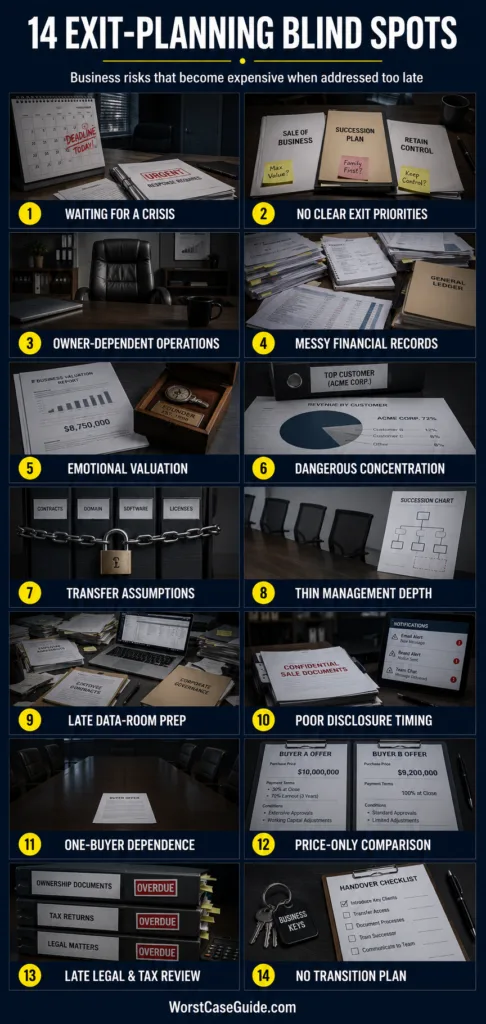
Mistake 6: Ignoring Customer, Supplier and Channel Concentration
Why It Happens
A large customer or dependable supplier can feel like a strength. From a buyer’s perspective, heavy dependence means one external decision could alter the business after closing. The same concern applies to a single online marketplace, distributor, software platform or referral source.
Early Warning Signs
- One relationship supplies a large share of revenue, gross profit or inventory.
- Important relationships are based on habit rather than written terms.
- The owner personally controls the main customer connection.
- No tested alternative exists for an essential supplier or sales channel.
Worst-Case Result
The buyer may lower the offer, require contingent payment or wait for a contract renewal. If the relationship ends during the sale, financing and negotiations may collapse together.
A Safer Approach
Concentration can be measured by revenue, profit, purchases and channel dependence. Diversification takes time, so progress over several periods may be more persuasive than a burst of new accounts just before sale. Where concentration remains, transferable contracts and shared relationships may reduce uncertainty.
Mistake 7: Assuming Contracts, Licenses and Digital Assets Will Transfer
Why It Happens
Operational access is often mistaken for ownership or transferability. Leases, customer agreements, permits, domains, software accounts, intellectual property and vendor arrangements may contain consent, assignment or change-of-control restrictions.
Early Warning Signs
- Business domains or subscriptions are registered to a former employee or personal account.
- Contract assignment clauses have not been reviewed.
- Freelancer or developer agreements do not clearly address ownership of work.
- A permit depends on the current owner, location or legal entity.
Worst-Case Result
A buyer may discover that an asset central to the deal cannot move as expected. Closing can be delayed while third parties consider consent, or the transaction may proceed without part of the value originally assumed.
A Safer Approach
An asset and contract register can record ownership, renewal dates, consent needs and responsible contacts. Legal requirements differ by location and transaction type, so qualified jurisdiction-specific review may be needed before promises are made to a buyer.
Mistake 8: Neglecting Management Depth and Employee Retention
Why It Happens
Owners sometimes protect confidentiality by excluding the people expected to carry the company through transition. Others assume loyal employees will remain regardless of uncertainty, altered reporting lines or a change in culture.
Early Warning Signs
- No second-level leader has managed a full operating cycle.
- Essential knowledge sits with one employee and has no backup.
- Compensation, responsibilities or development paths are unclear.
- Rumours begin before a communication plan exists.
Worst-Case Result
A valued employee may leave during diligence or soon after closing. The departure can weaken customer confidence, interrupt operations and change the buyer’s view of the company.
A Safer Approach
Succession readiness can include backup roles, documented knowledge, leadership exposure and carefully timed retention arrangements. Confidentiality still matters. The practical question is who needs to know what, and when, rather than whether everyone should be told at once.
Mistake 9: Building a Data Room Only After the Buyer Asks
Why It Happens
Due diligence can sound like a late transaction step. Yet its questions reach back through years of financial, commercial, employment, technology and corporate records. Gathering everything after an offer creates pressure at the point when the owner is also running the business and negotiating.
Early Warning Signs
- Signed contracts are scattered across personal inboxes.
- Corporate approvals, ownership records or policy documents have gaps.
- Security incidents, disputes or customer complaints have no central log.
- Different versions of the same document circulate internally.
Worst-Case Result
Slow or inconsistent answers can make an ordinary issue look concealed. The buyer may widen the investigation, postpone closing or seek stronger protections in the purchase agreement.
A Safer Approach
A maintained readiness file can cover financial statements, tax records, contracts, ownership documents, personnel information, insurance, intellectual property, technology controls and material disputes. Access should remain restricted, with confidential or personal information shared only through an appropriate process.
Mistake 10: Sharing the Exit at the Wrong Time
Why It Happens
Early disclosure may unsettle staff, customers and suppliers. Excessive secrecy can produce a different problem: people essential to continuity are surprised too late to prepare. Once rumours appear, silence may be interpreted in ways the owner never intended.
Early Warning Signs
- No stakeholder communication map exists.
- Buyers contact employees or customers without agreed boundaries.
- Confidential files or calendar entries are visible to the wider team.
- Co-owners give inconsistent explanations.
Worst-Case Result
Employees may leave, customers may seek alternatives and competitors may exploit uncertainty. If the deal later fails, the business may still carry the effects of disclosure.
A Safer Approach
A staged communication plan can define audiences, timing, message ownership and likely questions. In sensitive processes, confidentiality agreements and controlled buyer contact may help protect operations while allowing necessary information to move.
Mistake 11: Depending on One Buyer Too Early
Why It Happens
An unsolicited approach feels efficient. The buyer may already understand the industry, and avoiding a wider process appears to save time. Yet one interested party does not establish market value or guarantee closing.
Early Warning Signs
- Detailed information is shared before the buyer’s seriousness is assessed.
- Exclusivity begins before major commercial terms are settled.
- No alternative buyer, successor or hold strategy remains active.
- The owner stops investing in ordinary operations during negotiations.
Worst-Case Result
The buyer may revise terms after gaining exclusivity or withdraw after months of distraction. The owner then returns to market with weaker performance, lost momentum and possible rumours about a failed deal.
A Safer Approach
Different situations call for different processes. A small family transfer may not need broad buyer outreach, while a third-party sale may benefit from credible alternatives. Even when one buyer is preferred, maintaining a workable no-deal option can protect negotiating flexibility.
Mistake 12: Comparing Offers by Headline Price Alone
Why It Happens
The largest number on an offer is easy to compare. The economic and practical result may also depend on cash paid at closing, deferred payments, earn-outs, seller financing, retained equity, working-capital adjustments, escrow, guarantees and post-sale employment.
Early Warning Signs
- A large portion of the price depends on future performance.
- The buyer will control decisions that affect an earn-out measure.
- Working-capital assumptions have not been quantified.
- The owner’s transition duties are described vaguely.
- Liability limits, claims periods or payment security remain open.
Worst-Case Result
An impressive headline value may produce less certainty, less immediate payment and more continuing exposure than a lower but cleaner offer. Disagreement after closing can consume time and delay expected payments.
A Safer Approach
Offers can be compared across payment certainty, timing, conditions, control, transition workload and retained obligations. Transaction documents carry legal and tax consequences that vary by deal and location; suitable legal and accounting review may therefore be appropriate before terms become difficult to change.
Mistake 13: Postponing Ownership, Tax and Legal Review
Why It Happens
Owners may wait for a buyer before examining shareholder agreements, option rights, liens, tax exposure, approvals or estate arrangements. Some changes require advance time, consent or a business purpose; they cannot simply be inserted between an offer and closing.
Early Warning Signs
- The ownership register does not match informal understandings.
- Former partners, family members or employees may claim rights.
- Loans, security interests or personal guarantees are poorly tracked.
- Co-owner approval and transfer provisions have not been tested.
- The expected net result is based only on the sale price.
Worst-Case Result
A consent problem, ownership dispute or unexpected obligation can delay closing and change what the owner receives. Some personal guarantees or continuing duties may survive unless they are specifically addressed.
A Safer Approach
An early review can identify who owns what, who must approve a transfer and which obligations may remain. This is an area where generalized articles cannot replace professional advice tied to the owner’s jurisdiction, entity type and proposed transaction.
Mistake 14: Planning the Transaction but Not the Transition
Why It Happens
Negotiations can absorb so much attention that closing becomes the finish line. Yet the owner, employees, customers and successor still face a period of changed authority, routines and expectations. The personal shift can also be sharper than expected when work has shaped identity and daily structure for decades.
Early Warning Signs
- No written transition schedule defines decisions and handovers.
- The owner and buyer expect different levels of post-sale involvement.
- Customers do not know who will manage their relationships.
- The owner has planned the proceeds but not the next ordinary Monday.
Worst-Case Result
The owner may remain operationally trapped after giving up control, while employees receive conflicting instructions from old and new leadership. Customer service can slip at the exact moment when continuity is being judged.
A Safer Approach
A transition plan may define authority by date, customer introductions, employee communication, knowledge transfer and limits on the former owner’s role. A separate personal plan can address time, purpose and family expectations. Real succession is usually slower and less theatrical than television makes it look.
Risk Patterns That Connect These Mistakes
Transferability Matters More Than Activity
A busy company is not automatically transferable. Buyers look for earnings, relationships, systems and rights that can continue under new ownership. When value is attached mainly to one person, one customer or one informal agreement, the business resembles a bridge supported by a single column.
Evidence Carries More Weight Than Assurance
Owners know their companies through lived experience. Buyers work through records, contracts, interviews and observed results. “This has never been a problem” may be sincere, but documented controls and stable history are easier for another party to rely on.
Price and Certainty Are Different Measures
Two offers with the same stated value may produce very different outcomes. Payment conditions, buyer funding, retained liability and transition duties affect certainty. The same distinction applies outside a sale: a named successor is not yet a succession plan until authority, ability and funding have been tested.
The Business Must Keep Operating During the Exit
Sale preparation can become a second job. If normal performance declines while records are assembled and buyers are entertained, the evidence supporting the deal weakens. Delegation, controlled access and a realistic timetable can reduce this tension.
A Failed Deal Needs Its Own Plan
Not every signed letter of intent reaches closing. Financing can fail, diligence can uncover disagreements and buyer priorities can change. A fallback plan may include continued ownership, another buyer group, management succession or a later sale window. Without one, a failed transaction can turn disappointment into urgency.
A Practical Readiness Test
An owner who stepped away for 30 days would learn a great deal about exit readiness. Could the team price work, serve major customers, access records, approve spending and solve exceptions without constant calls? The weak points revealed by that exercise often deserve attention whether an exit is near or not.
Frequently Asked Questions
How early should a business owner begin exit planning?
There is no universal period. Changes involving leadership, customer mix, financial history or owner independence may require several years, while document organization may take much less time. Planning can begin before the owner selects a sale date.
Is an exit strategy only needed when selling the business?
No. It can also support family succession, a management buyout, gradual transfer, merger, emergency transition or orderly closure. Preparing multiple routes reduces dependence on a single future event.
What makes a business difficult to sell?
Common obstacles include unreliable financial records, heavy owner dependence, concentrated customers, weak management depth, non-transferable contracts and unrealistic valuation expectations. The effect of each issue depends on the company and buyer.
Can an owner sell a business that depends heavily on them?
It may still be possible, but buyers may request a longer transition, deferred payment or conditions tied to retained customers and performance. Reducing owner dependence before marketing the company may widen the available options.
Why can a buyer lower an offer during due diligence?
The buyer may find that earnings, working capital, liabilities, customer stability or transfer rights differ from the assumptions used in the initial offer. Clear records and early internal review can reduce avoidable surprises.
Is the highest offer always the better exit?
No. An offer may include deferred payments, earn-outs, retained equity, seller financing, escrow or lengthy employment duties. Payment certainty, conditions, control and continuing exposure all affect the practical result.
What happens if a planned business sale fails?
The company continues to face employee, customer and operating needs. A fallback route may involve continued ownership, another buyer, management succession or a later sale. Maintaining normal performance during negotiations makes those alternatives easier to preserve.