A crisis does not damage reputation through the triggering event alone. People also judge how the organization responds, whether its statements match observable facts, and whether affected groups receive useful information. A manageable incident can become a lasting trust problem when communication appears slow, evasive, fragmented, or detached from the human impact.
Crisis communication involves more than publishing a statement. It connects incident verification, leadership decisions, employee communication, media relations, customer support, social monitoring, and operational recovery. A weakness in any one of these areas can distort the public message.
The difficult part is balance. Speaking too late leaves an information vacuum. Speaking too early without verification can spread errors. The safer middle ground is an early acknowledgment followed by clearly labeled, evidence-based updates.
Why Crisis Communication Creates Reputation Risk
During normal operations, a minor wording error may pass unnoticed. During a crisis, every statement is compared with screenshots, employee accounts, customer experiences, official findings, and previous promises. Attention is concentrated, while tolerance for ambiguity is low.
Reputation risk rises when the communication response creates a second problem: stakeholders no longer question only what happened; they begin questioning whether the organization can be trusted to explain it.
Common Assumptions That Lead to Poor Decisions
Many communication failures begin with assumptions that feel reasonable inside a pressured meeting. They often look different outside the organization.
| Internal Assumption | How Stakeholders May Interpret It | Safer Interpretation |
|---|---|---|
| Silence prevents escalation | The organization is hiding, confused, or unconcerned | A short acknowledgment can limit speculation without claiming certainty |
| More detail always creates transparency | Unverified or private information is being released carelessly | Useful transparency depends on accuracy, relevance, and timing |
| Legal approval alone makes a message suitable | The statement sounds cold, evasive, or unreadable | Legal review and audience clarity serve different needs |
| One public statement completes the response | The organization has disappeared while the situation continues | Stakeholders may need scheduled updates and a clear closure notice |
| Employees will follow the public announcement | Staff learn about their own organization through external channels | Internal communication usually needs its own sequence and detail |
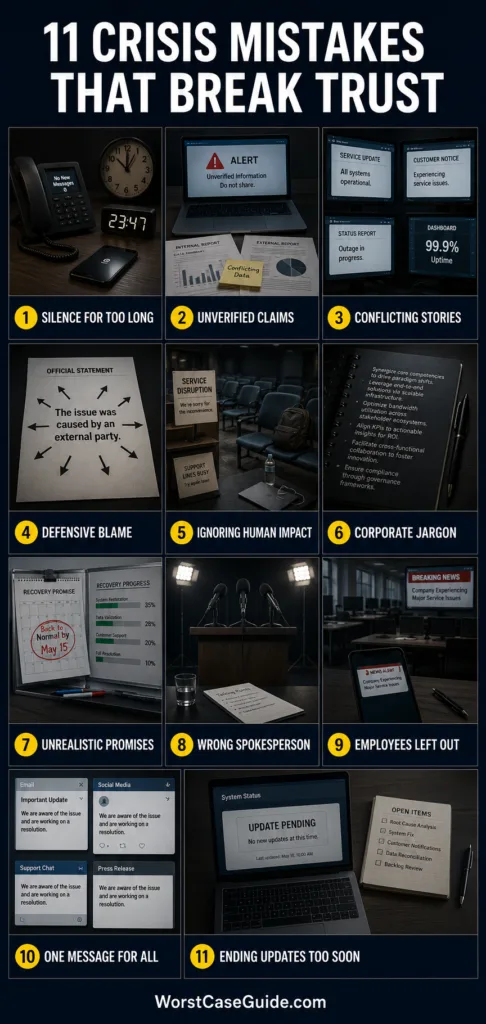
11 Crisis Communication Mistakes That Damage Reputation
Mistake 1: Waiting for Complete Certainty Before Acknowledging the Crisis
Why It Happens
Leaders may fear that an early response will contain errors, create liability, or draw attention to an incident that might fade. Approval chains can also stall while teams debate individual words.
Early Warning Signs
- Customers or employees are asking questions without receiving acknowledgment.
- News reports and social posts are becoming the main source of information.
- A draft statement is circulating through repeated approval rounds while conditions change.
Worst-Case Outcome
The information vacuum is filled by speculation, leaked material, and third-party interpretations. When the official response finally appears, it may be treated as late damage control rather than a useful source.
A Safer Approach
An initial holding statement can acknowledge awareness, identify what is being checked, explain what affected people can do, and state when another update is expected. It does not need to settle every question.
Mistake 2: Publishing Unverified Information to Appear Fast
Why It Happens
Pressure for an immediate answer can turn an early assumption into an official claim. A senior voice may repeat preliminary information before investigators, technical teams, or local managers have confirmed it.
Early Warning Signs
- Words such as “definitely,” “only,” or “fully contained” appear in an early draft.
- The source of a claim cannot be named internally.
- Different teams are reporting conflicting numbers, timelines, or causes.
Worst-Case Outcome
Later corrections make the organization appear unreliable or deceptive, even when the first error was accidental. Screenshots preserve the original claim, so deleting it rarely removes the contradiction.
A Safer Approach
Confirmed facts, working assessments, and unknowns can be separated. Phrases such as “based on information confirmed at this time” show the limits of current knowledge without sounding evasive.
Mistake 3: Allowing Different Teams to Tell Different Stories
Why It Happens
Executives, customer service, regional offices, social teams, and external partners may receive updates at different times. Without a controlled source of approved facts, each group fills gaps independently.
Early Warning Signs
- Customer support scripts conflict with the public statement.
- Regional managers are creating their own explanations.
- Spokespeople use different figures or describe the incident differently.
Worst-Case Outcome
Stakeholders assume that information is being manipulated or that leaders have lost control. Journalists and online communities may focus on the contradictions rather than the original incident.
A Safer Approach
A time-stamped source of approved facts can support every channel. It may include confirmed details, unresolved questions, wording for common inquiries, restricted information, and the next review time.
Mistake 4: Using Defensive Language or Shifting Blame
Why It Happens
Leaders may feel personally accused or believe that accepting any responsibility means accepting every allegation. Attention then moves toward critics, suppliers, former employees, or customers.
Early Warning Signs
- The statement spends more space rebutting criticism than explaining the response.
- Internal conversations focus on “winning” the argument.
- Questions receive combative, sarcastic, or dismissive replies.
Worst-Case Outcome
A dispute that might have remained technical becomes a public test of character. Blame shifting can also damage relationships with employees, contractors, regulators, and business partners whose cooperation is needed for recovery.
A Safer Approach
The response can distinguish between acknowledging impact and confirming a cause that is still under review. Observable actions, verified facts, and stakeholder needs usually carry more weight than defensive explanations.
Mistake 5: Showing No Recognition of the Human Impact
Why It Happens
Operational teams naturally concentrate on systems, costs, schedules, and containment. A statement built only from those inputs can overlook the disruption experienced by customers, employees, families, or local communities.
Early Warning Signs
- The opening paragraph discusses the organization before affected people.
- Technical performance is emphasized while practical consequences are absent.
- An apology uses conditions such as “if anyone was offended or inconvenienced.”
Worst-Case Outcome
Even an accurate response can appear indifferent. Public attention may shift from the incident itself to the organization’s apparent lack of empathy, extending the reputation problem.
A Safer Approach
Recognition can be specific and restrained: who has been affected, what disruption they face, and what support is available. Empathy sounds more credible when it is connected to visible action.
Mistake 6: Hiding Meaning Behind Corporate or Technical Language
Why It Happens
Statements are often assembled from legal, technical, security, and executive drafts. Internal terms survive the editing process because they are familiar to the writers, even though the public may not understand them.
Early Warning Signs
- The message contains undefined acronyms or process language.
- A reader cannot tell what happened after reading the first two paragraphs.
- Simple questions receive long answers without dates, actions, or practical meaning.
Worst-Case Outcome
Dense language is interpreted as concealment. Media summaries and social posts may replace it with shorter explanations that are easier to understand but less accurate.
A Safer Approach
A plain-language review can test whether the message answers four questions: What happened? Who may be affected? What is being done? When will more information arrive? Necessary technical terms can be defined in one sentence.
Mistake 7: Making Promises the Organization Cannot Yet Support
Why It Happens
Absolute reassurance may feel calming in the first hours. Leaders may promise that operations will return by a certain time, no additional people are affected, or the same problem can never happen again.
Early Warning Signs
- Recovery dates have not been confirmed by the teams doing the work.
- The statement guarantees outcomes outside the organization’s control.
- Reassurance is stronger than the available evidence.
Worst-Case Outcome
A missed promise becomes a new headline and a fresh reason for doubt. Repeated deadline changes can make later information less believable, including information that is accurate.
A Safer Approach
Commitments can focus on controllable actions: update frequency, investigation steps, customer contact, or publication of verified findings. Estimated recovery times can be labeled as estimates and revised openly.
Mistake 8: Choosing a Spokesperson by Rank Alone
Why It Happens
The most senior executive may be treated as the automatic public voice. Yet rank does not always bring subject knowledge, interview discipline, calm delivery, or availability for repeated updates.
Early Warning Signs
- The spokesperson has not reviewed likely questions.
- Answers drift beyond confirmed information.
- The speaker becomes irritated when challenged or corrected.
Worst-Case Outcome
An improvised answer can contradict written statements, expose private information, or create an emotionally charged clip that travels farther than the full briefing.
A Safer Approach
The public role can match the situation. A senior leader may address accountability and organizational action, while a trained technical representative explains verified operational details. Both need the same approved facts.
Mistake 9: Letting Employees Learn About the Crisis From Outside Sources
Why It Happens
External publication receives priority because leaders expect immediate media attention. Internal communication is delayed, or a public statement is assumed to contain everything employees need.
Early Warning Signs
- Frontline staff cannot answer basic customer questions.
- Employees are sharing news screenshots in private channels.
- Managers have no instructions for absences, service changes, or media inquiries.
Worst-Case Outcome
Employees feel disregarded and begin relying on rumors. Customers receive inconsistent answers, while internal messages may leak because staff believe the public account is incomplete.
A Safer Approach
Internal audiences may need earlier or more detailed communication than the public, within privacy limits. Useful internal updates cover known facts, operational expectations, escalation contacts, approved responses, and the timing of the next notice.
Mistake 10: Treating Every Channel and Audience the Same
Why It Happens
Publishing one identical statement everywhere is efficient. It can also ignore the fact that customers, employees, suppliers, local residents, journalists, and online followers have different questions.
Early Warning Signs
- A long press statement is pasted unchanged into short social posts.
- Support channels lack practical instructions.
- Questions on review sites or community platforms remain unseen.
Worst-Case Outcome
People cannot find the information relevant to them, so they continue asking publicly or create their own explanations. The organization may appear absent even while publishing frequently.
A Safer Approach
The verified facts can remain consistent while format and detail vary. A status page may hold updates, customer messages may explain service effects, employee notices may cover work procedures, and social posts may direct attention to the latest confirmed information.
Mistake 11: Ending Communication Before Trust Has Started to Recover
Why It Happens
Communication activity often drops once media interest declines or operations resume. Teams return to normal work, leaving promised reviews, corrective actions, and unanswered questions without public closure.
Early Warning Signs
- The last update still says that more information will follow.
- Corrective actions have no owner, date, or reporting method.
- Customer questions continue after the crisis team has disbanded.
Worst-Case Outcome
The unresolved account becomes part of search results, employee memory, and future coverage. During the next incident, old promises return as evidence that the organization did not learn or follow through.
A Safer Approach
A closing phase can explain what has been restored, what remains under review, which changes were completed, and where later findings will appear. Recovery communication may continue at a lower frequency until stated commitments are resolved.
How the Risk Changes With the Situation
Not every issue needs a public campaign. In a small internal disruption, direct communication with the affected group may be enough. In a larger incident involving public safety, personal data, widespread service loss, or strong media interest, the audience and update requirements may expand quickly.
If claims are spreading but the underlying facts remain uncertain, a narrow acknowledgment may carry less risk than a detailed rebuttal. If harm is already confirmed, people usually need practical support information before a lengthy account of the organization’s intentions.
Risk Patterns Behind Repeated Communication Failures
The mistakes above rarely occur alone. They tend to form chains. Slow approval causes silence; silence increases speculation; speculation encourages a rushed response; the rushed response contains an unsupported claim; and the later correction weakens trust. One weak handoff can tilt the whole row.
- Speed without verification: The organization publishes quickly but loses accuracy.
- Verification without acknowledgment: Teams investigate carefully but leave affected people without basic information.
- Consistency without relevance: Every channel repeats the same message, yet no audience receives what it needs.
- Empathy without action: Concern is expressed, but support and corrective work remain unclear.
- Action without visibility: Real recovery work occurs, but stakeholders cannot see evidence of it.
- Closure without follow-through: The crisis is declared over while commitments remain unresolved.
Questions That Can Expose a Weak Response Before Publication
A short review can reveal problems that are difficult to notice during a pressured drafting session.
- Which statements are confirmed facts, and who confirmed them?
- What remains unknown or subject to change?
- Can affected people identify what the incident means for them?
- Does the message recognize human impact before defending the organization?
- Are the spokesperson, support team, and internal managers using the same facts?
- Could any sentence be read as an absolute promise?
- Does each audience know where and when the next update will appear?
- Are public statements supported by actions that stakeholders can observe?
Frequently Asked Questions
What is the most damaging crisis communication mistake?
There is no single mistake in every situation, but prolonged silence often allows several others to develop. Rumors spread, employees improvise answers, and later statements face greater suspicion. A verified acknowledgment can reduce that exposure without pretending that the investigation is complete.
Should an organization respond before all facts are known?
An early response can acknowledge the situation without announcing an unconfirmed cause. It may state what is known, what is being checked, what affected people can expect, and when another update is planned.
Can deleting a mistaken social media post protect reputation?
Deletion alone can create more suspicion because screenshots and archived copies may remain. When an error affects understanding, a visible correction that identifies what changed is usually clearer than silent removal.
How often should crisis updates be published?
The suitable interval depends on the pace and impact of the incident. Updates are more useful when they follow a stated schedule or appear after a material change. Repeating the same message too often can add noise, while disappearing without a next-update time creates uncertainty.
Why is internal communication part of reputation management?
Employees answer customer questions, speak with families and communities, and interpret leadership behavior. When they receive late or conflicting information, external inconsistency becomes more likely and internal trust can also decline.
Does an apology always require accepting fault?
No. An organization can recognize disruption, distress, or inconvenience without confirming a cause that remains under investigation. Any statement about responsibility needs to match verified facts and the circumstances of the incident.
When is a crisis communication response complete?
The response is not necessarily complete when attention fades. Closure may require a final operational update, answers to remaining stakeholder questions, publication of corrective actions, and follow-through on earlier commitments.