A team handoff looks simple from the outside: one group finishes its part, another group continues the work. The risk sits in the gap between those two moments. Small missing details, unclear ownership, stale decisions, hidden assumptions, and scattered context can turn a normal transfer into information loss between teams. The damage is rarely dramatic on day one. It usually shows up later as rework, duplicated questions, delayed delivery, customer confusion, or a new team quietly rebuilding knowledge that already existed somewhere.
That is why handoffs deserve more care than a final meeting, a shared folder, or a short message saying “everything is documented.” A handoff is not only a transfer of files. It is a transfer of context, judgment, decisions, risks, dependencies, and unfinished thinking.
When teams miss that, the work may continue, but it continues with blind spots. Like passing a map with the street names removed, the next team can still move forward, but every turn becomes slower and less certain.
Risk Lens: The safest handoff is not the longest handoff. It is the one where the receiving team can explain the current state, the open risks, the recent decisions, and what would be unsafe to assume.
Why Team Handoffs Are Risky
Information loss between teams often happens because work changes form during transfer. A product team may think in customer problems. An engineering team may think in systems and constraints. A support team may think in user symptoms. Operations may think in timing, ownership, and repeatability.
Each team may be right from its own angle. The handoff fails when those angles are not connected.
Common handoff risk areas include:
- Context loss from meetings that are not captured well.
- Decision loss when the reason behind a choice disappears.
- Ownership gaps when nobody knows who answers follow-up questions.
- Tool fragmentation across email, chat, docs, tickets, dashboards, and spreadsheets.
- Assumption drift when old information is treated as current.
- Tacit knowledge loss when workarounds, warnings, and “do not do this” details stay in people’s heads.
In smaller projects, the damage may be a few days of confusion. In larger systems, the same type of mistake can affect reporting, customer experience, compliance checks, release timing, service quality, or internal trust between teams.
Common Wrong Assumptions About Team Handoffs
Most handoff problems begin before the handoff itself. They begin with assumptions that feel reasonable in a busy workplace.
| Wrong Assumption | What Usually Goes Missing | Safer Reading |
|---|---|---|
| “The document explains everything.” | Decision history, trade-offs, exceptions, and unresolved questions. | Documentation needs a short live review or receiver check. |
| “The meeting covered it.” | People remember different parts, and absent stakeholders may never catch up. | Meetings need durable notes, owners, and open items. |
| “The new team will ask if something is unclear.” | New owners may not know what they do not know yet. | The sender should surface known risks before questions appear. |
| “The ticket status is enough.” | Why the status changed, what was blocked, and what was intentionally skipped. | Status should be paired with context and next action. |
| “Everyone uses the same definition of done.” | Acceptance criteria, quality expectations, review steps, and edge cases. | Done should be defined before the work crosses the boundary. |
These assumptions are not careless by default. They are normal under time pressure. The issue is that they create a soft handoff, where the receiving team gets materials but not enough meaning.
9 Handoff Mistakes That Cause Information Loss Between Teams
Mistake 1: Treating The Handoff As A Final Event Instead Of A Transfer Period
A handoff is often scheduled as one meeting near the end of a project phase. The sending team presents what was done, shares links, answers a few questions, and moves on. That feels efficient. It can also be too thin.
Why It Happens
Teams are usually measured by delivery, not by how well another team can continue the work. Once the sending team feels “finished,” the handoff becomes a closing task rather than a shared transition.
Early Warning Signs
- The handoff meeting is scheduled after the sending team has already moved to new work.
- Questions are handled casually in chat instead of being tracked.
- The receiving team is expected to absorb months of context in one session.
- No follow-up window is agreed.
Worst-Case Result
The receiving team starts with a surface-level understanding and discovers gaps only when work is already moving. This can lead to rework, missed dependencies, avoidable escalations, or a slow restart of decision-making that had already happened.
A Safer Approach
A safer handoff can be treated as a short transfer period with three parts: pre-handoff preparation, receiver review, and post-handoff support. The receiving team should have time to inspect the materials, ask questions, and confirm what they believe they now own.
Useful Check: Before the sending team fully exits, the receiving team should be able to describe the current state in its own words. That replay often reveals missing context fast.
Mistake 2: Passing Documentation Without Passing Decision Context
Many handoffs include files, tickets, diagrams, requirements, timelines, and status notes. Those are useful. They still may not explain why a choice was made, what alternatives were rejected, or which constraint shaped the final path.
Why It Happens
Decision context feels obvious to the people who lived through it. They remember the debate, the trade-off, the customer issue, the technical limitation, or the budget pressure. The next team only sees the result.
Early Warning Signs
- Documents describe what was chosen but not what was rejected.
- Old debates restart after the handoff.
- People ask, “Why did we do it this way?” and nobody has a clean answer.
- Exceptions are hidden inside comment threads or private messages.
Worst-Case Result
The receiving team may reverse a decision without realizing why it existed. In software, this can reintroduce bugs. In operations, it can break a process that was designed around a real constraint. In customer-facing work, it can create inconsistent promises.
A Safer Approach
Each major decision can include a short note: decision made, reason, alternatives considered, known downside, and when to revisit. This does not need to be long. A few clear lines can prevent weeks of repeated discussion.
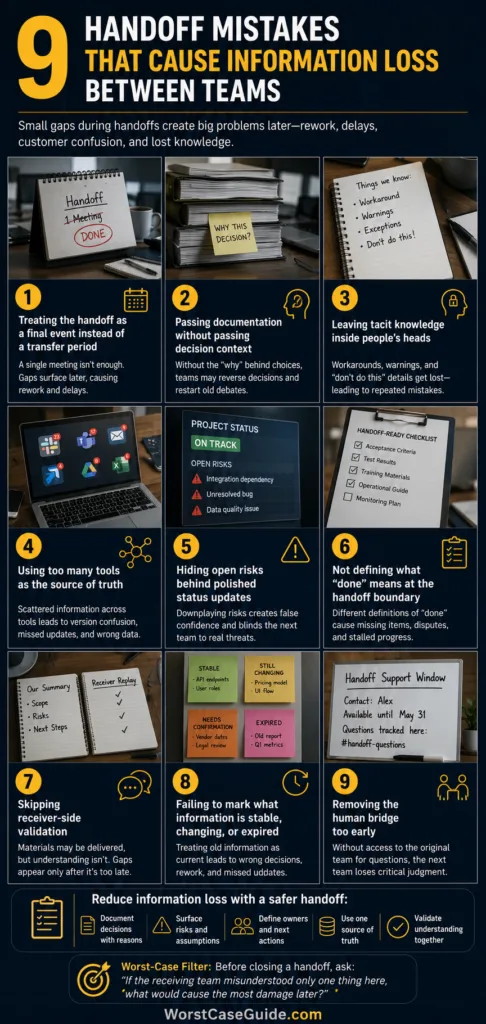
Mistake 3: Leaving Tacit Knowledge Inside People’s Heads
Some of the most useful handoff information is not formal. It may be a workaround, a warning, a customer preference, a fragile dependency, a naming convention, a recurring delay, or a “never change this without checking that first” note.
This is tacit knowledge. It is easy to lose because it does not always look like official project information.
Why It Happens
People often document the formal path and leave out the messy reality. They may think the informal details are too small, too obvious, or too difficult to explain cleanly.
Early Warning Signs
- The sending team says, “You will see what we mean once you start.”
- Only one person knows how certain exceptions are handled.
- Runbooks describe normal cases but not edge cases.
- Workarounds are mentioned verbally but not written anywhere stable.
Worst-Case Result
The receiving team follows the official process and still gets poor results because the real operating knowledge was never transferred. This can cause repeated mistakes, slow onboarding, fragile fixes, or dependence on one unavailable person.
A Safer Approach
A handoff can include a “things we learned the hard way” section. It should capture workarounds, exceptions, known traps, sensitive dependencies, and choices that look odd from the outside but serve a purpose.
Small Detail, Big Effect: Teams often document what to do. They forget to document what not to do. Negative knowledge can be the difference between safe continuation and repeated failure.
Mistake 4: Using Too Many Tools As The Source Of Truth
One team may work in project boards. Another may rely on shared documents. A third may track decisions in chat. A fourth may use email for approvals. None of these tools is wrong by itself. The risk appears when each one contains a different piece of the handoff story.
Why It Happens
Teams choose tools based on their own habits. During active work, that may feel manageable. During handoff, the receiving team has to reconstruct the project across scattered systems.
Early Warning Signs
- People say, “The latest version might be in Slack.”
- Different tools show different statuses.
- Approvals are buried in email threads.
- The receiving team receives a list of links with no order or priority.
Worst-Case Result
The next team works from the wrong version, misses an approval, uses outdated requirements, or trusts a dashboard that no longer reflects reality. The project may not fail immediately. It may simply drift.
A Safer Approach
The handoff should name one source of truth for current status, open risks, decisions, owners, and next actions. Supporting links can still exist, but the receiving team should not need to hunt through five places to know what is current.
Mistake 5: Hiding Open Risks Behind Polished Status Updates
Handoffs often become performance moments. The sending team wants to show that work is under control. That can lead to status updates that sound cleaner than the actual situation.
A clean update is not the same as a safe update.
Why It Happens
Teams may worry that open risks will be judged as poor work. They may soften uncertainty, compress messy details, or avoid mentioning unresolved tension between teams.
Early Warning Signs
- Status says “on track,” but several blockers are still unresolved.
- Known concerns are described as “minor” without explanation.
- The risk register is missing, outdated, or too vague.
- People discuss real concerns privately after the official meeting.
Worst-Case Result
The receiving team inherits a problem without enough warning. Because the risk was softened during handoff, the new team may plan with false confidence and lose time when the issue becomes visible.
A Safer Approach
A safer handoff separates current status from open risk. For each risk, the team can state the trigger, likely effect, owner, current mitigation, and next review point. This keeps the tone calm while still being honest.
Mistake 6: Not Defining What “Done” Means At The Handoff Boundary
One team may believe the work is ready once the file is delivered. Another may expect testing notes, customer scenarios, approval records, monitoring details, training material, or operational instructions. The word “done” can hide a lot.
Why It Happens
Teams often inherit different standards from their own function. Design, engineering, content, operations, sales, support, legal review, and finance may all use different completion signals.
Early Warning Signs
- The receiving team keeps asking for missing items after handoff.
- The sending team says, “That is not part of our scope.”
- Acceptance criteria are written for task completion, not transfer readiness.
- Quality checks happen after the new team has already taken ownership.
Worst-Case Result
The handoff becomes a dispute about responsibility. Work slows while teams renegotiate expectations. In larger systems, this can delay launch readiness, support readiness, reporting accuracy, or operational continuity.
A Safer Approach
Teams can define a handoff-ready checklist before transfer begins. It may include current owner, next owner, final status, known gaps, testing evidence, open questions, related links, decision notes, and confirmation from the receiver.
| Handoff Readiness Item | Information Loss It Helps Prevent |
|---|---|
| Named current owner and next owner | Responsibility gaps and delayed follow-up. |
| Decision notes with reasons | Repeated debates and accidental reversal of past choices. |
| Known risks and triggers | Late discovery of blockers or fragile dependencies. |
| Open questions | False certainty and hidden uncertainty. |
| Latest source of truth | Version confusion and tool-hunting. |
| Receiver acknowledgment | Assumed understanding that was never tested. |
Mistake 7: Skipping Receiver-Side Validation
Many teams judge a handoff by whether the sender delivered the materials. That is only half the transfer. The more useful question is: can the receiving team use the information without reconstructing it?
Why It Happens
Sender-side completion is easier to measure. A document can be shared. A folder can be delivered. A meeting can be marked complete. Receiver understanding is harder to see, so it is often assumed.
Early Warning Signs
- The receiving team is quiet during the handoff but confused afterward.
- Questions arrive in waves over the next few weeks.
- New owners restate the project incorrectly.
- The sender says, “We already explained that.”
Worst-Case Result
The receiving team accepts ownership without real understanding. Later, they make reasonable decisions based on incomplete context. That is the hard part: the mistake may look rational from their side.
A Safer Approach
Receiver-side validation can be simple. The receiving team can replay the scope, open risks, next actions, dependencies, and uncertain areas. The sending team can then correct gaps before the transfer becomes permanent.
If the receiver cannot explain it, the handoff is not finished yet.
Mistake 8: Failing To Mark What Information Is Stable, Changing, Or Expired
Handoff materials often contain a mix of stable facts, active assumptions, old notes, pending approvals, and abandoned ideas. If these are not clearly marked, the receiving team may treat everything as equally current.
Why It Happens
During active work, teams know which details are outdated because they remember the sequence. After handoff, that memory disappears. The document remains, but the timeline behind it is unclear.
Early Warning Signs
- Documents contain old notes without dates.
- Assumptions are written as facts.
- Change logs are missing or hard to follow.
- People disagree about whether a requirement still applies.
Worst-Case Result
The receiving team uses expired information to make current decisions. This can cause mismatched expectations, wrong estimates, repeated approvals, or process steps based on conditions that no longer exist.
A Safer Approach
Handoff notes can label information as stable, still changing, needs confirmation, or expired. This small label gives the next team a cleaner map of what can be trusted now.
Mistake 9: Removing The Human Bridge Too Early
Some teams try to make handoffs fully self-service. The documents are shared, the board is updated, and the original team moves away. That can work for routine, low-risk work. It is less safe when the project has many dependencies, unresolved questions, or hidden history.
Why It Happens
People are busy. Once a handoff is complete on paper, the sending team may be reassigned. Managers may also assume that asking more questions means the documentation was poor, so the receiver stays quiet.
Early Warning Signs
- No named person is available for follow-up questions.
- Former owners redirect questions too quickly.
- The receiving team depends on old meeting recordings instead of live clarification.
- Edge cases are discussed only after something breaks.
Worst-Case Result
The receiving team loses access to the judgment behind the work. They may eventually recover, but recovery takes time and may create avoidable errors. In complex work, a missing human bridge can turn a normal transition into a slow knowledge leak.
A Safer Approach
A short support window can reduce risk. For example, the sending team can name one contact for clarification, agree on a limited follow-up period, and track questions in a shared place so answers become reusable knowledge.
General Risk Patterns Behind Poor Handoffs
The exact handoff mistake may change from one team to another, but the underlying patterns are often similar.
Pattern 1: Information Is Shared, But Meaning Is Not
Files, tickets, and dashboards can show what happened. They do not always show why it happened, what was uncertain, or what would be risky to change. Meaning needs context.
Pattern 2: The Sender Measures Delivery, The Receiver Measures Usability
The sender may feel successful because everything was sent. The receiver may still struggle because the information is hard to apply. This mismatch is one of the quiet causes of information loss between teams.
Pattern 3: Uncertainty Gets Cleaned Up Too Early
Polished handoffs can hide unresolved issues. A safer transfer keeps uncertainty visible. Not dramatic. Just visible.
Pattern 4: Ownership Changes Faster Than Knowledge
A team can assign a new owner in one message. Knowledge moves slower. If ownership changes before context is absorbed, the receiving team may carry responsibility without enough understanding.
A Safer Team Handoff Checklist
This checklist can help teams reduce information loss without making the process heavy. It works best when adapted to the size and risk of the work.
- Current state: What is finished, what is active, and what is paused?
- Next owner: Who owns the work after transfer?
- Decision context: Which choices matter, and why were they made?
- Open risks: What could still go wrong, and what would trigger concern?
- Known dependencies: Which teams, systems, vendors, approvals, or dates matter?
- Unresolved questions: What still needs confirmation?
- Stable versus changing information: Which details are safe to rely on now?
- Negative knowledge: What should the receiving team avoid repeating?
- Source of truth: Where should the team look first for current information?
- Receiver replay: Can the receiving team explain the work back accurately?
- Support window: Who can answer follow-up questions, and for how long?
Worst-Case Filter: Before closing a handoff, it helps to ask one calm question: “If the receiving team misunderstood only one thing here, what would cause the most damage later?” That answer deserves extra clarity.
How Handoff Risk Changes By Team Situation
If The Work Is Small And Routine
The handoff may not need a long process. A short checklist, clear owner, current status, open issues, and one place for follow-up questions may be enough.
If The Work Crosses Several Teams
The risk rises because each group may carry a different version of the story. A shared source of truth, decision notes, and explicit dependencies matter more here.
If The Work Affects Customers Or Operations
Support teams, operations teams, and customer-facing teams need more than project status. They need known failure modes, escalation paths, customer language, timing constraints, and what not to promise.
If The Work Is Technical Or System-Dependent
Technical handoffs often need architecture notes, environment details, access requirements, monitoring expectations, unresolved bugs, deployment steps, rollback notes, and the reason behind design trade-offs.
FAQ
What causes information loss between teams during handoffs?
Information loss usually comes from missing context, unclear ownership, scattered tools, undocumented decisions, hidden assumptions, and weak receiver validation. The handoff may look complete because files were shared, while the receiving team still lacks the meaning behind the work.
What is the biggest mistake in a team handoff?
One of the most damaging mistakes is treating the handoff as a final event instead of a short transfer period. A single meeting rarely gives the receiving team enough time to absorb context, test understanding, and surface missing information.
How can teams prevent context loss during project handoff?
Teams can reduce context loss by documenting decision reasons, open risks, unresolved questions, known dependencies, and what information is stable or still changing. A receiver replay also helps because it shows whether the next team can explain the work accurately.
Why is documentation alone not enough for a handoff?
Documentation may explain the final state but miss the judgment behind it. Trade-offs, rejected options, exceptions, workarounds, and warnings often need a short review conversation or a clear decision log.
What should a handoff checklist include?
A useful handoff checklist includes current state, next owner, source of truth, open risks, decisions and reasons, dependencies, unresolved questions, stable versus changing information, known traps, and receiver acknowledgment.
How do you know if a handoff was successful?
A handoff is more likely to be successful when the receiving team can explain the work in its own words, identify the next actions, name the open risks, locate the current source of truth, and continue without repeatedly reconstructing missing context.