A training program can look polished, well-attended, and well-rated, yet still fail where it matters: people do not use the skill when real work begins. This is the quiet risk behind many learning projects. The class ends, the certificate is issued, the dashboard looks healthy, and then the old habits return on Monday morning. The problem is not always the trainer, the platform, or the learner. Often, the program was never built for skill transfer in the first place.
Skill transfer means a person can take what they learned and apply it in the job environment, with real tools, real pressure, real customers, real deadlines, and real trade-offs. That is a different goal from “finishing training.” It is also harder to fake.
Why does this topic carry risk? Because a failed training program does not always announce itself. It may hide behind attendance rates, quiz scores, happy reaction surveys, and neat slide decks. The cost shows up later: repeated errors, uneven service, weak handoffs, slow onboarding, avoidable rework, and managers wondering why “everyone was trained” but nothing changed.
Safer reading of the risk: training does not fail only because people forget. It often fails because the work system gives them no clear moment, permission, support, or feedback to use the new behavior.
Why Training Programs Become Risky After the Session Ends
The risky part of training is not the event itself. It is the gap between the training room and the job floor.
In smaller projects, this gap may look harmless. A manager asks for a short workshop. The team attends. Everyone agrees the topic was useful. Then daily workload takes over, and the new method is never used again.
In larger systems, the same mistake can spread across departments. A company launches a new process, tool, safety routine, service script, or leadership behavior. People receive the training, but the work environment still rewards the old way. That is where the training becomes a map that does not match the road.
Common Wrong Assumptions That Lead to Poor Skill Transfer
Many failed programs start with assumptions that sound reasonable. They are not foolish assumptions. They are just incomplete.
- “If people understand it, they will do it.” Understanding is not the same as performance under pressure.
- “A good trainer can fix a broken process.” Training cannot repair unclear ownership, poor tools, or conflicting incentives by itself.
- “Completion means readiness.” A completed module may show exposure, not applied skill.
- “One workshop is enough.” New behavior usually needs practice, reminders, feedback, and a safe chance to make small mistakes.
- “The same content works for every role.” Frontline staff, managers, analysts, support teams, and new hires may need different examples and practice conditions.
- “The learner owns the whole transfer problem.” The learner matters, but so do managers, workload, tools, peer norms, measurement, and timing.
| What Looks Good | What May Still Be Missing | Transfer Risk |
|---|---|---|
| High attendance | People may not have time or permission to use the skill afterward. | Training becomes a calendar event, not a work change. |
| Good quiz scores | The quiz may test memory instead of job performance. | Learners know the answer but cannot apply it in context. |
| Positive feedback forms | People may enjoy the session without changing behavior. | Reaction data hides weak application. |
| Detailed slide deck | The content may not match daily tasks, tools, or edge cases. | Workplace reality overrides classroom logic. |
| Fast rollout | Managers may not be prepared to coach or reinforce. | The skill fades before it becomes routine. |
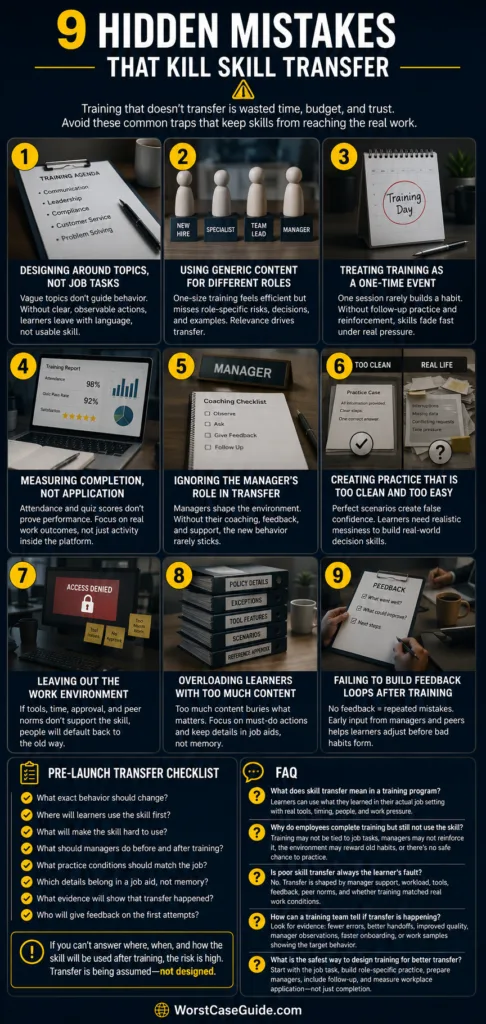
9 Training Program Mistakes That Fail to Transfer Skills
The mistakes below are common because they feel efficient. They save time during design, planning, or rollout. Later, they create a transfer gap that is harder to repair.
Mistake 1: Designing Training Around Topics Instead of Job Tasks
A program may be organized around topics such as “communication,” “leadership,” “compliance,” “customer service,” “project planning,” or “data quality.” These are familiar labels, but they are often too broad to guide behavior.
Why It Happens
Topic-based training is easy to plan. It fits neatly into agendas, slide sections, and course catalogs. It also feels safe because nobody has to define the messy details of the actual job.
The problem starts when the topic is never translated into observable work actions. “Improve communication” may mean giving clearer handoff notes, asking better discovery questions, escalating risks earlier, or confirming client expectations before work begins. Those are different skills.
Early Warning Signs
- Training objectives use vague verbs such as “understand,” “learn,” or “be aware of.”
- Examples are generic and could apply to almost any department.
- No one can describe what learners should do differently on the job next week.
- The course outline follows theory before work situations.
Worst-Case Result
Employees leave with language, not usable skill. They can discuss the concept but still hesitate when the real moment appears. In customer-facing work, this may lead to inconsistent service. In operations, it may lead to repeated handoff errors. In management training, it may create leaders who know the model but avoid the conversation.
Safer Approach
A safer design starts with the job. The program can ask: What exact task should improve? What decision should be made faster? What mistake should become less common? What behavior should a manager be able to observe?
From there, the training can be built around real actions: diagnose, choose, explain, escalate, document, repair, approve, reject, hand off, coach, or follow up. These verbs are closer to work than broad topic labels.
Mistake 2: Using Generic Content for Different Roles and Skill Levels
One-size training often looks efficient. Everyone gets the same message. The rollout is simple. The budget is easier to defend. Yet transfer suffers when learners cannot see where the training fits their own work.
Why It Happens
Organizations often want consistency. That makes sense. But consistency in message does not require identical practice for every role.
A new hire, experienced specialist, team lead, and senior manager may all need the same policy or process, but they do not need the same examples. Their risks are different. Their decisions are different. Their pressure points are different.
Early Warning Signs
- Learners say, “This is useful, but not really for my role.”
- Exercises use fictional scenarios that do not match daily work.
- Beginners feel lost while experienced staff feel bored.
- Managers attend the same session as employees but receive no coaching guidance.
Worst-Case Result
The program creates uneven transfer. A few motivated people adapt the content on their own, while others dismiss it as irrelevant. In larger teams, this can create process drift: everyone was trained, but each group interprets the skill differently.
Safer Approach
The core message can stay shared, while practice becomes role-specific. A customer support team may practice handling a frustrated caller. A project manager may practice risk escalation. A supervisor may practice giving follow-up feedback after observing the behavior.
For mixed groups, the training can use branching activities: “If you approve work, use this scenario. If you perform the task, use this one. If you manage the team, use this coaching prompt.” Small tailoring can make transfer feel much less abstract.
Mistake 3: Treating Training as a One-Time Event
A single training session can introduce a skill. It rarely makes the skill stick by itself.
Why It Happens
Calendars reward events. Budgets reward deliverables. A workshop has a start, an end, and a neat attendance number. Transfer is less tidy. It happens over days and weeks, often through small attempts that do not fit cleanly on a project plan.
There is also a human reason. After a session, everyone wants to move on. The trainer moves to the next course. The manager returns to deadlines. The learner returns to the inbox. The new skill waits for a quiet moment that may never come.
Early Warning Signs
- No follow-up activity is scheduled before the training begins.
- Managers are not told what to reinforce.
- There is no practice plan for the first week after training.
- The program ends with a certificate rather than a workplace action.
Worst-Case Result
The skill decays before it becomes useful. People remember the idea but do not build the habit. In high-volume work, the old process quickly wins because it is familiar, faster, and socially accepted.
Safer Approach
The program can include a transfer window, not just a training date. For example, learners might complete one job-based practice task within three days, receive manager feedback within a week, and revisit a difficult case after two weeks.
Small reinforcement beats a large memory burden. A short checklist, peer review, manager prompt, or job aid can keep the skill alive when the first real test arrives.
Mistake 4: Measuring Completion Instead of Workplace Application
Completion data is useful, but it can become a comfort blanket. It tells whether people passed through the training. It does not prove the skill reached the work.
Why It Happens
Completion, attendance, and satisfaction are easy to collect. Application is harder. It may require observation, manager input, work samples, customer data, error trends, or before-and-after performance checks.
Because application data takes more effort, teams may settle for what the learning platform can report quickly.
Early Warning Signs
- The success report focuses on attendance, pass rates, and star ratings.
- No one tracks whether the target behavior appears in real work.
- The assessment tests recall rather than performance.
- Leaders ask, “Did they take the training?” instead of “Can they now do the task?”
Worst-Case Result
The organization keeps funding training that looks active but changes little. The learning team may be blamed later, even though the measurement system never checked the real outcome. This is how a weak program can survive for years.
Safer Approach
Measurement can move closer to the job. Instead of only asking whether people passed, the program can define a few visible transfer indicators:
- Are fewer corrections needed after the task?
- Are handoffs clearer?
- Are managers observing the target behavior?
- Are customer issues resolved with fewer repeats?
- Are new hires reaching independent performance sooner?
The data does not need to be perfect. It needs to be close enough to show whether the training changed work, not just activity.
Mistake 5: Ignoring the Manager’s Role in Transfer
Managers are often treated as observers of training. In skill transfer, they are usually part of the delivery system.
Why It Happens
Training teams may design the course and invite employees, while managers receive only calendar notices. The manager may not know the behavior being taught, the practice expected afterward, or the feedback language to use.
Sometimes managers unintentionally block transfer. They ask employees to attend training, then pressure them to return to old speed, old shortcuts, and old priorities the next day.
Early Warning Signs
- Managers cannot explain what the training is supposed to change.
- Employees return from training to a backlog with no practice time.
- Managers praise speed while the training asks for careful use of a new method.
- No one has planned coaching conversations after the session.
Worst-Case Result
The workplace quietly rejects the new skill. Learners may even feel punished for using it because it slows them down at first. Over time, the message becomes clear: the training was official, but the old behavior is what still gets rewarded.
Safer Approach
Managers can be prepared before learners attend. They may need a short briefing, a coaching checklist, sample observation notes, and one or two questions to ask after training:
- “Where will you use this skill first?”
- “What might get in your way?”
- “What should I watch for so I can give useful feedback?”
This is not extra decoration. It is part of the transfer path.
Mistake 6: Creating Practice That Is Too Clean and Too Easy
Training practice often happens in a clean room. The instructions are clear. The case is simple. The learner knows which topic is being tested. Real work is rarely that polite.
Why It Happens
Clean practice is easier to facilitate. It reduces confusion during the session. It also makes learners feel successful quickly, which can be useful early on.
The danger appears when the program never moves from clean practice to realistic practice. If the job involves interruptions, unclear requests, missing data, difficult conversations, tool limits, or time pressure, the practice should eventually include those conditions.
Early Warning Signs
- Exercises have one obvious answer.
- Scenarios do not include exceptions, trade-offs, or incomplete information.
- Learners perform well in class but freeze during real cases.
- The practice activity feels more like a worksheet than work.
Worst-Case Result
The training creates false confidence. People believe they can perform the skill, then discover that real conditions are messier. This can damage trust in future training because employees feel the program did not prepare them for the actual job.
Safer Approach
Practice can be staged. Start simple, then add realism. A customer service training might begin with a clear request, then move to a frustrated customer, then to a case where the policy is unclear and the employee must decide what to escalate.
The aim is not to overwhelm people. It is to let them rehearse the real friction points before the workday supplies them without warning.
Mistake 7: Leaving Out the Work Environment
Some training programs treat skill as if it lives only inside the learner. In practice, behavior is shaped by tools, process design, workload, peer norms, permission, and time.
Why It Happens
It is easier to change training content than to change the work environment. A course can be edited quickly. A process, tool, or team habit may need coordination across people who do not report to the training team.
This is where many programs become fragile. They teach the right behavior but send people back into a system that makes the behavior hard to perform.
Early Warning Signs
- The new skill requires a tool that is slow, confusing, or unavailable.
- Employees need approval to use the skill, but approvers were not trained.
- Peer habits pull people back to the old way.
- The workflow gives no natural place to apply the new method.
Worst-Case Result
The organization blames learners for not applying training, even though the environment made application difficult. This can create frustration on both sides: leaders see low transfer, employees see unrealistic expectations.
Safer Approach
Before launch, the team can inspect the transfer environment. Are the tools ready? Do managers support the behavior? Does the workflow allow it? Are peers likely to accept it? Is there time to practice while output may be slower?
Training and workplace design do not need to be perfect. They do need to point in the same direction.
Mistake 8: Overloading Learners With Too Much Content
Content overload is easy to miss because it often comes from good intentions. Teams want to include every policy detail, every exception, every tool feature, and every possible scenario. The result can be a course that is full but not transferable.
Why It Happens
Stakeholders may ask for more content because they want to reduce risk. Subject matter experts may struggle to separate “nice to know” from “needed to perform.” Legal, compliance, operations, and leadership teams may all want their section included.
The learner then receives a heavy bundle of information with no clear priority. It is like packing a toolbox so full that the right tool is buried when the repair starts.
Early Warning Signs
- The course keeps expanding because every stakeholder adds “just one more thing.”
- Learners cannot name the first action they should take after training.
- Slides explain many exceptions before the basic workflow is practiced.
- Assessments reward memory of details instead of correct use of the skill.
Worst-Case Result
Learners remember fragments, not a usable sequence. Under time pressure, they revert to what they already know. In process training, this may create inconsistent execution. In software training, people may avoid useful features because they never formed a clear mental path.
Safer Approach
A safer program separates content into layers:
- Need to do: the actions required for job performance.
- Need to decide: the judgment points where mistakes are likely.
- Need to find: reference details that belong in a job aid, not memory.
- Nice to know: background that can be optional or saved for later.
This reduces mental clutter and gives the learner a clearer path from training to work.
Mistake 9: Failing to Build Feedback Loops After Training
Skill transfer needs feedback. Without it, learners may repeat mistakes, abandon the new method, or assume they are doing well when they are not.
Why It Happens
Feedback after training often falls between roles. The trainer may not see the work. The manager may be too busy. Peers may notice problems but stay quiet. The learner may not know what “good” looks like outside the training exercise.
Some workplaces also lack psychological safety. People may avoid asking basic questions because they do not want to look unprepared. That silence can make small errors travel further than they should.
Early Warning Signs
- No one reviews first attempts after training.
- Learners ask the same questions repeatedly in private channels.
- Managers only notice the skill when something goes wrong.
- People create unofficial shortcuts because the trained method feels uncertain.
Worst-Case Result
Incorrect habits become normal. A learner may practice the wrong version of the skill until it feels automatic. Later correction takes more effort because the organization is no longer teaching a new habit; it is trying to unteach an old one.
Safer Approach
Feedback can be planned in small, humane ways. A manager might review the first three completed examples. A peer might shadow one live case. A team might compare two anonymized work samples and discuss what made one clearer.
The feedback should arrive early, while the behavior is still flexible. That is when correction is easiest.
General Risk Patterns Behind Failed Skill Transfer
Across these mistakes, a few patterns repeat. They are useful because they help diagnose future programs before money and time are spent.
The Program Solves a Learning Problem When the Real Problem Is a Work Problem
If people already know what to do but lack time, tools, approval, or manager support, more training may not fix the issue. The safer move is to separate knowledge gaps from workflow gaps.
The Program Teaches the Ideal Case but the Job Uses Edge Cases
Many real mistakes happen in the gray area: unusual customer requests, missing data, unclear ownership, tool errors, rushed approvals, or conflicting priorities. Training that avoids these situations may feel smooth but transfer poorly.
The Program Ends Before Behavior Starts
If the strongest part of the learning design happens before the first real attempt, transfer is left to chance. A better program stays connected through early use, feedback, and adjustment.
The Program Rewards Visible Activity Over Real Change
Dashboards can show motion without movement. Attendance, completion, and satisfaction matter, but they should not replace evidence of job application.
A Safer Pre-Launch Check for Training Transfer
Before a training program launches, a few plain questions can reveal whether it is likely to transfer. These questions do not need a long report. They need honest answers.
- What exact behavior should change?
- Where will learners use the skill first?
- What will make the skill hard to use during real work?
- What should managers do before and after training?
- What practice conditions should match the job?
- Which details belong in a job aid instead of memory?
- What evidence will show that transfer happened?
- Who will give feedback on the first attempts?
Practical caution: if a program cannot answer where, when, and how the skill will be used after training, the risk is not small. It means transfer is being assumed rather than designed.
How to Read Training Failure Without Blaming the Wrong Thing
When a program fails to transfer, it is tempting to blame motivation. Sometimes motivation is part of it. Still, that explanation can be too easy.
If learners do not apply a skill, the better diagnostic question is: What made the old behavior easier than the new one?
The answer may be workload, unclear timing, fear of making mistakes, lack of manager follow-up, poor tools, or practice that did not resemble the job. This is why training transfer should be treated as a work design issue, not only a learning issue.
FAQ
What does skill transfer mean in a training program?
Skill transfer means learners can use what they learned in their actual job setting. It is not just remembering content. It includes applying the skill with real tools, real timing, real people, and normal work pressure.
Why do employees complete training but still not use the skill?
This often happens when the training is not tied to job tasks, managers do not reinforce the behavior, the work environment rewards old habits, or the learner has no safe chance to practice after the session.
Is poor skill transfer always the learner’s fault?
No. Learner effort matters, but transfer is also shaped by manager support, workload, tools, feedback, peer norms, and whether the training matched real work conditions.
How can a training team tell if transfer is happening?
The team can look for evidence in the workplace: fewer errors, better handoffs, improved task quality, manager observations, faster onboarding, clearer customer interactions, or work samples that show the target behavior.
What is the safest way to design training for better transfer?
A safer design starts with the job task, builds role-specific practice, prepares managers, includes follow-up, and measures workplace application rather than only attendance or completion.