A performance review can motivate an employee when it feels fair, specific, and connected to real work. It can also do the opposite. A rushed review, a vague rating, or a conversation that arrives too late can make a good employee feel unseen, cornered, or unsure about what to do next. The risk is not only one bad meeting. The larger risk is a slow loss of trust, effort, and honest communication.
Performance reviews are sensitive because they sit at the intersection of feedback, pay, promotion, career growth, fairness, and manager-employee relationships. A few careless choices can turn a review into a scoreboard instead of a useful conversation.
This topic matters most when employees already care about their work. People who want to improve usually look for clarity. When the review process gives them confusion instead, motivation can drain quietly. No dramatic moment. Just a little less initiative next week, a little less candor next month, and maybe a job search later.
Risk Lens: A weak performance review does not always fail because the feedback is negative. It often fails because the employee cannot see the link between what happened, what it means, and what can change next.
Why Performance Reviews Can Demotivate Employees
Many employees do not reject feedback itself. They reject feedback that feels random, late, biased, or disconnected from reality. A review can become demotivating when the employee leaves the conversation with one of these impressions:
- “My manager did not really notice my work.”
- “The rating was decided before the conversation started.”
- “One recent mistake mattered more than months of effort.”
- “I was judged, but not helped.”
- “There is no clear path from here.”
That is where motivation becomes fragile. Employees can accept high standards when the standards are visible. They can work on gaps when the gaps are named clearly. They can handle hard feedback when it is delivered with care and evidence. What wears people down is uncertainty mixed with judgment.
Common Wrong Assumptions About Performance Reviews
Many review problems begin before the meeting. They begin with assumptions that sound reasonable, yet create risk once real people, real pressure, and real career concerns enter the room.
| Wrong Assumption | Why It Creates Risk | Safer Interpretation |
|---|---|---|
| “The annual review is enough.” | Feedback arrives too late to help employees adjust while the work is happening. | Reviews work better when they reflect ongoing conversations, not one yearly download. |
| “Employees know what I mean.” | Vague phrases leave room for confusion and resentment. | Employees usually need examples, context, and next steps. |
| “A rating explains performance.” | A number or label rarely explains behavior, trade-offs, or growth areas. | The rating should be supported by clear evidence and discussion. |
| “Hard feedback will demotivate people.” | Avoiding difficult points can make the final review feel unfair or sudden. | Respectful honesty usually protects trust better than silence. |
| “The manager should do most of the talking.” | The employee may feel processed rather than heard. | A useful review leaves room for the employee’s view, context, and questions. |
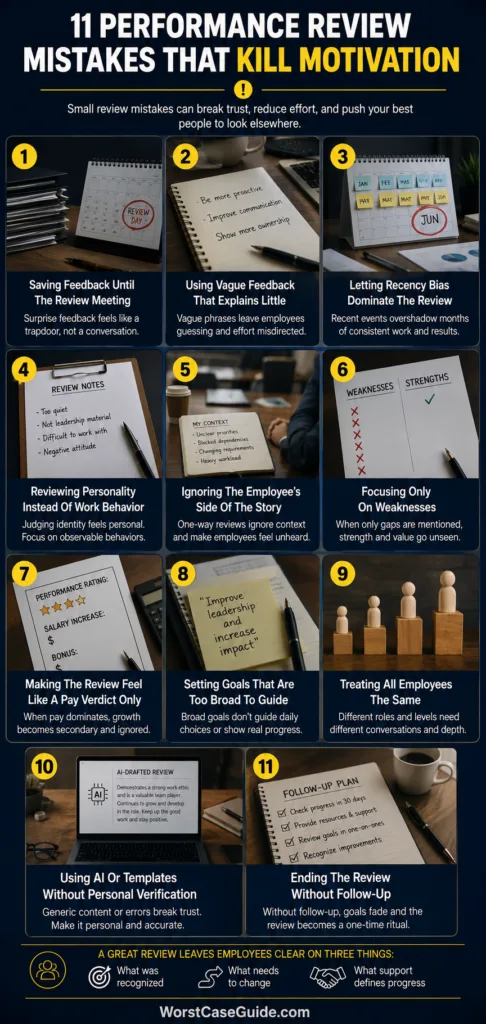
11 Performance Review Mistakes That Demotivate Employees
These mistakes are common in small teams, large departments, remote workplaces, and fast-moving companies. The details change, but the pattern is familiar: the review becomes less about useful feedback and more about control, surprise, or paperwork.
Mistake 1: Saving Feedback Until The Review Meeting
This happens when managers treat the performance review as the main place for feedback instead of the place where earlier feedback is organized and discussed. The employee hears about issues only after weeks or months have passed.
Why It Happens
Managers may be busy, unsure how to start hard conversations, or waiting for “the right time.” In smaller projects, this can look like casual avoidance. In larger systems, it may happen because review cycles are treated like the official channel for every serious topic.
Early Warning Signs
- Feedback appears for the first time in the written review.
- The employee says, “I wish I had known this earlier.”
- One review conversation tries to cover six months of unresolved issues.
- Managers rely on old notes instead of recent, shared conversations.
Worst-Case Result
The employee feels ambushed. Even if the feedback is valid, the timing can make it feel unfair. Motivation drops because the employee sees the review as a trapdoor rather than a check-in.
Safer Approach
A safer review process treats the meeting as a recap of known themes. If an issue matters enough to affect the review, it usually matters enough to discuss before the review. The employee should not need detective skills to understand how they are doing.
Mistake 2: Using Vague Feedback That Sounds Polite But Explains Little
Vague feedback often sounds harmless: “be more proactive,” “improve communication,” “show more ownership,” or “step up.” These phrases may be common in office conversations, but they can leave employees guessing.
Why It Happens
Managers sometimes use broad language to soften the message. They may also lack concrete examples. The intent may be kind, yet the effect can be foggy. A review without examples is like a map with street names missing.
Early Warning Signs
- The employee asks, “Can you give me an example?” more than once.
- The review uses personality labels instead of work behaviors.
- Feedback could apply to almost anyone on the team.
- The employee leaves with no clear action to take.
Worst-Case Result
The employee tries to improve in the wrong direction. They may overcorrect, withdraw, or become hesitant because the target keeps moving. Motivation suffers because effort no longer feels connected to results.
Safer Approach
Feedback becomes safer when it names specific behavior, specific context, and specific impact. For example, instead of saying “communicate better,” a manager can describe what was missing, when it happened, who was affected, and what a stronger version would look like next time.
Mistake 3: Letting Recency Bias Dominate The Review
Recency bias happens when the most recent work weighs more heavily than the full review period. A strong final month can hide earlier gaps. A rough final week can overshadow steady performance.
Why It Happens
Recent events are easier to remember. Managers under time pressure may rely on what is fresh in their mind instead of checking notes, goals, project outcomes, and earlier feedback. It is a very human mistake. It is also risky.
Early Warning Signs
- The review focuses heavily on the last project.
- Older wins or issues are missing from the discussion.
- The employee’s self-review mentions work the manager forgot.
- The rating changes sharply because of one recent event.
Worst-Case Result
Employees may decide that consistent work does not matter. They may focus on looking good near review season instead of doing steady, reliable work throughout the year. That damages both trust and performance quality.
Safer Approach
A safer review uses notes from the full period: goals, deliverables, feedback records, project milestones, customer or stakeholder input, and previous check-ins. The review should feel like a fair timeline, not a snapshot taken on a bad day.
Mistake 4: Reviewing Personality Instead Of Work Behavior
Feedback becomes demotivating when it sounds like a judgment of identity rather than a discussion of observable work. Words such as “negative,” “not leadership material,” “too quiet,” or “difficult” can feel personal if they are not tied to clear examples.
Why It Happens
Managers may notice patterns but describe them loosely. They may also confuse style differences with performance problems. In remote or hybrid teams, written tone can be misread. In cross-functional work, one person’s directness may be another person’s “poor communication.”
Early Warning Signs
- The review uses labels more than examples.
- The employee cannot tell what behavior should change.
- Feedback focuses on tone, attitude, or presence without context.
- Different employees receive different standards for similar behavior.
Worst-Case Result
The employee feels judged as a person. Once that happens, defensiveness is likely. The conversation shifts from improvement to self-protection, and honest dialogue becomes harder next time.
Safer Approach
A safer review separates personality from work behavior. Instead of “you are not collaborative,” the review can describe a missed handoff, an unanswered dependency, or a meeting where a decision was not shared with the team. Behavior can be discussed. Identity feels harder to change.
Mistake 5: Ignoring The Employee’s Side Of The Story
A one-way review may be efficient on paper, but it can damage motivation. Employees often have context the manager does not see: unclear priorities, blocked dependencies, changing requirements, workload trade-offs, or support gaps.
Why It Happens
Some managers feel pressure to “deliver” the review, especially when ratings have already been entered into a system. The meeting becomes a reading session. The employee listens, nods, and leaves with unspoken concerns.
Early Warning Signs
- The manager speaks for most of the meeting.
- The employee gives short answers and stops offering context.
- There is no space for disagreement or clarification.
- The review ignores blockers that affected the work.
Worst-Case Result
The employee feels powerless. Even when they stay polite, they may stop raising risks early. That creates a quiet problem: managers receive less truth, while employees carry more frustration.
Safer Approach
A safer review includes room for the employee’s view. Useful prompts can be simple: “What context should be considered here?” or “Where did you feel blocked?” The point is not to excuse every outcome. The point is to understand the work accurately before deciding what the review means.
Mistake 6: Focusing Only On Weaknesses
Some reviews become a list of gaps. The manager may think this is practical because weaknesses need attention. Yet employees also need to know what to keep doing, what they are trusted with, and where their strengths create value.
Why It Happens
Problems demand attention. Good work can become invisible because it causes no noise. In busy teams, the employee who quietly keeps things working may receive less specific recognition than the employee whose issues require management time.
Early Warning Signs
- The review contains many corrections and little recognition.
- Strengths are described with generic praise, such as “good job.”
- The employee cannot tell which contributions mattered most.
- High performers leave the review feeling strangely deflated.
Worst-Case Result
The employee may feel that effort is noticed only when something goes wrong. Over time, they may stop going beyond the minimum because extra care receives no clear value in the review process.
Safer Approach
A balanced review names both strengths to repeat and areas to improve. Recognition should be specific enough to be useful: which project, which behavior, what effect, and why it mattered. Praise without detail can feel nice for a moment, then disappear.
Mistake 7: Making The Review Feel Like A Pay Verdict Only
Pay, bonuses, promotions, and ratings often sit near performance reviews. That connection is not automatically wrong. The mistake is letting compensation become the only thing the review communicates.
Why It Happens
In many companies, review cycles are tied to budget decisions. Managers may spend most of their preparation time on rating justification and little time on development. Employees then read the whole meeting through one lens: reward or rejection.
Early Warning Signs
- The conversation jumps quickly to rating, raise, or promotion status.
- Development goals feel like an afterthought.
- The employee hears what they received but not how to grow.
- The review has no practical plan for the next review period.
Worst-Case Result
If the employee is disappointed by the reward decision, they may dismiss the rest of the feedback. If they are satisfied, they may ignore growth areas. Either way, learning becomes secondary.
Safer Approach
A safer process separates the messages clearly: performance evidence, reward decision, growth plan, and next expectations. If the company cannot change the reward outcome, the manager can still provide honest clarity about what is within the employee’s influence next.
Mistake 8: Setting Goals That Are Too Broad To Guide Behavior
Goals such as “be more strategic,” “improve leadership,” or “increase impact” may sound useful in a review document. They are often too broad to guide daily choices. What should the employee do on Monday morning?
Why It Happens
Broad goals are easy to write and hard to measure. Managers may use them when the real issue is unclear, or when the role itself has shifting expectations. In fast-growing teams, goals can become slogans instead of working agreements.
Early Warning Signs
- The goal cannot be observed in actual work.
- The employee and manager define success differently.
- The goal lacks timing, owner, support, or evidence.
- The same goal appears in multiple reviews with no progress detail.
Worst-Case Result
The employee spends months aiming at a blurred target. At the next review, the manager may still feel improvement was not enough, while the employee feels they were never given a fair path.
Safer Approach
A safer goal connects the desired outcome to visible behavior, examples, support, and review points. “Improve leadership” can become “lead the weekly project risk review, document decisions, and escalate blocked dependencies within one business day.” That gives the employee something real to work with.
Mistake 9: Treating All Employees As If They Need The Same Review Style
A new employee, a senior specialist, a manager, and a high performer in a stretched role may all need different kinds of review conversations. The mistake is using the same tone, depth, and structure for everyone.
Why It Happens
Standard templates make reviews easier to manage. That can help with fairness, but templates can also flatten context. A junior employee may need clear skill guidance. A senior employee may need scope clarity, influence feedback, or career trade-off discussions.
Early Warning Signs
- Every review uses nearly the same phrases.
- High performers receive generic praise with no growth challenge.
- New employees receive broad criticism without coaching detail.
- Employees in different roles are compared by unclear standards.
Worst-Case Result
Employees may feel unseen. Some receive too little guidance; others receive feedback that does not match their role. Motivation drops because the review feels copied, not considered.
Safer Approach
A safer review uses consistent standards but adapts the conversation to role level, tenure, project complexity, and career direction. Fairness does not mean identical wording. It means employees can understand how the standard applies to their actual work.
Mistake 10: Using AI Or Templates Without Personal Verification
AI tools and templates can help managers organize thoughts, improve wording, and reduce blank-page stress. The risk appears when the review sounds generic, includes errors, or uses sensitive information carelessly.
Why It Happens
Managers may face many reviews at once. A tool that drafts polished language can feel helpful. Yet polished language is not the same as accurate feedback. Employees can often sense when a review was assembled from thin input.
Early Warning Signs
- The review uses generic phrases that do not match the employee’s work.
- Examples are missing, wrong, or too broad.
- The tone feels warmer or harsher than the manager’s real view.
- Private or sensitive details are placed into tools without clear approval.
Worst-Case Result
The employee may feel processed by a machine rather than understood by a manager. A single factual error can also weaken trust in the whole review, even the parts that are accurate.
Safer Approach
A safer use of tools keeps the manager responsible for accuracy, tone, privacy, and examples. Templates can shape the cup; they should not become the drink. The final review should sound like it came from someone who knows the employee’s work.
Mistake 11: Ending The Review Without Follow-Up
A review can sound thoughtful in the moment and still fail afterward. Without follow-up, goals fade, support disappears, and the employee has to guess whether anything discussed still matters.
Why It Happens
Once the review cycle closes, managers return to urgent work. The written review is filed away. The next real conversation may not happen until the same process starts again.
Early Warning Signs
- No follow-up date is agreed during the review.
- Development goals are not discussed in one-on-ones.
- Support promised in the review never appears.
- The next review repeats the same issues.
Worst-Case Result
The employee learns that review conversations are ceremonial. They may stop taking goals seriously because the organization does not treat them as living commitments.
Safer Approach
A safer review ends with a small, clear follow-up plan: what will be checked, when it will be discussed, what support is needed, and how progress will be recognized. The plan does not need to be long. It needs to be real.
Risk Patterns Behind Demotivating Performance Reviews
The individual mistakes above often come from a few larger patterns. Spotting these patterns can help managers, HR teams, and business owners improve the process before employees lose trust.
Pattern 1: The Review Becomes A Memory Test
When managers rely on memory, recent events and strong emotions tend to win. Better reviews usually need records: goals, notes, examples, project outcomes, and prior conversations.
Pattern 2: The Review Measures The Employee But Not The System Around The Employee
Performance is personal, but it is not only personal. Role clarity, staffing, tools, priorities, handoffs, and manager support can affect outcomes. If those factors are ignored, the review may punish the employee for problems the system helped create.
Pattern 3: The Review Talks About Improvement Without Making Improvement Easier
Employees need more than a list of gaps. They need practical next steps, examples, feedback rhythm, and enough support to act. Otherwise, “development” becomes a word on a form.
Pattern 4: The Review Protects The Process More Than The Relationship
A company may complete every form and still leave employees feeling unheard. Process matters, but the conversation matters too. Trust is not a soft extra; it is part of how feedback becomes usable.
Useful Check: After a review, an employee should be able to explain three things in plain language: what was recognized, what needs to change, and what support or evidence will define progress next.
How To Make A Review Less Demotivating Without Making It Soft
A safer review is not a softer review. It can still be honest, direct, and clear about missed expectations. The difference is that the employee can see the reasoning and the path forward.
Before The Review
- Collect examples from the full review period, not only recent weeks.
- Compare feedback against goals, role expectations, and actual responsibilities.
- Check whether the employee has heard the main themes before.
- Separate performance facts from assumptions about personality or intent.
- Prepare one or two development priorities instead of a long list of complaints.
During The Review
- Explain ratings with evidence, not labels.
- Allow the employee to add context or challenge unclear points.
- Name strengths with the same care used for weaknesses.
- Keep the conversation tied to work behavior and outcomes.
- Translate feedback into next actions before the meeting ends.
After The Review
- Use one-on-ones to revisit review goals.
- Track progress while it is happening.
- Offer feedback early when the employee is off track.
- Recognize improvement before the next formal review.
- Update goals when the role or business priorities change.
If You Are In A Smaller Team
Smaller teams often rely on informal communication. That can be warm and fast, but it can also create unclear expectations. A founder, owner, or team lead may think feedback has been “obvious” because they mentioned it casually once.
In this situation, review quality improves when informal feedback is captured in simple notes. Nothing fancy is required. A shared goal document, a one-on-one recap, or a short follow-up message can prevent the review from becoming a memory contest.
If You Are In A Larger Organization
Larger organizations often have rating systems, calibration meetings, HR timelines, promotion panels, and compensation bands. These can support consistency, but they can also make the review feel distant from the employee’s real work.
In this situation, managers may need to translate the system back into human terms. What does the rating mean? What evidence was used? What can the employee influence? What cannot be changed right now? Silence around these questions can be more demotivating than the answer itself.
A Practical Review Quality Checklist
This checklist can be used before a review conversation to reduce the risk of surprise, vagueness, and avoidable demotivation.
| Review Element | Question To Check | Risk If Missing |
|---|---|---|
| Evidence | Are examples tied to real work and dates or projects? | The review may feel like opinion. |
| Timing | Has the employee heard the main feedback before? | The meeting may feel like an ambush. |
| Balance | Are strengths named as clearly as gaps? | The employee may feel only mistakes are noticed. |
| Context | Have blockers, role changes, and workload been considered? | The review may feel unfair or incomplete. |
| Next Steps | Does the employee know what to do next? | Motivation may turn into confusion. |
| Follow-Up | Is there a plan to revisit progress? | The review may become a one-time ritual. |
FAQ
Why do performance reviews demotivate employees?
Performance reviews demotivate employees when they feel unfair, vague, late, biased, or disconnected from real work. Employees usually need clear examples, a chance to add context, and practical next steps. Without those, the review can feel like judgment rather than useful feedback.
What is the most common performance review mistake?
One of the most common mistakes is saving feedback until the formal review meeting. When employees hear important feedback for the first time during the review, they may feel surprised or treated unfairly, even if the feedback itself is valid.
How can managers give negative feedback without demotivating employees?
Negative feedback is less demotivating when it is specific, timely, respectful, and tied to behavior rather than personality. A safer approach is to explain what happened, why it mattered, what should change, and what support or follow-up will be available.
Should performance reviews include employee self-assessments?
Employee self-assessments can make reviews more accurate when they are used well. They help surface context, achievements, blockers, and goals that the manager may not fully see. The self-assessment should not replace the manager’s responsibility to provide clear feedback.
Can performance ratings reduce motivation?
Performance ratings can reduce motivation when they are not explained clearly or when they feel disconnected from evidence. A rating is easier to accept when the employee understands the examples behind it, the standard used, and what can be improved before the next review.
How often should managers discuss performance with employees?
Performance is usually easier to manage through regular conversations rather than one large annual review. The exact rhythm depends on the role and workplace, but employees benefit from feedback while there is still time to adjust their work.