Supply chain mistakes that create fulfillment delays rarely start as one obvious failure. More often, a delay begins as a small mismatch: a forecast that looked reasonable, a supplier promise that was never tested, a warehouse location that was not updated, or a shipping cutoff that nobody questioned. The order still looks fine on the screen. The customer still expects delivery. Then the gap appears.
A fulfillment delay is not only a late package. It can affect customer trust, inventory accuracy, warehouse labor, carrier costs, cash flow, and the next batch of orders waiting behind it. In smaller projects, one late supplier can create a few uncomfortable emails. In larger systems, the same mistake can spread like a traffic jam after one blocked lane.
Practical view: Fulfillment delays usually come from a chain of weak assumptions, not one lazy team or one bad shipment. The safer approach is to look for places where planning, inventory, supplier communication, warehouse execution, and transportation stop matching each other.
Why Fulfillment Delays Are Risky Before They Are Visible
A supply chain can look calm while it is already behind. Purchase orders may be open, inventory may appear available, and the warehouse may still be picking orders. The problem is that many delays hide in lead time, data quality, and handoff points.
One team may see enough inventory. Another team may know that part of it is damaged, reserved, mislabeled, or sitting in the wrong facility. A supplier may confirm a ship date but not confirm production capacity. A carrier may accept a booking but miss the pickup window. None of these issues feels like a crisis at first.
Then the order enters fulfillment. That is where vague planning becomes a real promise.
| Stage | Common Weak Point | Delay It Can Create |
|---|---|---|
| Demand Planning | Forecasts based on stale sales patterns | Stockouts, rushed replenishment, uneven warehouse load |
| Procurement | Supplier lead times accepted without buffer | Late inbound stock and missed launch dates |
| Inventory Control | System stock does not match physical stock | Overselling, cancellations, backorders |
| Warehouse Operations | Poor slotting, unclear pick paths, weak packing flow | Slow picking, mispicks, late dispatch |
| Transportation | Carrier capacity and cutoff times not planned early | Missed pickups, higher shipping costs, late delivery |
Common Wrong Assumptions Behind Fulfillment Delays
Many fulfillment delays begin with assumptions that sound reasonable in a meeting. The risk is that they are often not tested against the real movement of goods, labor, systems, and customer demand.
- “If the system says it is in stock, we can ship it.” Stock may be damaged, reserved, misplaced, or not yet received properly.
- “Our supplier has never been late before.” Past performance helps, but it does not replace capacity checks, backup options, and clear escalation paths.
- “A small forecast error will stay small.” In supply chains, a small demand signal can grow as each team adds its own safety buffer.
- “Warehouse labor can absorb the spike.” People can work faster for a short time, but layout, batching, packing stations, and carrier pickup windows still set limits.
- “The customer only cares about the final delivery date.” Many customers can tolerate a delay better than silence, changing promises, or unclear tracking.
A safer question: “Where does our promise to the customer depend on a number, date, or status that nobody has verified recently?” That question often finds the weak spot before the customer does.
9 Supply Chain Mistakes That Create Fulfillment Delays
The following mistakes are ordered from early planning errors to late-stage fulfillment problems. In real operations, they often overlap. A weak forecast can create a purchasing rush, which can overload receiving, which can cause warehouse errors, which can then delay outbound orders.
Mistake 1: Treating Forecasts As Fixed Truth Instead Of Working Estimates
Why It Happens
Forecasting often becomes too neat. A planner may use last year’s sales, a recent campaign, or a marketplace trend and turn it into a demand plan that looks precise. The forecast then moves into purchasing, staffing, inventory allocation, and warehouse planning as if it were a promise.
The issue is not forecasting itself. The issue is using one forecast without enough scenario planning, demand sensing, seasonality checks, promotion timing, supplier lead time awareness, and inventory buffer logic.
Early Warning Signs
- Sales forecasts change often, but purchase orders do not change with them.
- Promotions are planned before fulfillment capacity is reviewed.
- Slow-moving stock grows while popular SKUs run out.
- Teams argue over “the right number” instead of planning for ranges.
Worst-Case Result
The business sells products it cannot fulfill on time, then tries to recover with emergency purchasing, rushed inbound freight, overtime labor, and split shipments. The customer sees delay notices. The warehouse sees disorder.
A Safer Approach
A more stable process treats the forecast as a range of possible demand. For example, a base case, low case, and high case can help teams decide when to reorder, when to reserve labor, and when to slow promotions before fulfillment promises become unrealistic.
If you are in a smaller project, even a simple weekly review of top SKUs, current stock, inbound dates, and open orders can reduce blind spots. In larger systems, the same idea may require demand planning software, supplier portals, inventory alerts, and shared exception reports.
Mistake 2: Relying On One Supplier Without A Real Backup Path
Why It Happens
A single supplier can seem simpler. Fewer contracts. Fewer price lists. Fewer conversations. Over time, that convenience can turn into dependency, especially when the supplier controls a core product, component, packaging material, or replacement part.
This mistake becomes more risky when supplier performance is judged only by price and past delivery, not by capacity, production schedule, location risk, material availability, quality control, and communication speed.
Early Warning Signs
- The supplier is the only approved source for a high-volume SKU.
- Lead time changes are shared late or informally.
- Backup suppliers exist in theory but have not been tested with real orders.
- Small quality issues are accepted because switching feels difficult.
Worst-Case Result
A supplier delay stops replenishment, and fulfillment slows down even when the warehouse team is ready. Orders move into backorder status. Customer service starts explaining a delay that was already forming weeks earlier.
A Safer Approach
A safer supplier setup separates primary supply from recovery supply. The backup path does not have to replace every order. It should be able to handle urgent volume, substitute materials, or priority SKUs when the main supplier cannot deliver.
For important items, it helps to test the backup supplier before there is pressure. A small trial order can reveal packaging differences, label issues, product quality gaps, and real lead time. A backup that exists only in a spreadsheet may not protect fulfillment when timing gets tight.
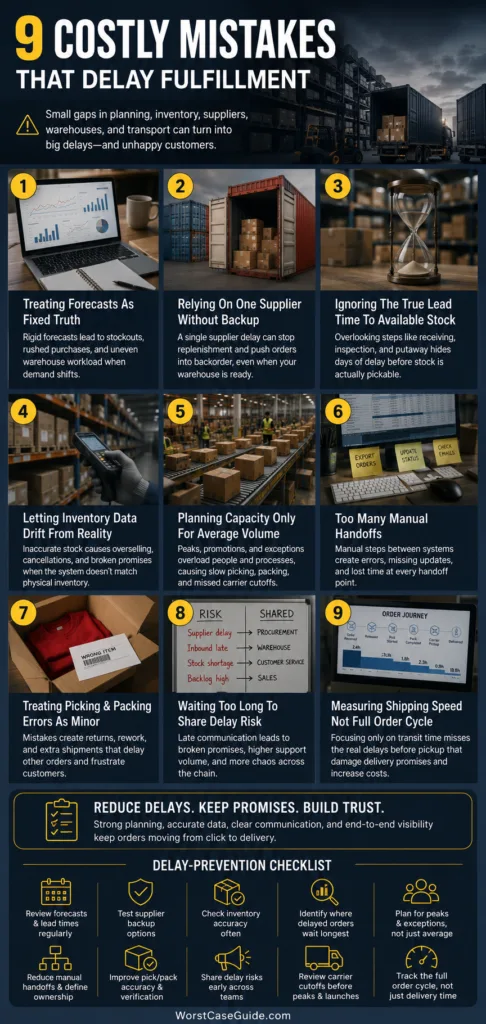
Mistake 3: Ignoring The True Lead Time From Order To Available Stock
Why It Happens
Lead time is often measured too narrowly. A supplier may say production takes ten days, but that does not include purchase order approval, payment checks, production queue time, quality inspection, export paperwork, inbound transport, receiving, putaway, and system availability.
That missing time matters. A product is not truly ready for fulfillment when it is “shipped by the supplier.” It is ready when it is received, checked, located, and available for picking.
Early Warning Signs
- Reorder points are based on supplier production time only.
- Inbound shipments arrive but sit unprocessed for days.
- Teams use different definitions of “available stock.”
- Customer-facing delivery promises do not account for receiving delays.
Worst-Case Result
The business believes stock will be ready in time, keeps accepting orders, and then discovers that the goods are not pickable. The delay feels sudden to the customer, but internally it was hidden inside the lead time calculation.
A Safer Approach
A more reliable lead time view includes every step from purchase request to pickable inventory. This can be written as a simple chain: approval, supplier confirmation, production, quality check, transit, receiving, inspection, putaway, system update, and release for sale.
In larger systems, it may help to track planned lead time, actual lead time, and lead time variation by supplier and SKU. The variation is often where fulfillment risk lives.
| Lead Time Part | Often Counted? | Why It Matters For Fulfillment |
|---|---|---|
| Supplier Production | Yes | Shows when goods may leave the supplier, not when they can be shipped to customers. |
| Purchase Approval | Sometimes | Slow internal approvals can delay the order before the supplier even starts. |
| Transit And Customs | Sometimes | Carrier delays, inspections, or route changes can shift arrival dates. |
| Receiving And Inspection | Often missed | Stock may be physically present but unavailable for customer orders. |
| Putaway And System Release | Often missed | The warehouse cannot pick what has not been located and updated. |
Mistake 4: Letting Inventory Data Drift Away From Physical Reality
Why It Happens
Inventory accuracy can decay quietly. Returns may not be processed correctly. Damaged goods may stay in available stock. Workers may move items without scanning them. Bundles may consume components without updating the count. Marketplace orders may reserve stock faster than the warehouse management system reflects.
When inventory records drift, order management becomes guesswork with a clean dashboard.
Early Warning Signs
- Pickers often report missing items that the system shows as available.
- Customer service sees more “sorry, out of stock” messages after purchase.
- Cycle counts find repeated differences in the same SKUs or locations.
- Returns, damaged units, and reserved inventory are handled manually.
Worst-Case Result
The company oversells. Orders that should have shipped today become partial shipments, backorders, cancellations, or awkward substitutions. The delay is not caused by a missing product alone; it is caused by trusting the wrong number for too long.
A Safer Approach
A safer inventory process uses regular cycle counts, clear damaged-stock status, barcode scanning, lot or batch tracking where needed, and strict rules for manual adjustments. The aim is not perfection. It is to find drift early enough that fulfillment promises still mean something.
If the operation sells across several channels, stock allocation also matters. A shared pool with no reservation logic can let one channel consume inventory that another channel has already promised.
Mistake 5: Planning Warehouse Capacity Only Around Average Order Volume
Why It Happens
Averages are comfortable. If a warehouse ships 1,000 orders a day on average, planning may revolve around that number. Yet fulfillment delays often happen on days that are not average: promotional launches, holiday peaks, influencer mentions, marketplace events, weather disruptions, supplier catch-up days, or month-end batch releases.
Capacity is not only headcount. It includes pick paths, packing benches, label printers, scanners, staging space, dock doors, carrier pickup windows, and exception handling.
Early Warning Signs
- Orders wait between picking and packing because packing stations are full.
- One experienced worker becomes the hidden bottleneck for exceptions.
- Carrier pickups are missed on high-volume days.
- Temporary labor is added, but training and supervision do not scale with it.
Worst-Case Result
The warehouse receives more orders than it can process within the promise window. Staff work harder, but delays still grow because the constraint is not effort; it is flow. Orders pile up like water behind a narrow pipe.
A Safer Approach
A more practical plan looks at peak volume, not only average volume. It also separates normal orders from exceptions: address issues, out-of-stock lines, damaged units, failed payment checks, special packaging, and split shipments.
For smaller warehouses, this may be a weekly capacity board. For larger operations, it may involve labor planning, wave picking rules, slotting analysis, automation limits, and carrier capacity reviews before campaigns go live.
Mistake 6: Creating Too Many Manual Handoffs Between Systems And Teams
Why It Happens
Many supply chains grow faster than their systems. A team may start with spreadsheets, email approvals, manual order exports, and copied tracking numbers. That can work for a while. Then order volume rises, more SKUs are added, and each manual handoff becomes a place where time and accuracy leak.
The risky part is that manual work can look flexible. It feels like people are solving problems. Sometimes they are. Sometimes they are holding together a process that needs cleaner rules.
Early Warning Signs
- Orders are downloaded from one system and uploaded into another.
- Shipment status depends on someone updating a spreadsheet.
- Teams use different SKU names, product codes, or order statuses.
- Urgent orders are managed through chat messages instead of workflow rules.
Worst-Case Result
Orders fall between systems. A customer receives a tracking number late, a warehouse picks from an outdated order file, or a purchase order waits because an approval email was missed. The delay is small at each handoff, but the total delay becomes visible at the customer’s door.
A Safer Approach
A safer setup reduces unnecessary handoffs and defines ownership for each order status. If integration is not possible yet, the process can still use controlled templates, timestamped updates, clear approval limits, and exception queues instead of scattered messages.
It also helps to map the order path from “customer placed order” to “carrier accepted shipment.” The weak step is often not where people first expect it to be.
Mistake 7: Treating Picking, Packing, And Labeling Errors As Small Warehouse Issues
Why It Happens
Picking and packing mistakes may look like isolated errors: the wrong size, the wrong color, a missing accessory, a damaged item, a label on the wrong parcel. The deeper cause can be poor SKU naming, crowded storage locations, weak product images, similar packaging, rushed packing stations, or unclear quality checks.
These errors create fulfillment delays because fixing them uses the same labor, stock, and carrier capacity needed for new orders.
Early Warning Signs
- Returns mention wrong items or missing parts.
- Workers ask the same SKU questions repeatedly.
- Similar products are stored close together without strong visual separation.
- Packing checks happen only after mistakes reach customers.
Worst-Case Result
The warehouse ships the wrong order, then ships the correction, handles the return, updates inventory, and answers customer messages. One mistake becomes several extra tasks. During busy periods, those extra tasks delay other orders that were not part of the original error.
A Safer Approach
A safer fulfillment process uses clear SKU labels, barcode checks, separated lookalike items, packing verification, and simple exception rules. For high-error SKUs, it may help to review photos, naming, bin location, packaging, and pick instructions together rather than blaming the picker.
If you are handling kits or bundles, component availability should be checked before the order reaches packing. A bundle that is missing one small insert can delay a whole shipment.
Mistake 8: Waiting Too Long To Communicate Delay Risk Across The Chain
Why It Happens
Teams often wait for certainty before sharing bad news. A supplier may hope a late batch can still ship. A warehouse may expect to clear the backlog by the afternoon. Customer support may wait for operations to confirm the exact delay. The silence is understandable, but it can make the delay harder to manage.
Fulfillment problems worsen when delay signals stay local. Procurement knows. The warehouse does not. The warehouse knows. Customer service does not. Customer service knows. The storefront still shows the old delivery promise.
Early Warning Signs
- Delay updates are shared only after customers complain.
- Supplier issues are discussed in private emails, not visible status reports.
- Customer-facing delivery estimates remain unchanged during known backlog periods.
- Teams use different words for the same status, such as “delayed,” “pending,” “on hold,” and “waiting.”
Worst-Case Result
The company keeps making promises based on old information. Customers receive late updates, support volume rises, and teams spend time defending the delay instead of reducing it.
A Safer Approach
A safer communication process defines when a risk must be shared, even before the final outcome is known. For example, if a supplier misses a confirmation date, if inbound stock is not received by a cutoff time, or if the warehouse backlog passes a certain order count, the right teams should know early.
Customer messaging should be calm and specific. A clear revised window is usually better than repeated vague updates. Nobody enjoys delay news, but uncertainty makes it worse.
Mistake 9: Measuring Shipping Speed But Not The Full Order Cycle
Why It Happens
Many teams track delivery time after carrier pickup but pay less attention to what happens before that pickup. The customer sees one experience: order placed, order processed, order shipped, order delivered. Internally, those steps may belong to different teams and systems.
If the business only watches carrier transit time, it may miss delays in order release, fraud review, allocation, picking, packing, labeling, staging, and pickup acceptance.
Early Warning Signs
- Carrier performance looks acceptable, but customers still complain about late delivery.
- Orders sit in “processing” longer than expected.
- Same-day shipping promises fail near cutoff time.
- Teams cannot easily answer where an order waited the longest.
Worst-Case Result
The company optimizes the wrong part of the process. It may pay for faster shipping while the real delay sits inside warehouse release, payment review, stock allocation, or dock staging. Costs rise, but the customer still receives the order late.
A Safer Approach
A safer measurement view tracks the full order cycle: order received, order released, stock allocated, pick started, pack completed, label created, carrier pickup, first scan, transit, delivery. This makes delay diagnosis more honest.
In smaller teams, this can be reviewed manually for delayed orders each week. In larger operations, dashboards can show where orders age beyond normal limits and which SKUs, suppliers, locations, or carriers appear most often in delay cases.
General Risk Patterns Behind Supply Chain Fulfillment Delays
The specific mistakes vary by business, but many fulfillment delays follow the same patterns. Seeing these patterns early can make the system easier to manage.
Pattern 1: The System Looks Accurate Because Nobody Has Checked The Physical Flow
Dashboards can create confidence, but fulfillment depends on physical movement. Stock must be received, counted, stored, picked, packed, staged, and handed to a carrier. If the data is clean but the warehouse reality is messy, the delay will eventually show up.
Pattern 2: Teams Optimize Their Own Step And Miss The Delay They Create For The Next Step
Procurement may buy in bulk to reduce unit cost. The warehouse then runs out of space. Marketing may launch a promotion. Operations then faces a volume spike. Shipping may chase cheaper rates. Customers then wait longer. Each decision may make sense locally while slowing the whole chain.
Pattern 3: Exceptions Are Treated As Interruptions Instead Of A Workstream
Address errors, damaged items, payment holds, missing components, split shipments, and customer changes are not rare in real fulfillment. If exceptions do not have a clear lane, they interrupt normal work and create hidden queues.
Pattern 4: Recovery Plans Are Designed After The Delay Has Already Happened
A late response often costs more than a prepared response. Emergency freight, overtime, manual rework, and rushed supplier orders may be needed at times, but they should not be the first time the business thinks about recovery.
Safer operating habit: Review delayed orders backward. Start with the customer promise, then trace each order back through carrier pickup, packing, picking, allocation, inventory status, supplier timing, and forecast assumptions. The repeated delay point is usually more useful than the loudest complaint.
A Practical Delay-Prevention Checklist
This checklist is not meant to replace a formal operations review. It can help teams find weak spots before they turn into missed fulfillment dates.
- Check whether top-selling SKUs have realistic reorder points and full lead time calculations.
- Review whether supplier backup options have been tested with real orders.
- Compare system stock to physical stock for items with repeated fulfillment issues.
- Look at delayed orders and identify where they waited longest.
- Separate normal orders from exceptions in warehouse planning.
- Review carrier cutoff times before promotions, launches, and peak periods.
- Make delay-risk alerts visible to procurement, warehouse, customer service, and sales teams.
- Track order cycle time before carrier pickup, not only delivery time after shipment.
- Use clear status names so teams do not interpret the same order differently.
FAQ
What is the most common supply chain mistake that causes fulfillment delays?
One common mistake is trusting inventory data without checking whether the physical stock is actually available, accurate, undamaged, and ready to pick. When the system and warehouse reality do not match, orders can be accepted before they can be fulfilled.
How do poor forecasts create fulfillment delays?
Poor forecasts can cause understocking, overstocking, rushed purchasing, weak labor planning, and uneven warehouse workload. A forecast does not have to be wildly wrong to cause problems; even a modest error can create delays when supplier lead times are long or order volume changes fast.
Why does supplier communication matter so much for fulfillment?
Supplier communication affects replenishment timing, inbound stock visibility, quality expectations, and recovery planning. If supplier delays are shared late, the warehouse and customer service teams may continue working from outdated promises.
Can faster shipping fix fulfillment delays?
Faster shipping may help after an order leaves the warehouse, but it does not fix delays caused by stockouts, slow receiving, picking errors, packing backlogs, or late supplier shipments. It can also raise costs without solving the root cause.
What metrics help find fulfillment delay risks?
Useful metrics include inventory accuracy, supplier lead time variation, order cycle time, warehouse backlog, pick accuracy, pack completion time, carrier pickup success, backorder rate, and the time orders spend in each status before shipment.
How can small businesses reduce fulfillment delays without complex software?
Small businesses can start with weekly checks of top SKUs, simple reorder points, clean stock counts, supplier confirmation dates, clear packing rules, and a review of delayed orders. The goal is to find repeated delay points before order volume makes them harder to control.