Freelancer management mistakes rarely delay projects all at once. They usually start as small gaps: a vague brief, a missing login, a silent stakeholder, a revision that sounds minor but changes the work. One gap may not matter. Several gaps can turn a simple freelance project into a slow, awkward traffic jam where nobody is fully sure what is late, what is approved, or who needs to act next.
Freelancers can move fast when the work is clear, the decision path is short, and the handoff is clean. Delays begin when the client treats freelance work as “just a task” instead of a temporary working relationship with its own scope, access, feedback rhythm, and approval rules.
This matters for design projects, content production, web development, marketing campaigns, virtual assistant work, consulting, automation builds, and many other outsourced tasks. The same pattern appears often: the freelancer is hired to save time, then the project loses time because the management process was never shaped before the work began.
Working Principle: Freelancer management is not about watching every minute. It is about making the work easy to start, easy to review, and easy to finish without hidden blockers.
Why Freelancer Management Can Delay Good Projects
A freelancer may be skilled, responsive, and motivated, yet the project can still drift. Skill does not remove the need for clear scope, usable assets, access to systems, review rules, and a realistic timeline. A good freelancer cannot approve their own work on behalf of the client. They cannot guess brand preferences that were never shared. They cannot build around missing dependencies without creating risk.
The risky part is that many delays look harmless in the moment. A delayed reply feels like “just one day.” A missing file feels easy to send later. A new stakeholder feels helpful. A small extra request feels reasonable. Then the project starts carrying more weight than the original plan allowed.
In smaller projects, the delay may show up as a missed launch date or a rushed final review. In larger systems, it can affect multiple teams, campaigns, budgets, customer promises, and internal trust.
Common False Assumptions That Create Delays
Many freelancer projects begin with friendly confidence. That is useful. It is not enough. These assumptions often sit quietly underneath the project plan:
- “The freelancer will know what we mean.” They may understand the field, but not the client’s internal preferences.
- “We can define the details later.” Later often means after work has already been done in the wrong direction.
- “A short project does not need much process.” Short projects have less room to recover from confusion.
- “More reviewers will improve quality.” More reviewers can help, but only when one person owns the final decision.
- “A project tool will keep everything organized.” A tool only reflects the process placed inside it.
- “Fast freelancers can absorb messy input.” Some can, for a while. The project still pays for the mess through rework.
Freelancer Project Delay Risk Table
The table below connects common management gaps with the delay pattern they usually create.
| Management Gap | Early Signal | Likely Delay Pattern | Safer Control |
|---|---|---|---|
| Vague Scope | Questions repeat after kickoff | Rework and disputed deliverables | Define deliverables, exclusions, and revision limits |
| Slow Feedback | Reviews sit unanswered | Idle time between milestones | Set review windows and one decision owner |
| Missing Assets | Freelancer waits for files or logins | Late start and broken sequencing | Prepare access before the start date |
| Uncontrolled Changes | “Small” requests appear often | Timeline expands without a clear reset | Use a simple change request log |
| No Acceptance Criteria | Done means different things to each person | Endless final tweaks | Define what finished work must include |
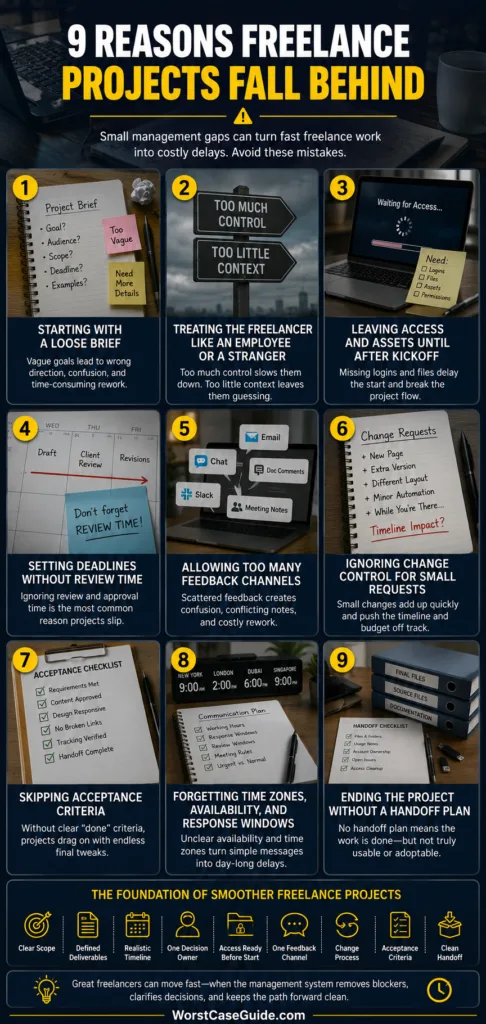
9 Freelancer Management Mistakes That Delay Projects
Mistake 1: Starting With a Loose Brief
A loose brief feels fast at the beginning. It can also create the first delay before the freelancer has produced anything. When the brief says “make it professional,” “improve the website,” or “write something engaging,” the freelancer has to translate vague intent into real decisions.
Why It Happens
Clients often know the outcome they want, but not the details needed to produce it. Internal teams may also assume the freelancer already understands the brand, audience, tone, files, approvals, and limits.
That assumption creates fog. Everyone can see the rough shape of the project, but not the road in front of them.
Early Warning Signs
- The freelancer asks basic questions after work has started.
- The project goal changes depending on who explains it.
- There is no clear list of deliverables.
- Examples are shared, but nobody explains what should be copied or avoided.
- The deadline is fixed, but the scope is still open.
Worst-Case Result
The freelancer produces work that is technically acceptable but directionally wrong. The client then asks for major changes, the freelancer feels the brief changed after delivery, and the project loses time to avoidable rework.
Safer Approach
A safer brief usually explains what is being made, who it is for, what good output looks like, what is outside the job, what assets are available, and who approves the final work. For creative work, a few examples with notes can help more than a long brand document.
Useful Brief Check: If a new person could read the brief and describe the deliverable, audience, deadline, approval owner, and exclusions in plain language, the project is less likely to stall early.
Mistake 2: Treating the Freelancer Like an Employee or Like a Stranger
Freelancers sit in a middle space. They are part of the project, but they are not always part of the company. Problems start when the client pulls them into employee-style routines that slow them down, or gives them almost no context and expects them to guess.
Why It Happens
Some teams copy their internal management habits onto outside talent. Others do the opposite and keep freelancers away from useful information because they are external. Both patterns can delay the work.
Early Warning Signs
- The freelancer is invited to long meetings that do not affect their tasks.
- They are excluded from short context notes that would help them work faster.
- They receive only task fragments, not the reason behind the task.
- Internal staff assume the freelancer knows company shorthand.
- The freelancer has no clear contact person.
Worst-Case Result
The freelancer spends too much time in low-value coordination or too little time with needed context. Either way, delivery slows. In some cases, the freelancer may disengage because the working relationship feels confusing or inefficient.
Safer Approach
A balanced setup gives the freelancer enough context to make good decisions without dragging them through every internal discussion. A short kickoff, a written brief, a named contact, and access to relevant documents usually do more than repeated status calls.
If you are working with a contractor, it is also sensible to keep the relationship clean and professional: clear deliverables, clear payment terms, and clear communication channels. That is not legal advice; it is basic operational hygiene.
Mistake 3: Leaving Access and Assets Until After Kickoff
A project can look ready in a calendar invite and still be blocked in practice. The freelancer joins the kickoff, understands the task, then waits for passwords, files, brand assets, analytics access, product screenshots, source documents, or stakeholder notes.
Why It Happens
Clients often think access is admin work, so it can be handled later. In reality, access is part of the work path. If the freelancer cannot enter the workspace, inspect the current system, or review the source material, the project has not truly started.
Early Warning Signs
- The first messages after kickoff are about missing files.
- Permissions require approval from someone who is not in the project.
- The freelancer receives partial assets and has to keep asking for the rest.
- Logins are shared informally instead of through a safe process.
- The project timeline starts before setup is complete.
Worst-Case Result
The freelancer loses the first few days waiting, then the client still expects the original deadline. Work gets compressed. Quality review becomes rushed. The end of the project carries pressure that was created at the start.
Safer Approach
Before the start date, a simple ready-to-work checklist can reduce delay: files, login access, brand guidance, project tool access, communication channel, examples, decision owner, and any security rules. For technical work, a read-only access level may be enough at first. For content or design, organized folders can save hours.
Mistake 4: Setting Deadlines Without Review Time
Many freelancer timelines only count production time. They do not count client review time, stakeholder feedback, revision review, final approval, or the waiting period between each handoff. That is where schedules often break.
Why It Happens
Production feels like the main work. Review feels like a small step. Yet review can become the slowest part when multiple people need to comment, the decision owner is busy, or feedback comes in separate waves.
Early Warning Signs
- The plan says “delivery Friday” but says nothing about review.
- Feedback is expected from several people with no deadline.
- The freelancer is asked to “keep moving” while approval is pending.
- Revision rounds are not connected to calendar dates.
- Stakeholders join late and restart old decisions.
Worst-Case Result
The freelancer delivers on time, but the project still misses its real launch date because approvals take longer than the work itself. The delay may be blamed on execution even when the bottleneck was decision speed.
Safer Approach
A safer timeline separates work time from review time. For example, draft delivery may take five working days, client review may take two, revisions may take two, and final approval may take one. That gives the schedule a real shape.
One practical question helps: who must respond for the freelancer to continue? If that person is not available during the review window, the project plan should reflect that reality.
Mistake 5: Allowing Too Many Feedback Channels
Freelancers can lose time not only from late feedback, but from scattered feedback. Comments arrive in email, chat, project cards, document comments, meeting notes, screenshots, and private messages. Some comments conflict. Some are outdated. Some are not final.
Why It Happens
People respond where it feels easiest. A manager replies in chat. A designer comments in the file. A stakeholder sends an email. A founder leaves a note during a call. Nobody means to create confusion, but the freelancer is left to merge the signals.
Early Warning Signs
- The freelancer asks which feedback is final.
- Comments repeat because reviewers did not see each other’s notes.
- One stakeholder approves while another requests a restart.
- The freelancer keeps a private list to make sense of feedback.
- Meetings end with verbal decisions that are not written down.
Worst-Case Result
The freelancer implements the wrong comment, misses a hidden note, or spends time reconciling opinions instead of producing work. The project becomes slower and more tense because nobody trusts the current version.
Safer Approach
Feedback works better when one place is treated as the source of truth. It can be a project card, a shared document, a design file, or a tracked email thread. The tool matters less than the rule: final feedback should be visible, dated, and owned by one decision maker.
Review Rule: If feedback comes from many places, the project contact can gather it into one clean list before sending it to the freelancer. This may feel slower for one hour, then save several days.
Mistake 6: Ignoring Change Control for Small Requests
Freelance projects often drift because the extra work does not look large enough to name. A new page. A second version. A different layout. A minor automation. A “while you’re there” request. Each change may be reasonable. Together, they can push the project beyond its original time and budget.
Why It Happens
Clients may not see how a small request affects testing, revisions, dependencies, or delivery order. Freelancers may accept too many additions to preserve the relationship. The delay grows quietly because nobody pauses to reset expectations.
Early Warning Signs
- New requests are described as “tiny” before they are assessed.
- The freelancer says yes but becomes slower later.
- Original tasks remain unfinished while new tasks appear.
- There is no record of what changed.
- The deadline stays fixed even though the work changed.
Worst-Case Result
The project becomes bigger without anyone agreeing to a new timeline. The freelancer may feel squeezed, the client may feel surprised by delays, and the final work may receive less care because the schedule is overloaded.
Safer Approach
Small changes do not need a heavy process. They do need a visible pause: what is the request, does it replace something, does it add time, does it affect cost, and who approves the change? A simple change log can protect both sides.
If the project is small, the log can be a short list in the project thread. If the project is larger, change requests may need review before the freelancer starts extra work.
Mistake 7: Skipping Acceptance Criteria
One of the most expensive delay points appears near the end: nobody agreed what “done” means. The freelancer believes the deliverable is complete. The client believes it is close, but not ready. Both may be acting in good faith.
Why It Happens
Acceptance criteria can feel too formal for a freelance project. In practice, they give the project a finish line. Without them, completion becomes a matter of taste, mood, memory, or late-stage preference.
Early Warning Signs
- Final review focuses on broad reactions instead of agreed requirements.
- The client says the work is “not quite there” without naming testable gaps.
- Revision requests repeat because the target keeps moving.
- The freelancer asks what is needed for approval.
- The final milestone has no checklist.
Worst-Case Result
The project enters a long final stretch where the work is never clearly rejected, but never fully accepted. Payment, launch, handoff, and scheduling for the next project can all get stuck behind that uncertainty.
Safer Approach
Acceptance criteria should be plain and testable. For a website page, that might include approved copy, responsive layout, working form, correct tracking, no broken links, and handoff notes. For a content project, it might include word range, tone, target audience, required sections, edit format, and revision limit.
The aim is not to remove judgment. It is to make judgment easier.
Mistake 8: Forgetting Time Zones, Availability, and Response Windows
Freelance work often crosses cities, countries, and work habits. A client may expect same-day answers. The freelancer may work in a different time zone or follow a schedule shaped around other client projects. Both sides may be reasonable, yet delays still happen.
Why It Happens
Availability is often discussed casually, not operationally. People say “we’ll stay in touch” instead of defining response windows, meeting times, urgent contact rules, and quiet hours.
Early Warning Signs
- Messages arrive outside the freelancer’s working hours and wait overnight.
- The client expects live collaboration that was never agreed.
- Reviews are scheduled when a decision maker is traveling or unavailable.
- Urgent messages are mixed with normal updates.
- The freelancer misses context because meetings happen without them.
Worst-Case Result
The project loses a day here and a day there. Nobody sees one major failure, but the calendar keeps slipping. Small response delays stack like unread messages after a long weekend.
Safer Approach
A realistic communication plan can include working hours, expected reply times, review windows, meeting rules, and the difference between urgent and normal requests. For international teams, overlap hours matter more than constant availability.
If you are in a fast launch cycle, a short daily written update may be useful. In a slower project, two or three scheduled checkpoints may be enough.
Mistake 9: Ending the Project Without a Handoff Plan
Some freelance projects are late even after the work is finished. The output exists, but the client cannot use it cleanly. Files are scattered, access is unclear, documentation is missing, or the next team does not know what changed.
Why It Happens
The finish line is treated as delivery, not adoption. A freelancer may upload files or mark a task complete, while the client still needs setup notes, editable source files, account ownership, final exports, license details, passwords returned, or training notes.
Early Warning Signs
- The final deliverable has no storage location.
- Only one person knows where files are saved.
- The client asks basic usage questions after delivery.
- No one confirms what access should be removed or retained.
- The next internal owner was not involved before handoff.
Worst-Case Result
The project is technically complete but not operationally usable. The client pays for finished work, then spends extra time locating files, rebuilding knowledge, or asking the freelancer to explain decisions that should have been documented.
Safer Approach
A handoff plan can be simple: final files, editable files, usage notes, account ownership, open issues, recommended next steps, and access cleanup. For technical work, handoff may also include environment notes, deployment instructions, known limits, and backup details.
In larger systems, it helps to name the internal owner before the freelancer leaves. That person becomes the keeper of context.
General Risk Patterns Behind Freelancer Project Delays
The mistakes above look different, but they share a few patterns. Once those patterns are visible, freelancer projects become easier to plan.
The Work Is Clearer Than the Decision Path
A freelancer may know what to create but not who can approve it. That creates idle time. Projects move faster when the decision path is as clear as the task list.
The Timeline Counts Production but Not Waiting
Many project plans count the freelancer’s workdays but ignore client response time. Real schedules need space for review, revision, approval, access, and handoff.
The Scope Changes Without a Visible Tradeoff
Extra requests are not automatically bad. Hidden tradeoffs are the problem. When scope grows, something else usually changes: time, cost, quality, or priority.
The Project Depends on People Who Are Not in the Plan
A missing approver, developer, brand owner, finance contact, or legal reviewer can delay a freelancer who is otherwise ready. Dependencies should not be discovered only after the freelancer is waiting.
A Safer Freelancer Management Setup
A safer setup does not need to be heavy. It needs to reduce guessing. Before work begins, the project owner can shape a small operating agreement around the work.
- Scope: What is included, what is excluded, and what counts as a revision.
- Deliverables: What files, formats, pages, assets, or outputs will be delivered.
- Timeline: Production time, review time, revision time, and final approval time.
- Decision Owner: One person who gathers feedback and gives final direction.
- Access: Files, tools, permissions, and security expectations ready before start.
- Feedback Channel: One place where final comments and decisions are recorded.
- Change Process: A light rule for adding, replacing, or delaying tasks.
- Acceptance Criteria: A plain checklist for what “done” means.
- Handoff: Final storage, documentation, ownership, and access cleanup.
Low-Friction Rule: The smaller the freelance project, the shorter the process can be. It should still answer the same basic questions: what, by when, with whose input, approved by whom, and delivered in what form.
When the Project Is Already Delayed
If the freelancer project is already slipping, blaming the person may not reveal the real bottleneck. A calmer review can help identify whether the delay comes from unclear scope, slow approvals, missing access, new requests, or unrealistic sequencing.
A useful reset can include these questions:
- What deliverables are still unfinished?
- Which items are blocked, and by whom?
- What feedback is final, and what is still opinion?
- What changed since the original agreement?
- What can be removed, delayed, or turned into a later phase?
- What date is realistic if review and handoff are counted properly?
This type of reset keeps the focus on the work system, not personal frustration. It also gives the freelancer a fair chance to recover the timeline without guessing what matters most.
FAQ
Why do freelancer projects get delayed even when the freelancer is skilled?
Skilled freelancers still need clear scope, timely feedback, access to files, and a decision owner. Many delays come from the management process around the work, not from the freelancer’s ability to do the work.
What is the most common freelancer management mistake?
One common mistake is starting with a vague brief. When deliverables, review rules, exclusions, and approval owners are unclear, the freelancer may work in the wrong direction and lose time to rework.
How can a client reduce freelancer project delays?
A client can reduce delays by preparing assets before kickoff, naming one decision owner, using one feedback channel, setting review windows, defining acceptance criteria, and recording any scope changes before extra work begins.
Should freelancers attend every internal project meeting?
Not always. Freelancers usually need enough context to complete their work, but too many internal meetings can reduce production time. A short kickoff, focused check-ins, and written decisions are often more useful.
What should be included in freelancer acceptance criteria?
Acceptance criteria should explain what finished work must include. Depending on the project, this may cover file format, revision limits, technical checks, content sections, design requirements, testing, documentation, or final handoff steps.
How should small changes be handled during a freelance project?
Small changes can be recorded in a simple change log. The client and freelancer can note what changed, whether it adds time or cost, and whether it replaces an existing task or expands the project.
What is a safe handoff process for freelance work?
A safe handoff includes final files, editable files when agreed, usage notes, storage location, open issues, ownership of accounts or assets, and access cleanup. Technical projects may also need setup notes and deployment details.