Organic reach can decline even when an account posts regularly and attracts genuine followers. The cause is rarely one isolated algorithm change. More often, several small mistakes weaken audience relevance, viewing time, interactions, recommendation eligibility, or the platform’s ability to understand the content.
Organic reach refers to the number of unique people who see unpaid content. It is different from impressions, which may count repeated views, and engagement, which measures actions such as comments, saves, shares, clicks, or reactions. A post can have modest reach yet strong engagement among the people who see it. Another can reach widely and produce almost no meaningful response.
Reach diagnosis: A short decline does not automatically mean an account has been penalized. Audience availability, topic demand, competing posts, content format, seasonal behavior, and normal recommendation testing can all change distribution.
Why Organic Reach Is Easy to Misread
Recommendation systems do not distribute every post to every follower. They attempt to match individual content with people who may find it relevant. Instagram, Facebook, TikTok, YouTube, LinkedIn, Pinterest, and other platforms use different combinations of viewing behavior, topic signals, relationships, feedback, and content eligibility.
This makes reach volatile. One post may be tested with a well-matched audience, while another reaches people who show little interest. A sudden decline may reflect weak packaging or audience mismatch rather than poor production quality.
Common Assumptions That Distort Reach Decisions
- “More followers always produce more reach.” Inactive, mismatched, or artificial followers may contribute little useful distribution.
- “Posting more will repair a decline.” Extra posts can multiply weak signals if the underlying problem remains.
- “The same post should work everywhere.” Each network has different viewing habits, formats, and discovery surfaces.
- “A poor first hour means the post has failed.” Some posts travel slowly through search, recommendations, shares, or later audience activity.
- “Hashtags control distribution.” They can add context, but they cannot repair unclear or uninteresting content.
- “Low reach proves a shadowban.” Recommendation restrictions are possible, but ordinary performance variation is far more common.
Organic Reach Risk Map
| Mistake | Early Signal | Possible Reach Effect | Safer Response |
|---|---|---|---|
| Unclear audience focus | Unrelated topics attract different groups | Weak audience matching | Define a repeatable audience promise |
| Identical cross-posting | Awkward crops, labels, or watermarks | Low native engagement | Adapt each asset to the platform |
| Slow opening | Early exits and low retention | Limited further testing | Present the subject sooner |
| Promotional overload | Views without saves or discussion | Audience fatigue | Balance offers with useful content |
| Artificial engagement | Generic comments or follower spikes | Distorted audience data | Build genuine interactions |
| Eligibility problems | Account-status warnings | Reduced recommendation access | Review status and content policies |
| Poor measurement | Decisions based only on likes | Repeated weak choices | Compare metrics with the post’s purpose |
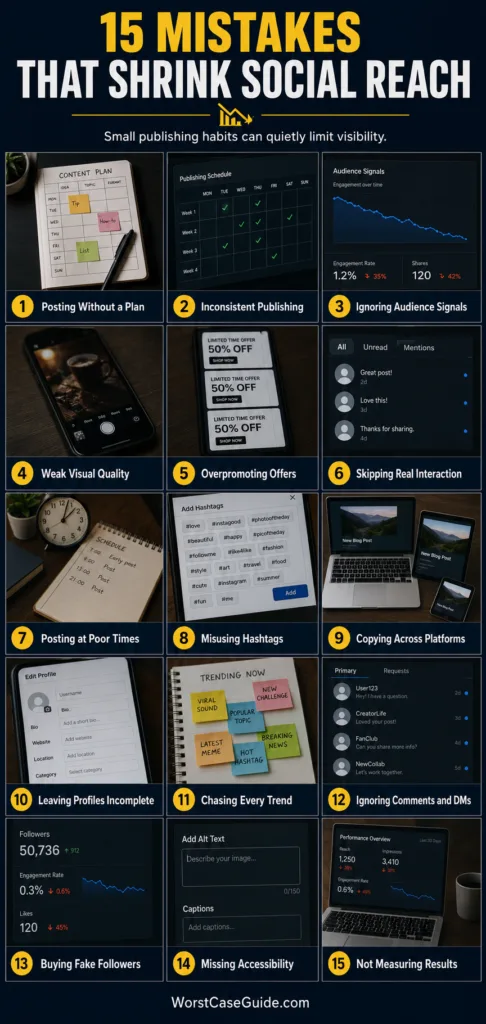
15 Mistakes That Reduce Organic Reach
Mistake 1: Publishing Without a Clear Audience Promise
Why It Happens
An account may cover every topic connected to a business, creator, or organization. The subjects make sense internally, but they may serve unrelated audience groups. A restaurant account, for example, might alternate between recipes, staff notices, supplier news, local politics, and sales offers.
Early Warning Signs
- Different posts attract entirely different followers.
- Returning-viewer or returning-audience figures remain low.
- People engage with one topic and ignore the next several posts.
- The profile description and recent content suggest different purposes.
Worst-Case Outcome
The platform receives inconsistent evidence about who may value future posts. Distribution becomes unreliable, while followers learn that most posts are probably not meant for them.
Safer Approach
A clearer content promise can connect several related themes to one audience need. In smaller accounts, two or three dependable content categories may be enough. Larger organizations may need separate accounts when their audiences have little meaningful overlap.
Mistake 2: Copying the Same Post Across Every Platform
Why It Happens
Cross-posting saves production time. The trouble begins when efficiency turns into identical publishing: the same dimensions, opening line, caption length, call to action, and editing style appear on every network.
Early Warning Signs
- Text or subtitles are covered by interface controls.
- Captions refer to features that do not exist on the destination platform.
- A visible watermark identifies another network.
- One platform repeatedly performs far below the others.
Worst-Case Outcome
The content feels imported rather than native. Viewers leave early, recommendation testing weakens, and duplicated or minimally changed material may receive less distribution on platforms that favor original work.
Safer Approach
The underlying idea can remain the same while its delivery changes. A detailed LinkedIn post might become a short vertical demonstration, a carousel, or a search-oriented video. Adaptation does not always require a new production session; it requires attention to how people use each platform.
Mistake 3: Delaying the Value of the Post
Why It Happens
Creators often add introductions, logo animations, background stories, or greetings before revealing the subject. These elements may feel polite or professional during editing, but a scrolling viewer has not yet agreed to wait.
Early Warning Signs
- Video retention drops sharply during the opening seconds.
- People swipe before the main point appears.
- Carousel viewers rarely move beyond the first slide.
- Text posts hide their useful point beneath a long preamble.
Worst-Case Outcome
Even accurate, well-produced material receives too little attention for the system to test it more widely. Production effort rises while distribution remains flat.
Safer Approach
The opening can identify the subject, result, tension, or useful detail immediately. This does not require exaggerated hooks. A precise first sentence or clear first visual often gives viewers enough reason to continue.
Mistake 4: Treating the Account as an Advertising Board
Why It Happens
Organizations naturally want posts to support products, services, events, or website traffic. Over time, nearly every publication becomes an announcement, offer, launch, or request.
Early Warning Signs
- Most captions contain a sales instruction.
- Followers view posts but rarely save, share, or discuss them.
- Reach falls during repeated promotional campaigns.
- Comments appear mainly when discounts are offered.
Worst-Case Outcome
Followers stop treating the account as a useful source. Lower voluntary interaction reduces the content’s ability to travel through recommendations and person-to-person sharing.
Safer Approach
Promotional posts can sit beside demonstrations, explanations, comparisons, customer questions, behind-the-process material, and informed observations. If the account supports a narrow commercial purpose, useful pre-purchase and post-purchase information can still attract the right audience.
Mistake 5: Using an Unstable Posting Rhythm
Why It Happens
Posting often depends on spare time, launches, or sudden pressure to improve reach. Long periods of silence are followed by several posts in one day. When results remain weak, even more content is added.
Early Warning Signs
- The publishing calendar repeatedly collapses.
- Several similar posts compete for the same audience within hours.
- Quality drops during high-volume periods.
- The team cannot respond to comments on everything it publishes.
Worst-Case Outcome
Audience attention becomes difficult to predict, performance data becomes noisy, and content fatigue develops. In extreme cases, high-volume automated activity may resemble spam and lead to visibility or account restrictions.
Safer Approach
A sustainable schedule is more useful than a universal posting number. If production capacity is limited, fewer well-prepared posts may provide cleaner learning. Timing can then be adjusted using audience activity and actual results rather than generic “perfect time” charts.
Mistake 6: Buying Engagement or Using Engagement Bait
Why It Happens
Follower packages, automated comments, engagement groups, reaction polls, and forced “comment yes” prompts can produce visible activity quickly. They seem to offer social proof during slow growth.
Early Warning Signs
- Follower growth is detached from profile visits or content views.
- Comments are generic, repetitive, or unrelated.
- Large reaction counts produce few saves, inquiries, or returning viewers.
- Audience locations and interests no longer match the account.
Worst-Case Outcome
Artificial activity contaminates audience data and makes real performance harder to interpret. Platforms may remove metrics, limit distribution, restrict features, or suspend accounts when manipulation violates their rules.
Safer Approach
Questions work better when a real answer adds to the discussion. Partnerships, community participation, customer contributions, and properly targeted advertising can expose content to real people without presenting purchased activity as organic interest.
Mistake 7: Reposting Without Adding Original Value
Why It Happens
Trending clips, quotes, memes, and third-party videos provide a fast publishing supply. Minor edits such as borders, captions, speed changes, or a new soundtrack may be mistaken for meaningful transformation.
Early Warning Signs
- Most posts can be found on larger accounts.
- Reposted videos carry watermarks or creator labels.
- Followers remember the material but not the account that shared it.
- Original posts and reposts have no clear editorial connection.
Worst-Case Outcome
Recommendation systems may favor the original version, deprioritize duplicates, or classify a repost-heavy account as ineligible for some discovery surfaces. Copyright complaints create another risk.
Safer Approach
Third-party material may support original analysis, reporting, criticism, education, or a properly licensed collaboration. The new contribution should be clear enough that the post has a purpose beyond redistributing someone else’s work.
Mistake 8: Giving Platforms Too Little Topic Context
Why It Happens
Captions may be vague, titles may omit the actual subject, and hashtags may consist only of broad popularity terms. Spoken videos sometimes never name the topic clearly, while on-screen text favors clever wording over searchable language.
Early Warning Signs
- Search traffic remains low despite steady publishing.
- Comments reveal that viewers misunderstood the subject.
- Hashtags attract irrelevant accounts.
- Content appears beside unrelated recommendations.
Worst-Case Outcome
The platform tests the post with poorly matched viewers. Their weak response may stop wider distribution before the intended audience encounters it.
Safer Approach
Titles, captions, spoken words, on-screen text, descriptions, categories, and a small set of relevant hashtags can reinforce the same subject. Natural clarity is more useful than repeating a keyword or filling the caption with loosely related tags.
Mistake 9: Ignoring Mobile Viewing and Accessibility
Why It Happens
Content is often reviewed on a large editing screen rather than inside the final mobile interface. Text seems readable, audio seems clear, and important objects appear fully visible until platform controls cover them.
Early Warning Signs
- Subtitles are clipped or hidden behind buttons.
- Text requires pausing or zooming.
- Videos depend on sound but lack accurate captions.
- Images contain information that is absent from the caption or alternative text.
Worst-Case Outcome
People leave because the content is uncomfortable or impossible to consume in their setting. The account loses both accessibility and the retention signals that often support further distribution.
Safer Approach
Posts can be checked inside the intended platform before publication. Readable contrast, accurate captions, safe text placement, clear audio, suitable dimensions, and descriptive alternative text make the material usable in more viewing conditions.
Mistake 10: Turning Every Post Into an Exit Ramp
Why It Happens
Website visits, newsletter subscriptions, sales pages, and downloads may be the business goal. As a result, each post gives only a fragment of information and immediately asks the viewer to leave.
Early Warning Signs
- Captions repeatedly say “link in bio” without delivering useful context.
- Posts receive impressions but little on-platform interaction.
- Link clicks remain low because viewers have not gained enough trust.
- Accounts without an external request perform noticeably better.
Worst-Case Outcome
The audience learns that posts are previews for something elsewhere. This can reduce saves, shares, viewing time, and discussion even when the platform applies no direct penalty to external links.
Safer Approach
A post may provide a complete useful idea before offering a relevant next step. Some publications can focus entirely on on-platform value, while link-oriented posts can be reserved for situations where the destination genuinely extends the subject.
Mistake 11: Publishing and Then Leaving the Conversation
Why It Happens
Production and scheduling receive most of the available time. Comment replies, mentions, direct questions, and community discussions are treated as optional tasks after publication.
Early Warning Signs
- Questions remain unanswered for days.
- Repeat commenters stop participating.
- Comments contain useful follow-up topics that are never developed.
- The account posts frequently but rarely interacts elsewhere.
Worst-Case Outcome
The account gains views without forming an active audience. People have fewer reasons to return, contribute, or share the content with others.
Safer Approach
Conversation time can be included in publishing capacity. Thoughtful replies, follow-up posts, credited audience questions, and relevant participation in nearby communities may strengthen relationships. Instant replies are not required, and repetitive automation can do more harm than a slower human response.
Mistake 12: Chasing Trends That Do Not Fit the Audience
Why It Happens
A trending sound, meme, challenge, or news topic can appear to offer ready-made reach. The account joins even when the trend has little connection to its subject or audience.
Early Warning Signs
- Trend posts gain views but few relevant follows.
- New followers ignore the account’s normal content.
- The connection between the trend and the account feels forced.
- Performance disappears as soon as the trend ends.
Worst-Case Outcome
A viral post attracts an audience that does not care about later publications. Follower totals rise while average reach, retention, and audience fit weaken.
Safer Approach
A trend may be useful when it helps explain a familiar audience problem or presents an established topic in a timely format. If the account’s normal audience would not value the post without the trend, the reach may offer little lasting benefit.
Mistake 13: Measuring Success With Likes Alone
Why It Happens
Likes are visible, familiar, and easy to compare. Other measures such as watch time, completion, saves, shares, qualified profile visits, returning viewers, search discovery, and negative feedback require more interpretation.
Early Warning Signs
- Popular posts fail to attract relevant followers or inquiries.
- Low-like posts continue receiving search views and saves.
- The team cannot state the intended job of each content type.
- Every post is judged by the same metric.
Worst-Case Outcome
The account repeats easily liked material while abandoning content that builds discovery, trust, or future demand. Reach may look active without supporting the actual audience goal.
Safer Approach
Metrics can be matched to purpose. A short educational video may be assessed through retention and saves. A discussion post may depend on relevant comments. A discovery post may be judged through non-follower reach, search exposure, and qualified profile activity.
Mistake 14: Ignoring Eligibility, Settings, and Account Warnings
Why It Happens
Weak reach is often treated as a creative problem. Yet a private profile, restricted visibility setting, copyright issue, removed post, recommendation warning, age limitation, or repeated policy concern may affect who can discover the account.
Early Warning Signs
- Non-follower reach falls close to zero across many posts.
- Account-status or policy panels show unresolved notices.
- Public posts are unavailable when viewed while logged out.
- Certain features, sounds, monetization tools, or recommendation surfaces become unavailable.
Worst-Case Outcome
Months of new content are published while the account remains unable to enter normal recommendation or search surfaces. Repeated unresolved violations may lead to wider restrictions.
Safer Approach
Professional dashboards, account-status pages, copyright notices, visibility controls, and recommendation eligibility can be reviewed during a reach decline. Appeals may be appropriate when a decision appears incorrect. Deleting random posts without identifying the notice rarely provides a reliable diagnosis.
Mistake 15: Changing Everything Before the Data Is Clear
Why It Happens
A disappointing result creates pressure for immediate action. The topic, format, posting time, caption style, length, visual design, and call to action all change at once. Low-performing posts may also be deleted before their later discovery pattern becomes visible.
Early Warning Signs
- No content format is repeated long enough for comparison.
- Reports compare unrelated posts and audience conditions.
- Decisions rely on the first few hours only.
- The team cannot explain which change improved or reduced performance.
Worst-Case Outcome
Reach management becomes guesswork. Useful formats are abandoned during normal variation, weak ideas are repeated after one lucky result, and the account never develops dependable evidence.
Safer Approach
Smaller controlled tests can isolate one main variable: opening, topic, length, format, posting window, or call to action. Results are more useful when compared across several similar posts and reviewed after enough time has passed for that platform’s discovery cycle.
General Risk Patterns Behind Reach Declines
Audience Mismatch
Unrelated topics, unsuitable trends, artificial followers, and broad hashtags can place content in front of people who were never likely to care. The apparent problem is low engagement; the deeper problem is distribution to the wrong audience.
Weak Consumption Signals
Slow openings, unreadable text, poor cropping, missing captions, and unnecessary length create early exits. A post may contain useful information while still being difficult to consume.
Low Trust and Repetition
Constant promotion, engagement bait, duplicated material, and vague promises train audiences to expect little value. Once that expectation forms, even stronger posts may need time to rebuild attention.
Restricted Discovery
Visibility settings, recommendation eligibility, policy notices, copyright claims, and private-account controls differ from an ordinary performance decline. Creative changes alone cannot resolve an account-level restriction.
Poor Learning Loops
Vanity metrics, premature decisions, uncontrolled changes, and deleted data prevent useful comparisons. The account stays busy but learns very little from what it publishes.
A Safer Reach Review Cycle
- Check access and eligibility. Visibility settings, account status, recommendation notices, copyright issues, and feature restrictions can be reviewed first.
- Separate account-wide decline from post-level decline. One weak publication suggests a content issue; a sustained fall across formats may deserve a broader audit.
- Identify where distribution changed. Follower reach, non-follower reach, search, recommendations, profile discovery, and external traffic can tell different stories.
- Review consumption behavior. Openings, retention, completion, carousel progression, saves, shares, and negative feedback reveal where attention was lost.
- Compare like with like. Similar topics and formats offer more useful comparisons than unrelated viral and routine posts.
- Test one main change. A clearer opening, narrower subject, different length, or more suitable format can be evaluated without replacing the entire strategy.
- Record the outcome. A simple log of topic, audience, format, opening, publishing time, and result can expose patterns that memory misses.
A practical distinction: Reach problems usually fall into one of three categories: the content was not eligible to travel, it reached the wrong people, or the people who saw it did not respond strongly enough. Each category calls for a different response.
Frequently Asked Questions
Why has my social media organic reach suddenly dropped?
A sudden drop may result from normal performance variation, lower topic demand, audience inactivity, stronger competing content, format changes, weak early retention, or a recommendation restriction. Account status and traffic sources can help separate an eligibility problem from an ordinary content-performance decline.
Does deleting a low-performing post improve future reach?
There is no reliable rule that deleting an ordinary low-performing post improves later distribution. Removal also erases useful comparison data and may interrupt delayed search or recommendation discovery. Deletion may still make sense for inaccurate, outdated, duplicated, rights-restricted, or brand-damaging material.
Do too many hashtags reduce organic reach?
A large group of irrelevant or repetitive hashtags can create unclear context and attract poorly matched viewers. The effect is not a universal numerical penalty. A smaller set of accurate terms, supported by a clear caption and subject, usually provides cleaner context.
Do external links reduce social media reach?
External links are handled differently across platforms, and a direct penalty should not be assumed without account-level evidence. Link-focused posts can still perform poorly because they offer limited on-platform value or ask people to leave before trust has formed.
How often should an account post for better reach?
No posting frequency fits every account. A workable rhythm depends on production capacity, platform, audience behavior, and the ability to maintain quality and conversation. Consistent testing with a sustainable schedule provides better evidence than sudden high-volume publishing.
Is low reach proof that an account is shadowbanned?
No. Low reach alone does not prove a hidden restriction. A recommendation warning, account-status notice, unavailable feature, or sustained loss of non-follower discovery provides stronger evidence. Ordinary audience mismatch and weak retention are more common explanations.
Can fake followers reduce organic reach?
Fake or uninterested followers can distort audience data and weaken engagement ratios because they do not behave like the intended audience. Purchased activity may also violate platform rules. Removing the underlying acquisition source and rebuilding with relevant viewers is more useful than adding further artificial engagement.
How long does organic reach take to recover?
Recovery time depends on the cause. A weak content format may improve after several focused tests, while audience mismatch or an account-level restriction may take longer. Progress is better judged across comparable posts and discovery sources than through one unusually strong publication.