Moving is often treated as a transport problem. It is usually a handoff problem instead. Furniture leaves one space, passes through stairs, lifts, trucks, storage gaps, weather, tired decisions, and finally lands in a home that may still be half-set up. That is why a move can look “mostly done” while the bed is unbuilt, the Wi-Fi is still dead, and a scratched table is leaning against the wall like an unwanted receipt. Settlement, in practical terms, means daily life starts working again.
What makes this topic risky is not one dramatic failure. It is the way small oversights stack. A missing tool delays disassembly. That delay pushes loading into a tighter window. The tighter window leads to rushed lifting. Rushed lifting leaves marks on wood, chipped corners, bent brackets, and a longer first night than anyone expected. The move becomes a chain, and the weakest link is rarely the truck.
Quiet Risk: Many moving articles focus on boxes and cost. The more stubborn problem is functional delay: furniture arrives, but the home still does not work properly. That gap is where wasted time, repeat lifting, surface damage, and avoidable frustration tend to grow.
Why This Topic Gets Risky Faster Than People Expect
A furniture-damaging move rarely begins with reckless behavior. It usually begins with a reasonable assumption that turns out to be wrong. The sofa fit when it came in, so it should fit when it goes out. The movers will “figure it out.” The building probably does not need a freight lift booking. The internet can be activated whenever. Each thought feels small. Together, they can turn moving day into wet cardboard and hallway gridlock.
In smaller moves, the hidden risk is often underplanning because the job looks manageable. In larger systems such as family homes, apartment towers, or mixed work-from-home households, the risk shifts toward dependency failure. One blocked access point or one delayed utility can slow the whole settlement process.
Common Assumptions That Create Trouble
- “If it survived daily use, it will survive the move.” Furniture is often damaged during transitions, not while standing still.
- “Packing and moving are the same task.” They overlap, but they create different risks and need different timing.
- “The new place is ready once I have the keys.” Access, utilities, cleaning, elevator rules, and room readiness may still be unresolved.
- “The cheapest quote and the lowest total cost are the same thing.” They often are not, especially when delays and rework appear.
- “I will remember where each screw, shelf, and cable goes.” This is one of the most expensive forms of optimism in any move.
| Mistake | Typical Furniture Damage | Typical Settlement Delay |
|---|---|---|
| No measurements | Scraped edges, broken legs, dented frames | Truck waits, repacking, awkward rerouting |
| Weak protection | Gouges, chipped veneer, broken glass | Sorting damage, replacing parts, re-cleaning areas |
| Poor access planning | Rain exposure, corner impacts, dropped items | Elevator queues, parking issues, missed time slots |
| No inventory or photos | Damage becomes harder to prove or even notice | Longer disputes, slower unpacking, missing-item confusion |
| No unload sequence | Repeat lifting, floor scuffs, hardware loss | Bed, kitchen, desk, and storage stay unusable longer |
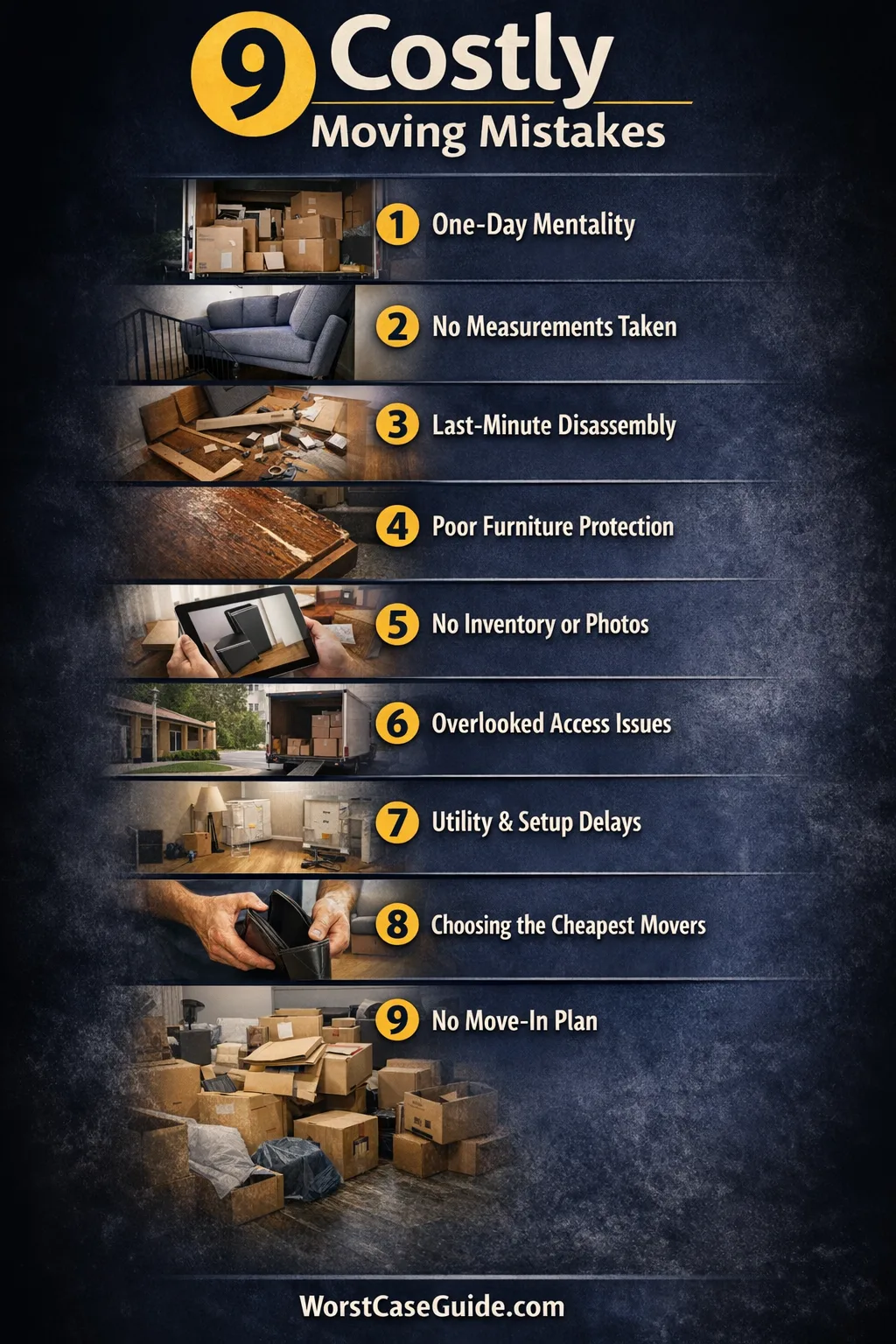
9 Moving Mistakes That Damage Furniture and Delay Settlement
Mistake 1: Treating The Move As A One-Day Event
This mistake sits at the front of many bad moves. A move is not just loading and unloading. It includes sorting, packing, disassembly, access coordination, cleaning, paperwork, handover, and the first wave of setup at the new place. Once all of that is squeezed into one date, people start borrowing time from safety.
Why It Happens
The visible part of the move is the truck, so the schedule is built around the truck. The hidden work is treated like background noise. It rarely is. That mismatch leads to rushed packing, mixed hardware bags, and overfilled boxes that feel fine until someone lifts them.
Early Warning Signs
- Most tasks are still unstarted in the final week.
- No room-by-room packing sequence exists.
- Cleaning, key handover, or utility timing is still vague.
- There is no time buffer for traffic, weather, or slow loading.
Worst-Case Outcome
The move becomes a race against the clock. Furniture gets dragged instead of carried, drawers are left full because emptying them takes time, and parts are removed in a hurry then misplaced. The result is physical damage plus a house full of items that cannot be used properly on arrival.
Safer Approach
A staged timeline usually reduces risk more than extra muscle does. If you are in a smaller move, separate packing day from move day. If you are in a larger household move, it often helps to treat disassembly, loading, transport, and first-night setup as four distinct phases rather than one blur.
Mistake 2: Skipping Measurements And Route Checks
People often measure the room. They forget the route. Door frames, stair turns, lift interiors, hallway width, handrails, ceiling height, loading dock corners, and even the angle of a parking approach can decide whether a piece moves cleanly or gets chewed up on the way through.
Why It Happens
There is a common belief that if furniture entered one home once, it can leave it the same way. Homes change. New flooring is added. Railings appear. Door stops stay fixed. The new place may be tighter than the old one, even if the room itself looks larger.
Early Warning Signs
- No one has measured the old property and the new property.
- The move includes tight stairs, narrow corridors, or shared lifts.
- Large items have removable legs, doors, or headboards that are still attached.
- The plan depends on “angling it a bit more.”
Worst-Case Outcome
The sofa jams halfway through a turn. A cabinet is forced against a wall edge. Veneer cracks, legs twist, and the crew burns time trying three routes instead of one. Sometimes the piece has to be left in a hallway or returned to storage, which turns one moving day into two.
Safer Approach
A route-first check often reveals more than a room measurement does. If you are moving into an apartment building, lift depth and door width matter as much as the furniture itself. In houses with tight stairs, photos of corners and landings can clarify the plan before the first scrape happens.
Mistake 3: Leaving Disassembly Until The Last Minute
Some furniture travels better in one piece. A lot of it does not. Beds, dining tables, sectional sofas, shelving units, desks, wardrobes, and media units often become safer to move once certain parts are removed. The mistake is not failing to disassemble everything. It is failing to control what actually should be taken apart.
Why It Happens
People worry that disassembly will make reassembly harder, so they postpone the choice. Then moving day arrives, tools are missing, screw types are mixed, and someone says the sentence that usually starts trouble: “We’ll remember where this goes.”
Early Warning Signs
- No tool kit has been kept aside.
- Hardware bags are unlabeled or reused.
- Assembly manuals, photos, or part counts do not exist.
- Loose shelves, glass inserts, and detachable legs are still installed.
Worst-Case Outcome
Fast disassembly leads to stripped screws, bent brackets, missing dowels, warped side panels, and unstable reassembly. A bed frame that survived the truck may still be unusable that night because one small fitting disappeared into the cardboard fog. It sounds minor. It is not minor at 11:40 p.m.
Safer Approach
A controlled approach often means selective disassembly, not total disassembly. Photos, labeled hardware bags, and one clearly separated tool pouch can shorten both ends of the move. In larger households, assigning part ownership by room often cuts confusion more than memory ever does.
Mistake 4: Protecting Boxes Better Than Furniture
Boxes usually get the tape. Furniture needs the strategy. Wood surfaces, upholstered corners, glass shelves, stone tops, metal legs, and drawer fronts each fail in different ways. A cabinet can arrive structurally intact and still look rough enough to feel ruined. Cosmetic damage counts, especially in visible rooms.
Why It Happens
Packing materials are often bought with dishes and small items in mind. Then the large pieces are wrapped quickly, or barely at all, because the truck is already waiting. Protection becomes generic. Furniture damage is usually specific.
Early Warning Signs
- Bare wood or painted surfaces will touch walls, truck sides, or other furniture.
- Drawers and doors are not secured.
- Glass parts are staying inside units during transport.
- Soft items are expected to “buffer” hard furniture without real padding.
Worst-Case Outcome
Edges chip. Fabric snags. Drawer runners bend. Glass cracks under shifting pressure. One of the more frustrating outcomes is the slow damage you do not notice immediately: a leg loosened by impact, a rail slightly bent, a door that no longer closes cleanly after the move.
Safer Approach
Furniture protection tends to work better when it matches the material and the contact points. Corner protection, drawer restraint, removal of loose glass or shelves, and separation between hard surfaces usually matter more than adding “more wrap” in a vague way. If you are moving antique, lacquered, or easily marked pieces, handling time should be treated as part of protection, not as wasted time.
Mistake 5: Moving Without A Condition Record Or Inventory Trail
This is one of the least glamorous parts of a move, which is why it gets skipped. Yet it often decides whether damage is noticed, understood, and recoverable. Without a clear item list and pre-move condition record, people discover losses late and argue from memory.
Why It Happens
Administrative work feels optional when there are boxes everywhere. It does not feel urgent. Then a cracked sideboard appears, one shelf is missing, or a box count seems off by one. At that point, “I think it was fine before” is a weak position.
Early Warning Signs
- No photo set exists for fragile or high-value pieces.
- Boxes are not numbered.
- Furniture condition is not noted anywhere.
- The move relies on memory instead of a simple item trail.
Worst-Case Outcome
Damage is found after the room is already cluttered, so the exact moment and cause stay muddy. Missing items go unnoticed until the home is half-unpacked. Claims, if any are possible under the move terms, become harder because evidence is thin and notice windows may differ by contract or route type.
Safer Approach
A light inventory system often does enough. Photos of condition, box numbers, room labels, and a short note for pre-existing scratches or loose joints can create a usable record without turning the move into office work. The goal is clarity, not bureaucracy.
Mistake 6: Ignoring Access Logistics Until The Truck Arrives
Moving plans often stop at the address. Real moves happen at the access layer: parking rules, loading distance, building management windows, freight lifts, entry codes, dock access, floor protection requirements, and weather exposure between truck and door.
Why It Happens
People assume the hard part is lifting. Often, the hard part is the route around other people, other vehicles, and building rules. In apartment buildings, one blocked loading area can slow a move more than heavy furniture does.
Early Warning Signs
- No one has confirmed parking, permits, or lift reservations.
- The mover or helper asks access questions and gets uncertain answers.
- The building has shared corridors or strict moving windows.
- The weather forecast suggests rain, wind, or heat exposure for a long carry.
Worst-Case Outcome
The truck parks far away. Furniture travels farther, gets bumped more often, and sits longer in bad conditions. Time slots slip. Additional carrying fees may appear. A move that should have ended by afternoon spills into evening, when fatigue becomes another source of dents, drops, and poor judgment.
Safer Approach
If you are moving into a managed building, access details often matter as much as the crew size. In houses, the relevant questions may be different: driveway angle, gate width, wet ground, stair grip, and where large items can be staged temporarily without being damaged. Logistics is not a side note. It is part of furniture protection.
Mistake 7: Assuming Utilities, Internet, And Handover Timing Will Sort Themselves Out
This is where damage risk and settlement delay quietly meet. A move can be physically successful and still functionally poor. No hot water. No internet. No confirmed keys for one room. No cleared floor for the bed. No working lights in the space where furniture now needs to be assembled.
Why It Happens
Transport gets the attention because it is visible. Utility overlaps, cleaner timing, key release, appliance testing, and first-night usability feel secondary. They are not secondary if someone needs to work the next morning, store food safely, or sleep on assembled furniture rather than among boxes.
Early Warning Signs
- Activation dates are not confirmed in writing.
- Old and new services do not overlap at all.
- Move-in cleaning, repairs, or paint touch-ups are still unfinished.
- No first-night room has been prioritized.
Worst-Case Outcome
The home becomes a warehouse with keys. Furniture has to be moved again later so floors can be cleaned, sockets can be reached, or repairs can be done. Repeat handling raises the odds of scratches and chips. Settlement stretches out, sometimes by days, sometimes by a full tired week.
Safer Approach
A move tends to settle faster when one room is treated as operational first: usually the bedroom, bathroom, or work area, depending on the household. If you are moving with children, pets, or remote work needs, service timing becomes less of a convenience issue and more of a stability issue.
Mistake 8: Choosing Movers Or Help Based Mostly On Price
Cheap help can be expensive in very ordinary ways. Not cinematic ways. A slow crew, poor communication, vague terms, weak furniture handling, or surprise charges for stairs, long carry distance, or waiting time can turn a modest quote into an expensive afternoon. The risk is not only financial. It is also care quality.
Why It Happens
Moving quotes are tiring to compare, so people simplify the decision. Lowest number wins. The trouble is that some quotes describe only transport, while others quietly include wrapping, disassembly, equipment, crew size, or liability terms that change what happens if furniture is damaged.
Early Warning Signs
- The quote does not clearly describe the scope of service.
- Inventory details are barely discussed.
- Access complications are ignored during quoting.
- Coverage, delay, and change terms are hard to pin down.
Worst-Case Outcome
The crew arrives underprepared. Furniture is rushed because the schedule is too tight or the job was underpriced. A damaged item then meets weak documentation and limited compensation paths. What looked like savings turns into delay, repairs, replacements, or a longer stretch of “we’ll fix that later.”
Safer Approach
A steadier comparison usually looks at scope, handling method, access assumptions, crew size, and liability terms together. If you are doing a hybrid move with friends plus paid help, the handoff between those two groups also matters. Mixed responsibility can blur where damage actually happened.
Mistake 9: Finishing The Move Without A Settlement Sequence
Unloading is not settlement. That difference catches many people. When every box enters the new home without a destination plan, heavy items get moved twice, sometimes three times. This is where floor scuffs, crushed corners, lost hardware, and late-night frustration show up all at once.
Why It Happens
There is a natural urge to get everything indoors fast and sort it later. That can work in very small moves. In fuller households, it often creates a traffic jam indoors. Rooms lose shape. Essential furniture gets buried behind nonessential items. The home stops feeling like a destination and starts feeling like a storage unit with a kettle.
Early Warning Signs
- Boxes are not marked by room.
- There is no priority list for the first 12 to 24 hours.
- Large furniture placement is undecided on arrival.
- The bed, kitchen basics, and chargers are packed somewhere “easy to find.”
Worst-Case Outcome
Furniture gets shifted repeatedly to clear pathways or reach outlets, wardrobes, and appliances. Each repeat move adds friction, and friction leaves marks. Settlement slows because the household keeps spending energy on relocation inside the new home instead of actually living in it.
Safer Approach
A simple unload sequence usually pays off fast: bed first, bathroom basics, kitchen basics, work setup, then everything else. In smaller projects, room labels may be enough. In larger systems, color coding, numbered zones, or a basic floor plan can reduce repeat lifting and protect both furniture and energy.
General Risk Patterns Behind Bad Moves
Hidden Dependencies
Bad moves often fail through dependencies that looked too small to matter: one missing Allen key, one access code, one utility activation, one parking restriction, one room that was not actually ready. These are the loose threads that pull at the whole jumper.
Damage At Transition Points
Furniture is most vulnerable where surfaces, angles, and hands change. Doorways, lift thresholds, truck edges, ramps, and room corners create the most contact. That is why a piece can survive years of daily use and still get marked in twenty seconds on moving day.
Evidence Problems After The Fact
People notice damage late, after boxes are stacked, packaging is gone, and memories are already fuzzy. A thin record makes every next step harder. Not impossible, just harder. That extra friction is part of the loss.
Fatigue Changes Judgment
Many poor decisions happen late in the move, not early. Tired people lift awkwardly, skip padding “for one minute,” pile items where they do not belong, and postpone setup that would have prevented a second round of handling. Fatigue is not just discomfort. It is a risk multiplier.
A Practical Reading Of Risk: A safer move usually comes from reducing repetition, uncertainty, and forced improvisation. Fewer repeat lifts, clearer routes, clearer records, and a faster first-night setup tend to protect furniture and shorten the time between arrival and normal life.
FAQ
What furniture gets damaged most often during a move?
Pieces with exposed corners, glass parts, long legs, delicate finishes, and removable sections usually carry more risk. Beds, dining tables, shelving units, dressers, sectionals, and media units are common trouble spots because they combine weight, awkward shape, and assembly hardware.
Is it better to disassemble all furniture before moving?
Not always. Some items travel safely as they are, while others become easier to protect once parts are removed. The safer question is not “Should everything come apart?” but “Which parts create width, weakness, or break risk if they stay attached?”
Why does a move feel finished even though the home still does not work?
Because transport and settlement are different phases. A home may contain all the belongings and still be functionally delayed by missing utilities, blocked rooms, unassembled furniture, or poor unload order. Arrival is not usability.
Do photos and inventory notes really make a difference?
Yes, especially when damage is discovered later or a box count seems wrong. A light record of condition, item numbers, and room labels often makes unpacking clearer and any follow-up discussion less uncertain. It creates reference points instead of guesswork.
What is the most overlooked source of moving-day delay?
Access logistics are often missed: parking distance, lift booking, loading windows, building rules, or a route that looks open until a large item reaches the tight turn. These details seem small on paper and very large in real life.