Flooring is one of those renovation choices that looks easy until it is not. A sample board feels simple. A finished house is not. Once subfloor condition, room moisture, sunlight, pets, chair legs, cleaning habits, and door clearances enter the picture, the floor stops being a décor choice and starts behaving like part of the house. That is why a bad flooring decision can be so stubborn: it is seen every day, walked on every day, and rarely cheap to undo.
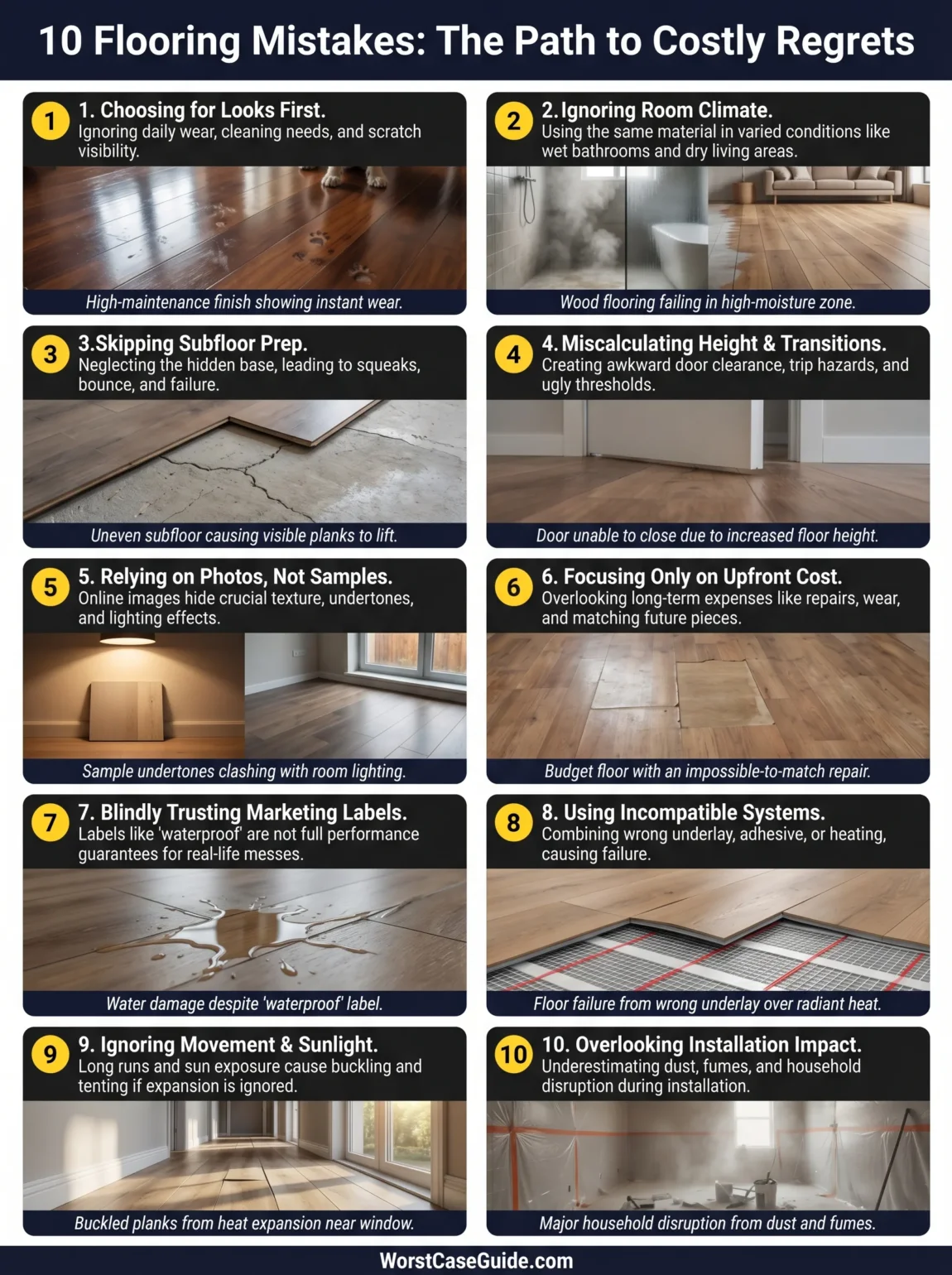
Why Flooring Selection Is Risky In Home Renovations
Many renovation choices can be changed later with moderate effort. Flooring usually is not one of them. It touches trim, doors, cabinets, stairs, thresholds, underlay, heating performance, acoustics, and the way adjacent rooms feel together. A floor that looks fine in a showroom can become noisy, hard to clean, visually heavy, or awkward at transitions once it is installed across a real home.
There is also a timing problem. Flooring is often chosen while the renovation still feels abstract, before the household has fully thought through spills, wet shoes, pets, rolling chairs, sunlight, or whether future repairs will be possible. The mistake usually begins early. The cost shows up later.
One quiet risk pattern shows up again and again: people compare materials, but the house experiences systems. The floor, the subfloor, the room climate, the installation method, and the daily use pattern all push on each other.
Common Wrong Assumptions Before A Flooring Purchase
- “If it looks good in the showroom, it will look good at home.” Home lighting, wall color, dust, and room size often change that impression fast.
- “Waterproof means worry-free.” The surface may resist water, while the edges, subfloor, adhesive, or transitions still do not.
- “Using one floor everywhere is always the cleanest design choice.” Sometimes it is. In other houses, it forces a weak compromise into rooms that need very different performance.
- “The installer will solve whatever the floor needs.” Some problems can be corrected on site. Others are built into the product choice itself.
- “The lowest material price is the lowest total cost.” Trim, extra prep, replacement difficulty, maintenance products, and future matching can change that math.
- “A label like scratch-resistant or pet-friendly settles the question.” Labels help, but they do not describe how the floor will age in one specific home.
| Mistake | What Gets Missed First | What Fails Later | Where It Usually Hurts Most |
|---|---|---|---|
| Choosing For Looks Alone | Daily wear pattern | Finish, cleaning tolerance, comfort | Living rooms, entries, open-plan spaces |
| Ignoring Room Conditions | Moisture, traffic, noise | Edges, joints, surface stability | Bathrooms, basements, kitchens, hallways |
| Skipping Subfloor Review | Flatness, dryness, soundness | Squeaks, bounce, movement, callbacks | Whole-house renovations |
| Forgetting Height And Transitions | Total build-up | Door swing, trip points, awkward thresholds | Doorways, stairs, kitchens |
| Buying On Price Alone | Repair path and lifespan | Visible wear, mismatch during replacement | Family homes, rentals, large areas |
The 10 Flooring Selection Mistakes That Create The Most Trouble
Mistake 1: Choosing Flooring For Appearance Before Daily Use
The clean, seamless look seen in renovation reels can be persuasive. Still, a floor is not viewed once. It is lived on. Gloss level, texture, softness underfoot, and how the surface shows dust or scratches matter more after week three than on purchase day.
Why It Happens
People shop visually first. That is natural. The mistake appears when the visual test becomes the only test. Dark glossy surfaces, pale matte finishes, heavily grained patterns, and trendy wide planks each carry trade-offs in maintenance and wear visibility.
Early Warning Signs
- The product looks best under showroom lighting, not home lighting.
- No one in the project discussion has asked how often the floor will need cleaning.
- Comfort, slipperiness, acoustics, and repairability are barely mentioned.
Worst-Case Outcome
The floor still looks attractive in photos, yet becomes irritating in real use: every footprint shows, every pet nail leaves a mark, chairs sound harsh, the room feels colder than expected, and the owner begins adapting daily habits around the floor instead of the floor serving the home.
A Safer Approach
Start with use, then narrow by style. In smaller projects, that may mean asking what the room needs on a Tuesday evening, not what it looks like in a staged photo. In larger systems, it helps to rank priorities: wear, cleaning tolerance, acoustics, warmth, and visual continuity.
Mistake 2: Treating Every Room As If It Has The Same Climate
A home does not behave like one uniform box. Entryways collect grit and water. Bathrooms trap humidity. Basements can feel calm one season and slightly damp the next. Kitchens mix spills, chair movement, and heat. One material logic rarely fits all rooms equally well.
Why It Happens
Many homeowners want continuity, and continuity can look excellent. The trouble begins when visual unity is allowed to overrule room conditions. Wood in wet zones, carpet in damp spaces, or delicate finishes in heavy traffic areas often start with that kind of compromise.
Early Warning Signs
- The same floor is being considered for bathroom, kitchen, bedroom, and basement without separate discussion.
- The plan talks about “whole-house flow” but not about moisture, traction, or cleaning needs.
- There is no note about pets, children, older adults, or mobility needs.
Worst-Case Outcome
Edges swell, joints loosen, surfaces become slippery at the wrong moments, and the rooms that need resilience most receive the least suitable surface. It may still be possible to live with it. It just stops feeling like a wise renovation.
A Safer Approach
If the renovation includes very different room types, a room-by-room performance check is usually safer than forcing one answer everywhere. Sometimes that leads to one continuous floor. Sometimes it leads to two related materials with cleaner risk control. A house can feel coherent without pretending every room lives the same life.
Mistake 3: Treating The Subfloor As Someone Else’s Problem
People often say, “We’ll decide the visible floor now and let the installer handle the base.” That separation sounds tidy. It is not. The visible floor and the hidden base are tied together. Unevenness, moisture, flex, old adhesive residue, damaged sheathing, or concrete that has not settled properly can undo a good product choice.
Why It Happens
Subfloor issues are not exciting. Samples are. So the purchase gets attention while the substrate check gets pushed back. Many flooring failures still trace back to moisture, movement, poor prep, or adhesive mismatch rather than to the decorative surface alone.
Early Warning Signs
- No one has asked whether the subfloor is flat, dry, and structurally sound.
- The renovation scope includes leveling or patching “if needed,” with no real allowance for it.
- The household expects the installation to reveal problems and solve them on the same day.
Worst-Case Outcome
Squeaks, hollow spots, cupping, soft areas, loose planks, cracked grout lines, adhesive failure, and repeated callbacks. This is where a floor can become a postcard over a problem.
A Safer Approach
Selection gets safer when the product is chosen with the substrate in mind. If you are working on an older home, some materials are more forgiving than others. If the base is concrete, moisture behavior deserves early attention, not last-week attention.
Mistake 4: Forgetting Total Floor Height, Thresholds, And Door Clearance
This mistake hides in the drawings. A floor is not just the visible layer. It is the visible layer plus underlay, adhesive, leveling compound, membranes, heating systems, and trim. Add them together and the house can start arguing back.
Why It Happens
Homeowners compare finishes by color and material family, while the build team is quietly worried about build-up. Door bottoms, appliance clearance, stair nosing, and awkward transitions between rooms rarely appear on the sample board. They appear later, when they are harder to fix neatly.
Early Warning Signs
- The renovation plans show floor changes but not section details.
- There is no discussion of reducers, thresholds, stair edges, or door undercuts.
- The phrase “we’ll make it work at the doorway” appears more than once.
Worst-Case Outcome
Doors scrape, robots cannot cross thresholds, exterior entries become awkward, stair geometry looks off, and the polished whole-house look breaks at exactly the spots people notice with their feet.

A Safer Approach
Think in layers, not surfaces. In open-plan renovations, continuity matters, but so do clean transitions and safe height changes. In smaller projects, checking one doorway and one appliance clearance early can prevent a cascade of trim compromises later.
Mistake 5: Skipping Real Samples In The Actual Rooms
Online photos flatten texture, soften glare, and hide the way undertones behave next to cabinetry, paint, stone, and daylight. This is one of the most avoidable errors, yet it happens often because people feel they already “know the look.”
Why It Happens
Samples seem like a small step, almost too small to matter. Yet flooring covers a large visual field. A half-shade shift in undertone can make walls look dull, woodwork look yellow, or the whole room feel colder. What is neutral in the store may turn pink, gray, or beige at home.
Early Warning Signs
- The decision is being made from photos, tiny swatches, or memory.
- No one has checked the sample in morning, afternoon, and evening light.
- The product is being chosen before cabinets, paint, and countertops are finalized.
Worst-Case Outcome
The floor is technically fine, yet visually wrong. Rooms feel flatter, darker, busier, or less calm than intended. That kind of mistake is frustrating because nothing is “broken,” but the result still feels off every single day.
A Safer Approach
It usually helps to place larger samples beside trim, cabinets, and the next room’s finish. The showroom is a trailer. The house is the full film.
Mistake 6: Buying On Upfront Price Without Checking Lifespan, Repair Path, And Future Matching
Cheap flooring is not always a bad choice. Some projects need a modest budget and a practical answer. The mistake is narrower: judging value only by the first invoice. Wear layer, finish quality, refinishing options, plank replacement difficulty, and whether a matching product will still exist later all matter.
Why It Happens
Budgets put pressure on visible line items. The hidden line items come later: extra trim, faster wear, inability to refinish, or the awkward moment when one damaged area cannot be matched because the product line changed. Many short articles stop at “buy quality.” Real decisions need more than that.
Early Warning Signs
- The decision is based on price per square foot alone.
- No one has asked what happens if one plank, one tile, or one section fails later.
- The project is ordering only the exact measured quantity.
Worst-Case Outcome
The floor ages unevenly, repair pieces do not match, and a small future incident turns into a partial-room replacement. That is when a “budget win” starts looking expensive in slow motion.
A Safer Approach
When comparing options, it helps to ask three quiet questions: How will this age? How will this be repaired? Will matching material still be obtainable later? Those questions often separate merely cheap flooring from flooring that is economical in a real household.
Mistake 7: Letting Marketing Labels Do Too Much Decision-Making
Waterproof. Scratch-resistant. Kid-proof. Pet-friendly. Low-maintenance. These labels are useful, yet they are not a full description of performance. They usually refer to a specific test condition, surface behavior, or product layer. A home is messier than a label.
Why It Happens
Labels reduce complexity, and renovations create decision fatigue. So the brain reaches for a shortcut. “Waterproof” sounds final. “Scratch-resistant” sounds settled. The real question is always narrower: resistant to what, for how long, and under which conditions?
Early Warning Signs
- The household is using label language more than product specifications.
- No one has checked edge behavior, seam behavior, or substrate requirements.
- The sales conversation jumps from one marketing badge to another.
Worst-Case Outcome
Spills do not ruin the top surface, yet moisture still reaches vulnerable layers below. The floor resists light scratching, yet chair casters or grit wear it down. The product was not false; the interpretation was too broad.
A Safer Approach
Marketing terms work best as a starting point. The safer move is to translate them into everyday scenarios: muddy entryway, bathroom steam, dog bowls, office chair wheels, direct sun, or a dining table moved every weekend. Performance claims become clearer when tied to one real habit.
Mistake 8: Mismatching Underlay, Adhesive, Heating, And Installation Method
A flooring choice is rarely just “wood,” “tile,” or “vinyl.” It is also floating or glue-down, nailed or clicked, with one underlay or another, over radiant heat or not, over concrete or timber, with one adhesive family or another. This is where elegant material choices can quietly become bad system choices.
Why It Happens
People think in categories. Installations behave in combinations. Carpet and thick pad may feel warm, yet reduce heat transfer over radiant systems. Wood can perform well in many homes, though some builds benefit more from engineered boards than solid boards because dimensional movement is lower. Underlay can help acoustics in one case and create unwanted softness in another.
Early Warning Signs
- The product is being selected before the installation method is settled.
- Radiant heat, sound control, or adhesive choice is mentioned late in the process.
- Different trades are making assumptions about the floor stack without one shared detail.
Worst-Case Outcome
The floor feels too soft, too loud, too cool, too reactive to seasonal change, or not covered by warranty because the system components were never truly compatible. That outcome is annoying because each piece looked reasonable on its own.
A Safer Approach
If you are renovating one room, this may mean checking the full stack from subfloor to finish. In larger systems, one coordinated specification matters more than a string of separate product picks. A floor assembly should be chosen as a package, not as a pile of parts.
Mistake 9: Forgetting Movement, Sunlight, And Long Continuous Runs
People often assume movement problems belong to old laminate horror stories. Not quite. Many floating floors still need room to move, especially across wide spaces, near hot glazing, at fixed islands, and through long open-plan runs.
Why It Happens
Open layouts encourage the dream of one uninterrupted field of flooring. That can work beautifully. It can also ignore expansion needs, transition planning, and the fact that sunlight heats parts of a room unevenly. “Waterproof” and “rigid core” do not erase movement.
Early Warning Signs
- The plan runs flooring through many rooms with few or no breaks.
- There are large windows, strong afternoon sun, or heated zones.
- Kitchen islands, fireplaces, or columns are being treated as visual details rather than fixed obstacles.
Worst-Case Outcome
Tenting, buckling, pinching at edges, noisy transitions, or awkward emergency fixes where trim is added after the fact to relieve pressure. The floor may still be salvageable, but the clean look that justified the decision is gone.
A Safer Approach
Movement planning belongs in the selection stage because it affects which products are suitable for long runs and which layouts need better transition strategy. If a project values a seamless appearance above all else, that preference should be tested against room size, sun exposure, and fixed obstructions early.
Mistake 10: Ignoring Indoor Air Quality, Odor, And Household Downtime
Some flooring discussions stop at appearance, wear, and cost. Real homes add one more question: what will installation feel like while people are still living there? Adhesives, finishes, dust, odor, drying time, ventilation needs, and room closure can matter a lot, especially with children, pets, older adults, or work-from-home routines.
Why It Happens
Renovation planning often treats occupancy as background noise. Yet flooring can temporarily change how the house is used. Some products and finishing methods ask more of the household during installation than others. That is not always a deal-breaker. It should still be part of the choice.
Early Warning Signs
- No one has discussed ventilation, off-gassing, curing, or room downtime.
- The household plans to use the room immediately after installation with no buffer.
- Product decisions are being made without thinking about who will be in the home during the work.
Worst-Case Outcome
The family is pushed out of key spaces longer than expected, the house smells unpleasant, dust migrates farther than planned, and a product that looked convenient on paper becomes disruptive in daily life.
A Safer Approach
A safer selection process asks not only, “How will this look when it is done?” but also, “How will this install while the house is still functioning?” That small shift often changes the shortlist in a useful way.
General Risk Patterns Behind Most Flooring Regrets
- Surface Thinking Over System Thinking: The visible finish gets chosen first, while moisture, base layers, transitions, and movement are treated as side notes.
- Single-Room Thinking In A Multi-Room Renovation: One room looks good in isolation, though the doors, stairs, nearby materials, and circulation path tell a different story.
- Price Certainty Illusion: The material price feels concrete, while prep, trim, downtime, and future replacement stay vague until late.
- Label Trust Without Scenario Testing: Buyers trust broad claims but do not translate them into wet shoes, office chairs, pets, sunlight, or weekend cleaning habits.
- Perfect-Look Bias: The project chases a seamless visual result and downplays the practical details that make a floor easy to live with.
The safest flooring choices are rarely the flashiest choices on day one. They are usually the ones that still make sense after the room is occupied, cleaned, heated, cooled, scratched a little, and repaired once or twice.
FAQ
Is Using The Same Flooring Throughout The House Always A Mistake?
No. It can create strong visual continuity and simplify some transitions. The risk appears when one material is forced into rooms with very different moisture, traction, acoustic, or maintenance needs.
What Flooring Mistake Is Usually The Most Expensive To Fix?
Subfloor and moisture mistakes tend to be the hardest to undo cleanly because they sit below the visible finish. A beautiful product installed over the wrong base can fail in ways that look like a surface problem but are not.
Does Waterproof Flooring Remove Moisture Risk In Basements And Bathrooms?
Not fully. A water-resistant surface can still sit over a damp substrate, vulnerable edges, or weak transitions. Moisture control and product compatibility still matter.
When Is Engineered Wood A Safer Choice Than Solid Wood?
Often in homes with more seasonal movement, radiant heat, or conditions where dimensional stability matters more than the romance of solid boards. The safer choice depends on the room, the substrate, and the whole floor build-up.
Should Extra Flooring Be Considered During Planning?
Usually yes, because cuts, breakage, pattern waste, and future repairs are all real possibilities. The right allowance depends on layout complexity, material type, and whether a matching product is likely to be available later.