Months of event planning can still unravel during the final few hours if the operating details are vague. A venue may be ready, vendors may be booked, and the guest list may be finished, yet day-of execution depends on smaller connections: who arrives when, who owns each decision, which version of the schedule everyone follows, and what happens when timing moves. The danger is rarely one dramatic failure. More often, several ordinary planning mistakes begin interacting at the same time.
That is why an event that looks finished on paper may still be operationally fragile. Planning the event and running the event are related jobs, but they are not the same job.
Why Day-Of Execution Is Easy to Misjudge
Before event day, problems usually arrive one at a time. There is time to send another email, revise the floor plan, call a vendor, or discuss a schedule change.
During execution, those delays disappear. Catering setup may overlap with AV testing while registration staff are asking questions and a speaker needs direction. A five-minute scheduling change can affect several teams because their work is connected.
This creates a common false assumption: if every individual task has been planned, the event itself has been planned. The missing piece is often coordination between those tasks.
Assumptions That Create Trouble on Event Day
- Everyone has the latest schedule.
- Vendors know exactly where and when they can enter.
- Team members understand who can approve changes.
- A verbal briefing is enough for people to remember their responsibilities.
- Equipment that worked previously will work in the event setup.
- Small delays can be recovered later without affecting anything else.
- The organizer will have enough time to answer every question personally.
Any one of these assumptions may turn out to be correct. Depending on all of them at once is much less comfortable.
| Planning Gap | What It Can Affect | Early Warning |
|---|---|---|
| No shared run-of-show | Timing, speakers, vendors, transitions | Different people quote different times |
| Unclear decision ownership | Fast schedule and setup changes | Questions are repeatedly passed around |
| Loose vendor arrival planning | Load-in and room readiness | Arrival details exist only in old emails |
| Little technical testing | Audio, presentations, lighting, connectivity | Equipment is being tested close to guest arrival |
| No usable fallback | Schedule recovery and service continuity | The response to disruption is “we will figure it out” |
10 Event Planning Mistakes That Can Derail Execution
Mistake 1: Treating the General Timeline as a Run-of-Show
A planning timeline might say that registration opens at 9:00, a presentation begins at 10:00, lunch starts at noon, and the program ends at 4:00. That describes the event. It does not necessarily explain how the event will operate.
Where the Gap Appears
A working run-of-show usually needs more operational detail: setup activity, staff call times, speaker readiness, room transitions, technical cues, catering movement, guest entry, changeovers, and the person responsible for each item.
Early warning: team members keep asking, “What happens after this?” or “Who is handling that?” even though a schedule already exists.
Worst-case result: individually prepared teams begin working from different mental versions of the event. One delay then travels through the schedule because nobody can immediately see its dependencies.
Safer approach: a day-of document can identify time, activity, location, owner, dependency, and cue where those details matter. Small events may need only a few pages. Multi-room or vendor-heavy events generally need more detail.
Mistake 2: Allowing Several “Final” Versions of the Schedule to Survive
Schedules naturally change during planning. The problem starts when old copies remain active in inboxes, shared folders, printed packets, and messaging threads.
Someone may have the correct information and still execute the wrong instruction because the document in front of them is outdated.
Early warning: files are named things such as “final,” “final-new,” “latest-final,” and “final-v3.” Printed copies do not show when they were issued.
Worst-case result: a vendor prepares for an old start time, a speaker is brought to the wrong location, or a room transition is handled according to a schedule that no longer exists.
Safer approach: one clearly identified active version can serve as the operating document. When something changes, the people affected need the change itself, not simply another attachment added to a long conversation.
Mistake 3: Leaving Decision Authority Undefined
A team can have excellent communication and still lose time if nobody knows who is allowed to decide.
Suppose setup is running behind. Can the coordinator shorten a transition? Can catering shift service slightly? Can a room open before every decorative detail is finished? If every minor adjustment requires finding several stakeholders, event-day decisions become slow.
Early warning: simple operational questions repeatedly receive answers such as “I need to check with someone.”
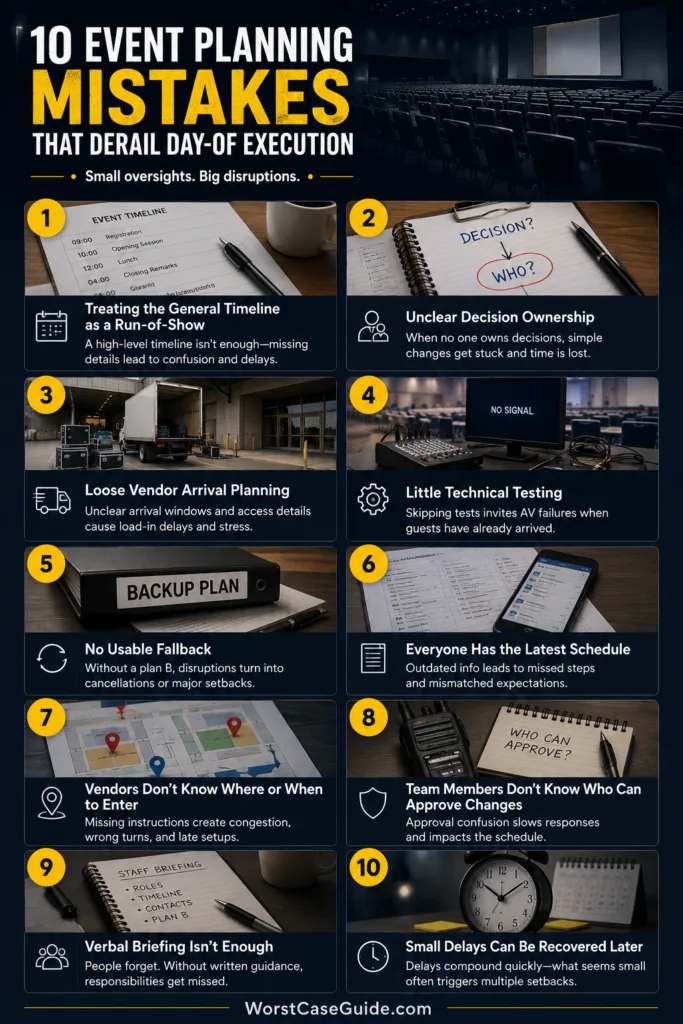
Worst-case result: a manageable delay becomes a larger one while people wait for approval. Teams may also make separate decisions because no common decision path exists.
Safer approach: responsibilities can distinguish between routine operational decisions, changes that need organizer approval, and matters owned by the venue or specialist vendors. Named ownership is clearer than “the team will handle it.”
Mistake 4: Confirming the Vendor but Not the Vendor Arrival
A signed agreement confirms that a vendor is expected to provide a service. It may not settle the smaller logistics that determine whether setup actually happens smoothly.
Arrival time, service entrance, unloading location, parking arrangements, setup area, venue contact, access restrictions, equipment movement, and teardown expectations can all matter.
Early warning: the vendor knows the venue address but is still asking where to enter or whom to contact when arriving.
Worst-case result: multiple suppliers arrive through the same access point, equipment reaches the room late, or a vendor waits outside while the event schedule continues moving.
Safer approach: each supplier can receive a short day-of logistics brief containing the information needed to reach the correct place and begin work without searching for the organizer.
For a small private event, this may be a short message. For a large venue with several suppliers, staggered arrival windows and separate setup areas may make more sense.
Mistake 5: Scheduling Tasks Without Their Dependencies
A schedule can look spacious and still be impossible.
Why? Because tasks that appear separate may depend on each other. Signage cannot be positioned until the layout is settled. A technical rehearsal cannot happen properly while the stage is still being assembled. A room reset requires time after one activity and before the next.
Early warning: the timeline shows when tasks start but rarely shows what must be finished first.
Worst-case result: the first delayed task blocks several later tasks. The schedule begins behaving like a row of falling dominoes.
Safer approach: activities with direct dependencies can be planned together. Where a transition is delicate, a small timing buffer may offer more protection than an unrealistically tight sequence.
Mistake 6: Treating Technical Setup as Equipment Delivery
Having microphones, displays, speakers, lighting equipment, laptops, presentation files, or an internet connection on site does not mean the technical side is ready.
The actual setup matters: the device connected to the room system, the presentation opened on the machine that will run it, the microphone used from the position where the speaker will stand, and any media played in the format intended for the event.
Early warning: phrases such as “it worked last time” replace testing in the actual venue setup.
Worst-case result: guests are already entering while staff troubleshoot sound, presentation files, displays, or connectivity. The opening schedule slips before the event has properly begun.
Safer approach: technical checks can mirror real use as closely as practical. For an event built around presentations or streamed content, a rehearsal also reveals handoff problems that equipment checks alone may miss.
Mistake 7: Creating Backup Plans That Are Too Vague to Use
“We have a backup plan” sounds reassuring until somebody asks what it actually is.
An alternative location that has not been checked, spare equipment stored somewhere nobody can identify, or a replacement activity that has never been fitted into the schedule is not yet an operational fallback.
Early warning: the response to a predictable disruption begins with “If that happens, we can probably…”
Worst-case result: the team has to invent the alternative while the event is already running. Several people may begin solving the same problem differently.
Safer approach: backups for the most disruptive operational failures can identify what changes, who activates the alternative, what resources it needs, and which later parts of the schedule are affected.
Not every possible inconvenience needs its own plan. The useful question is simpler: Which failures would stop the next important part of the event from happening?
Mistake 8: Planning the Program but Underplanning Guest Flow
Organizers naturally spend a lot of attention on what happens on stage or inside the main room. Guests experience something wider: arrival, entry, registration, finding seats, moving between areas, locating facilities, refreshments, and departure.
An event can therefore be running “on schedule” while guests are forming a queue somewhere the planning team did not expect.
Early warning: the floor plan shows where activities happen but does not answer how groups will move between them.
Worst-case result: slow check-in delays entry, people reach rooms late, or one transition creates congestion that affects the next scheduled activity.
Safer approach: the planning process can follow the event from the guest’s physical point of view. Where do people arrive? What do they see first? Where might they hesitate? What happens when many people move at once?
Mistake 9: Letting Every Question Reach the Lead Organizer
The person who planned the event often knows more than anyone else. That makes the same person an obvious target for every vendor question, guest issue, staff request, speaker update, and schedule decision.
It works for a while. Then the organizer becomes the bottleneck.
Early warning: several people are waiting for answers from one person while other team members have little authority to respond.
Worst-case result: important decisions compete with minor questions for the same person’s attention. Information also becomes harder to track because instructions are being given through calls, messages, radio conversations, and face-to-face requests at once.
Safer approach: communication can be divided by responsibility. Vendors may have one contact, registration another, technical production another. The lead coordinator can then remain available for issues that actually require broader judgment.
Mistake 10: Treating the Final Scheduled Activity as the End of the Event
When the last presentation finishes or the final guest-facing activity ends, operational work may still be active.
Vendor collection, rented equipment, leftover materials, room handback, personal belongings, final counts, signage removal, transport coordination, and teardown responsibilities can remain.
Early warning: the run-of-show becomes nearly empty immediately after the advertised finish time.
Worst-case result: vendors receive conflicting teardown instructions, rented items are difficult to account for, or a small group is left trying to close the venue without clear ownership.
Safer approach: day-of planning can continue through guest departure, vendor release, teardown, and venue handback. The public event may be over, but execution is not finished until the operational responsibilities are closed.
The Risk Patterns Behind These Mistakes
The ten mistakes look different, yet most belong to a few recurring patterns.
Information Exists but Is Not Operational
A vendor contract, floor plan, schedule, contact list, and staff assignment may all exist. Day-of execution fails when those documents do not tell the right person what to do at the moment the information is needed.
Ownership Is Shared Too Broadly
Shared responsibility sounds cooperative, but live execution often needs named owners. If four people are responsible for something, each may reasonably assume one of the other three is handling it.
Planning Focuses on Activities Instead of Handoffs
The vulnerable moments are often between activities: vendor arrival to setup, setup to testing, registration to seating, one session to another, program finish to teardown. Handoffs deserve planning of their own.
The Schedule Assumes Perfect Conditions
A timeline with no room for setup variation, guest movement, technical checks, or ordinary delays may look efficient before the event. On the day, it can leave the team with no recovery space.
What a More Execution-Ready Plan Usually Contains
- One active run-of-show that identifies important owners and dependencies.
- A clear method for communicating schedule changes.
- Named contacts for vendors and major operating areas.
- Confirmed vendor arrival, access, setup, and teardown information.
- Technical testing based on the equipment’s actual event-day use.
- Practical alternatives for disruptions capable of stopping the program.
- Guest-flow planning for arrival, movement, transitions, and departure.
- Enough time around delicate transitions to absorb ordinary variation.
- A defined handoff from guest-facing activity to event closeout.
The smaller the event, the simpler this can be. A short gathering may need one coordinator, one timeline, and a few confirmed vendor details. A large program with several rooms, suppliers, speakers, or technical transitions may need much clearer division of responsibility. Complexity should determine the amount of coordination, not the thickness of the planning document.
Questions Worth Asking Before Event Day
- If the organizer became busy for twenty minutes, could everyone else continue?
- Does every vendor know where to arrive and who will meet them?
- Could two team members accidentally be working from different schedules?
- Which three delays would have the widest effect on the program?
- Are technical elements tested in the form guests will actually experience?
- Does every major transition have an owner?
- What happens after the final guest-facing activity?
If several answers are uncertain, the event may not need more creative planning. It may simply need clearer operating detail.
Frequently Asked Questions
What is the difference between an event timeline and a run-of-show?
An event timeline can show major times and activities. A run-of-show is more operational. It may also identify owners, locations, technical cues, dependencies, transitions, vendor activity, and other information needed while the event is running.
Who should receive the run-of-show?
The useful distribution depends on the event. Team leads, coordinators, production staff, and relevant vendors generally need the parts that affect their responsibilities. Giving everyone unnecessary operational detail can create as much confusion as giving them too little.
How can planners reduce confusion when the schedule changes?
A single active schedule and a known change process make updates easier to control. When timing changes, affected teams need to know what changed, when the new timing applies, and whether their responsibilities also moved.
Do small events need contingency planning?
Small events usually need less documentation, but a few practical alternatives may still be useful when one vendor, one piece of equipment, or one location supports a large part of the event. The amount of preparation can match the actual exposure.
Why do well-planned events still run late?
Planning may account for each activity without allowing enough time for the connections between them. Guest movement, setup changes, vendor handoffs, technical preparation, and delayed decisions can gradually move the schedule even when every planned activity is reasonable on its own.