Affiliate revenue can fall even when traffic stays steady. The problem is often not the article, the audience, or the affiliate program itself. Small problems between the recommendation and the merchant checkout can quietly reduce tracked clicks, conversions, and commissions. A link may still look normal while sending readers to a poor landing page, losing tracking data, or competing with several other links for the same click.
That makes affiliate links more than simple URLs. They sit inside a chain: reader intent → recommendation → click → redirect → merchant page → purchase → attribution. A weak point anywhere in that chain can reduce earnings without producing an obvious error message.
Why Affiliate Link Problems Can Be Hard to Notice
A visibly broken link is easy to find. More difficult problems still allow the visitor to click, which makes everything appear healthy from the publisher’s side.
- The destination opens, but the affiliate tracking parameter disappears.
- The product exists, but the link reaches a generic category page instead.
- Desktop visitors reach the correct page while mobile visitors are redirected elsewhere.
- Clicks increase while completed referrals remain flat.
- A merchant changes products, URLs, commission terms, or tracking behavior.
- Several competing calls to action divide attention between similar offers.
This is why raw click totals can give false reassurance. A click is only one stage of the journey. It does not confirm that the visitor reached the intended product or that the resulting purchase was attributed correctly.
Common Assumptions That Create Affiliate Revenue Leaks
Several assumptions sound reasonable until a site grows and begins carrying hundreds of commercial links.
- “If the link opens, it works.” Opening the destination does not verify tracking.
- “More affiliate links create more opportunities to earn.” More choices can also divide attention.
- “The highest commission is the strongest offer.” Conversion probability and audience fit matter too.
- “One desktop test is enough.” Mobile redirects, apps, regional stores, and browser behavior can create different paths.
- “A high click count means the placement works.” Clicks without downstream conversions can indicate a weak destination or mismatched expectation.
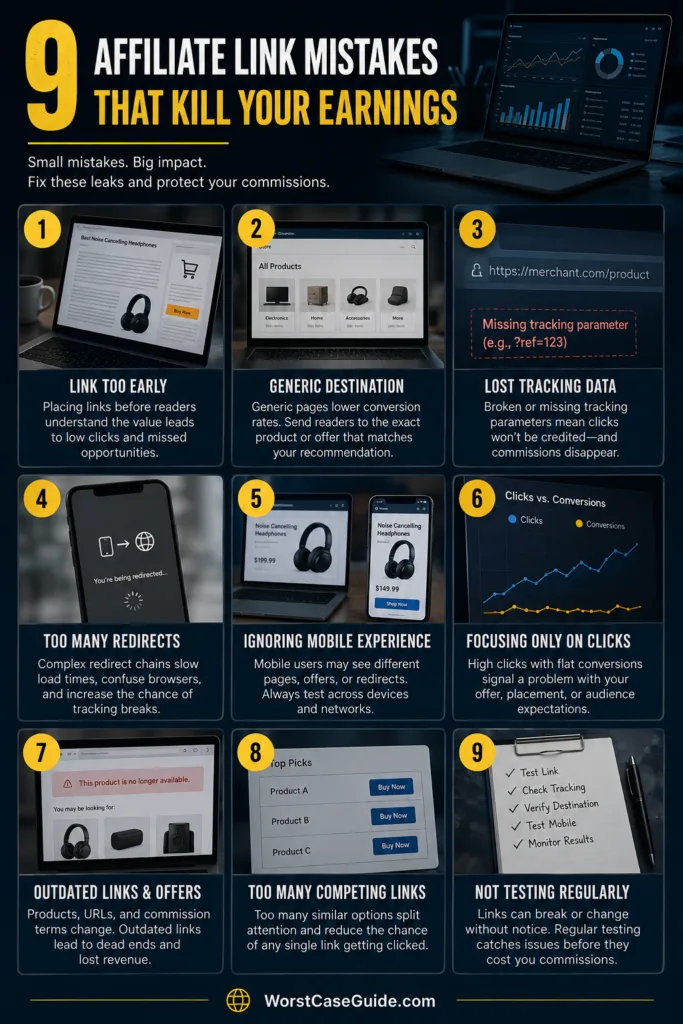
Mistake 1: Placing the Affiliate Link Before the Reader Has a Reason to Click
Why It Happens
Publishers sometimes place a prominent product button immediately after mentioning an item. The link is visible, yet the reader may still be deciding whether the product fits the problem that brought them to the page.
Early Warning Signs
- Prominent buttons receive surprisingly few clicks.
- Links farther down the article outperform links near the beginning.
- Readers receive little product context before encountering a commercial call to action.
Worst-Case Result
The page can attract qualified visitors but fail to transfer their interest to the merchant. More traffic then produces only a modest increase in affiliate revenue.
A Safer Approach
A link generally has more context after the reader understands what the product does, who it suits, and why it appears in the article. For comparison content, the first commercial link may fit naturally after the main difference or recommendation has been explained rather than before it.
Mistake 2: Sending Readers to a Generic Destination
Why It Happens
A merchant homepage is often easier to link than a specific product, plan, configuration, or category. It also creates another decision for the visitor.
If an article discusses a particular laptop model and the link opens a retailer’s general electronics department, the reader has to search again. That extra step creates friction.
Early Warning Signs
- Affiliate links point mainly to merchant homepages.
- The destination does not show the product or offer described nearby.
- Click volume looks healthy but conversion performance is weak.
- Readers would need another search or several navigation steps after clicking.
Worst-Case Result
The article does the work of creating purchase intent, then hands the reader an unrelated starting point. Some visitors continue searching. Others leave.
A Safer Approach
Where an affiliate program supports stable deep links, the destination can match the recommendation as closely as practical. Product availability changes, though, so a very narrow destination also needs occasional checking.
Mistake 3: Adding Too Many Competing Affiliate Links
Why It Happens
More links can feel like more monetization opportunities. On a comparison page, this sometimes turns into several stores, products, buttons, text links, banners, and repeated calls to action within a small section.
The reader then has to answer a new question: Which of these links am I supposed to choose?
Early Warning Signs
- Several links beside one recommendation perform the same job.
- Calls to action repeat after almost every paragraph.
- The page visually emphasizes links more strongly than the comparison itself.
- Clicks are distributed across many low-volume destinations.
Worst-Case Result
Commercial clutter can weaken both decision clarity and reader trust. Instead of guiding a purchase decision, the page starts resembling a collection of exits.
A Safer Approach
Pages with several merchants can still work well when each link has a distinct purpose, such as availability, region, product version, or retailer preference. Repeated links that offer no new choice may add little value.
Mistake 4: Testing the Destination but Not the Tracking Path
Why It Happens
A normal link check usually confirms only that a page returns successfully. Affiliate links may pass through redirect services, tracking domains, link-management plugins, geo-routing systems, or merchant tracking before the visitor reaches the final page.
Early Warning Signs
- Clicks recorded by the website differ sharply from clicks shown by the affiliate program.
- A link-management tool reports activity while the merchant dashboard does not.
- Tracking parameters disappear during redirects.
- Links changed after a merchant or affiliate network migration.
Worst-Case Result
A popular page can continue sending buyers to a merchant while some or all referrals go unattributed. Because the customer experience still appears normal, the problem can remain unnoticed for weeks.
A Safer Approach
Testing can include the whole journey rather than only the first URL: original affiliate link, redirects, final destination, expected tracking identifiers, and the affiliate dashboard’s click reporting. High-traffic links deserve more attention because a small tracking failure there can affect far more referrals.
Mistake 5: Using the Same Tracking Identifier Everywhere
Why It Happens
A single affiliate URL is easy to copy across a website. The disadvantage appears later: the program may report total clicks and sales without showing which article, table, button, or comparison generated them.
Early Warning Signs
- Revenue can be connected to a merchant but not to individual pages.
- Several call-to-action positions cannot be compared.
- A high-traffic article receives updates without knowing whether it already converts.
- Low-performing placements remain because their results are mixed with stronger ones.
Worst-Case Result
The publisher sees revenue but cannot identify what created it. Optimization becomes guesswork, and a change intended to improve earnings can accidentally remove a strong placement.
A Safer Approach
When a program supports sub-IDs, tracking IDs, campaign tags, or other placement identifiers, they can separate meaningful groups such as article, comparison table, button, and newsletter traffic. The naming system does not need to be elaborate. It needs to remain understandable months later.
Mistake 6: Leaving Affiliate Links Untouched After Products Change
Why It Happens
Affiliate articles often remain online far longer than the products they recommend. Retailers discontinue items, manufacturers release replacements, programs change networks, and destination URLs move.
A link does not need to return a 404 page to become stale. It may redirect successfully to an unrelated product or search page.
Early Warning Signs
- A previously strong page experiences a drop in conversion without a similar traffic drop.
- Products remain unavailable for long periods.
- Old links redirect to search results or replacement categories.
- The merchant announces a platform or affiliate-network change.
Worst-Case Result
An article may continue ranking for commercial searches while its most valuable clicks reach products readers cannot buy. The traffic remains, but much of its earning potential disappears.
A Safer Approach
A link review can prioritize pages by traffic, historical affiliate revenue, and commercial intent. That is often more useful than treating every old link as equally urgent.
Mistake 7: Assuming Mobile Visitors Follow the Same Path as Desktop Visitors
Why It Happens
Affiliate links are commonly created and checked on desktop computers. Real visitors may arrive through phones, retailer apps, in-app browsers, different operating systems, or regional storefronts.
A link that behaves perfectly in a desktop browser can take a different route on mobile.
Early Warning Signs
- Mobile traffic is high but mobile affiliate performance is unusually weak.
- Retailer apps open after a click.
- Visitors are redirected between regional versions of a store.
- Mobile destinations differ from the product shown in the article.
Worst-Case Result
A site can optimize its link strategy around a desktop experience that represents only part of its audience. Problems affecting the larger mobile segment then remain hidden inside overall averages.
A Safer Approach
Important commercial links can be checked from more than one common device path. The useful question is not merely whether the page opens, but whether the expected product, retailer, and tracking journey survive the transition.
Mistake 8: Making the Affiliate Relationship Difficult to Understand
Why It Happens
Publishers sometimes treat disclosure as a piece of site administration rather than part of the reader experience. It may appear far from the recommendation, use vague wording, or sit only on a separate disclosure page.
Early Warning Signs
- The commercial relationship is explained only in the footer or another page.
- Wording assumes readers already know what an affiliate link means.
- Product recommendations look editorially neutral while compensation is difficult to notice.
- Different pages use inconsistent disclosure wording.
Worst-Case Result
Readers may discover the relationship after clicking and question whether the recommendation was shaped by commission. That trust loss can affect more than one transaction; it can change how future recommendations are interpreted.
A Safer Approach
Plain language is easier to understand than technical affiliate terminology. A short statement explaining that the publisher may receive a commission from qualifying purchases communicates the commercial relationship without interrupting the article. Commercial links can also be handled consistently in site markup, including the appropriate sponsored-link attributes where applicable.
Mistake 9: Choosing Links Mainly by Commission Rate
Why It Happens
A larger percentage or higher payout is easy to compare. Reader behavior is harder. A lower-paying offer can sometimes produce more total revenue when it fits the search intent better, has stronger availability, or sends the visitor to a simpler buying experience.
Commission rate alone does not describe earning potential.
Early Warning Signs
- Offers are replaced mainly because another merchant advertises a higher payout.
- Merchant conversion performance receives little attention.
- A promoted product only loosely matches the query that brings visitors to the page.
- High-click offers generate few approved commissions.
Worst-Case Result
A publisher can send fewer successful buyers to a higher-paying merchant and earn less overall. Worse, the recommendation may become less useful to the reader simply because the commission looks attractive.
A Safer Approach
Offer evaluation can consider several signals together: audience fit, destination quality, conversion rate, approved commissions, availability, refund or reversal behavior, and payout. Earnings per click can also reveal differences that commission percentage alone hides.
| Observed Pattern | Possible Link Problem | Useful Check |
|---|---|---|
| Traffic stable, revenue falling | Stale destination or changed program | Review highest-traffic commercial links |
| Website clicks exceed program clicks | Redirect or tracking interruption | Follow the complete redirect path |
| Many clicks, few conversions | Destination or intent mismatch | Compare recommendation with landing page |
| Mobile performs far below desktop | App, regional, or mobile redirect issue | Test common mobile paths |
| Revenue exists but cannot be traced to content | Insufficient link-level attribution | Use supported placement identifiers |
| Several links receive tiny click shares | Too many competing choices | Review whether each link serves a distinct purpose |
The Risk Patterns Behind Most Affiliate Link Problems
A Working Link Is Not Necessarily a Working Affiliate Link
The technical destination and the commercial tracking path are separate things. A browser reaching the merchant proves only that the first objective succeeded.
More Choices Can Reduce Decision Clarity
Affiliate pages often improve when links represent meaningful choices rather than repeated opportunities to leave the article. Readers usually need enough information to understand why one destination deserves the click.
Older High-Traffic Pages Carry More Hidden Risk
An old article can keep attracting visitors long after its affiliate setup was last reviewed. Products and tracking systems move faster than evergreen content. That mismatch makes established commercial pages worth monitoring even when their rankings look healthy.
Affiliate Performance Needs More Than Click Counts
Clicks are useful, but they make more sense beside downstream information. If a page receives 1,000 affiliate clicks and another receives 300, the first page is not automatically the stronger earner. What happened after those clicks matters.
Useful measurements can include click-through rate, conversion rate, approved referrals, earnings per click, merchant performance, and placement-level results. Not every program exposes every metric, so the available signals will vary.
Questions That Often Come Up About Affiliate Link Performance
Can too many affiliate links reduce earnings?
They can when several links compete for the same decision or interrupt the reading experience. Multiple links are not automatically harmful. The problem appears when additional links create confusion without giving the reader a meaningful new option.
How can an affiliate link be broken if the destination still opens?
The destination may open after a redirect while tracking information is lost, changed, or no longer recognized by the affiliate program. A retailer can also redirect an expired product URL to another page that technically works but no longer matches the recommendation.
Is a higher affiliate commission always better?
No. A higher payout can still produce lower total earnings if the product converts poorly, has limited availability, receives more reversals, or fits the audience less closely. Payout makes more sense when considered beside actual conversion performance.
Why should mobile affiliate links be tested separately?
Phones can introduce different redirects, apps, regional storefronts, and in-app browsers. Those differences may change either the destination or the tracking path even when the desktop version behaves normally.
Which affiliate links deserve attention first on a large site?
Pages combining high traffic with strong commercial intent usually expose more potential revenue to link problems. Historically strong earning pages can also deserve priority because a sudden tracking or destination failure there has a larger effect than the same problem on a rarely visited article.