A project can look affordable on the day it is approved and still become expensive for a simple reason: the price was built around one scope while the team later delivered another. Budget overruns are often blamed on bad estimating, expensive vendors, or slow execution, yet the problem may begin earlier. A vague boundary, an unspoken requirement, or a harmless-looking extra request can add labor, rework, testing, coordination, procurement, and delay without appearing as a new line item at first.
Scope problems are especially difficult because they rarely arrive as one large event. They usually appear as small additions, unclear decisions, and work that nobody remembers approving. By the time the cost report shows the damage, much of that work may already be underway.
A useful distinction: a scope change is not automatically a mistake. Projects change. The budget problem begins when the change is not identified, priced, approved, scheduled, or traded against something else.
Why Scope Errors Turn Into Cost Errors
A project budget normally reflects assumptions about deliverables, effort, people, duration, materials, systems, testing, approvals, and outside dependencies. Change one of those inputs and the cost picture can change with it. Even when a request sounds small, it may affect several downstream tasks.
For example, adding one field to a software form may also require database changes, validation rules, interface updates, permissions, analytics, documentation, testing, and training. In a renovation, moving one fixture can affect electrical work, plumbing, finishes, inspections, and sequencing. The visible request is only the tip of the work.
Common Assumptions That Create Trouble
- “Everyone knows what is included.” Different stakeholders may be imagining different outcomes.
- “We can define the details later.” Later decisions may arrive after estimates, contracts, or schedules are already fixed.
- “A small request will not affect the budget.” Small requests can create hidden follow-on work.
- “The contingency will cover it.” A risk allowance is not the same thing as an unlimited allowance for added scope.
- “We can make it up later.” Removing time from testing, review, or handover may simply move the cost into rework.
| Scope Warning Sign | What May Be Happening | Possible Cost Effect |
|---|---|---|
| Frequent “small” requests | Work is being added outside a formal change path | Extra labor, testing, coordination, and delay |
| Repeated clarification meetings | Requirements or boundaries are not settled | Rework and decision overhead |
| Teams disagree about what “done” means | Acceptance criteria are missing | Late revisions and extended testing |
| Estimate stays fixed while deliverables grow | Scope and budget are no longer aligned | Forecast overruns or quality trade-offs |
| Important work appears late | The original scope decomposition missed tasks | Unplanned labor, procurement, or specialist costs |
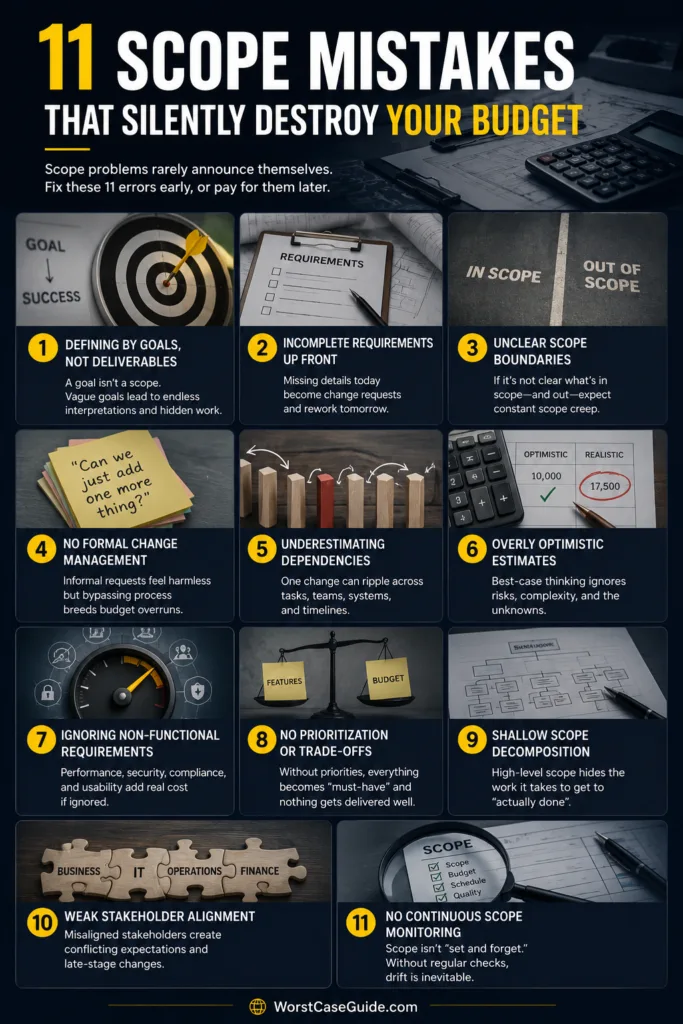
Mistake 1: Defining the Project by a Goal Instead of Deliverables
“Launch the new customer portal,” “renovate the office,” or “improve the onboarding process” may describe a goal, but they do not tell the team what must actually be delivered. A goal can support many different versions of the same project, each with a different price.
Why It Happens
Early project discussions often focus on the desired outcome. That is useful, but the outcome can be mistaken for the scope itself. Teams then estimate before the deliverables, interfaces, environments, documentation, migration work, training, or handover needs are clear.
Early Warning Signs
- Different people give different answers when asked what will be delivered.
- The scope statement relies heavily on words such as “improve,” “modernize,” or “support.”
- Major outputs are described without quantities, locations, versions, or completion conditions.
Worst-case result: the project keeps absorbing reasonable-sounding work because there is no clear test for whether that work belongs inside the original commitment. The budget becomes a target for an undefined product.
Safer approach: the goal can remain broad, while the delivery scope is written in concrete terms. In smaller projects, a short list of named outputs may be enough. In larger projects, the work may need to be broken into deliverables, sub-deliverables, interfaces, and ownership boundaries.
Mistake 2: Estimating Before Requirements Are Mature Enough
An early estimate can be useful for deciding whether an idea is worth exploring. Trouble starts when a rough estimate is treated as a committed budget even though major requirements are still unknown.
Why It Happens
Stakeholders may want a number before they are ready to answer detailed questions. The team supplies one, often with assumptions attached. Months later, people remember the number but not the assumptions.
Early Warning Signs
- The estimate contains many “to be confirmed” items.
- Major user groups, locations, integrations, materials, or workflows are undecided.
- The budget is being communicated externally as fixed while discovery is still active.
Worst-case result: later requirements are treated as estimating errors even though they were never part of the information used to create the estimate. The project may then cut useful work, seek more money, or continue with a budget that everyone already knows is unrealistic.
Safer approach: early numbers can be labeled according to their level of certainty, with assumptions kept visible. Once requirements become clearer, the estimate can be refreshed rather than silently carrying an old number into a new scope.
Mistake 3: Failing to State What Is Out of Scope
A scope document that lists only what is included leaves a dangerous blank space around the project. Stakeholders may assume adjacent work is included because nobody explicitly said it was excluded.
Why It Happens
Teams sometimes avoid exclusions because they sound negative or overly contractual. Yet exclusions are often where expectations become clear. If a website redesign includes page templates but not content migration, for example, that boundary can affect many hours of work.
Early Warning Signs
- Requests begin with “I assumed that was included.”
- Related teams expect support that was never estimated.
- Vendors and internal teams interpret the same statement differently.
Worst-case result: the project becomes responsible for surrounding tasks that were never priced, staffed, or scheduled. Because each task appears connected to the original objective, rejecting it becomes difficult after work has started.
Safer approach: important exclusions can sit beside the included scope, especially where confusion is predictable. The purpose is not to create a wall of disclaimers. It is to make the boundary visible before money is committed.
Mistake 4: Skipping Detailed Work Breakdown
A budget built from large work packages can hide entire categories of effort. “Build reporting,” for instance, may sound like one task while actually requiring data mapping, permissions, calculations, interface work, export behavior, validation, testing, and documentation.
Why It Happens
Breaking work down takes time, and early project momentum can make that work feel administrative. Yet decomposition often reveals tasks that broad labels conceal.
Early Warning Signs
- Large budget lines have no smaller work packages underneath them.
- Owners cannot explain what activities are included in an estimate.
- Testing, documentation, deployment, migration, training, or handover appear nowhere in the plan.
Worst-case result: missing work is discovered during execution, when the team has fewer options to absorb it cheaply. Late work can also interfere with sequencing, creating cost beyond the task itself.
Safer approach: work can be decomposed until the team can estimate, assign, and verify it with reasonable confidence. The right depth depends on the project. A two-week internal change does not need the same level of detail as a multi-vendor program.
Mistake 5: Leaving Assumptions and Dependencies Unwritten
Many budgets only work if certain things are true: data arrives on time, another team completes an interface, a site is accessible, a supplier provides a component, an existing system supports the planned feature, or a stakeholder makes decisions quickly. Those conditions are part of the cost story even when they are not deliverables.
Why It Happens
Assumptions can feel obvious inside the planning team. They become risky when the person controlling the dependency never agreed to them, or when the assumption changes without anyone revisiting the estimate.
Early Warning Signs
- The plan depends on another group but has no named owner or date for that dependency.
- Estimators use phrases such as “assuming the existing system can handle it.”
- A supplier, approver, or data owner has not confirmed the condition the budget relies on.
Worst-case result: the assumed condition fails and the project must buy, build, redo, or wait for something that was never funded. A hidden dependency can turn into both a scope increase and a schedule extension.
Safer approach: cost-sensitive assumptions and dependencies can be recorded beside the related scope item. When one changes, the team has a clear trigger to revisit effort, schedule, and budget.
Mistake 6: Using Vague Acceptance Criteria
A deliverable may be technically complete and still be rejected if stakeholders had a different picture of acceptable quality, behavior, performance, or finish. “Done” needs enough detail to be testable.
Why It Happens
Teams spend time defining what they will build but less time defining how it will be accepted. That gap stays quiet until review, demonstration, testing, or handover.
Early Warning Signs
- Approval depends on subjective terms such as “easy,” “professional,” “fast,” or “high quality.”
- Reviewers are not identified until late in the project.
- Acceptance tests are created only after the deliverable is built.
Worst-case result: repeated revision cycles appear after the budgeted build work is finished. The project pays to discover expectations at the most expensive stage.
Safer approach: acceptance conditions can be agreed while the work is being scoped. In creative or exploratory work, where exact criteria may be hard to write, prototypes, samples, review stages, or bounded revision rounds can reduce ambiguity.
Mistake 7: Treating Stakeholder Alignment as a One-Time Approval
A signed scope does not guarantee that all affected people share the same understanding. New stakeholders can enter later, business needs can shift, and a sponsor may approve a document without seeing how a particular decision affects another department.
Why It Happens
Projects often identify the obvious decision-makers and miss downstream users, operations teams, support groups, security reviewers, facilities staff, or subject-matter specialists. Their requirements surface only when the project reaches them.
Early Warning Signs
- A newly involved team introduces requirements that appear mandatory.
- Stakeholders approve the scope but disagree during design reviews.
- Decisions are repeatedly reopened because one affected group was absent earlier.
Worst-case result: completed work is revised to satisfy late-arriving requirements. The project may pay twice: once for the original interpretation and again for the corrected one.
Safer approach: stakeholder alignment can be treated as an ongoing check around major decisions, not merely a signature at kickoff. For larger systems, mapping who uses, supports, approves, supplies, or inherits each major deliverable can expose missing voices early.
Mistake 8: Allowing Small Additions to Bypass Change Control
Scope creep often arrives wearing casual clothes: “While you are there, could you also…?” The request may take only a few hours by itself. Ten similar requests can change the project.
Why It Happens
Formal change handling can feel excessive for small requests, so teams absorb them informally. The requester sees no budget effect, the project manager sees no approved change, and the delivery team still spends the time.
Early Warning Signs
- Work is being added through chat messages or meeting notes.
- Team members say they can “fit it in” without checking cumulative impact.
- The task list grows while the approved scope and budget remain unchanged.
Worst-case result: many individually minor changes consume the margin that was meant for genuine uncertainty. The overrun appears late because no single request seemed large enough to trigger concern.
Safer approach: a change process can be lightweight. Small projects may only need a simple record of the request, effort, schedule effect, decision, and owner. Larger projects may need formal review. The important part is that added work becomes visible before it becomes normal.
Mistake 9: Adding Unrequested Work Through Gold Plating
Not every scope increase comes from the customer. Teams sometimes add polish, features, automation, documentation, technical refinement, or design work because it seems beneficial. This is often called gold plating.
Why It Happens
People naturally want to improve what they deliver. A developer sees a cleaner architecture, a designer sees another refinement, or a contractor sees an upgrade that would look better. The intention may be good, but the work still consumes resources.
Early Warning Signs
- Team members are working on features that have no matching requirement.
- Extra quality or functionality is justified mainly by “it would be nice to have.”
- Optional improvements are being completed before approved deliverables are secure.
Worst-case result: budget and schedule are spent on work the sponsor did not request, while required items become compressed later. Extra features can also create new testing, support, maintenance, or compatibility obligations.
Safer approach: useful ideas can be captured without automatically entering the active scope. If an improvement is worth doing, its cost and effect can be considered like any other change.
Mistake 10: Forgetting the Cost of Interfaces, Handoffs, and Supporting Work
Projects are often estimated around the main deliverable while the connecting work receives less attention. That can include data migration, integration, procurement, approvals, deployment, training, documentation, cleanup, support transition, and handover.
Why It Happens
The central product is easier to see. Supporting work is scattered across teams and phases, so no single person notices that several necessary tasks are missing from the scope.
Early Warning Signs
- The plan ends when the main product is built rather than when it is usable or handed over.
- Integration work is assumed to belong to “the other team.”
- Training, migration, testing environments, documentation, or operational support have no owner or estimate.
Worst-case result: the main deliverable is finished but cannot be put into normal use without additional funded work. The project looks almost complete while the remaining cost keeps growing.
Safer approach: scope reviews can follow the deliverable through its full path: creation, connection, validation, approval, release, use, and handover. That simple walk-through often exposes work hidden between organizational boundaries.
Mistake 11: Accepting Scope Changes Without Re-Baselining Cost and Schedule
Sometimes a change is fully justified. A customer need shifts, a technical constraint appears, or a better option becomes available. The mistake is approving the new scope while leaving the old budget and deadline untouched as though nothing changed.
Why It Happens
Decision-makers may want the benefit of the change without reopening commitments. Teams may also fear that revising the baseline looks like poor performance. That creates a mismatch between what the project is now expected to deliver and what it is still measured against.
Early Warning Signs
- A change is approved with no recorded cost or schedule effect.
- The team is told to add work but “keep the same date.”
- The original budget remains the official target after major deliverables change.
- Forecast reports show pressure, yet the scope baseline is never updated.
Worst-case result: the project appears to be failing against a plan that no longer describes the approved work. Teams may compensate by rushing, cutting useful checks, deferring work, or absorbing hidden overtime, none of which fixes the underlying mismatch.
Safer approach: when scope changes materially, the decision can include the trade-off. That might mean more budget, more time, reduced scope elsewhere, a different sequence, or a different delivery target. A changed project needs a changed planning basis.
The Risk Patterns Behind Most Scope-Driven Overruns
The 11 mistakes above look different, but several patterns repeat. First, ambiguity is being treated as agreement. People move forward while holding different assumptions about what is included, what quality means, or who owns supporting work.
Second, scope information and cost information become separated. The scope changes in meetings, messages, design decisions, or technical discoveries, while the budget remains frozen in an earlier version of the project.
Third, projects often notice visible additions but miss downstream work. A new feature, room, report, integration, or requirement can trigger testing, documentation, coordination, procurement, approvals, training, and maintenance. One request can cast a longer cost shadow than expected.
A practical scope check is not simply, “Has anything been added?” It is also: “Has anything become clearer, harder, broader, more connected, or more demanding than the estimate assumed?” That is where many overruns begin.
When a Project Is Already Showing Scope Pressure
If a project is already drifting, the useful question is not who first caused the problem. The more useful question is which version of the scope the current forecast actually represents. Comparing the approved baseline with the work currently being performed can expose additions, omissions, changed assumptions, and unfinished decisions.
- Current deliverables can be compared with the originally priced deliverables.
- Unapproved or informally approved additions can be separated from baseline work.
- Missing supporting tasks can be identified before they become emergency work.
- Open assumptions and dependencies can be checked against present conditions.
- Remaining work can be re-estimated using the scope that actually exists now.
In a smaller project, this may be a one-page reconciliation. In a larger program, it may require a structured review across workstreams and suppliers. Either way, the aim is the same: make the cost of the current scope visible.
Frequently Asked Questions
What is the difference between scope creep and a normal scope change?
A normal scope change is visible and intentionally evaluated. Its effect on effort, cost, timing, risk, and other deliverables can be considered before approval. Scope creep usually refers to work that expands gradually without the same level of control or adjustment.
Can a fixed-price project still suffer from scope problems?
Yes. A fixed price does not remove ambiguity. If the contract or statement of work leaves room for different interpretations, the result may be change requests, disputes about what is included, reduced flexibility, or pressure on delivery quality. Clear boundaries still matter.
Does every small project need formal change control?
Not necessarily. The process can match the size of the work. A small project may only need a written record of what changed, why, who accepted it, and whether cost or timing moved. The point is visibility, not paperwork for its own sake.
Why do scope mistakes sometimes appear as estimating mistakes?
An estimate can only reflect the information available when it is created. If requirements, dependencies, quality expectations, or supporting tasks appear later, the final cost may exceed the early estimate even when the original calculation was reasonable for the original scope.
What is the earliest warning that scope may be affecting the budget?
One early signal is a growing gap between the work people are discussing and the work described in the approved scope. Frequent “small” additions, repeated clarification, reopened decisions, and new dependencies can all indicate that the cost basis is becoming outdated.