Maintenance neglect rarely breaks a home overnight. What it does is compress the useful life of materials and systems through small, repeated exposures—water, heat, vibration, dirt, pests, and time. The risk is not “one missed chore.” The risk is a chain reaction where a minor issue becomes hidden damage that stays invisible until it is expensive in effort and disruptive.
If a home is treated like a set of independent parts, it is easy to miss how one neglected area can degrade several others. Moisture moves. Air moves. Loads shift. Small gaps become entry points. Maintenance is less about perfection and more about catching change early, when the home still has options.
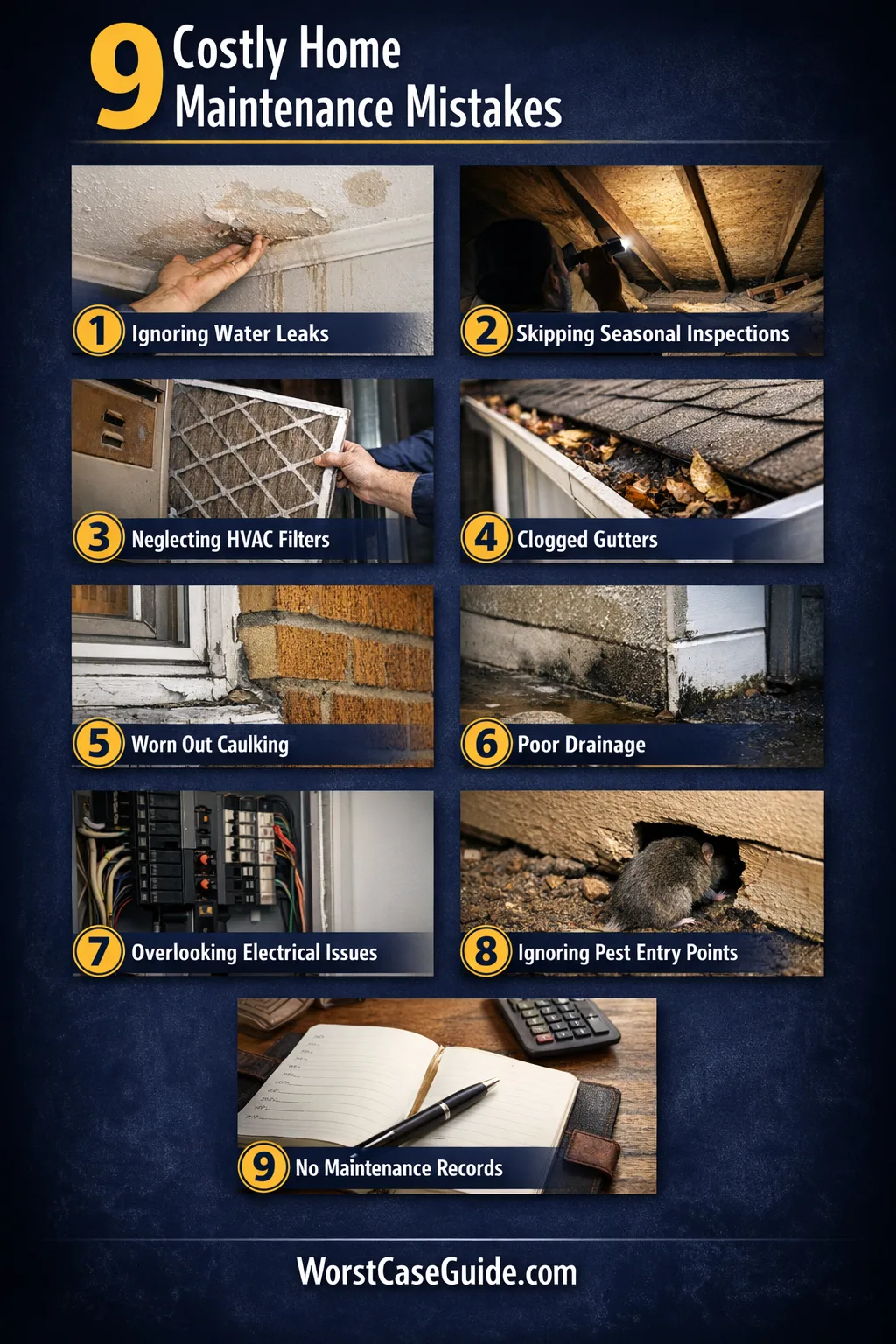
Maintenance Neglect Mistakes That Shorten Home Lifespan
This guide focuses on common mistakes that shorten a home’s lifespan by increasing wear, moisture exposure, and cascading failures. It is not meant to alarm. It is meant to help a homeowner spot avoidable risk before it becomes hard to reverse.
Why This Topic Is Risky
Neglect is risky because the most damaging processes are often quiet: slow leaks, poor drainage, air bypasses, corrosion, and micro-cracks. Many homes look fine until a threshold is crossed, then the symptom becomes sudden. By that point, the “fix” may involve opening walls, drying structures, or correcting underlying design limitations.
Common Wrong Assumptions
- “If nothing looks broken, the system is fine.” Many failures start as performance drift, not visible damage.
- “A small leak is not urgent.” Moisture can move into hidden cavities and stay there.
- “Newer homes don’t need maintenance yet.” New materials still have seals, joints, and moving parts.
- “I will remember what was done.” Without records, maintenance becomes guesswork and timing gets skewed.
- “I can catch problems when I have time.” Some issues require fast response to avoid secondary damage.
A Simple Triage Table
This table is not a checklist for every home. It is a way to notice where neglect tends to compound and where early signals can be easy to miss. The “why it matters” column points to lifespan impact, not aesthetics.
| Area | What Neglect Looks Like | Early Signals | Why It Matters |
|---|---|---|---|
| Moisture / Leaks | Drips, staining, “temporary” patches | Musty odor, paint bubbling, soft spots | Rot, mold risk, structural weakening |
| Drainage | Clogged gutters, poor grading | Overflow marks, pooling near foundation | Foundation movement, moisture intrusion |
| HVAC / Airflow | Dirty filters, skipped servicing | Uneven rooms, longer run times | Shortened equipment life, humidity issues |
| Exterior Seals | Cracked caulk, failed paint | Drafts, insect activity at gaps | Water entry, material degradation |
| Electrical Safety | Warm outlets, frequent trips ignored | Flicker, burning smell, buzzing | Component damage, safety hazards |
The Mistakes
Mistake 1: Treating Small Water Leaks As “Later” Problems
Water is a lifespan shortcut because it attacks multiple materials at once: wood, drywall, insulation, metal fasteners, adhesives, and finishes. A leak that seems small at the surface can be large in the cavity where it spreads and stays undetected.
Why It Happens
- The visible spot looks dry after a while, so it feels resolved.
- Repairs are perceived as messy, so temporary measures linger.
- Leak sources can be non-obvious (condensation, flashing, drain lines).
Early Warning Signs
- Musty or “earthy” odors that appear after humidity changes.
- Paint bubbling, peeling, or discoloration.
- Flooring that feels spongy or trim that swells.
Worst-Case Outcome (Without Drama)
A slow leak can create hidden rot and persistent moisture that reduces the load capacity of framing or subflooring over time. It can also lead to a repair that requires opening finished surfaces to dry and rebuild, turning a small plumbing or flashing issue into a multi-trade disruption.
A Safer Approach
Many homeowners find it safer to focus on source confirmation rather than surface cleanup: where the water is coming from, where it travels, and what stays wet longer than expected. Even a simple record of location, date, and conditions (rain, HVAC running, shower used) can make the next step clearer without guessing.
Mistake 2: Skipping Seasonal “Look For Change” Inspections
Homes shift with seasons. Seals shrink, wood moves, and drainage patterns change. When inspections are skipped, the first time a problem is noticed is often when it becomes inconvenient—during heavy rain, heat waves, or cold spells—when stress is highest and options feel limited.
Why It Happens
- Inspection feels like busywork without a clear payoff.
- People assume “annual” means any time, so it drifts.
- Some areas are out of sight (attic corners, crawlspaces, roof edges).
Early Warning Signs
- New hairline cracks around windows or corners that weren’t there before.
- Door or window operation changing (sticking, misalignment).
- Water marks near downspouts or at roof transitions.
Worst-Case Outcome (Without Drama)
Small “changes” can accumulate into water entry, air leakage, or misaligned drainage that shortens the life of finishes and structural interfaces. The repair becomes harder mainly because the timeline is unknown, making it difficult to tell what is active versus old.
A Safer Approach
A low-friction approach is to look for change, not perfection: new stains, new smells, new drafts, new noises, new insect trails. Some people keep a photo baseline of a few spots (under sinks, attic access area, around the water heater) so differences are easier to spot without relying on memory.
Mistake 3: Neglecting HVAC Filters, Drain Lines, And Airflow Basics
HVAC neglect shortens lifespan through strain and humidity mismanagement. Filters, condensate drains, and airflow restrictions affect both comfort and the home’s moisture balance. When airflow is constrained, systems run longer, coil conditions change, and condensation can become a building problem, not just an equipment one.
Why It Happens
- Filters are easy to forget because the system still runs.
- Drain issues can be invisible until water shows up somewhere else.
- People assume “bigger filter rating” automatically means better for every system.
Early Warning Signs
- Rooms that become harder to cool or heat compared to last season.
- Longer run times, new cycling patterns, or unusual supply air feel.
- Water near the indoor unit, or a stale odor when the system starts.
Worst-Case Outcome (Without Drama)
Over time, airflow and drain neglect can lead to premature equipment wear and moisture that affects nearby materials—insulation, drywall, subflooring—especially if condensation is recurring. The home may develop persistent humidity that stresses finishes and increases the chance of hidden dampness.
A Safer Approach
A safer framing is to treat HVAC as part of the home’s moisture control. When filters are changed, it can also be a moment to notice: any water near the unit, any new odor, any unusual vibration. If a system has a history of drain issues, many people choose a routine that checks the condensate pathway during high-use months.
Mistake 4: Letting Gutters And Downspouts Become Decorative
Gutters are not a cosmetic accessory. They are a water routing system. When they overflow or discharge too close to the house, water is redirected into places that are not built for it: fascia boards, siding joints, and the soil next to the foundation.
Why It Happens
- Clogs accumulate slowly, so the failure shows up only in heavy rain.
- Downspout extensions feel temporary and end up staying that way.
- People focus on the roof surface and miss the edges where water exits.
Early Warning Signs
- Overflow marks or algae streaks on siding.
- Soil that erodes into channels under roof edges.
- Basement/crawlspace humidity that rises after storms, or musty smells after rain.
Worst-Case Outcome (Without Drama)
Repeated overflow can shorten the life of roof edges and exterior wood, and can saturate soil next to the foundation. Over time, water patterns can contribute to settlement, interior dampness, and finishes failing earlier than expected. The most frustrating part is that the visible symptom may appear far from the root cause.
A Safer Approach
Some people treat heavy rain as a “test day” and observe where water is actually going. If overflow happens, it often helps to think in paths: roof edge → gutter → downspout → discharge point. The safer goal is predictable routing, not a perfect-looking gutter line.
Mistake 5: Ignoring Caulk, Sealants, And Exterior Penetrations
Exterior seal failures are small gaps with big consequences. Wind-driven rain, capillary action, and temperature cycling can push moisture through joints around windows, doors, vents, and hose bibs. Once water gets behind the surface, drying can be slow, especially in shaded areas or layered wall assemblies.
Why It Happens
- Sealant failure is gradual, so it looks normal.
- People assume siding is a waterproof shell rather than a drainage plane.
- Exterior penetrations multiply over time (cables, lights, cameras), creating new seams.
Early Warning Signs
- Cracked or separated caulk lines, especially on the top edges of trim.
- Paint failures localized around corners or penetrations.
- Insect activity where two materials meet, suggesting a gap.
Worst-Case Outcome (Without Drama)
Water that repeatedly enters at penetrations can degrade sheathing and framing over time, leading to localized rot and the need to remove exterior finishes to access the damage. The “worst” part is not the gap itself, but the time window where water entered unnoticed, making the repair footprint wider than expected. Hidden damage is what shortens lifespan.

A Safer Approach
A safer mindset is to treat the exterior as a system of transitions. Where materials change, there is a seam. Many homeowners prioritize seams that see direct water exposure (top edges, horizontal ledges) and keep notes on what sealant was used and when, so the next inspection has a reference point.
Mistake 6: Allowing Drainage And Grading To Drift Over Time
Drainage is a “set-and-forget” illusion. Soil settles, landscaping changes, downspouts get moved, and small grading shifts can redirect water toward the home. This mistake is a lifespan reducer because it makes moisture a recurring condition, not a rare event. Recurring moisture wears materials down.
Why It Happens
- Landscaping is adjusted for appearance, unintentionally changing water paths.
- Settling is slow, so the new grade feels normal.
- Water problems may show up inside, so the outside cause is missed.
Early Warning Signs
- Pooling near the foundation after moderate rain.
- Efflorescence or damp spots on basement walls.
- Mulch lines that look like they were washed or shifted, indicating flow.
Worst-Case Outcome (Without Drama)
Persistent water near the foundation can increase the chance of moisture intrusion, create conditions for material decay, and contribute to movement in soils over time. The result can be earlier-than-expected cracking, interior dampness, and a cycle of repairs that address symptoms instead of the water source.
A Safer Approach
Many people find it safer to think of drainage as maintenance, not construction. After heavy rain, it can help to observe where water stands for more than a short period. If water regularly lingers, the next step is often mapping the source (roof discharge, slope, hardscape) before making changes that could move the problem somewhere else.
Mistake 7: Normalizing Electrical “Quirks”
Electrical systems often provide early signals that something is off: heat, smell, sound, or repeated trips. When these are normalized, a small connection problem can turn into component damage or a safety hazard. The lifespan impact comes from chronic overheating and the hidden deterioration it causes. Signals matter here.
Why It Happens
- Intermittent issues feel random and hard to describe.
- People avoid investigating because they fear complication.
- Temporary workarounds (different outlet, different breaker) feel good enough.
Early Warning Signs
- Outlets or switches that feel warm.
- Flickering lights tied to specific appliances or circuits.
- Buzzing, crackling, or a burning odor near panels or receptacles.
Worst-Case Outcome (Without Drama)
Ignored symptoms can lead to accelerated wear on breakers, outlets, and wiring connections. In more serious cases, overheating can damage adjacent materials or create a fire risk. The disruption is often compounded by uncertainty: it may require troubleshooting across circuits and opening access points to find the actual failure. Uncertainty is part of the cost.
A Safer Approach
A safer approach is to treat repeating electrical symptoms as diagnostic data: what was running, which circuit, which room, and how often. That information can make professional troubleshooting faster and less invasive. When something feels like a new pattern rather than a one-off, it often deserves attention sooner rather than later.
Mistake 8: Forgetting That Pests Use Small, Repeatable Paths
Pest problems are often treated as “one-time events,” yet many infestations start with access: gaps, cracks, and unsealed penetrations. Once a path is reliable, it becomes repeatable. The lifespan impact comes from chewing, nesting, and contamination, plus the damage created when moisture and pests combine. Access control is maintenance.
Why It Happens
- Entry points can be tiny, so people assume they are irrelevant.
- Seasonal behavior makes it feel temporary.
- Attention goes to the visible pest, not the route.
Early Warning Signs
- Small droppings, nesting material, or scratching sounds in quiet hours.
- Ant trails along baseboards or near plumbing penetrations.
- Chewed insulation, damaged stored items, or new gaps around utility lines.
Worst-Case Outcome (Without Drama)
Repeated access can lead to ongoing damage to insulation, ducting, wiring, and stored materials, plus contamination in attics or crawlspaces. The longer the access remains, the more the home becomes a stable habitat, making remediation larger and more disruptive than a small sealing effort would have been. Repeatability is the risk.
A Safer Approach
A safer approach focuses on two tracks: reducing access points and reducing attractants. Many homeowners start by identifying where utilities enter the home, where siding meets foundations, and where vents terminate. When activity is noticed, documenting location and timing often helps distinguish a one-off from a pattern that needs a more thorough response.
Mistake 9: Operating Without Maintenance Records, Dates, Or “Known History”
Without records, maintenance becomes a cycle of guessing and repeating. Filters get changed too late or too often. Water heaters age with no clear timeline. Warranties and manuals disappear. When something fails, the lack of history makes it harder to decide what is normal wear and what is abnormal change.
Why It Happens
- Records feel optional until a problem happens.
- Information is scattered: paper manuals, email receipts, random notes.
- People assume they will remember dates, which fails under stress.
Early Warning Signs
- Uncertainty like “I think it was serviced last year… maybe.”
- Multiple similar parts replaced without knowing why (repeat failures).
- No clear model numbers or warranty details for major equipment, creating delays during repairs.
Worst-Case Outcome (Without Drama)
The worst-case effect is not paperwork. It is slow decision-making during urgent situations, leading to rushed choices, duplicated work, and missed warranty windows. Over years, the home can accumulate “unknowns” that shorten lifespan because maintenance becomes reactive. Unknown history raises the chance of repeated neglect.
A Safer Approach
A practical approach is a single “home log” that captures date, what was done, and any notes about conditions or anomalies. Some people also keep photos of model plates and shutoff locations. The goal is not detail for its own sake; it is faster clarity when something changes.
General Risk Patterns Behind Maintenance Neglect
Across these mistakes, the same patterns show up. Spotting them can prevent repeating the same risk in different parts of the home.
- Hidden-path problems: Water, air, and pests travel through cavities and seams, so surface appearance can be misleading.
- Threshold failures: Many systems degrade quietly, then symptoms appear suddenly once a limit is reached.
- Compound exposure: Minor issues become major when they are repeated (every storm, every season, every cycle).
- Untracked history: Without baseline photos or logs, “normal” is guessed, and change is spotted late.
- Symptom chasing: Fixing the visible sign without finding the root cause increases recurrence.
A Small Framing Shift That Reduces Risk
Maintenance becomes safer when it is framed as early detection and damage limitation, not perfection. The more a home is treated as a set of paths (water paths, air paths, access paths), the easier it is to decide what matters most in a given season without doing everything at once.
FAQ
Which maintenance tasks usually prevent the most lifespan-shortening damage?
Tasks that reduce recurring moisture and catch changes early tend to have the biggest impact: monitoring for leaks, keeping drainage functional, and watching exterior seams. The common thread is reducing repeated exposure and noticing new patterns.
How can a homeowner tell if a “small” water stain is still active?
Clues often come from timing and conditions: does it change after rain, after HVAC use, or after plumbing use? Even when the surface looks dry, the safer question is whether anything behind it stays damp longer than expected. Tracking when it appears can reduce guesswork.
Is it normal for doors and windows to start sticking over time?
Some seasonal movement can be normal, especially with humidity changes. The risk rises when the change is new, persistent, or paired with other signs like cracking, moisture, or drainage issues. The useful focus is change over time, not a single moment.
What are the most overlooked places where pests commonly enter?
Entry points often cluster around penetrations and transitions: where utilities enter, where siding meets foundations, around vents, and gaps near trim. The more repeatable the route, the more likely the issue becomes ongoing. Looking for paths tends to be more effective than looking only for pests.
How detailed do maintenance records need to be to be useful?
Useful records can be simple: date, what was done, and a short note if something looked unusual. Photos of model numbers and shutoff locations can also be high value. The goal is faster clarity when a new issue appears, not perfect documentation. Consistency matters more than detail.
When does a recurring issue stop being “maintenance” and become a bigger investigation?
A recurring issue often crosses that line when it has a pattern (every storm, every season, every cycle) or when the symptom moves location. Patterns suggest a root cause that is still active. At that point, gathering observations—where, when, what conditions—can support a more targeted next step and reduce trial-and-error.