API integrations often look stable in a demo, in a staging environment, or during a calm week of traffic. The trouble starts when real production conditions arrive all at once: expired tokens, slower upstream responses, retry storms, schema drift, partial failures, and the quiet mismatch between what one system promises and what another system assumes. That is why this topic carries a high rollback cost. A small integration mistake can spread across billing, notifications, sync jobs, customer dashboards, background workers, and audit logs before anyone notices.
Many teams do not break production because they wrote bad code. They break it because they trusted a narrow success signal. The request returned 200 in the sandbox. The webhook arrived once. The OAuth token worked yesterday. It all looked fine. Then production behaves like production.
Why This Topic Turns Risky So Fast
An API integration sits between systems that fail differently, change on different schedules, and keep state in different ways. In smaller projects, one bad assumption may create a support headache. In larger systems, the same assumption can create duplicate charges, stale inventory, silent data loss, or a queue that never fully drains. The danger is not only downtime. It is wrong state that looks valid.
Production risk grows when three things meet: external dependency, mutable data, and retry behavior. That mix can turn one network hiccup into a chain of side effects.
Common Assumptions That Cause Trouble
- If the sandbox works, production will work. Sandboxes rarely mirror traffic shape, latency, quotas, token rotation, or messy user data.
- A retry is always safer than a failure. Only some requests are safe to repeat. A second write can be worse than the first timeout.
- The provider will not change anything important without warning. In practice, field names, enum values, webhook order, pagination behavior, and deprecation windows can all shift.
- A 200 response means the business action is done. Some APIs accept a request first and finish later through async processing.
- Logs will tell the story later. Not if request IDs, payload versions, error classes, and downstream timing are missing.
| Assumption | What Usually Happens Instead | Likely Production Effect |
|---|---|---|
| “The API is fast enough.” | Latency spikes under load or during provider incidents. | Timeouts, worker pileups, user-facing delays. |
| “The response shape is stable.” | Fields become nullable, nested, renamed, or reordered. | Parser errors, silent bad mapping, corrupted syncs. |
| “Retries will fix it.” | Writes are replayed without idempotency protection. | Duplicate records, duplicate actions, billing issues. |
| “Monitoring is good enough.” | Only generic errors are logged. | Slow diagnosis, missed blast radius, long incident windows. |
9 Mistakes That Break Production Systems
Most incidents in this area do not come from exotic edge cases. They come from ordinary integration work done with incomplete production thinking. An API that survives only the happy path is a glass bridge: it looks solid right until real weight lands on it.
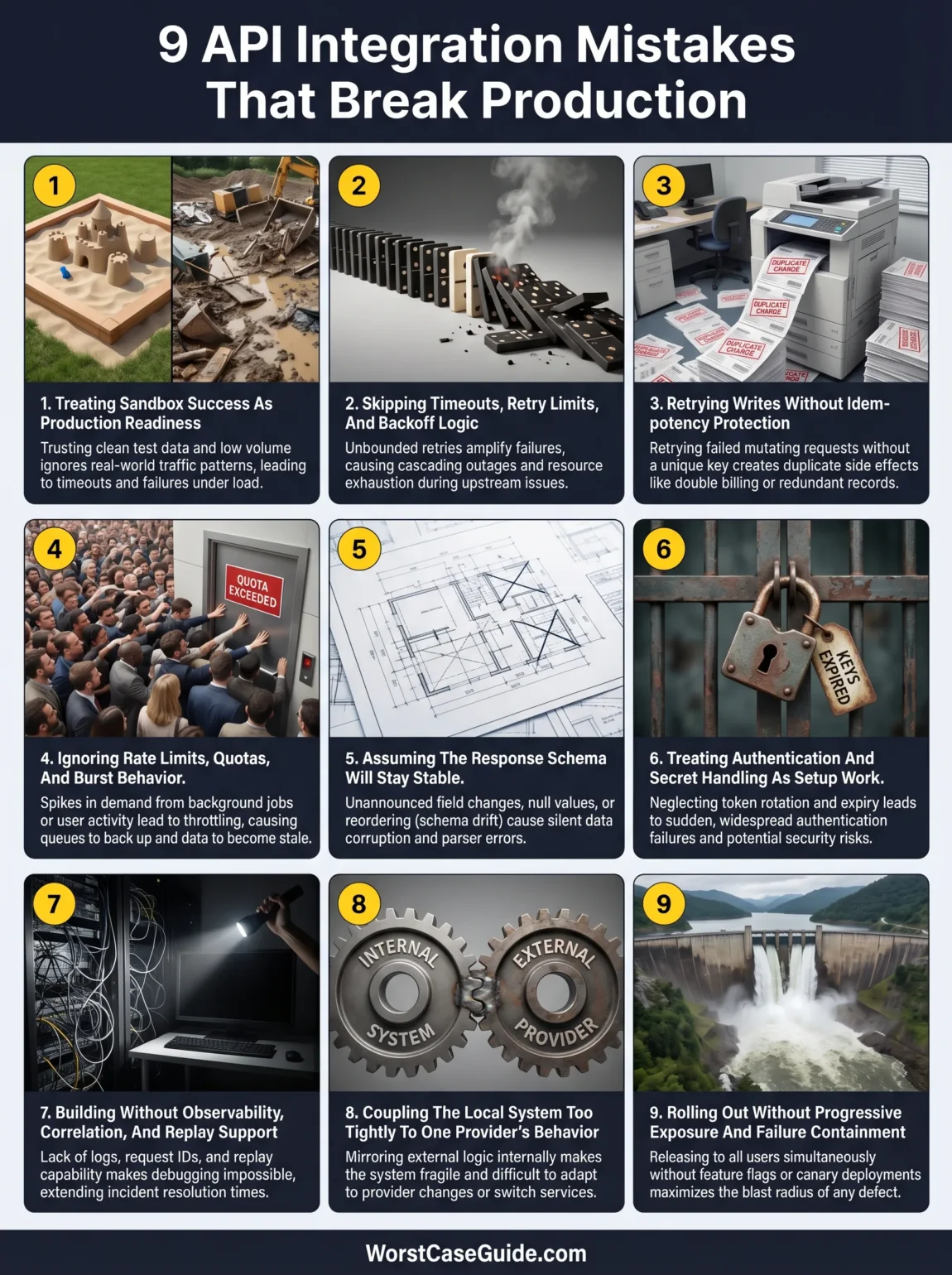
Mistake 1: Treating Sandbox Success As Production Readiness
Why It Happens
Teams often validate against clean test data, forgiving rate limits, and simpler auth flows. The integration “works,” so the rollout moves forward. That is understandable. Sandboxes are easier to trust than unknown traffic patterns.
Early Warning Signs
- Staging never sees realistic volume or concurrency.
- Only one or two golden-path payloads were tested.
- Token refresh, clock skew, and permission scopes were not exercised.
- Large payloads, partial records, and malformed values were not simulated.
Worst-Case Outcome
The first busy period exposes timeouts, parser failures, and auth errors at the same time. Customer-facing actions begin to fail while background jobs keep retrying, which widens the incident.
A Safer Approach
Teams usually reduce this risk when they test with production-like payload variety, realistic latency, quota limits, and permission boundaries. In larger systems, replaying sanitized production traffic into a non-customer path often reveals issues that a sandbox never will.
Mistake 2: Skipping Timeouts, Retry Limits, And Backoff Logic
Why It Happens
API clients frequently start with default settings. Some wait too long. Some retry too aggressively. Some never stop. Under normal load, nobody notices. During an upstream slowdown, the integration becomes its own amplifier.
Early Warning Signs
- Long tail latency keeps growing during provider degradation.
- Worker pools fill with blocked requests.
- Error rates rise after retries, not before them.
- 429 and 5xx responses appear in bursts.
Worst-Case Outcome
A brief upstream issue turns into cascading failure. Threads, containers, or serverless executions pile up. Internal systems slow down while the provider is already struggling. Now two outages exist, not one.
A Safer Approach
A steadier design usually includes bounded timeouts, retry caps, exponential backoff, and jitter. In smaller projects, even basic limits help. In larger systems, retry policy often needs to differ by endpoint, verb, and business impact.
Mistake 3: Retrying Writes Without Idempotency Protection
Why It Happens
When a POST request times out, the client cannot always tell whether the provider never processed it or processed it and lost the response. Teams under delivery pressure often add retries first and idempotency later.
Early Warning Signs
- Occasional duplicate orders, tickets, subscriptions, or messages.
- Support teams see “double action” complaints that are hard to reproduce.
- The same business event appears with different external IDs.
- Reconciliation jobs keep finding near-identical records.
Worst-Case Outcome
Duplicate side effects reach customers or accounting systems. That can mean double billing, repeated provisioning, repeated emails, inventory mismatch, or a broken audit trail. Retries without idempotency are a copier with a stuck button.
A Safer Approach
Integrations tend to behave better when a business-level idempotency key travels with mutating requests and the receiving side stores the outcome of the first accepted attempt. If the provider supports idempotency headers or tokens, that feature often changes the entire risk profile of retries.
Mistake 4: Ignoring Rate Limits, Quotas, And Burst Behavior
Why It Happens
Early traffic is low, so quotas look generous. Later, background syncs, backfills, cron jobs, and customer activity collide. That is where polite traffic turns into accidental hammering.
Early Warning Signs
- 429 responses cluster around the top of the hour or batch windows.
- One tenant or region degrades the whole integration.
- Pagination jobs speed through small datasets but stall on large ones.
- Recovery after a provider incident causes an even larger spike.
Worst-Case Outcome
The integration gets throttled during peak demand, then falls behind. Queues grow, retry waves increase pressure, and data freshness disappears. In systems with downstream dependencies, stale state can look like missing state.
A Safer Approach
Teams often lower blast radius with client-side rate limiting, per-tenant throttles, queue smoothing, and backfill windows that respect provider quotas. Where pagination exists, cursor-based flows and resumable jobs usually age better than huge one-shot pulls.
Mistake 5: Assuming The Response Schema Will Stay Stable
Why It Happens
Many integrations are written against today’s payload, not the provider’s change habits. A field that was always present becomes nullable. An enum gains a new value. A nested object appears only for some accounts. This is where schema drift enters quietly.
Early Warning Signs
- Parsers break on unexpected nulls or unknown enum values.
- Optional fields are treated as mandatory in mapping code.
- Webhook consumers assume field order or event order.
- Version pinning exists in docs but not in code or tests.
Worst-Case Outcome
The integration keeps running but writes wrong values into the local model. This is often worse than a loud failure. A loud failure gets fixed. Quiet corruption spreads.
A Safer Approach
Safer teams usually parse defensively, tolerate unknown fields, version their contracts, and validate business invariants after mapping. Contract tests help, though they matter most when those tests include messy payloads instead of only ideal examples.
Mistake 6: Treating Authentication And Secret Handling As Setup Work
Why It Happens
Auth tends to be solved once, then mentally moved into the “done” column. Yet token expiry, key rotation, scope changes, mTLS rules, IP allowlists, and environment separation keep moving over time.
Early Warning Signs
- Manual key changes cause surprise outages.
- Refresh token logic works on one service instance but not another.
- Secrets are copied across environments.
- Permissions are broader than the integration actually needs.
Worst-Case Outcome
Requests fail at once across jobs and user flows, or a leaked credential becomes a wider security issue. Even without a breach, poor auth hygiene can create a full production stop during routine rotation.
A Safer Approach
Risk usually drops when secrets are externalized, rotated in a planned way, scoped narrowly, and separated by environment and tenant where relevant. In regulated systems, auditability matters almost as much as the auth flow itself.
Mistake 7: Building Without Observability, Correlation, And Replay Support
Why It Happens
Logging often starts as an afterthought because shipping the integration feels more urgent than understanding it. Then the 3 a.m. incident channel opens, and nobody can answer a basic question: Which request created this state?
Early Warning Signs
- Logs show generic errors without provider response class.
- Request IDs are missing or not propagated.
- Metrics track total errors but not endpoint, tenant, or operation type.
- Dead-letter queues exist, yet replay is manual and risky.
Worst-Case Outcome
Incident response slows down. Teams guess. Guessing is expensive. A recoverable issue becomes a long outage because nobody can trace request path, payload version, retry count, and downstream side effects.
A Safer Approach
Stronger integrations usually log structured events, propagate correlation IDs, store provider request identifiers, and make replay possible with controls around idempotency and sequencing. In event-driven systems, dead-letter handling is only half the story; safe replay is the other half.
Mistake 8: Coupling The Local System Too Tightly To One Provider’s Behavior
Why It Happens
It is tempting to let the external API shape internal state, status codes, enum names, or workflow steps. That feels fast. Later, one provider change starts leaking through the whole application.
Early Warning Signs
- Internal business rules mirror third-party status names exactly.
- One provider-specific field appears across many services.
- Replacing the provider would require a broad code rewrite.
- Fallback behavior does not exist because local logic assumes one source of truth.
Worst-Case Outcome
A small provider change becomes an internal migration under pressure. Parts of the product stop behaving consistently because the application no longer has a clean boundary between external contract and internal model.
A Safer Approach
Many teams gain room to breathe when they introduce an adapter layer, a canonical internal model, and explicit translation for status, error classes, and webhook events. This does add code. It also reduces long-term fragility.
Mistake 9: Rolling Out Without Progressive Exposure And Failure Containment
Why It Happens
Release plans often focus on deployment, not blast radius. The code is merged, the flag is flipped, and the new path becomes live for every tenant, every job, and every region at once. That is a lot of trust to place in fresh integration logic.
Early Warning Signs
- No feature flag or tenant allowlist exists.
- There is no dark launch, shadow traffic, or canary path.
- Circuit breaker behavior is undefined.
- Fallback mode for degraded provider service has not been discussed.
Worst-Case Outcome
A defect reaches all customers at the same time. Recovery becomes slower because rollback is mixed with data cleanup, replay decisions, and customer support work. In larger systems, regional isolation would have made the same bug far cheaper.
A Safer Approach
Safer rollouts usually expose new integrations gradually, observe error budgets and business metrics together, and define degraded behavior before launch. If the provider is down, what still works? If webhook lag rises, what becomes read-only? Those answers matter before launch, not after.
General Risk Patterns Behind Most Integration Failures
Across these mistakes, a few patterns repeat. They are worth noticing because they show up in REST APIs, GraphQL endpoints, webhook consumers, partner platforms, internal service-to-service calls, and older SOAP-style integrations too.
- State uncertainty: the client does not know whether an action completed, partially completed, or completed twice.
- Hidden coupling: one provider’s contract leaks too deeply into internal code and data models.
- Failure amplification: retries, batches, and queues turn a small external issue into internal stress.
- Silent corruption: bad mapping and schema drift create wrong records without obvious alerts.
- Weak containment: all tenants, all regions, or all workflows share the same failure path.
One pattern stands out: teams often prepare for request failure but not for state ambiguity. A timeout is visible. “Did the side effect already happen?” is where the harder incidents begin.
FAQ
Which API integration mistake causes the most expensive cleanup?
It is often retrying write operations without idempotency. Downtime is painful, though duplicate side effects usually create a longer cleanup path because data repair, support work, and audit review may all be needed.
Are read-only API calls much safer than write calls?
Usually, yes. Read operations can still trigger latency, quota, and cache issues, though mutating requests carry more risk because they may create state that is difficult to reverse when retries or partial failures happen.
Why do integrations fail in production even when tests pass?
Tests often cover the expected path, while production adds traffic spikes, unusual payloads, token expiry, provider throttling, delayed webhooks, and partial network failure. Passing tests may only prove that one narrow path works.
What is the difference between retry safety and idempotency?
Retry safety is the broader idea that a failed request can be repeated without causing harm. Idempotency is one of the main ways to achieve that for mutating operations, because the same request can be processed once in effect even if it is sent more than once.
Do small teams need the same safeguards as large platforms?
Not always at the same depth. Small teams may not need multi-region isolation or a large replay pipeline. They still benefit from timeouts, bounded retries, basic idempotency, structured logs, and gradual rollout. The shape changes. The logic does not.