Storage planning in a home looks simple until it becomes a series of small, expensive frictions: doors that cannot open fully, closets that never stay organized, and “temporary” stacks that turn into permanent clutter. The risk is rarely dramatic. It is slow, cumulative, and often hard to reverse once furniture is purchased, walls are drilled, or routines form. The goal is not perfection. The goal is to avoid the kinds of planning mistakes that lock a space into daily inefficiency.

Residential storage has a specific trap: it mixes objects, habits, and physical constraints. If any one of those is guessed wrong, storage “solutions” create new problems. In smaller homes, the penalty is usually wasted floor area and constant reshuffling. In larger homes, the penalty is often duplication—buying the same items because they cannot be found, and maintaining multiple micro-storages that drift out of sync.
Why storage planning is risky: It is easy to underestimate volume growth, overlook access paths, and commit to fixed layouts that cannot adapt to changing needs.
Common Assumptions That Quietly Break Storage Plans
- “If it fits today, it will fit later.” Household inventories tend to grow in categories, not evenly.
- “More bins means more organization.” Containers can hide the real issue: unclear categories and poor access.
- “Any unused corner is good storage.” Corners can become dead zones if retrieval is awkward.
- “Closets are always efficient.” A closet with the wrong depth, height, or layout becomes a black hole.
- “I’ll remember what’s where.” Memory-based systems collapse under stress, guests, illness, or schedule changes.
Mistakes That Create The Worst Storage Outcomes
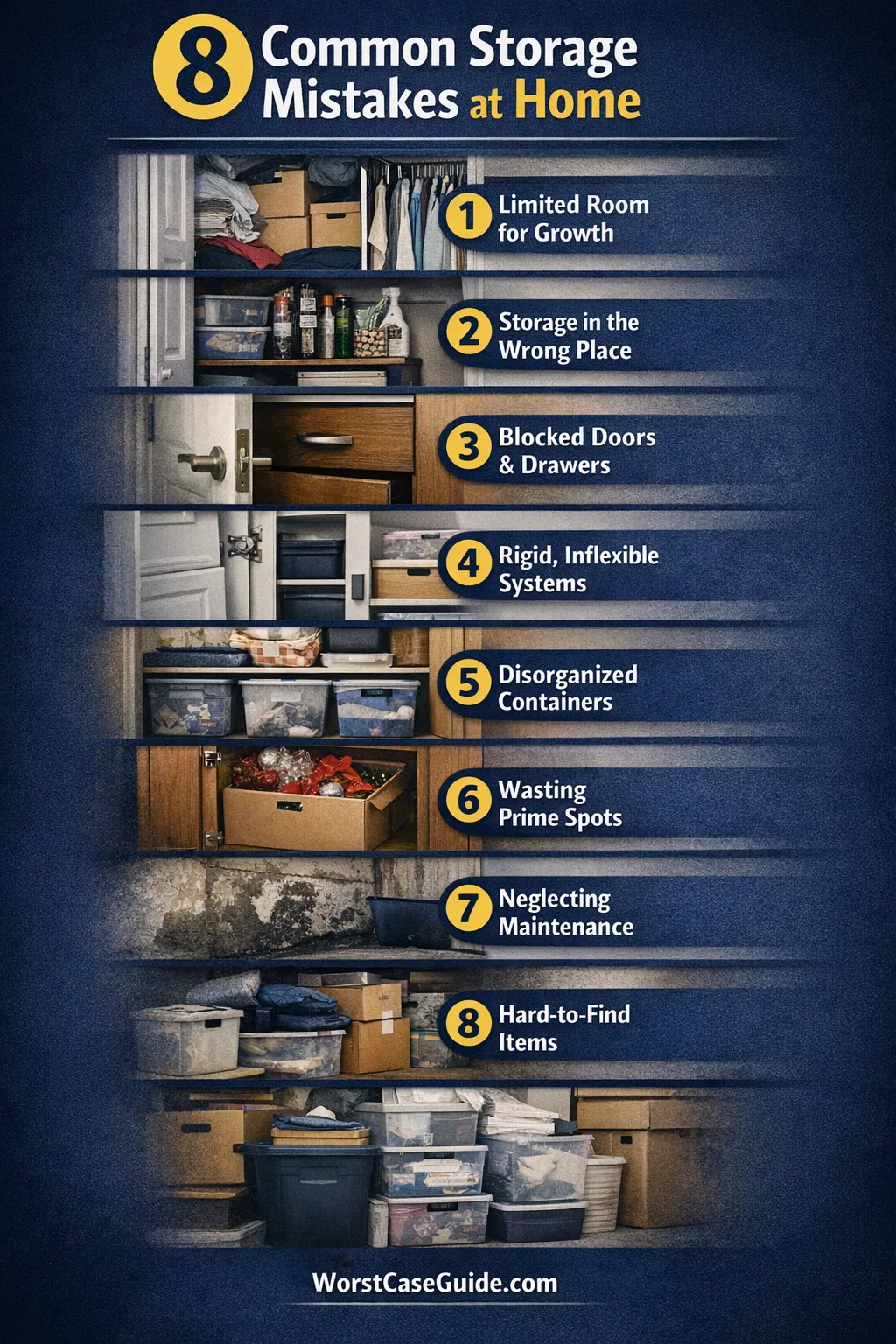
Mistake 1: Planning For Static Inventory Instead Of Real Growth
This happens when storage is sized for what exists now, not what reliably arrives later: seasonal items, replacements, gifts, hobby expansions, and household “just in case” purchases. A plan that has no growth margin becomes a constant negotiation.
Why it happens
- Underestimating how many categories grow (kitchenware, linens, cables, cleaning supplies).
- Assuming decluttering will offset new items, without a repeatable routine.
- Buying fixed storage early (built-ins, heavy furniture) before observing actual patterns.
Early warning signs
- “Temporary piles” that keep returning after being cleaned.
- One category regularly invading another (shoes in a coat closet, tools in a kitchen drawer).
- Frequent re-sorting rather than stable placement.
Worst-case outcome (without exaggeration)
Storage becomes a daily maintenance task. Items get duplicated because they cannot be found. Floors, counters, and chairs become default storage, reducing usable living space.
A safer approach
Leaving intentional slack (empty shelf space, buffer drawers, or adjustable zones) can keep a system stable. If you are in a household where hobbies, kids, or frequent guests change inventory quickly, modular storage often ages better than fixed, single-purpose units.
Mistake 2: Designing Storage For “Where It Fits” Instead Of “Where It’s Used”
When storage is located based on available space rather than daily use, it adds steps to routines. Those steps turn into avoidance, and avoidance turns into clutter.
Why it happens
- Prioritizing empty corners over use paths (entry, kitchen prep, laundry flow).
- Assuming everyone in the home follows the same logic.
- Not mapping the “touch points” where items are dropped and picked up.
Early warning signs
- Common items living on surfaces even though storage exists.
- People leaving items “near” the correct place but not inside it.
- Repeated comments like “it’s annoying to put that away.”
Worst-case outcome (without exaggeration)
Storage exists but is not used consistently. The home develops informal storage zones—chairs, countertops, stair landings—that crowd daily movement and create visual noise.
A safer approach
Placing storage where the item naturally enters and exits life usually reduces friction. In smaller projects, even one entry landing zone can prevent spread. In larger homes, aligning storage with routes (not rooms) can keep categories coherent.
Mistake 3: Ignoring Access Geometry (Doors, Drawers, Reach, And Clearance)
Storage can “fit” on paper and still be unusable if doors clash, drawers cannot fully extend, or shelves sit outside comfortable reach. These are not cosmetic issues. They directly determine whether storage stays functional.
Why it happens
- Measurements focus on width/height but miss clearance and swing arcs.
- Assuming standard solutions fit non-standard rooms.
- Not testing how a person actually moves through the space with hands full.
Early warning signs
- Drawers that hit handles, radiators, or door frames.
- Cabinet doors that cannot open fully near corners.
- People avoiding lower shelves because kneeling or bending feels like a penalty.
Worst-case outcome (without exaggeration)
Part of the storage becomes dead space. Over time, dead space becomes a dumping ground for rarely used items, making retrieval stressful and time-consuming.
A safer approach
Testing movement and access before committing to a layout reduces these failures. If you are dealing with tight clearances, storage that opens in a different way (pull-outs, sliding doors, open shelving in limited zones) can reduce collision points.
Mistake 4: Overbuilding A Single “Perfect System” Instead Of Creating Flexible Zones
Homes change. Storage that assumes a fixed lifestyle tends to age poorly. When a system cannot flex, it forces constant reconfiguration or creates overflow elsewhere.
Why it happens
- Trying to solve every category at once with a tight fit.
- Choosing built-ins before understanding which categories stabilize and which are seasonal.
- Optimizing for aesthetics while underweighting adaptability.
Early warning signs
- Storage looks neat only right after a full reset.
- Small changes (new appliance, new hobby) break the whole layout.
- Adding more bins keeps happening, but the home still feels “full.”
Worst-case outcome (without exaggeration)
Storage becomes fragile. One disruption causes spillover across rooms. The household spends time maintaining a system rather than benefiting from it.

A safer approach
Flexible zones with adjustable shelves, movable dividers, and spare capacity tend to tolerate change. If you are planning a long-term layout, it can help to treat some storage as unknown future rather than assigning every inch immediately.
Mistake 5: Treating Containers As Organization (Instead Of Category Design)
Boxes and bins can be useful, but they are not a category system. Without clear categories, containers become a way to hide mixed items—until something is needed quickly.
Why it happens
- Buying organizers before defining what belongs together.
- Using containers to “clean fast” rather than to create retrievable storage.
- Relying on vague labels (“misc,” “stuff,” “tools”) that collapse under pressure.
Early warning signs
- Bins that hold unrelated items across multiple categories.
- Labels that describe where the bin is, not what is inside.
- Searching requires emptying a container onto the floor.
Worst-case outcome (without exaggeration)
The home becomes “organized clutter.” It looks contained but behaves like clutter: slow retrieval, forgotten inventory, and frequent re-buying.
A safer approach
Clear categories with boundaries tend to outperform container-heavy systems. In smaller spaces, fewer, better-defined categories can reduce the need for many organizers. In larger systems, a simple rule like “one container = one category” can keep storage legible.
Mistake 6: Using High-Value Space For Low-Value Items
Not all storage locations are equal. Some are “prime”: near entry, at eye level, easy reach. If these areas are consumed by rarely used items, daily routines pay the price.
Why it happens
- Storing items based on size rather than frequency.
- Keeping sentimental or “maybe useful” items in the most accessible zones.
- Not re-evaluating space value after lifestyle changes.
Early warning signs
- Daily items are stored too high, too low, or too far away.
- Common routines require moving other items first.
- You know the closet has space, but it’s full of things rarely touched.
Worst-case outcome (without exaggeration)
Daily friction increases. People stop putting things away because the “right place” is inconvenient. Over time, the home becomes surface-dependent.
A safer approach
Allocating prime space to the most frequently used categories usually improves stability. If you are in a household with multiple schedules, “frequency” can mean “used by anyone daily,” not just by one person.
Mistake 7: Overlooking Maintenance Reality (Cleaning, Dust, Moisture, And Pests)
Storage is not only about placement. It also interacts with cleaning access, airflow, and materials. Poor choices can create odors, mold risk, or damage to items, especially in basements, attics, and under-sink areas.
Why it happens
- Assuming all enclosed spaces are “safe storage.”
- Using cardboard or fabric in areas with moisture or temperature swings.
- Blocking access to edges where dust and debris accumulate.
Early warning signs
- Musty smells in closets or cabinets.
- Warped wood, peeling laminate, or condensation near stored items.
- Items that feel slightly damp or develop stains over time.
Worst-case outcome (without exaggeration)
Stored items degrade: paper yellows, fabrics smell, electronics corrode, and cleaning becomes harder. Replacement costs appear slowly, often as “mysterious wear.”
A safer approach
Using storage materials that match the environment tends to reduce damage. If you are storing sensitive items, keeping them off the floor, allowing airflow, and avoiding sealed damp zones can reduce slow losses.
Mistake 8: Forgetting Visibility, Inventory, And Findability
If items cannot be found reliably, storage turns into a guessing game. Many households mistake “out of sight” for “solved,” then spend time searching, re-buying, and accumulating duplicates.
Why it happens
- Using deep shelves without a visibility strategy.
- Storing too many categories in one place with no mental map.
- Not defining a basic system for “rarely used but important” items.
Early warning signs
- Buying replacements because an item was “probably gone.”
- Discovering duplicates during cleaning.
- Feeling uncertain about what the household already owns.
Worst-case outcome (without exaggeration)
Inventory expands due to uncertainty. Storage volume grows faster than living space. Financially it is usually modest per incident, but repeated, it becomes noticeable.
A safer approach
Simple visibility aids often beat complex systems: grouping by category, using consistent labels, and keeping frequently searched items near the front. In larger homes, a small “house map” approach—knowing which zone holds which category—can reduce search cost.
A Practical Risk Map For Residential Storage
Patterns Behind Most Storage Failures
Friction beats intention. If storage adds steps, people default to the nearest flat surface.

Pattern: good intentions + inconvenient placement = surface clutter.
Dead space becomes risk storage. Hard-to-reach zones collect fragile, important, or forgotten items.
Pattern: low access + deep storage = loss of inventory control.
Containers can hide category decay. When categories blur, bins multiply and retrieval slows.
Pattern: more organizers + unclear boundaries = organized clutter.
Prime space is a limited resource. When prime space is assigned poorly, daily life pays the tax.
Pattern: low-frequency items in prime zones = routine inefficiency.
FAQ