Long-term planning feels safe because it looks structured on paper. The risk usually sits in the assumptions that stay invisible until time passes. In real life, priorities shift, constraints tighten, and “later” turns into a crowded backlog. When planning spans months or years, small oversights can compound into expensive rework, missed opportunities, or brittle systems that resist change.

Long-range plans are not “bad.” They are simply fragile when they rely on certainty that does not exist. The goal is not to predict the future perfectly; it is to reduce the chance that today’s choices quietly create tomorrow’s problems.
Why Long-Term Planning Creates Hidden Risk
Long-term planning often mixes two different activities: deciding direction and locking details. Direction can stay stable. Details rarely do. The bigger the timeline, the more likely that:
- Inputs change: customers, tools, costs, team capacity, regulations, vendors.
- Dependencies accumulate: every promise depends on other promises staying true.
- Feedback arrives late: problems surface after commitments harden.
Useful framing: Long-term planning is less about a single “correct plan” and more about designing a decision system that stays reliable as reality changes.
Common Wrong Assumptions People Plan With
- “We can estimate accurately this far out.” Estimates typically degrade with distance, even in familiar work.
- “The plan is commitment.” Plans are often treated like contracts rather than learning tools.
- “Big changes are rare.” Smaller changes happen constantly; they still reshape outcomes.
- “More detail means more control.” Detail can create false precision and slow adaptation.
- “We’ll remember why we decided this.” Without recorded context, future decisions become guesswork.
Long-Term Planning Mistakes That Create Future Problems
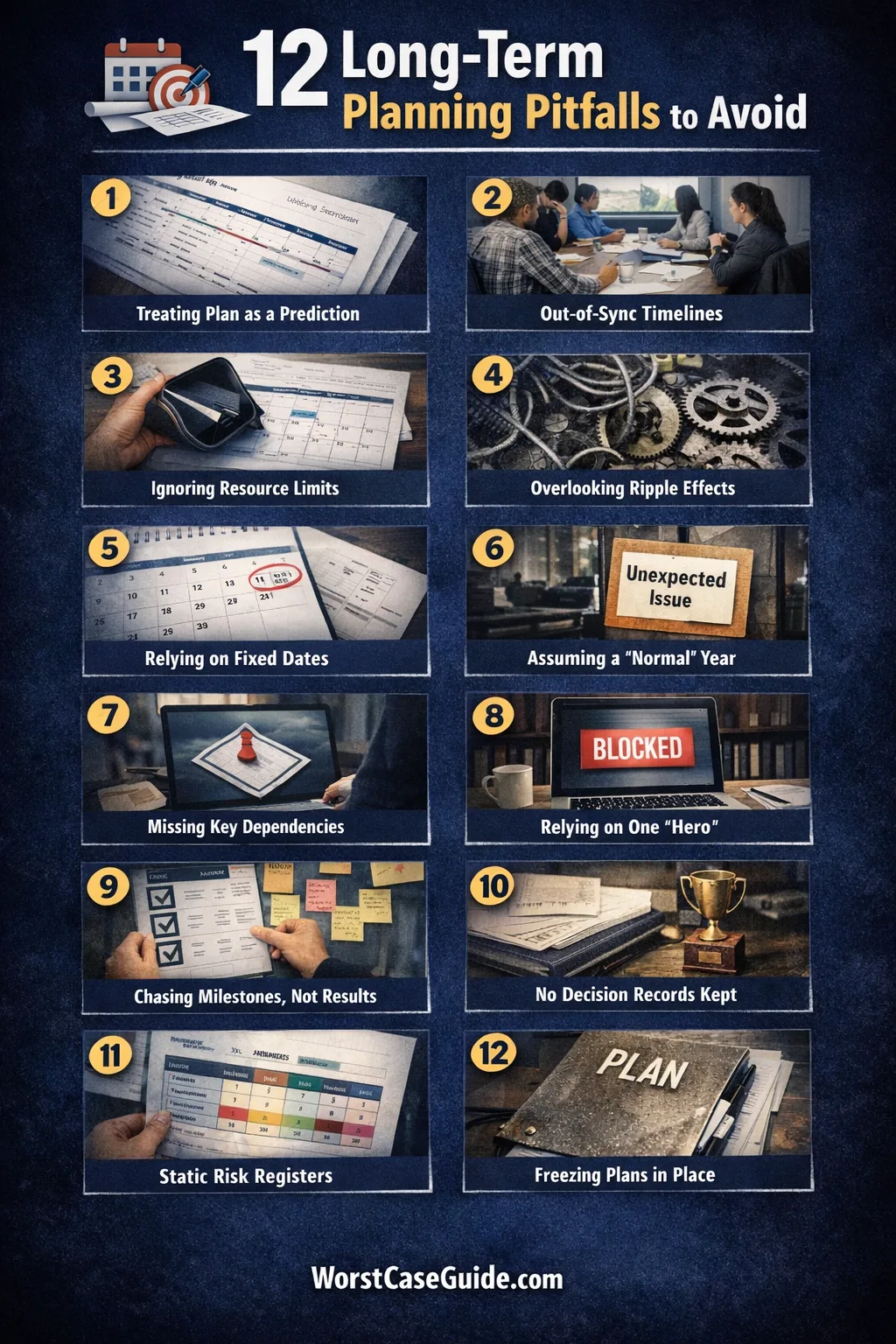
Mistake 1: Treating The Plan As A Prediction Instead Of A Hypothesis
Why It Happens
Planning artifacts often look authoritative. A timeline, roadmap, or multi-year budget can feel like a forecast, not a set of assumptions waiting to be tested.
Early Warning Signs
- People stop asking “what would change this?”
- Risks are described vaguely (“low/medium/high”) without triggers.
- The plan is used to end discussion rather than guide it.
Worst-Case Outcome
Commitments harden around incorrect assumptions, and the organization pays later through forced scope cuts, rushed quality tradeoffs, or reputational damage when promises slip.
A Safer Approach
It tends to be safer when the plan is framed as a testable hypothesis: what is believed, what evidence would confirm it, and what signals would invalidate it.
Mistake 2: Planning In One Timeline While The Work Runs In Another
Long-term plans often run yearly, while execution moves weekly or daily. When those rhythms do not connect, the plan becomes a separate universe.
Why It Happens
Leadership cycles (annual budgeting, quarterly reporting) can drift away from delivery cycles (iterations, operational tickets, support load). The plan stays static while reality stays dynamic.
Early Warning Signs
- Roadmaps do not reflect actual work-in-progress.
- Teams maintain “real plans” in private spreadsheets or chat threads.
- Progress updates feel like storytelling, not measurement.
Worst-Case Outcome
Work accumulates that does not advance strategic goals. Later, a rushed “alignment push” creates churn, reversals, and avoidable rework.
A Safer Approach
Better results often come when long-term direction is translated into shorter decision checkpoints that match the cadence of execution.
Mistake 3: Locking Scope Before Constraints Are Real
It is common to define “what we will build” before knowing what time, budget, people, or dependencies will realistically allow.
Why It Happens
Stakeholders prefer certainty. Detailed scope provides comfort, even if the constraints remain unverified.
Early Warning Signs
- Scope documents exist without capacity or dependency checks.
- Critical roles are “to be hired” or “borrowed later.”
- External dependencies are named but not negotiated.
Worst-Case Outcome
Delivery becomes a sequence of compromises: quality debt, missed deadlines, or partial launches that create user confusion and internal fatigue.
A Safer Approach
It can be safer to lock constraints first, then shape scope as an adjustable set of options that can expand or contract without collapsing the plan.
Mistake 4: Ignoring Second-Order Effects
Plans often focus on direct outcomes (ship X, launch Y) while missing the side effects (support load, maintenance, training, security reviews, vendor lock-in).
Why It Happens
Second-order effects are harder to quantify. They also show up later, so they are easier to postpone.
Early Warning Signs
- Operational costs are treated as “someone else’s problem.”
- Maintenance is absent from the plan or budget.
- No one owns post-launch responsibilities.
Worst-Case Outcome
Short-term delivery looks successful, then the system becomes expensive to keep running, slower to change, and harder to scale.

A Safer Approach
Many teams reduce surprise by mapping “what gets heavier after launch” and assigning ownership early, even if estimates stay rough.
Mistake 5: Using Single-Point Estimates For Long Horizons
“It will take 9 months” sounds clean. Over long horizons, it often hides wide uncertainty.
Why It Happens
Single numbers are easy to communicate. Ranges feel like indecision, even when they are more honest.
Early Warning Signs
- Dates are presented without confidence levels or assumptions.
- Buffers exist but are unofficial and politically sensitive.
- Every slip is treated as a failure, not as expected variance.
Worst-Case Outcome
Teams optimize for the date rather than the outcome, cutting corners and creating hidden debt that surfaces later.
A Safer Approach
It tends to be safer when long-term plans use ranges, scenario bands (best/expected/worst), and explicit assumption lists.
Small but powerful shift: A date can be presented as “expected if these conditions hold” rather than as a promise.
Mistake 6: Planning For A “Normal Year” That Rarely Exists
Many plans assume consistent productivity. Real life includes interruptions: outages, urgent requests, turnover, re-orgs, supplier delays, and compliance changes.

Why It Happens
Interruptions feel like exceptions. Over time, exceptions become the baseline.
Early Warning Signs
- Operational work is not tracked or forecasted.
- Key people are scheduled at or near 100% utilization.
- Every quarter includes “unexpected” urgent work.
Worst-Case Outcome
The plan becomes a recurring disappointment cycle. Trust erodes because variance is treated as incompetence.
A Safer Approach
Some stability comes from planning with a realistic “interrupt budget” and defining what gets deprioritized when surprises arrive.
Mistake 7: Forgetting Dependencies Until They Block Progress
Dependencies are easy to name and easy to underestimate. They also multiply over long timelines.
Why It Happens
Dependency work often lives outside the team’s control. People hope it will “work out” later.
Early Warning Signs
- Plans mention dependencies without owners or dates.
- External partners are surprised by your timeline.
- Approvals and procurement steps are invisible in the schedule.
Worst-Case Outcome
A late dependency failure can force redesigns, contract disputes, or a cascade of delays across other commitments.
A Safer Approach
It is often safer to treat key dependencies as first-class work items: owners, checkpoints, and fallback paths if the dependency fails.
Mistake 8: Building A Plan Around One “Hero” Person
Long-term plans sometimes assume a single expert will stay available, motivated, and healthy for the entire timeline.
Why It Happens
Specialized knowledge concentrates naturally. Planning then hard-codes that concentration into the future.
Early Warning Signs
- Critical tasks have one name next to them, repeatedly.
- Key decisions are delayed until one person is free.
- Documentation exists, but it is outdated or unused.
Worst-Case Outcome
Turnover, burnout, or re-assignment creates a knowledge cliff. Delivery slows, and quality drops while new people reconstruct context.
A Safer Approach
Plans tend to be more resilient when they include knowledge distribution: pairing, documentation, cross-training, and redundancy for critical areas.
Mistake 9: Optimizing For Milestones Instead Of Outcomes
Milestones are visible. Outcomes are often harder to measure. Long-term plans can drift toward what is easy to count.
Why It Happens
Reporting systems reward “completed phases.” Over time, phase completion becomes the goal.
Early Warning Signs
- Status is green while users still struggle with core pain points.
- Teams ship features that do not get adopted.
- Post-launch metrics are unclear or absent.
Worst-Case Outcome
The roadmap gets “done” without meaningful value. Later, a reset is needed, and previous effort becomes sunk cost.
A Safer Approach
Many plans improve when each milestone is tied to an observable outcome (behavior change, error reduction, time saved), even if measurement stays approximate.
Mistake 10: Not Recording Decision Context
Long-term plans outlive the meetings that created them. Without context, future teams inherit decisions without understanding the tradeoffs.
Why It Happens
Context feels like “extra work.” The urgency is to decide and move on.
Early Warning Signs
- People say, “Why are we doing this again?”
- Old decisions are re-litigated repeatedly.
- Teams hesitate because rationale is missing.
Worst-Case Outcome
Time is lost to repeated debates, inconsistent standards, and avoidable reversals. The organization pays in coordination cost.
A Safer Approach
It often helps when a plan includes a lightweight decision log: what was chosen, why, what alternatives were rejected, and what would change the decision.
Mistake 11: Treating Risk As A Static List
Risk registers are frequently created once, then forgotten. In long timelines, risk changes shape as the environment changes.
Why It Happens
Risk tracking can feel like paperwork. People prefer to focus on delivery, assuming risk work slows progress.
Early Warning Signs
- Risks are not connected to triggers or monitoring.
- Ownership is unclear (“someone should watch this”).
- New risks appear only after incidents occur.
Worst-Case Outcome
Predictable issues still surprise the team. Mitigations arrive late and cost more than they would have earlier.
A Safer Approach
Risk becomes more useful when it is treated as a living system: triggers, owners, review cadence, and predefined responses for a few high-impact scenarios.
Mistake 12: Freezing The Plan To Avoid “Confusion”
Some organizations avoid updating plans because change creates discomfort. The plan stays stable, while reality does not.
Why It Happens
Frequent changes can look like indecision. Leaders may fear losing credibility if the plan shifts.
Early Warning Signs
- Teams follow the plan even when it no longer matches current constraints.
- Plan updates are rare, large, and politically charged.
- Feedback loops exist, but they do not influence commitments.
Worst-Case Outcome
The organization drifts into a brittle mode: people work around the plan, trust declines, and the “official” roadmap becomes performative.
A Safer Approach
A plan can stay credible while still evolving if changes are tied to clear triggers and communicated as controlled adjustments, not reversals.
Quick Reference Table: Mistakes, Signals, And Safer Moves
| Mistake | Early Signal | Safer Move |
|---|---|---|
| Plan As Prediction | No “what would change this?” | Hypotheses + invalidation signals |
| Mismatched Cadence | Real plan lives elsewhere | Short checkpoints tied to execution |
| Scope Before Constraints | Capacity not validated | Constraint-first planning |
| Second-Order Effects | No post-launch owner | Operational costs + ownership mapped |
| Single-Point Estimates | Dates without assumptions | Ranges + scenarios |
| Normal-Year Planning | Chronic “unexpected” work | Interrupt budget + reprioritization rules |
| Late Dependencies | No owners for dependencies | Dependency checkpoints + fallbacks |
| Hero Reliance | Single name everywhere | Knowledge redundancy |
| Milestone Worship | Green status, weak adoption | Outcome-linked milestones |
| Missing Context | “Why are we doing this?” | Decision log with triggers |
| Static Risk Lists | Risks not revisited | Living risk system |
| Plan Freeze | Official roadmap feels performative | Controlled adjustments with clear logic |
General Risk Patterns Behind These Mistakes
Across different contexts—home projects, digital systems, business operations—the same patterns show up:
- False precision: detailed promises built on unstable inputs.
- Invisible load: maintenance and support not budgeted, then paid later.
- Coordination debt: missing context forces repeated re-decision.
- Single points of failure: one person, one vendor, one fragile dependency.
- Delayed feedback: signals arrive late, so course-correction becomes expensive.
How this scales: In smaller projects, the main risk is usually overcommitment. In larger systems, the main risk is often compounding dependencies and coordination drift.
FAQ
How far ahead is “long-term” in planning?
It depends on the volatility of inputs. For fast-changing environments, even 3–6 months can behave like long-term. For stable environments, 12–24 months may still be workable if assumptions stay explicit.
What makes a long-term plan trustworthy?
Plans tend to earn trust when they show assumptions, uncertainty ranges, ownership, and clear triggers for change. A plan can be stable in direction while flexible in detail.
Is frequent re-planning a sign of poor leadership?
Not necessarily. Frequent changes can signal poor clarity, yet they can also reflect a healthy response to new information. The difference is often whether changes follow predefined triggers or arrive as surprises.
How can dependencies be handled without slowing everything down?
A common approach is to identify only the highest-impact dependencies, assign ownership, and define checkpoints and fallback options. Many smaller dependencies can remain informal.
What if stakeholders demand fixed dates?
Some teams reduce tension by offering fixed review points and scenario bands, then tying date confidence to explicit assumptions. That can preserve accountability while acknowledging uncertainty.
How can decision context be recorded without heavy documentation?
A lightweight log often works: the decision, the reasons, the alternatives considered, and the conditions that would change it. The goal is retrieval, not perfection.