Heating and cooling bills rarely jump for one dramatic reason. More often, small maintenance misses stack up like traffic on a narrow road: airflow drops, heat transfer gets worse, controls drift, and the system keeps running long enough to look “fine” while quietly costing more. That is what makes HVAC maintenance mistakes so expensive. The unit may still heat, still cool, still turn on every day. The waste starts earlier than many people expect.
HVAC maintenance is not only about preventing breakdowns. It also affects airflow, humidity control, runtime, compressor strain, blower workload, and the gap between what the thermostat asks for and what the house actually receives.
Why This Topic Is Risky
Energy bills create a strange kind of blind spot. When comfort is still “acceptable,” many owners assume the system is healthy enough and that the higher bill must be weather, utility rates, or just bad luck. Sometimes that is true. Often, it is only part of the story.
HVAC systems also fail in a quiet way. Restricted return air, dirty coils, duct leakage, incorrect refrigerant charge, or thermostat misconfiguration can all raise operating cost before they create an obvious service emergency. That is why energy waste can sit in the background for months.
Common Wrong Assumptions
- If air is coming from the vents, the airflow must be fine.
- A stronger filter is always a better filter.
- A refrigerant “top-off” is normal maintenance.
- Closing vents in unused rooms always lowers the bill.
- If the system is newer, maintenance can wait.
- If the thermostat displays the right temperature, the control setup must be correct.
- If a tune-up was done, the whole problem must be solved.
One pattern shows up again and again: people wait for a comfort problem, while the energy problem has already started. A bill spike is often an early warning, not a late one.
| Maintenance Issue | How It Raises Energy Use | What People Often Misread |
|---|---|---|
| Dirty or badly fitted filter | Reduces airflow and forces the system to work harder for the same result | “The system is just getting older” |
| Dirty indoor or outdoor coil | Weakens heat transfer and extends runtime | “A little dust outside does not matter” |
| Refrigerant guesswork | Improper charge lowers efficiency and cooling performance | “Adding refrigerant fixed it last year, so do it again” |
| Leaky ducts | Conditioned air is lost before it reaches the room | “The vents still blow, so the ducts must be fine” |
| Bad thermostat use or setup | Creates unnecessary runtime, overshoot, or backup heat calls | “A smart thermostat always saves money by itself” |
| Ignored drainage and humidity clues | Moisture problems often arrive with airflow or cooling faults | “It is just condensation” |
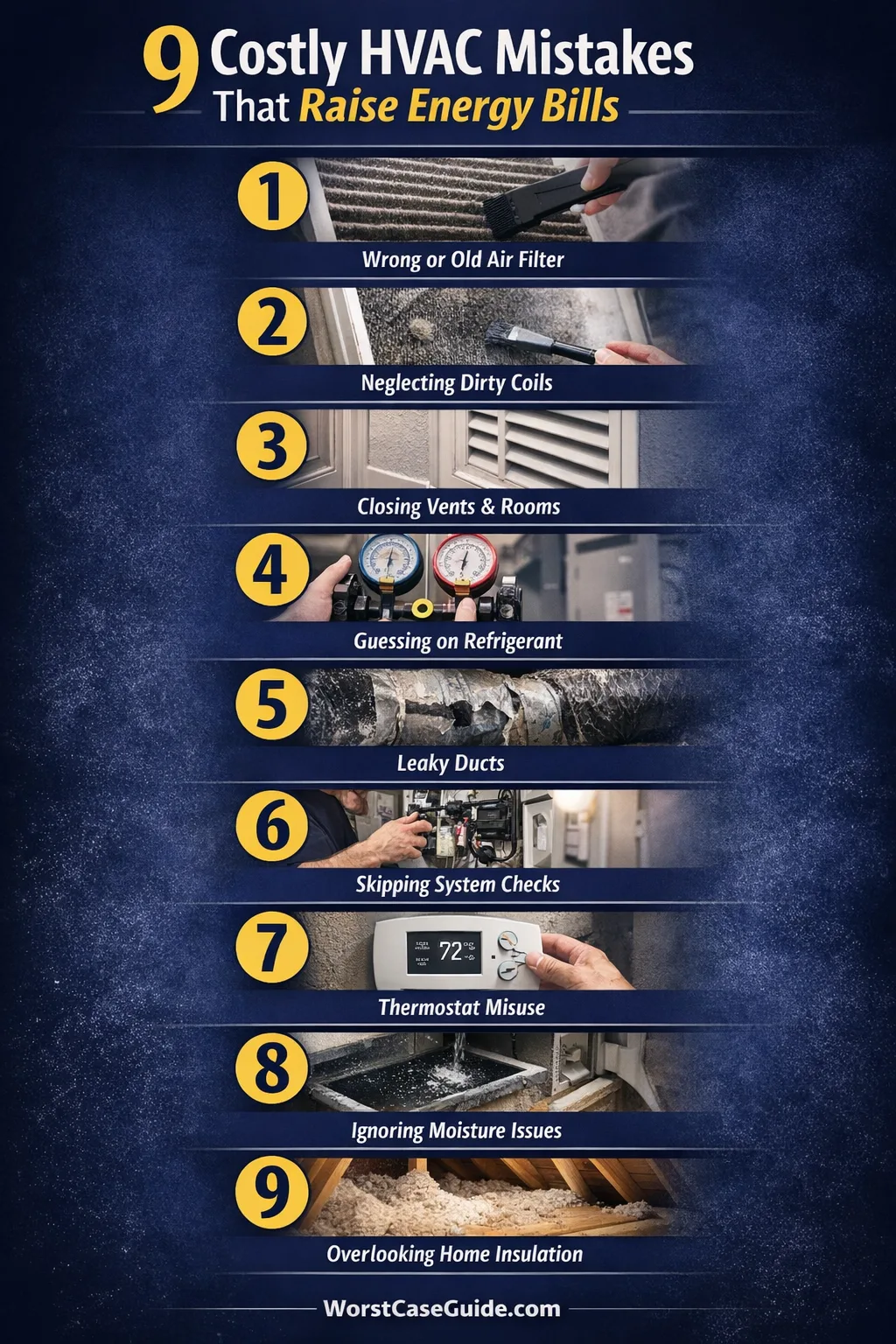
9 HVAC Maintenance Mistakes That Spike Energy Bills
Mistake 1: Using The Wrong Filter Setup Or Waiting Too Long To Change It
Why It Happens
Filter advice gets oversimplified. People hear “better filtration” and buy the most restrictive option that fits the slot, or they keep a filter in place far beyond its useful life because it still looks only slightly gray. Another version is quieter: the filter size is technically correct, but the fit is loose, so air bypasses around the frame and dirt reaches the blower and indoor coil anyway.

Early Warning Signs
- Weak airflow at supply registers
- Dust buildup downstream of the filter area
- Whistling at the return grille
- Short cycling in heating mode or icing in cooling mode
- Some rooms drifting warmer or colder than usual
Worst-Case Outcome
The bill rises first. After that, the system may start overheating in furnace mode, freezing at the evaporator coil in cooling mode, or putting extra strain on the blower motor. In a tighter filter cabinet with poor airflow margin, a “good” filter choice can become a bad system choice.
Safer Approach
A safer path is to match the filter type to the equipment and cabinet design, not only to indoor air quality goals. In homes with pets, renovation dust, or heavy seasonal pollen, inspection usually needs to happen more often, not just on a fixed calendar. If the system has a thin 1-inch filter slot, moving to a very restrictive filter without checking airflow can backfire. In larger systems with a proper media cabinet, higher filtration is often easier to support.
Mistake 2: Treating Coil Cleaning As Cosmetic
Why It Happens
The outdoor unit is visible, so people may focus on leaves, dirt, and fins only when the equipment looks neglected. The indoor evaporator coil is the opposite: it is hidden, so it is easy to forget. Yet both coils are heat-transfer surfaces. When they get dirty, efficiency falls even if the system still reaches setpoint eventually.
Early Warning Signs
- Longer cooling cycles during weather that used to feel manageable
- Supply air that feels less cool than before
- Higher indoor humidity even when temperature looks acceptable
- Outdoor unit running hot, loud, or surrounded by debris
Worst-Case Outcome
The system starts taking the long way around every cycle. Runtime grows, dehumidification gets weaker, and compressor stress builds. It is a slow tax on every day of cooling season. In heating mode on heat pumps, dirty outdoor coils can be just as frustrating.
Safer Approach
The safer approach is to treat coil condition as a performance issue, not a housekeeping issue. Outdoor units benefit from clear space and clean airflow. Indoor coil inspection matters too, especially when there has been past filter neglect, return leaks, or visible dust around the air handler.
Mistake 3: Closing Vents, Blocking Returns, Or Shutting Rooms To “Save Energy”
Why It Happens
This mistake feels logical. If a room is not being used, why send conditioned air there? In a ducted system, the answer is that the blower and duct layout were built around a certain airflow path. Closing supply vents, blocking return grilles with furniture, or keeping interior doors shut can raise static pressure and distort that path.
Early Warning Signs
- Whistling vents or noisy airflow
- Bedroom doors that push or pull when the system starts
- Hot or cold spots getting worse, not better
- More dust near door undercuts or hallway returns
Worst-Case Outcome
The system may spend more energy moving less useful air. In some setups, restricted airflow contributes to frozen coils, furnace limit trips, or uneven pressure from room to room. It can feel like a control problem when it is really an airflow problem.
Safer Approach
If a few rooms are habitually uncomfortable, the safer question is not “Which vents should be closed?” but “Why is the distribution uneven?” In smaller projects, the answer may be blocked returns or furniture placement. In larger systems, duct sizing, balancing, zoning, and room load differences often matter more than vent position.
Mistake 4: Accepting Refrigerant Guesswork Instead Of Measurement
Why It Happens
Some service calls turn into a shortcut: the system is weak, refrigerant is added, cooling improves for a while, and everyone moves on. That feels efficient. It is not. Refrigerant charge and airflow affect each other, and a recurring “top-off” can hide a leak, a metering issue, or a dirty coil problem.
Early Warning Signs
- The system needed refrigerant before and now needs it again
- Ice on the refrigerant line or indoor coil
- Warm air during cooling season
- Hissing sounds, longer runtimes, or weak humidity removal
Worst-Case Outcome
The bill climbs while cooling quality falls. Then the expensive part arrives: compressor damage, recurring service calls, or a replacement conversation that starts too early. A system can be undercharged, overcharged, or airflow-starved and still look “kind of working” from the living room.
Safer Approach
A safer service standard is measurement-based maintenance. That means checking airflow, verifying charge with proper measurements, and looking for leaks when the charge is not where it should be. If the equipment is a heat pump, control setup matters too; the wrong thermostat logic can trigger backup heat or odd staging behavior.
Mistake 5: Ignoring Duct Leaks Because Air Still Comes Out Of The Registers
Why It Happens
Duct leakage is easy to underestimate because it is mostly hidden. Supply air still reaches the rooms, so the loss feels abstract. Yet leaks in an attic, crawlspace, basement, or wall cavity mean the blower is conditioning spaces that were never meant to be conditioned. It is like drinking through a straw with a split in the side: effort goes up, delivery goes down.
Early Warning Signs
- Far rooms are always harder to keep comfortable
- Utility bills rise sharply in very hot or very cold weather
- Dust, attic smells, or crawlspace odors seem to enter the living area
- Visible disconnected, crushed, or poorly sealed duct sections
Worst-Case Outcome
The worst version is not only higher energy use. Pressure imbalances, humidity issues, and dust entry can follow. In older homes, duct leakage can imitate undersized equipment, leading to a replacement decision that does not solve the real problem.
Safer Approach
If accessible ducts show obvious gaps, disconnected joints, or failed tape, a more cautious approach is to treat duct condition as part of HVAC maintenance, not as a side issue. In homes with persistent room-to-room complaints, duct testing often reveals more than another thermostat adjustment ever will.
Mistake 6: Skipping Blower, Belt, Motor, And Electrical Checks Because The System Still Starts
Why It Happens
Startup becomes the test. If the furnace fires or the condenser starts, many assume the system passed inspection. Yet electrical connections, capacitors, contactors, blower wheels, bearings, belts, and fan motors can all degrade in a half-working state. The equipment runs, just not well.
Early Warning Signs
- Hard starts or delayed starts
- Buzzing, humming, or more vibration than before
- Intermittent shutdowns and restarts
- Rising bills without a clear comfort explanation
- Burning smells or warm electrical odors near equipment
Worst-Case Outcome
The energy penalty builds in the background, then a hot-day or cold-night failure exposes it all at once. Loose or failing electrical parts can shorten the life of larger components, and poor blower performance means poor air delivery even when the thermostat keeps calling.
Safer Approach
A steadier approach is to view tune-ups as performance maintenance, not a courtesy check. In older belt-driven systems, belt wear and tension matter. In newer equipment, motors and electrical readings matter more than many owners realize. “It still turns on” is a very low bar.
Mistake 7: Using The Thermostat Like An On-Off Switch
Why It Happens
Thermostats create false confidence because they are visible, easy to change, and full of settings. People chase comfort manually, override schedules all day, or install a smart thermostat and assume the device will solve a system problem by itself. A smart thermostat is not magic, and a premium display is not a cheat code.
Early Warning Signs
- Constant manual adjustments throughout the day
- Frequent recovery periods that feel slow or expensive
- Auxiliary or emergency heat running more than expected on heat pumps
- Temperature swings that appear after a new thermostat was installed
Worst-Case Outcome
The home becomes a place of constant correction: up, down, hold, cancel, repeat. In heat pump systems, poor setup can call more expensive backup heat. In conventional systems, bad scheduling can lengthen runtime and reduce comfort rather than improving it.

Safer Approach
A more reliable path is to use a thermostat schedule that fits the building, the equipment type, and the way the space is occupied. If the system is a heat pump, the thermostat should be matched and configured for that use case. If the schedule keeps being overridden, that often points to another issue first—distribution, insulation, solar load, or sensor placement.
Mistake 8: Ignoring Water, Humidity, And Freeze Clues
Why It Happens
Water near the indoor unit gets dismissed as a cleaning issue. Musty air gets blamed on the weather. Ice on the refrigerant line gets thawed and forgotten. These are often system clues, not random annoyances.
Early Warning Signs
- Standing water near the air handler or furnace
- Musty smells near supply vents
- Indoor humidity feeling sticky even when cooling is running
- Ice on the suction line, cabinet, or coil area
Worst-Case Outcome
The bill rises, comfort falls, and moisture damage may start around the unit or drain path. If a frozen coil is treated as a one-time event instead of a symptom, the same airflow or refrigerant problem often returns.
Safer Approach
A safer response is to treat condensate drainage, drain pans, and humidity behavior as part of HVAC performance. If water shows up where it should not, there is usually a reason. If ice shows up, thawing alone is not the fix.
Mistake 9: Blaming The Equipment For A House Load Problem
Why It Happens
This one is missed all the time. Bills rise, so all attention goes to the furnace, air conditioner, or heat pump. Yet the system serves the house it has, not the house people imagine it has. Air leaks, insulation gaps, attic heat gain, poor duct location, and sun-heavy rooms can push runtime up even when the equipment is maintained reasonably well.
Early Warning Signs
- The system passes basic service checks but still runs for long periods
- West-facing rooms lag badly in summer
- Upper floors drift away from setpoint
- Drafts appear around recessed lights, attic hatches, or rim areas
Worst-Case Outcome
The expensive mistake here is misdiagnosis. Parts get replaced. Maybe the whole system gets replaced. The bill remains stubborn because the load problem was never addressed. In larger homes or older building shells, this can turn into a loop of repair without relief.
Safer Approach
A safer way to read a bill spike is to ask two questions at once: Is the HVAC system performing well? and Is the house asking too much from it? That distinction matters. Maintenance solves many problems. It does not erase duct losses, air leakage, poor insulation, or strong solar gain by itself.
General Risk Patterns Behind Most HVAC Bill Spikes
- Airflow problems often disguise themselves as thermostat problems.
- “Working” and “working efficiently” are not the same thing.
- Good intentions can raise costs—better filters, deeper setbacks, and closed vents can all backfire in the wrong setup.
- Guesswork service is expensive service. Measurement matters with airflow, duct losses, static pressure, and refrigerant charge.
- House issues and HVAC issues overlap. Treating them as separate worlds leads to repeated frustration.
The safer reading of an energy bill spike is usually this: a system problem, a distribution problem, a control problem, a building-load problem, or a mix of them. The mix is common. That is why one quick fix so often disappoints.
FAQ
How often should HVAC filters be checked?
Many homes benefit from checking filters monthly during heavy heating or cooling use. The right interval depends on pets, dust, outdoor air quality, renovation activity, filter thickness, and system design. A calendar helps, but actual loading matters more than habit alone.

Can dirty coils really make energy bills rise even if the system still cools?
Yes. A system can still reach setpoint while doing it less efficiently. Dirty coils weaken heat transfer, which often means longer runtimes, weaker humidity control, and more strain on major components.
Is closing vents in unused rooms a smart way to save money?
Not always. In many ducted systems, closed vents and restricted room airflow can raise pressure and hurt distribution. The result may be uneven comfort, noise, and more runtime rather than less.
Why would my bill stay high after a tune-up?
A tune-up may address only part of the problem. Duct leakage, thermostat setup, building air leaks, insulation gaps, solar load, or hidden airflow issues can keep operating costs high even when the equipment itself receives service.
Will a smart thermostat lower HVAC bills by itself?
It can help, but it is not a substitute for proper airflow, clean coils, sealed ducts, and correct system setup. If the thermostat is badly configured—or matched poorly to a heat pump—it may add confusion rather than savings.
{
“@context”: “https://schema.org”,
“@type”: “FAQPage”,
“mainEntity”: [
{
“@type”: “Question”,
“name”: “How often should HVAC filters be checked?”,
“acceptedAnswer”: {
“@type”: “Answer”,
“text”: “Many homes benefit from checking filters monthly during heavy heating or cooling use. The right interval depends on pets, dust, outdoor air quality, renovation activity, filter thickness, and system design.”
}
},
{
“@type”: “Question”,
“name”: “Can dirty coils really make energy bills rise even if the system still cools?”,
“acceptedAnswer”: {
“@type”: “Answer”,
“text”: “Yes. A system can still reach setpoint while doing it less efficiently. Dirty coils weaken heat transfer, which often means longer runtimes, weaker humidity control, and more strain on major components.”
}
},
{
“@type”: “Question”,
“name”: “Is closing vents in unused rooms a smart way to save money?”,
“acceptedAnswer”: {
“@type”: “Answer”,
“text”: “Not always. In many ducted systems, closed vents and restricted room airflow can raise pressure and hurt distribution. The result may be uneven comfort, noise, and more runtime rather than less.”
}
},
{
“@type”: “Question”,
“name”: “Why would my bill stay high after a tune-up?”,
“acceptedAnswer”: {
“@type”: “Answer”,
“text”: “A tune-up may address only part of the problem. Duct leakage, thermostat setup, building air leaks, insulation gaps, solar load, or hidden airflow issues can keep operating costs high even when the equipment itself receives service.”
}
},
{
“@type”: “Question”,
“name”: “Will a smart thermostat lower HVAC bills by itself?”,
“acceptedAnswer”: {
“@type”: “Answer”,
“text”: “It can help, but it is not a substitute for proper airflow, clean coils, sealed ducts, and correct system setup. If the thermostat is badly configured—or matched poorly to a heat pump—it may add confusion rather than savings.”
}
}
]
}