Team communication rarely fails in one dramatic moment. It usually breaks in small, repeatable ways that feel normal—until deadlines slip, trust thins, and decisions drift. The real risk is not “people talking less.” It is coordination becoming unreliable, so the team cannot predict what will happen next.
Most teams do not need perfect communication. They need consistent handoffs, clear expectations, and a shared sense of what “done” means. When that baseline weakens, it can create hidden rework, avoidable delays, and decisions that no one can fully explain later.
Why Communication Breakdowns Are Risky In Teams
Communication is a system, not a mood. When it fails, the damage often lands in places that are hard to measure: unclear ownership, partial context, and silent assumptions. These create “work that looks finished” but cannot be safely shipped, merged, delivered, or supported.
In smaller teams, breakdowns often show up as interruptions and duplicated effort. In larger teams, they can become structural: teams move in different directions, priorities collide, and escalation paths become uncertain.
Where The Damage Usually Appears
- Decision quality drops because the inputs are incomplete.
- Speed drops because work needs re-approval or rework.
- Accountability blurs because ownership is implied, not stated.
- Morale erodes because problems feel personal, not systemic.
Why It’s Hard To Notice Early
Breakdowns often feel like normal busyness. Status updates still happen, messages still flow, and meetings still fill calendars. The missing piece is shared understanding: who decided what, why, and what changes next. Without that, the team can look active while the system becomes unreliable.
Common Assumptions That Hide Real Risk
Many teams rely on assumptions that work “most of the time,” especially when relationships are strong and work feels familiar. The trouble is that assumptions fail under load: new hires, changing priorities, distributed schedules, or a tight deadline. That is often when communication debt shows up.
- “Everyone saw the message.” In reality, people see different channels, at different times.
- “If it was important, someone would ask.” People often avoid asking when they feel behind or exposed.
- “We have meetings, so we’re aligned.” Meetings can create activity without clarity.
- “Documentation is optional for fast teams.” Speed without traceability can become fragile.
- “Silence means agreement.” Silence often means uncertainty, overload, or missed context.
Quick Reality Check
If a team cannot answer who owns the next step, what changed since last week, and why a decision was made, the issue is not “communication style.” It is operational clarity—and the system is already carrying risk.
The Mistakes That Disrupt Teams
Below are nine common mistakes that create communication breakdowns. Each one can look harmless in isolation. The risk rises when several happen at once, especially in cross-functional work where decisions need shared context.

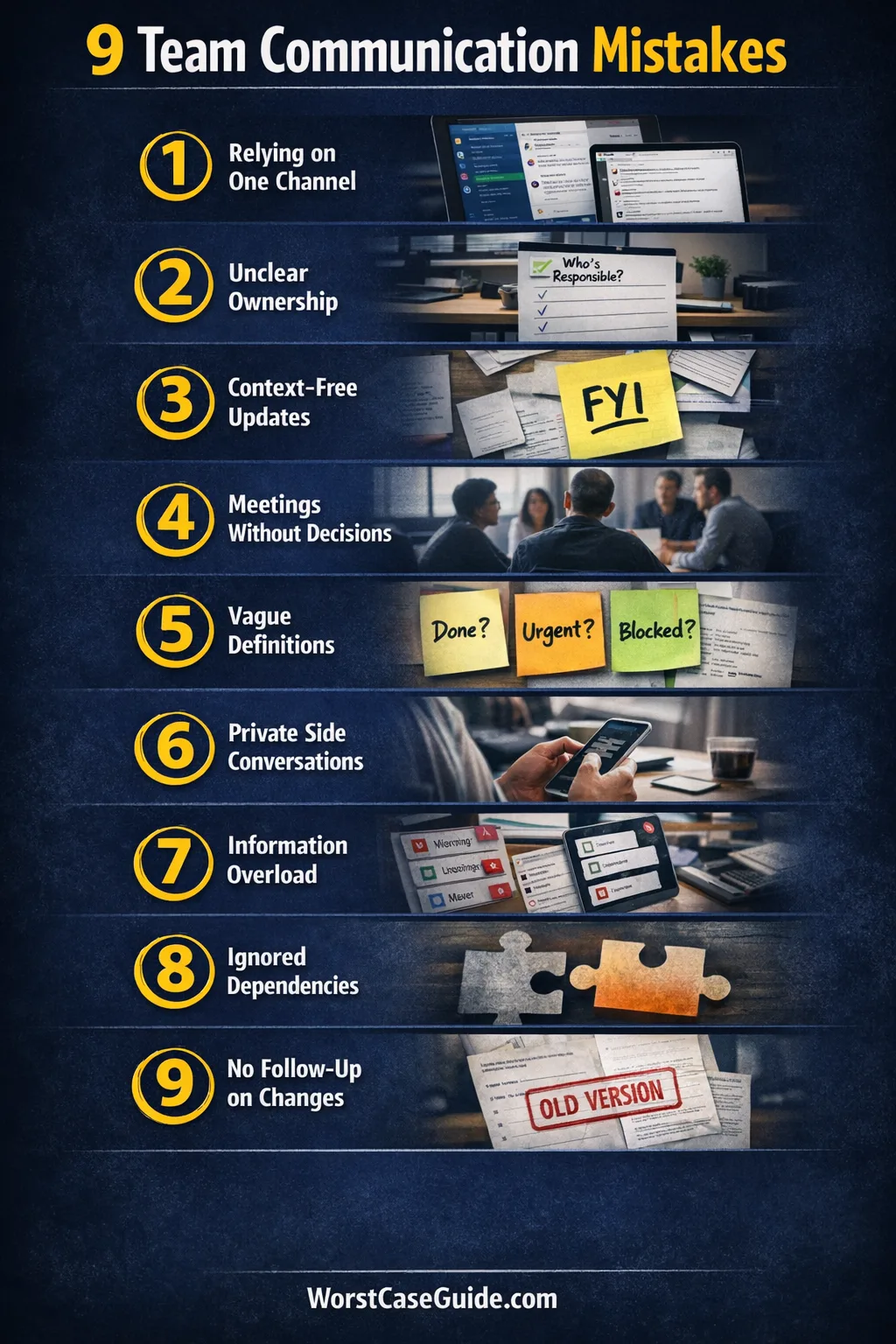
Mistake 1: Treating A Single Channel As The “Source Of Truth”
Why It Happens
Teams often default to whatever feels fast: chat, email, a project board, or meetings. Over time, the “source of truth” becomes assumed rather than defined. Different people then track work in different places, each believing their view is the view.
Early Warning Signs
- People ask “Did you see my message?” more than once a week.
- Status updates conflict across tools and threads.
- Work is “done” in one place but “in progress” in another.
Worst-Case Outcome
A key decision or dependency is missed, leading to late changes, broken handoffs, and a delivery that needs emergency coordination. The outcome is usually not catastrophic. It is avoidable churn that consumes trust and time, and becomes repeatable.
A Safer Approach
It can help when teams separate discussion from decisions. Discussion can live in chat. Decisions and current state can live somewhere that is easy to reference and hard to accidentally overwrite. If the project is small, a lightweight shared page may be enough; in larger systems, a consistent workflow for updates becomes protective.
Mistake 2: Leaving Ownership Implicit
Why It Happens
When teams have good will, ownership often feels obvious. But as work shifts, “obvious” becomes interpreted. The result is unassigned work that still feels important, so it waits for the person who thinks it is theirs—while others assume it is handled.
Early Warning Signs
- Tasks are described as “someone should…” or “we need to…” without a name.
- Follow-ups happen in private messages rather than in a shared place.
- Handoffs feel like soft suggestions, not explicit transfers.
Worst-Case Outcome
A dependency is not delivered, another team blocks, and the original owner cannot be identified quickly. The end result is a slow escalation chain, rushed work to recover, and a narrative of “people dropped the ball,” even though the system made it easy to drop. Over time, that becomes cultural damage.
A Safer Approach
Ownership can be safer when it is stated in the same place the work is tracked, using language that ties a person (or role) to a next action and a time expectation. In smaller projects, a single “owner + next step” line can prevent most confusion; in larger programs, an explicit RACI-style mapping for key flows can reduce handoff risk.
Mistake 3: Sharing Updates Without Context
Why It Happens
Updates often become shorthand: “Blocked,” “Done,” “Waiting,” “FYI.” This is efficient for the sender, but it leaves receivers to guess impact, priority, and what they should do next. The team then spends extra cycles reconstructing the missing story.
Early Warning Signs
- People reply with “What does this mean for X?” or “So are we on track?”
- Threads grow long because the first message lacked scope and impact.
- Different teams interpret the same update in different ways.
Worst-Case Outcome
A change lands late because its downstream effects were not understood. Teams then make local optimizations that conflict globally. The worst-case outcome is a release that technically “works” but fails operationally: support cannot handle it, stakeholders are surprised, or adoption stalls. The damage is usually preventable.
A Safer Approach
Updates can become safer when they include three small pieces: what changed, why it changed, and what it means next. If the project is small, a single sentence can cover it. If the system is larger, a structured template (impact, owners, timeline) reduces repeated clarification without forcing long reports.
Mistake 4: Letting Meetings Substitute For Decisions
Why It Happens
Meetings create a sense of progress. People talk, align emotionally, and feel heard. But unless the decision is captured, meeting outcomes become memory-based and role-dependent. Different attendees walk away with different conclusions, especially when there is no explicit “we decided X because Y.” That is how drift starts.
Early Warning Signs
- Recurring meetings revisit the same topic without resolution.
- People ask for “a quick sync” to clarify what was agreed.
- Action items exist, but there is no written decision or tradeoff.
Worst-Case Outcome
The team acts on different versions of the plan. Work is built against an outdated assumption, then reversed. The worst-case is not a single failure. It is a pattern of expensive rework that becomes normal, and a culture where people avoid committing because commitments feel unstable. That creates slow execution even with busy calendars.
A Safer Approach
Meetings tend to work better when they end with a small “decision record”: what was decided, who owns the follow-through, and when it will be reviewed. In smaller teams, this can live in the meeting notes. In larger organizations, a consistent place for decision logs makes later handoffs safer and reduces the need to re-litigate. It can also clarify when a topic is still open versus closed.
Mistake 5: Assuming Shared Definitions For “Done,” “Urgent,” And “Blocked”
Why It Happens
Teams use the same words with different meanings. “Done” can mean “coded,” “reviewed,” “approved,” “deployed,” or “documented.” “Urgent” can mean “today” or “this quarter.” Without explicit definitions, communication becomes ambiguous, and people fill in the gaps using their own defaults. That creates misalignment even when everyone is sincere.
Early Warning Signs
- Work keeps bouncing between states (“almost done,” “done but…”).
- Escalations happen because “urgent” was interpreted differently.
- Blockers are mentioned, but no one knows the unblocking path.
Worst-Case Outcome
Teams miss deadlines without understanding why, because every status report sounded positive. Stakeholders then reduce trust in updates and demand more reporting, which increases load and reduces real throughput. The worst-case is a feedback loop where language becomes a source of conflict, and “clarity work” becomes politicized. The operational cost can be significant without anyone doing anything “wrong.”
A Safer Approach
Definitions can be safer when they are explicit and tied to observable conditions. “Done” may include a checklist that fits the team’s reality; “blocked” may include who is needed and what is required. In smaller projects, a simple shared glossary may be enough. In larger systems, “definition of done” per workflow stage can reduce confusion without heavy process. The goal is not rigidity. It is predictability.
Mistake 6: Pushing Conflict Into Private Side Channels
Why It Happens
Private messages feel safer. They reduce social risk and avoid embarrassment. But when decision-relevant conflict moves into side channels, the shared system loses visibility. The team then acts on outcomes that are not fully explained, and important constraints stay hidden.
Early Warning Signs
- Key topics are discussed “offline” and summarized vaguely later.
- People say “I’ll DM you” about decisions that affect others.
- There is a growing gap between what people know and what is documented publicly.
Worst-Case Outcome
Teams develop two realities: the public one and the private one. That tends to create resentment, rumor, and uneven access to information. In a larger organization, it can also create compliance or audit issues if decision rationale is required to be traceable. The typical worst-case is a trust problem: people stop believing shared updates and start relying only on backchannels, which makes coordination fragile.
A Safer Approach
Side channels are sometimes necessary for sensitive conversations. The safer part is what happens next: capturing the decision and the relevant constraints in a shared place so others can act with confidence. If the team is small, a short post-meeting summary can do it. If the system is larger, a “decision note” pattern prevents invisible agreements from shaping visible work.
Mistake 7: Broadcasting More Than The Team Can Absorb
Why It Happens
When visibility feels low, teams often increase communication volume: more messages, more pings, more meetings. This creates noise, not clarity. People then skim, mute, or delay reading. The system becomes high output and low signal, which increases the chance that important information is missed. The breakdown is not laziness. It is capacity mismatch.
Early Warning Signs
- Important messages get reactions late or not at all.
- Threads mix unrelated topics because people are multitasking.
- People frequently say “I didn’t see that,” even when it was sent.
Worst-Case Outcome
Critical updates are missed, and the team starts building redundant “safety layers”: repeated check-ins, escalations, and manual tracking. This slows work and increases stress. The worst-case is a team that communicates constantly but still fails to coordinate, because attention has become a scarce resource and the system does not protect it. Over time, people disengage from shared channels, which reduces collective awareness.
A Safer Approach
Communication tends to be safer when it is tiered: routine updates go somewhere predictable, and exceptions use a clearly understood escalation path. In smaller teams, a brief daily or twice-weekly “state of work” note can replace many pings. In larger systems, structured status with clear “only-if-needed” alerts helps preserve attention while keeping risks visible. The emphasis is not less communication. It is better signal.

Mistake 8: Skipping Communication On Cross-Team Dependencies
Why It Happens
Dependencies feel administrative, so they get handled casually. But cross-team work has more failure points: different priorities, different calendars, and different definitions of “ready.” When dependencies are not made explicit, each team optimizes locally. That increases the chance of surprise work and late negotiation.
Early Warning Signs
- Requests are made without a clear deadline or reason.
- Dependencies show up only when something is blocked.
- Teams say “We didn’t know you needed that,” repeatedly.
Worst-Case Outcome
A project reaches the finish line and discovers it cannot ship because a dependency was not ready, not approved, or not compatible. The recovery can involve emergency reprioritization, rushed testing, or a delayed launch. The longer-term worst-case is that teams become reluctant to rely on each other. They build parallel solutions to avoid coordination, which raises cost and reduces coherence.
A Safer Approach
Dependency communication is safer when it is explicit, early, and reversible. A simple artifact—what is needed, by when, and the current risk level—often reduces surprises. In smaller projects, a shared checklist can handle it. In larger programs, dependency mapping with regular review prevents last-minute discovery. It also helps to clarify what happens if the dependency slips, so teams can plan for a fallback rather than a scramble.
Mistake 9: Failing To Close The Loop After Decisions And Changes
Why It Happens
Teams are good at starting conversations and making changes. They are less consistent at confirming that the change landed: who was informed, what was updated, and whether the new reality is reflected everywhere. Without loop-closure, the team carries stale assumptions. People keep acting on the old plan, and conflicts appear later as “unexpected” work. This is a coordination gap, not a personal failure.
Early Warning Signs
- Someone asks “Wait, when did we change that?”
- Docs, tickets, and conversations disagree about the current state.
- Post-change questions focus on basics instead of execution.
Worst-Case Outcome
A team makes a correct decision but fails to socialize it, so the organization experiences it as chaos. Downstream teams build against the old version, stakeholders are surprised, and trust drops. The worst-case is a repeated pattern of “surprise changes” that forces heavy governance later. Once that happens, even simple work becomes slow because everyone demands extra verification before acting. The cost is friction and lost autonomy.

A Safer Approach
Loop-closure can be safer when teams treat decisions like deliverables: announce them in the agreed place, update the canonical record, and confirm the affected owners were informed. In smaller teams, this might be a short “change note” message plus an updated page. In larger systems, it can help to include a routine “what changed this week” digest so late joiners and adjacent teams have a predictable way to catch up. The goal is stable shared reality.
A Simple Table Of Breakdown Types And Early Signals
This table can help map what is happening in a team to the underlying communication failure mode. It is not a diagnosis. It is a way to spot patterns and choose a safer response that fits the scale of the work. Look for repeatability: issues that happen once are often noise; issues that happen weekly are usually system signals.
| Breakdown Type | Early Signal | Typical Cost | Safer Move |
|---|---|---|---|
| Split source of truth | Conflicting statuses across tools | Rework, late surprises | Separate discussion vs decisions |
| Implicit ownership | “Someone should…” tasks | Blocked work, blame cycles | State owner + next action |
| Context-free updates | “FYI” threads that trigger questions | Misaligned execution | Include change, reason, impact |
| Meeting drift | Same topic returns weekly | Decision churn | Write a decision record |
| Unshared definitions | “Done” means different things | False confidence, late fixes | Define observable “done” states |
| Backchannel conflict | Key topics move to DMs | Uneven information access | Publish constraints after sensitive talks |
| Attention overload | People miss important messages | Slowdown, stress, disengagement | Use tiered updates and escalation |
| Dependency blind spots | Needs discovered only when blocked | Late reprioritization | Map dependencies early, review regularly |
| No loop-closure | “When did we change that?” | Surprise changes, low trust | Announce, update, confirm affected owners |
Risk Patterns That Keep Repeating
Communication breakdowns often cluster around a few repeatable patterns. Seeing them as patterns can reduce personalization and help teams respond with changes that are small but meaningful. The goal is not more process. It is fewer avoidable surprises.
- Ambiguity is treated as acceptable until it becomes expensive.
- Work grows, but communication habits stay informal.
- Information spreads by proximity (“who was in the room”) rather than accessibility.
- Teams optimize for speed today, then pay in rework tomorrow.
- Attention is assumed to be unlimited, even as load increases.
If The Team Is In “Fast Mode”
Fast mode often increases the chance of implicit decisions, missing context, and skipped loop-closure. If the work is small and the team is stable, this may be manageable. If the work is large, distributed, or dependency-heavy, fast mode can quietly convert into fragility. A safer posture is usually to protect decisions and ownership first, then worry about perfect updates.
FAQ
These questions come up when teams try to reduce communication breakdowns without turning work into a bureaucracy. Each answer focuses on risk and stability, not perfection.
How can a team reduce misunderstandings without adding more meetings?
Misunderstandings often come from missing context rather than missing time together. Many teams get better results by capturing decisions and ownership in a shared place, and using meetings only when tradeoffs are genuinely unclear. The communication volume can stay the same while the signal increases.
What is the earliest sign that communication is becoming a risk?
An early sign is when the team cannot easily answer what changed recently and why, or who owns the next step. Another is when people start relying on private clarifications more than shared updates. Those usually indicate drift, not a one-off miss.
Is chat enough for coordination in a small team?
Chat can work when the work is simple, the team is stable, and decisions are easy to recall. Risk rises when work has dependencies, approvals, or long timelines. Even in small teams, keeping a lightweight decision record and explicit ownership often prevents avoidable confusion.
Why do “status updates” sometimes make things worse?
Status updates can add noise when they focus on activity rather than impact. “Worked on X” is less helpful than “X changed in this way, and it affects Y.” When updates are frequent but low-signal, people start skimming and missing the few items that matter. That is an attention issue, and it can become systemic.
How can cross-team dependencies be communicated without friction?
Dependencies tend to be smoother when they are explicit early: what is needed, by when, and what happens if timing shifts. This can be small and lightweight. The key is making the dependency visible before it becomes a blocker, so the team has options instead of urgency. That reduces the chance of late surprises and protects trust.