Role definition looks simple until real work starts moving across people, teams, and tools. When accountability is vague, decision rights are unclear, or handoffs are assumed, small misunderstandings can turn into repeatable operational friction. Most organizations do not fail because nobody is working; they struggle because work boundaries are not explicit enough to prevent silent gaps and overlapping ownership.
What “worst case” means here: not a dramatic collapse, but persistent misalignment that creates missed deadlines, repeated rework, unclear escalation paths, and avoidable conflict—especially when the organization scales, changes tools, or adds new leaders.
Role Definition Mistakes In Organizations
Role definition is risky because it sits between people, process, and power. A role is not only a list of tasks; it is a set of boundaries about what someone owns, what they influence, and what they must escalate. If those boundaries are not shared across the organization, each person fills the gaps with personal assumptions.

Why This Becomes Hard To Undo
Once a team normalizes unclear roles, the organization starts building habits around them: side channels, unofficial approvals, and personal “go-to” people. Those patterns become invisible dependencies that are hard to replace without a clean reset of ownership.
Where Problems Show Up First
- Projects stall because nobody can make a final call on trade-offs or priority.
- Quality slips because “someone else” is assumed to be responsible for checks and sign-off.
- Meetings grow because alignment is attempted through attendance instead of structure and roles.
Common Wrong Assumptions
Role definition fails most often when people rely on assumptions that feel reasonable in the moment. The risk is that these assumptions create hidden gaps and overlaps that only appear under stress, urgency, or organizational change.
- “A job title implies the scope and authority.”
- “If someone is doing the work, they must be the owner of the outcome.”
- “A good manager can resolve ambiguity as it comes; no need for documentation or decision rules.”
- “A shared chat channel equals shared accountability.”
- “People will naturally coordinate; handoffs do not need explicit definitions.”
A Quick Orientation
If the organization is small, role ambiguity may feel efficient because everyone “just helps.” In larger systems, the same ambiguity becomes a coordination tax. The goal is not rigid bureaucracy; it is predictable ownership and clean escalation paths.
Mistakes That Create Role Confusion
Each mistake below is a common oversight. The details vary by industry, but the underlying patterns are consistent: unclear boundaries, missing decision rights, and unmanaged handoffs.
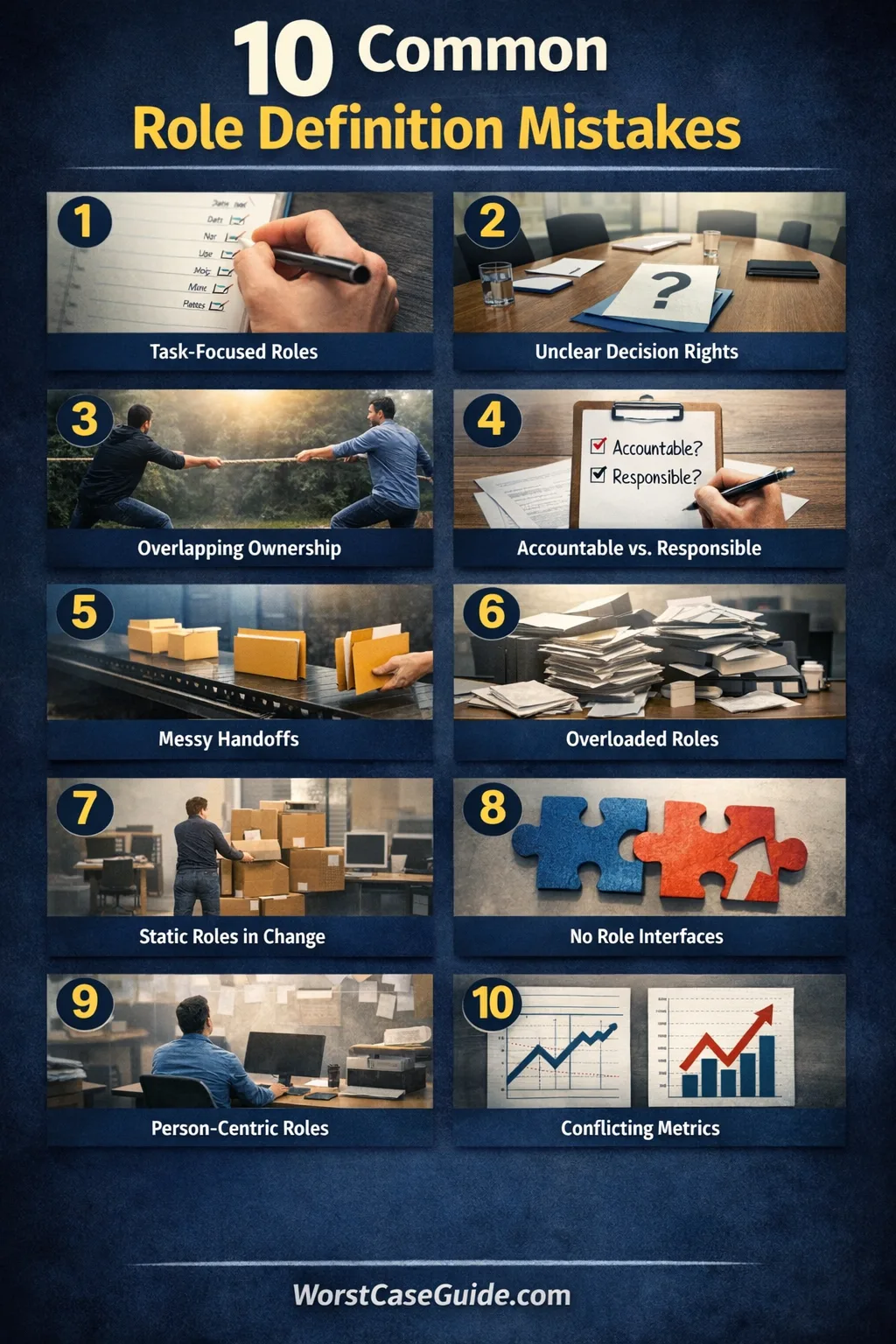
Mistake 1: Defining Roles As Task Lists Instead Of Outcomes
Why It Happens
Task lists are easy to write and easy to approve. Outcome ownership requires agreement on success metrics, trade-offs, and priority, which is more sensitive and takes longer.
Early Warning Signs
- People say “I did my part” while the overall result still fails.
- Work gets completed, but value is not clearly delivered to customers or internal users.
- Reviews focus on activity, not impact.
Worst-Case Outcome
Ownership fragments. The organization becomes good at motion but inconsistent at results, and leadership begins adding layers of checking to compensate for missing outcome ownership.
Safer Approach
A role definition can include tasks, but it tends to work better when it also states what the role is accountable for, what “done” looks like, and which outcomes the role must protect even when priorities shift.
Mistake 2: Leaving Decision Rights Implicit
Why It Happens
Decision rights feel political because they map to authority. Many teams avoid explicit statements and assume alignment will happen through meetings and consensus.
Early Warning Signs
- Same decision gets revisited multiple times with different attendees.
- People seek “one more sign-off” to feel safe.
- Escalations happen late, after work is already invested.
Worst-Case Outcome
Delivery slows because choices require informal approval from unclear power centers. Teams learn to optimize for stakeholder safety instead of user value.
Safer Approach
Decision rights can be described without turning roles into rigid ranks: who decides, who must be consulted, and who must be informed. In smaller projects, a short written note can be enough; in larger systems, a lightweight matrix is often easier to maintain.
Mistake 3: Creating Overlapping Owners For The Same Outcome
Why It Happens
Overlap is sometimes introduced to be “safe,” especially for critical work. The problem appears when two roles both believe they are the final owner and neither has a clear tie-break or boundary.
Early Warning Signs
- Two teams maintain parallel documents or trackers for the same domain.
- Disagreements about “who approved this” show up after changes ship.
- Success is claimed twice; failures are owned by no one.
Worst-Case Outcome
Conflicts become structural. People spend time protecting territory, and the organization starts adding more meetings to coordinate two competing ownership structures.
Safer Approach
Overlap can still exist, but it tends to be safer when it is explicit: one role owns the outcome, another owns a constraint (for example, quality or compliance) with a clear escalation rule when trade-offs appear.
Mistake 4: Mixing “Accountable” And “Responsible” Without Saying Which Is Which
Why It Happens
Many organizations use accountability language casually. In practice, the person doing the work (responsible) may not be the person who must answer for the result (accountable). When the difference is not stated, pressure falls unpredictably.
Early Warning Signs
- Delivery teams are blamed for delays caused by upstream dependencies.
- Managers step in late to “fix” what the team could not control.
- People avoid taking work because the risk feels undefined.
Worst-Case Outcome
Ownership becomes emotionally loaded. People protect themselves with documentation and approvals, and the organization loses speed while still not gaining real clarity.
Safer Approach
When role definitions mention responsibility, they can also state who is accountable for the outcome, and what that person can actually change. If accountability exists without authority, it often becomes a stress amplifier rather than a control.
Mistake 5: Ignoring Cross-Functional Handoffs
Why It Happens
Roles are often written within team boundaries. Real work crosses boundaries: requirements, approvals, testing, deployment, operations, support. If handoffs are not defined, they get replaced by personal relationships and tribal knowledge.
Early Warning Signs
- Work waits in a queue because “we are not sure who picks it up.”
- People ping specific individuals instead of using a clear process.
- Escalations go to whoever seems most senior, not most relevant.
Worst-Case Outcome
Delivery becomes dependent on a few key people who understand the informal network. When those people are unavailable, the organization experiences avoidable downtime and inconsistent service quality.

Safer Approach
Handoffs can be made safer by specifying inputs, expected outputs, and a default response time expectation for each cross-team boundary. Even a short “handoff contract” reduces guesswork.
Mistake 6: Assigning Accountability Without Capacity Or Time
Why It Happens
Leaders sometimes define roles based on needs rather than available bandwidth. The role looks good on paper, but the person cannot actually do it while handling existing workload, making accountability symbolic.
Early Warning Signs
- Owners delegate most decisions because they are constantly in other meetings.
- Work is “owned” by someone who rarely appears in critical discussions.
- Deadlines depend on late-night effort rather than planning.
Worst-Case Outcome
The organization builds a culture of burnout risk and reactive delivery. People learn that “ownership” means constant pressure, so they avoid roles that look important.
Safer Approach
Role definitions are safer when they match capacity: a realistic scope, explicit priorities, and clear rules for what gets dropped when new work appears. In larger systems, a backup owner or a rotation can reduce single-thread dependency.
Mistake 7: Treating Roles As Permanent When The Organization Is Changing
Why It Happens
Roles are often defined during a calm moment, then the organization changes: new product lines, new tools, new leadership, new compliance constraints. If the role model is not revisited, it becomes outdated while still being treated as true.
Early Warning Signs
- People say “that is not my job” about tasks that clearly emerged from new reality.
- New work is handled through exceptions, not through role updates.
- Teams create parallel roles informally to cope with change.
Worst-Case Outcome
Critical responsibilities drift into a gray zone. The organization becomes dependent on informal fixes and last-minute heroics, which reduces predictability and increases rework.
Safer Approach
A safer pattern is to treat roles as versioned rather than permanent: periodic review triggers (reorg, tool migration, new product surface) and a simple way to publish updates so people do not rely on old assumptions.
Mistake 8: Defining Roles Without Clear Interfaces Between Roles
Why It Happens
Organizations describe roles as islands, but work behaves like a system. Interfaces—what one role expects from another—are where ambiguity concentrates. Without explicit interfaces, people negotiate every boundary repeatedly, which increases coordination load.
Early Warning Signs
- Teams argue about what “ready” means at handoff points.
- Definitions are agreed verbally, then forgotten a week later.
- Different teams measure success with different metrics.
Worst-Case Outcome
Work quality becomes inconsistent. The same process yields different results depending on who is involved, which makes planning unreliable and reduces trust in commitments.
Safer Approach
Interfaces can be written simply: what inputs a role accepts, what outputs it produces, and what happens when inputs are missing. In smaller projects, a shared checklist can work; in larger systems, a lightweight “definition of ready/done” per handoff keeps expectations stable.
Mistake 9: Building Roles Around People Instead Of The Work
Why It Happens
In real organizations, roles are often shaped by who is available and who is trusted. That can be pragmatic, but if the role depends on one person’s strengths, it becomes hard to hire, train, or hand off. The role becomes person-specific.
Early Warning Signs
- Only one person can explain how something works end-to-end.
- Coverage plans are unclear or do not exist.
- New hires take a long time to become effective because the role is not portable.
Worst-Case Outcome
The organization develops fragile dependencies. When the person is unavailable, decisions pause, quality drops, and the team experiences a quiet form of operational risk that is easy to underestimate.
Safer Approach
Roles are safer when they are described in terms of repeatable responsibilities, expected artifacts, and decision rules. If a role truly requires rare expertise, it can still include a plan for documentation, backup, and gradual knowledge transfer.
Mistake 10: Measuring Role Performance Without Clarifying Trade-Offs
Why It Happens
People want roles to be accountable, so they add metrics. The risk is that metrics can conflict: speed vs quality, cost vs reliability, local optimization vs system health. If trade-offs are not stated, people make choices that look good for their metric but bad for the whole.
Early Warning Signs
- Teams hit targets while stakeholders still feel outcomes are slipping.
- People avoid work that is necessary but not measured.
- Conflicts arise because each role protects its own score.
Worst-Case Outcome
The organization drifts into metric gaming and reactive management. Leaders spend time correcting side effects instead of building stable systems and clear priorities.
Safer Approach
Role measurement tends to work better when it is paired with an explicit list of acceptable trade-offs and “never break” constraints. In larger systems, a small set of shared outcomes across roles can reduce local optimization and keep alignment realistic.
A Practical Table For Spotting Role Risk Early
This table is not a diagnosis tool; it is a way to connect visible symptoms to likely role-definition gaps. The same symptom can come from different causes, so it helps to look for clusters rather than single signals.
| Signal | Likely Role Gap | Lower-Risk Clarification |
|---|---|---|
| Repeated delays at the same step | Unclear handoff owner or missing interface | Define input/output and a default escalation path |
| Too many approvals for small changes | Implicit decision rights | State who decides for which scope, and who is consulted |
| Two teams maintain the same artifact | Overlapping ownership | Choose one outcome owner; keep the other as a constraint owner |
| Work is “done” but outcomes still fail | Role defined as tasks, not results | Add outcome accountability and a clear definition of done |
| One person becomes a constant bottleneck | Role built around a person | Create portable responsibilities, backups, and shared documentation |
Risk Patterns That Repeat
Across industries and organizational sizes, role-definition problems tend to repeat a few recognizable patterns. They are useful because they show where to look before conflicts become personal or delivery becomes chaotic.
- Boundary blur: work spans teams, but nobody owns the seam between them; handoffs become informal.
- Authority mismatch: accountability exists without matching decision rights.
- Double ownership: overlap is used as safety, but creates tie-break confusion.
- Stale role models: roles are not revisited after organizational changes, so reality and documents drift apart.
- Metric drift: role performance is measured without a shared view of trade-offs and system-level outcomes.
When The “Worst Case” Is Most Likely
Role ambiguity tends to become costly during growth, reorganizations, and tool migrations. In those moments, informal coordination becomes less reliable, and hidden dependencies show up as missed commitments and escalations. A small amount of explicit role work early often prevents large amounts of coordination work later.
FAQ
How detailed should a role definition be?
A role definition usually helps most when it is specific about outcomes, decision rights, and interfaces, and lighter on exhaustive task lists. In smaller teams, a short description plus a few decision rules can be enough. In larger systems, clarity about handoffs and escalation paths becomes more important than extra bullet points.
What is the difference between a job title and a role?
A job title is often a label for leveling, hiring, or compensation structures. A role is the set of responsibilities, decision scope, and ownership boundaries that make work predictable. Two people with the same title may have different roles depending on organization design.
Do role definitions slow teams down?
They can if treated as bureaucracy. They often speed teams up when used to reduce repeated negotiations about who owns what, who decides, and what happens at handoffs. The slowdown usually comes from unclear roles that force more coordination, not from clarity itself.
When should roles be revisited?
Common triggers include reorganizations, new leadership layers, major tool or process changes, and shifts in product scope. If work is being handled through repeated exceptions or constant escalation, that can be a signal that role definitions no longer match reality.
Is a RACI matrix always necessary?
Not always. In smaller projects, a simple written note about who decides, who must be consulted, and who must be informed can be sufficient. In larger systems with many handoffs, a lightweight matrix can reduce confusion, especially for recurring decisions.