Process design feels harmless because it looks like “just a workflow.” In practice, it shapes how decisions move, how work gets handed off, and what people do when something is unclear. When a process is slightly off, the team usually compensates. When it is structurally off, the compensation becomes the work.

Efficiency problems often get blamed on individuals, tools, or “not enough time.” Many of them are really process design problems: hidden queues, unclear ownership, premature standardization, and feedback that arrives too late to matter. The goal here is not to obsess over edge cases, but to see which mistakes tend to create the hardest-to-reverse friction in day-to-day work.
Why Process Design Becomes Risky Under Load
A process can look fine in a calm week and break in a busy one. The risk comes from compounding effects: a small delay at one step becomes a queue, a queue creates context switching, and context switching turns into rework. In smaller teams, this often shows up as “we talk all day and still ship late.” In larger organizations, it becomes a maze of handoffs where nobody feels responsible.
What “worst-case” means in process design: not disaster, but persistent drag that makes good people look slow—missed coordination windows, rising rework, unreliable delivery dates, and decisions that get made too late to be useful.
Common Wrong Assumptions
- “If we document it, people will follow it.” Documentation is not adoption; incentives and clarity usually decide behavior.
- “More steps means more control.” Extra gates can create queues without improving outcomes.
- “Standardization always speeds things up.” Standardizing the wrong thing can lock in waste.
- “A tool will solve it.” Tools amplify the process that exists; they rarely fix a broken one.
- “Everyone knows who owns what.” Ownership is often assumed, not designed.
Mistakes That Reduce Team Efficiency
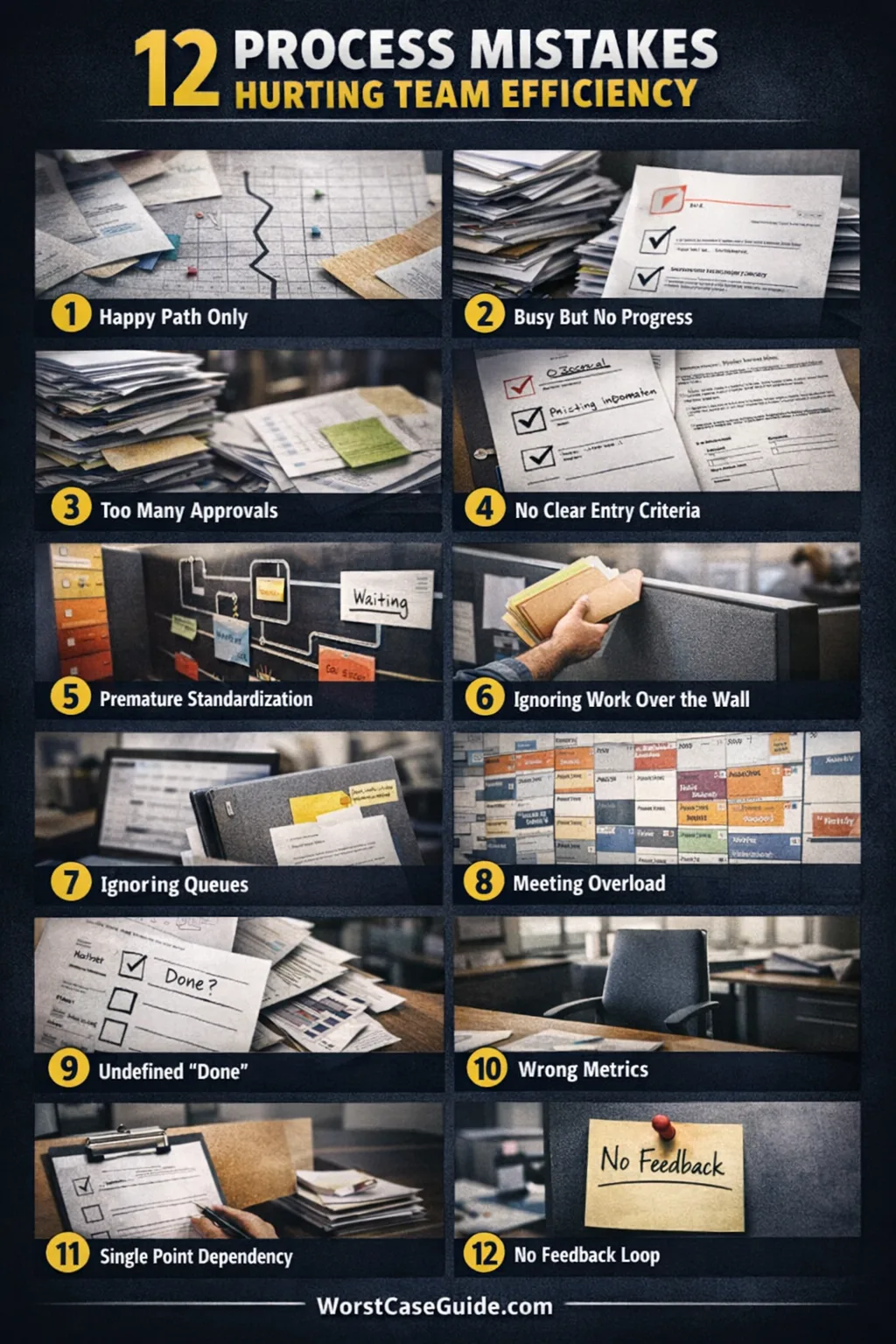
Mistake 1: Designing For The “Happy Path” Only
Why It Happens
Processes are often written from the perspective of a clean request with perfect inputs. Edge cases feel rare until the team hits real-world variability—missing information, exceptions, partial approvals, and urgent interruptions.
Early Warning Signs
- Work stalls because inputs arrive incomplete.
- People create side channels to “handle weird cases.”
- Repeated questions like “What do we do when…?”
Worst-Case Outcome
The team develops an informal shadow process that is faster than the official one, then the organization starts measuring the official process anyway. That gap becomes permanent misalignment and time loss.
A Safer Approach
A process often holds up better when it includes a small set of explicit exception paths (missing input, priority override, blocked dependency) and a clear rule for when work is paused versus rerouted.
Mistake 2: Confusing Activity With Progress
Why It Happens
It is easier to design steps that produce artifacts (forms, tickets, reports) than steps that reduce uncertainty. Teams then optimize for being busy, not for finishing.
Early Warning Signs
- Many handoffs, few “done” moments.
- Status updates feel detailed but delivery remains unpredictable.
- Work expands to fill templates and checklists.
Worst-Case Outcome
Cycle time grows while people feel more loaded. The team becomes excellent at maintaining process outputs and slow at producing usable results.
A Safer Approach
Processes tend to work better when steps are defined by decisions made or risks reduced (e.g., “requirements validated,” “handoff accepted”), not by documents produced.
Mistake 3: Adding Approval Layers Without Clear Decision Rights
Why It Happens
Approvals are a common response to uncertainty, quality concerns, or past mistakes. Without defined decision rights, approvals become “everyone checks everything.”
Early Warning Signs
- Approvers ask for context that should be predefined.
- Approvals bounce back with subjective feedback.
- Work sits in “waiting for review” states.
Worst-Case Outcome
Decisions drift to the most senior or most available person. That creates bottlenecks and risk avoidance rather than good decisions.
A Safer Approach
Approval steps are typically safer when they include explicit decision scope (“approve budget,” “approve risk tolerance,” “approve external commitments”) and a defined response expectation (accept, reject, request specific missing info).
Mistake 4: Building A Process Without Explicit Entry Criteria
Why It Happens
Teams assume request quality will be “good enough.” In reality, upstream variability is normal, especially across departments or external stakeholders.
Early Warning Signs
- Rework triggered by missing details.
- People debate whether something is “ready to start.”
- Frequent context resets and clarification meetings.
Worst-Case Outcome
Half-started work accumulates. The team carries a hidden inventory of unfinished items, and lead times become unreliable.
A Safer Approach
Entry criteria can be lightweight: a short checklist of required inputs, a defined owner, and a statement of what “ready” means for that specific work type.
Mistake 5: Over-Specifying The Process Too Early
Why It Happens
There is pressure to “get organized,” especially after a period of chaos. Standardization is then applied before the team understands the actual constraints and variation.
Early Warning Signs
- People comply mechanically but complain privately.
- Exceptions become common, then normalized.
- Training becomes long while outcomes do not improve.
Worst-Case Outcome
The organization invests in a process that optimizes the wrong target. Undoing it later is slow because tools, roles, and reporting become tied to it.
A Safer Approach
In early stages, a smaller “minimum viable process” often reduces risk: few steps, clear ownership, and a short feedback cycle that reveals where standardization actually helps.
Mistake 6: Ignoring Queue Design And Work-In-Progress Limits
Why It Happens
Many processes describe steps but not the queues between steps. When demand exceeds capacity, queues become the real system.
Early Warning Signs
- People start many items and finish few.
- Frequent context switching to “unblock” something.
- Priority debates repeat every week.
Worst-Case Outcome
Everything becomes urgent, and urgency becomes the routing mechanism. The team loses the ability to make stable commitments, and quality declines through rushed changes.
A Safer Approach
Queue-aware design often includes explicit WIP boundaries (even informal) and a rule for what happens when capacity is full: pause intake, renegotiate scope, or shift resources intentionally.
Mistake 7: Treating Handoffs As A “Throw Over The Wall” Moment
Why It Happens
Departments or roles optimize locally. A handoff is seen as “done with my part” rather than a shared moment of acceptance.
Early Warning Signs
- Downstream teams re-check work that was “completed.”
- Frequent back-and-forth messages asking for context.
- Ownership feels blurry at boundaries.
Worst-Case Outcome
The handoff becomes a repeated rework loop. Everyone stays busy while accountability becomes diffuse, and the overall flow slows down.
A Safer Approach
Handoffs tend to be safer when they include a small “acceptance contract”: what is delivered, what quality means, and how rejections are handled without restarting the entire process.
Mistake 8: Designing Meetings As The Process
Why It Happens
Meetings are a convenient default for coordination, especially when ownership is unclear. Over time, the process becomes a calendar.
Early Warning Signs
- Work moves forward mainly in recurring meetings.
- Decisions depend on who was present.
- People prepare slides more than deliverables.
Worst-Case Outcome
Delivery cadence becomes tied to meeting cadence. When schedules slip, decisions slip with them, and the team’s throughput quietly drops.
A Safer Approach
Meeting-heavy processes are often safer when meetings are reserved for the few decisions that truly require synchronous debate, while routine approvals and updates are designed to work asynchronously with clear criteria.
Mistake 9: Failing To Define “Done” In A Way Others Can Trust
Why It Happens
Teams use “done” to mean “done with my work,” not “ready for use.” When stakeholders depend on the output, this creates repeated verification cycles.
Early Warning Signs
- Stakeholders ask for last-minute changes after “completion.”
- Releases include follow-up fixes that feel predictable.
- Different people interpret done differently.
Worst-Case Outcome
Delivery becomes unreliable because “done” is no longer a signal. Planning turns into guesswork, and trust erodes across teams.

A Safer Approach
A robust “done” definition often includes observable acceptance checks: what was tested, what risks were reviewed, and what is explicitly out of scope for this iteration.
Mistake 10: Measuring The Wrong Metrics (Or Measuring Too Late)
Why It Happens
Organizations track what is easy to count: tickets closed, hours logged, tasks completed. Those numbers can rise while real outcomes stagnate.
Early Warning Signs
- Metrics look good while stakeholders report frustration.
- Teams optimize for the metric and create workarounds.
- Data arrives after decisions were already made.
Worst-Case Outcome
The process gets “improved” in ways that reduce real efficiency. The team ships more activity but less value, and future corrections become politically hard.
A Safer Approach
Useful measures often connect to flow and reliability: lead time ranges, queue time, rework rate, and the percentage of work that meets acceptance the first time. In larger systems, comparing cohorts (small vs large requests) can reveal where the process breaks.
Mistake 11: Making The Process Fragile To One Person Or One Role
Why It Happens
Processes evolve around the most experienced person. That can feel efficient in the short term, but it creates a single point of failure.
Early Warning Signs
- Work stalls when one person is away.
- People wait for “the person who knows.”
- Knowledge exists in DMs and memory, not in shared artifacts.
Worst-Case Outcome
Delivery becomes dependent on availability rather than system capacity. Onboarding slows, and the team scales slower than demand.
A Safer Approach
Processes are often more resilient when critical steps have a clear backup path: shared templates, lightweight documentation for decision logic, and at least two people capable of performing the gating actions.
Mistake 12: Changing The Process Without A Feedback Loop
Why It Happens
Process changes are frequently introduced as announcements rather than experiments. Without feedback, the organization cannot see whether the change reduced friction or just moved it.
Early Warning Signs
- People comply publicly and circumvent privately.
- New rules create new exceptions immediately.
- No one can explain whether the change improved cycle time.
Worst-Case Outcome
The process becomes a layered history of patches. Over time it turns into a “museum” of old decisions, and efficiency declines through accumulated complexity.
A Safer Approach
Safer process evolution often includes a short review window, a clear success signal, and a plan for rollback or revision. In smaller projects, a simple retrospective cadence can serve as the feedback system; in larger systems, sampling a few end-to-end cases can reveal the real impact.

Quick Pattern Map
| Mistake Pattern | What It Looks Like Day-To-Day | Lower-Risk Direction |
|---|---|---|
| Unclear Entry | Work starts with missing inputs; rework feels routine | Define lightweight “ready” criteria and ownership |
| Queue Blindness | Many items in progress; few finish; priorities reshuffled weekly | Make queues visible; use WIP boundaries and explicit overflow rules |
| Decision Ambiguity | Approvals bounce; senior people become bottlenecks | Clarify decision rights and acceptance criteria per gate |
| Handoff Erosion | “Done” is disputed; downstream teams re-check everything | Define acceptance at handoffs and a trusted “done” signal |
| Change Without Learning | Rules pile up; exceptions normalize; no one knows impact | Short feedback loops; reversible changes; case-based reviews |
Risk Patterns To Watch Across Processes
- Hidden work inventory: when unfinished items accumulate, efficiency drops even if people work harder.
- Local optimization: one step looks fast while the end-to-end flow slows.
- Ambiguous ownership: tasks move, but accountability does not.
- Late discovery: issues are detected after work is “done,” creating expensive rework loops.
- Process-tool entanglement: the workflow becomes hard to change because reporting and systems depend on it.
Sanity check that often reveals the real bottleneck: pick three recent items (one small, one medium, one large) and trace where they waited, not where people worked. Waiting time is usually where efficiency disappears.
FAQ
How can a team tell whether the problem is “people” or the process?
If capable people repeatedly hit the same delays, the system is usually shaping behavior. Signals include recurring rework at the same handoff, frequent “waiting for review,” and outcomes that remain unpredictable even when effort increases.
Is standardizing a process always a good idea for efficiency?
Standardization can reduce variance, but it can also lock in waste. It tends to help most when the work type is stable and the acceptance criteria are clear; it tends to hurt when the work varies widely or discovery is still ongoing.
What usually creates the biggest slowdowns in cross-team workflows?
Handoffs with unclear acceptance, approval gates without decision rights, and queues that are invisible to everyone except the team stuck behind them. These issues often compound together.
How many approval steps are “too many”?
The count matters less than the design. A small number of well-scoped approvals with clear outcomes can be lightweight. Multiple approvals that overlap in purpose tend to create uncertainty, queues, and senior bottlenecks.
What is a practical way to redesign a process without disrupting delivery?
Incremental changes tend to be lower risk: adjusting entry criteria, clarifying handoff acceptance, and making queues visible often improves flow without reorganizing everything at once.
Why do process changes fail even when everyone agrees they make sense?
Adoption usually fails when the process conflicts with incentives, when it increases effort without reducing pain, or when exceptions are common and poorly handled. Without a feedback loop, these problems stay hidden until the change quietly gets bypassed.