A small business price can set expectations faster than any brochure, and it can quietly shape cash flow, capacity, and who keeps coming back. Pricing feels “editable,” yet many changes are sticky: customer memory, market positioning, and internal habits don’t reset just because a number changed.
That’s why pricing strategy has a unique risk profile. It touches every sale, and a small mismatch can compound into weeks of wasted work or a slow margin leak that only shows up when it’s hard to fix.
Why Pricing Strategy Is Risky In Small Businesses
In a small operation, pricing is often tied to real constraints: limited team time, uneven demand, and thin buffers for mistakes. A price that “wins work” can still create a loss-making workload if the delivery effort is underestimated or demand arrives in the wrong shape.
- Perception locks early: once a customer anchors on a price, a later shift can feel unfair even if the offer changed.
- Pricing changes behavior: discounts can train waiting, while low prices can attract high-support customers who cost more to serve.
- Small errors scale fast: a $5 gap repeated across 200 transactions becomes a meaningful margin problem.
- Fixes are disruptive: repricing can force new terms, new messaging, and sometimes a new customer mix.
Useful framing: pricing risk is rarely about one “wrong” number. It’s about wrong assumptions meeting real-world variability (busy weeks, refunds, revisions, slow payers) until a fragile system shows cracks.
Common Wrong Assumptions
Many pricing problems begin with assumptions that sound reasonable in isolation. The risk increases when they are treated as always true, especially in early-stage businesses with shifting costs and uncertain demand.
- “If the price is lower, more people will buy, so profit will follow.”
- “Competitors already did the research, so matching them is safe.”
- “Discounts are temporary, so they won’t change customer behavior.”
- “More packages means more choice, and choice always increases conversions.”
- “Costs are stable enough; a quick markup is basically a strategy.”
- “If demand drops, pricing is the main lever that needs pulling, not the offer.”
Mistakes That Create Worst-Case Scenarios
The mistakes below tend to create hard-to-reverse outcomes: margin erosion, unreliable demand, customer distrust, and operational stress. Each one includes early signals that often appear before the damage becomes obvious.

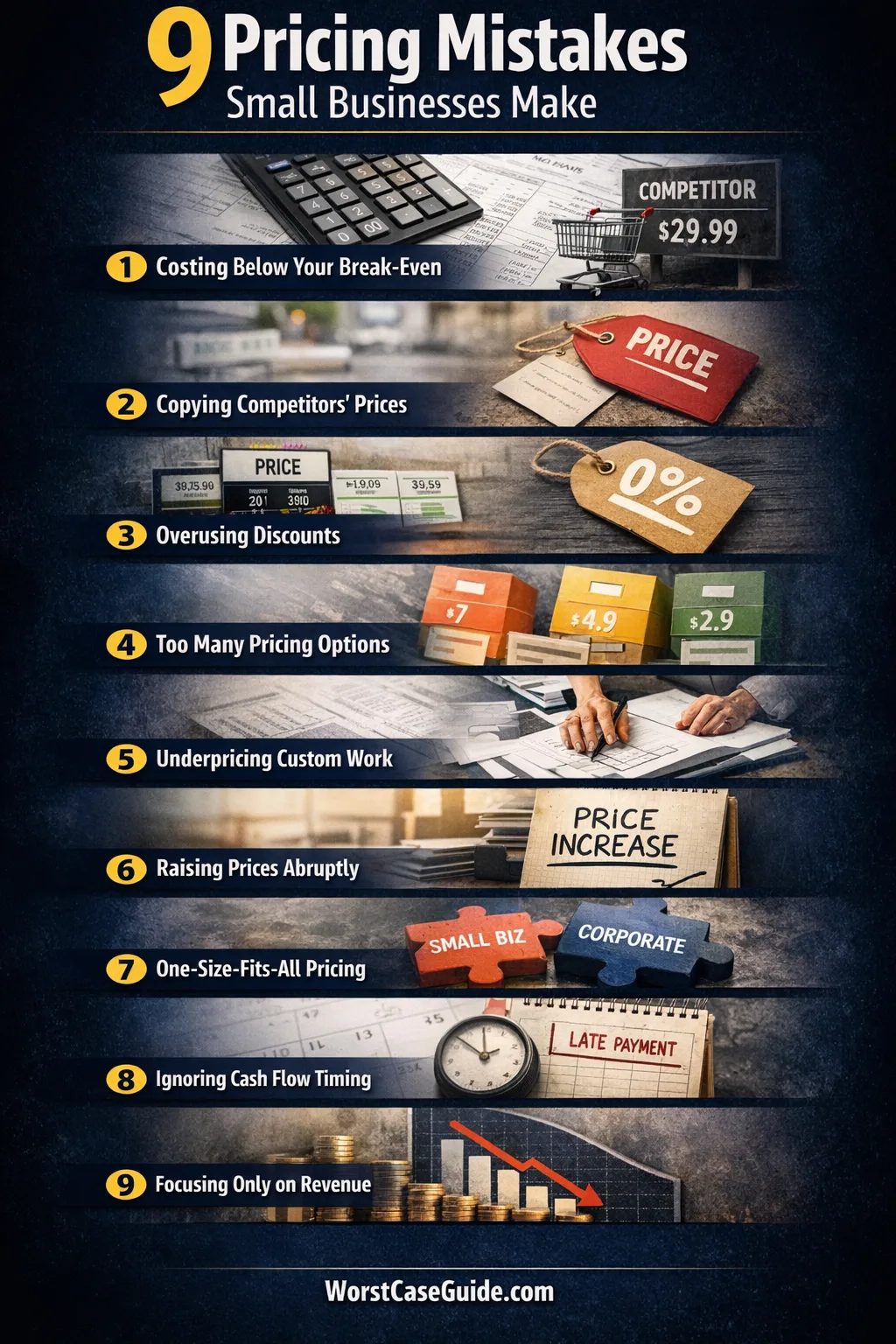
Mistake 1: Pricing Without A Clear Cost Floor
Why It Happens
Small businesses often mix direct costs, overhead, and owner time in ways that are hard to measure. When costs feel “fuzzy,” it’s easy to set prices based on what sounds acceptable rather than what stays viable.
Early Warning Signs
- Projects “sell,” but bank balance still feels tight.
- Delivery work requires unplanned hours that rarely appear in the quote.
- Refunds, returns, or rework remove most of the margin.
Worst-Case Outcome
The business can become busy but fragile: high activity with low resilience, where one bad month, a supplier change, or late payments triggers a cash crunch and rushed decisions.
Safer Approach
A safer approach often starts with a cost floor: a simple, maintained view of minimum viable margin and the time required to deliver reliably. Even a rough floor can reduce accidental underpricing when things get hectic.
Mistake 2: Copying Competitor Prices Without Context
Why It Happens
Competitor pricing feels like free data. The hidden risk is that competitors may have different costs, different bundling, or a different goal (growth, upsells, contracts) that makes the same number unsafe for a smaller business.
Early Warning Signs
- Quotes require explaining why the offer is “similar,” but the delivery looks different.
- Margins fall when trying to match promotions or bundled deals.
- Competitors seem to “afford” extras that would be costly for a small team.
Worst-Case Outcome
The business can drift into accidental commoditization: competing on price sameness instead of distinct value, attracting customers who switch quickly and leaving the team with low leverage.
Safer Approach
Competitor prices can be treated as bounds, not a target. A safer stance is to map what’s included (support, speed, warranty, setup) and align the price with a clear promise the business can deliver consistently, without relying on hidden heroics.
Mistake 3: Treating Discounts As The Default Sales Tool
Why It Happens
Discounts feel like a fast answer to slow demand or price objections. The overlooked risk is behavioral: repeated discounts can reset reference prices and make full price feel unreasonable, even when the offer didn’t change.
Early Warning Signs
- Customers ask, “Is there a deal right now?” more than they ask about fit.
- Sales cluster around promotional windows, then drop to near zero.
- Discount requests escalate: small discounts stop working, and bigger ones get normalized.
Worst-Case Outcome
Margins can become structurally weaker, not temporarily lower. The business may end up with discount-trained demand and unpredictable revenue, making staffing and inventory choices risky.
Safer Approach
If discounts exist, a safer pattern is to tie them to clear boundaries: limited scope, limited time, or a defined trigger (first order, off-peak booking) that doesn’t rewrite the everyday price. In many cases, small changes to packaging can achieve the same momentum with less long-term damage.
Mistake 4: Offering Too Many Pricing Options Too Early
Why It Happens
It can feel logical to cover every customer type with many tiers. Early on, too many options can create decision friction and internal complexity: support rules, exceptions, and edge cases that a small team has to remember.
Early Warning Signs
- Prospects ask for help choosing because the differences feel unclear or technical.
- Team members quote different prices for the “same” request.
- Billing has frequent adjustments, credits, or manual fixes.
Worst-Case Outcome
The business can lose trust through inconsistency: customers see pricing as negotiable or arbitrary, and sales cycles stretch while the team spends time explaining rather than delivering. Operationally, complexity can create hidden costs that erase margin.
Safer Approach
A safer approach often looks like fewer, clearer choices, with differences tied to outcomes or measurable scope. If you are in a situation with highly varied requests, a simple base package plus a small set of add-ons can preserve clarity without pretending every edge case has a dedicated tier.

Mistake 5: Underpricing Custom Work And Letting Scope Drift
Why It Happens
Custom work is easy to sell and hard to bound. Prices often reflect optimism about delivery effort and a desire to be flexible. Without scope anchors, the offer becomes elastic while the price stays fixed.
Early Warning Signs
- “Small tweaks” keep arriving after approval, each one reasonable on its own.
- Projects exceed the original timeline, but invoicing stays unchanged or awkward.
- Team members hesitate to push back, fearing a relationship cost that feels bigger than the margin loss.
Worst-Case Outcome
The worst case is not a single bad project; it’s a repeatable trap. Custom work becomes the default, delivery becomes unpredictable, and the business gains a reputation for being cheap and endlessly flexible. That reputation can pull in more of the same requests, creating persistent stress.

Safer Approach
Safer custom pricing usually includes scope language that’s easy to point to, plus decision points where changes can be evaluated. In smaller projects, this can be as simple as defining what “done” means and what counts as a new request, so the relationship stays clear even when the work evolves.
Mistake 6: Raising Prices Without Protecting Trust
Why It Happens
Price increases are often triggered by cost pressure or overwork. The mistake is treating the change as a simple number update, without accounting for customer memory and the implicit agreement they believe they had with the business.
Early Warning Signs
- Long-time customers react with surprise rather than curiosity or understanding.
- People ask whether the business is “changing,” implying a stability concern.
- Negotiations become more frequent, with customers trying to hold on to the old price.
Worst-Case Outcome
Trust can break in subtle ways: customers may not complain, they may simply leave quietly or reduce orders. The business can lose predictable revenue and trigger a reactive discount cycle that makes the increase feel pointless, while damaging the relationship base.
Safer Approach
A safer approach often includes predictability: clear timing, clear boundaries (new customers vs existing contracts), and a plain explanation anchored in service reliability rather than vague value claims. If you are in a relationship-heavy business, giving customers time to adapt can protect goodwill while still improving sustainability.
Mistake 7: Using One Price For Very Different Customer Segments
Why It Happens
One price feels fair and easier to explain. The risk is that different segments often have different service costs, different expectations, and different willingness to pay for speed or support. A single price can undercharge one group while overcharging another.
Early Warning Signs
- Some customers accept instantly, while others need heavy persuasion for the same offer.
- Support demand varies wildly by customer type, creating invisible costs that the price doesn’t reflect.
- Sales conversations keep circling back to “We don’t need everything,” a packaging mismatch that signals segmentation pressure.
Worst-Case Outcome
The business can attract the wrong mix: customers with higher support needs and higher friction, while quietly losing customers who would pay more for clarity or priority. Over time, the offer becomes optimized for the loudest segment, and the brand positioning drifts toward lowest-common-denominator pricing with higher workload.
Safer Approach
Segmentation can be handled without complexity by pricing the constraints that differ: urgency, volume, support level, or usage. In larger systems, this might look like tiers; in smaller projects, it can look like clear add-ons tied to priority or response time, keeping fairness while reflecting real costs.
Mistake 8: Forgetting Cash-Flow Timing In The Price
Why It Happens
Pricing decisions often focus on total revenue, not when the money arrives. In small businesses, timing matters because expenses can be immediate while payments can be delayed, creating a gap that is operationally dangerous even when a deal is “profitable.”
Early Warning Signs
- Work begins before any meaningful payment, relying on trust rather than a defined sequence.
- Late payments become “normal,” and the business starts making exceptions that are hard to reverse.
- Large orders create stress because inventory or labor must be funded upfront.
Worst-Case Outcome
The worst case is a timing-driven crisis: the business is owed money, but it cannot cover near-term obligations without delaying suppliers, reducing quality, or pausing fulfillment. This can trigger a trust cascade where customers notice delays and confidence drops, causing cancellations that make cash flow even worse.
Safer Approach
A safer approach ties pricing to delivery milestones and aligns terms with the cost curve. If you are in a service business, clearer stage payments can reduce exposure; in product businesses, minimum order policies or staged fulfillment can protect working capital without relying on constant follow-ups, preserving stability.
Mistake 9: Measuring Pricing Success Only By Revenue
Why It Happens
Revenue is visible and emotionally rewarding. The risk is that revenue can rise while profitability, retention, and support load deteriorate. Without a feedback loop, the business can “prove” a price works while the system becomes less sustainable and the team becomes more exhausted.
Early Warning Signs
- More customers arrive, but each one consumes more time than expected.
- Refunds, churn, or rework increase, yet revenue still looks fine at the top line.
- Sales wins correlate with a higher complaint rate, suggesting pricing is pulling in customers who are a poor fit.
Worst-Case Outcome
The business can lock into a bad growth loop: revenue rises, the team expands or commits to higher fixed costs, then churn or support load catches up. When the hidden costs surface, the correction becomes painful and often rushed, creating customer disruption and internal instability.
Safer Approach
A safer approach tracks a small set of leading indicators: margin per order, time-to-deliver, refund rate, and retention by segment. In smaller projects, even a lightweight monthly review can reveal trend shifts early, so pricing decisions remain deliberate rather than reactive, protecting stability.
Quick Risk Check Table
This table is a fast diagnostic for the most common failure modes. It doesn’t “solve” pricing, but it can surface where risk concentrates and which assumptions might be unexamined, helping the next decision feel safer.
| Signal | What It Often Means | Lower-Risk Check |
|---|---|---|
| “We’re busy but cash feels tight” | Cost floor is unclear or margin is leaking | Compare delivery time vs price, include rework and support |
| Sales depend on constant discounts | Offer or positioning lacks clarity at full price | Test packaging changes before deeper discounts |
| Customers are confused by options | Too many tiers or unclear differentiation | Reduce to fewer choices tied to scope or outcomes |
| Custom projects always “expand” | Scope boundaries are weak | Define “done,” change points, and what counts as new work |
| Revenue rises but complaints rise too | Wrong segment mix or hidden service costs | Track retention and support load by customer type |
Before changing a price, it can be safer to check whether the problem is demand quality, capacity, or offer clarity. Price changes can fix the wrong problem in the short term, and create a harder one later.
- Is the bottleneck lead volume or lead fit?
- Does delivery time vary because of scope or because the process is unstable?
- Are objections really about price, or about uncertainty (what happens next, what’s included, what “good” looks like)?
Risk Patterns That Show Up Across Mistakes
Different pricing mistakes often share the same risk pattern: a decision is made with partial information, then repeated until the outcome becomes normal. The longer a fragile pricing habit runs, the more it shapes customer expectations and internal routines, making a later correction feel costly.
- Hidden work becomes “free” work: rework, support, coordination, and exceptions quietly expand delivery cost until the price no longer fits.
- Pricing used as a patch: discounts or low prices mask unclear positioning and reduce pressure to fix the offer.
- Complexity grows faster than capacity: too many tiers, exceptions, and negotiations create administrative load that drains focus.
- Signals arrive late: revenue looks fine while retention and margin deteriorate, so the correction becomes more disruptive.
If you are in a situation where prices feel constantly disputed, it may indicate a mismatch between what the price promises and what the customer thinks they are buying. In smaller projects, tightening definitions and packaging often reduces dispute; in larger systems, segmentation and terms become the safety rails that keep pricing predictable.
FAQ
How often does a small business usually revisit pricing?
There isn’t one right cadence, but pricing tends to be safer when it’s reviewed alongside real delivery data: time-to-serve, refunds, and retention. In steady environments, reviews can be less frequent; in volatile costs or fast-changing demand, a lighter but more regular check can reduce surprises.
Is it risky to raise prices on existing customers?
It can be, mainly because of trust and expectations. Risk is lower when boundaries are clear (new customers, new scope, renewal points) and when the change is connected to reliability rather than vague claims. A predictable timeline often reduces the feeling of surprise.
When do discounts make sense without training customers to wait?
Discounts tend to be less risky when they have tight rules: a clear trigger, a clear limit, and a clear reason the standard price still exists. When discounts feel “always available,” customers can learn that the real price is negotiable, which can increase friction later.
What’s a common sign that pricing is attracting the wrong customers?
A pattern of high support load, frequent complaints, or short retention can suggest a mismatch. Revenue can still look healthy, so it helps to watch who stays and what types of customers generate the most exceptions. That combination often reveals whether pricing is pulling in high-friction demand.
How can pricing be simpler without being unfair?
Fairness often improves when the price reflects real constraints that vary: urgency, volume, or support level. A small set of options can stay simple while still acknowledging that different customers create different delivery costs. The goal is usually predictability rather than perfect personalization.
What if costs keep changing and it’s hard to set a stable price?
When costs are volatile, the main risk is pricing that becomes outdated without anyone noticing. It can help to track a few cost drivers and define review triggers (supplier changes, delivery time shifts, return rates) so updates are deliberate rather than constant. Stability often comes from rules, not from guessing one perfect number.