Home projects often feel straightforward until a permit detail turns into a schedule delay, a resale issue, or an expensive redo. The tricky part is not “getting in trouble.” It’s that small paperwork gaps can create hard-to-reverse problems once walls are closed, money is spent, and people move on.
Permits sit at the intersection of building safety, insurance, and future property value. In smaller projects, it may show up as a single failed inspection. In larger renovations, it can affect multiple trades, timelines, and even whether the work is considered legal when you try to sell.
Why This Topic Is Risky
Permitting isn’t only about the permit itself. It’s about scope definition, who is responsible, and how the project is documented over time. The risk increases when:
- The project touches structural, electrical, plumbing, or gas.
- Work is phased across weeks and multiple contractors, creating hand-off gaps and assumption stacking.
- The home is part of a HOA/condo/co-op where approvals can be separate from city permits.
- Online “permit not needed” advice is treated as universal rather than local.
Common Wrong Assumptions
Wrong assumption: “If my contractor starts work, permits must be handled.”

Reality: Responsibility can be unclear unless it’s explicitly written and verified with a permit record.
Wrong assumption: “A permit is just a formality and can be done later.”
Reality: “Later” can mean exposing finished work, redoing steps, or losing inspection continuity.
Wrong assumption: “My project is small, so permits don’t apply.”
Reality: Small scope can still involve regulated systems like electrical changes or load-bearing modifications.
Wrong assumption: “Passing one inspection means everything is fine.”
Reality: Inspections are staged. Missing a specific phase can still create compliance gaps later.
Mistakes That Create Permit Problems
Each mistake below includes the typical cause, early warning signs, the worst-case outcome (without drama), and a safer approach that keeps options open.
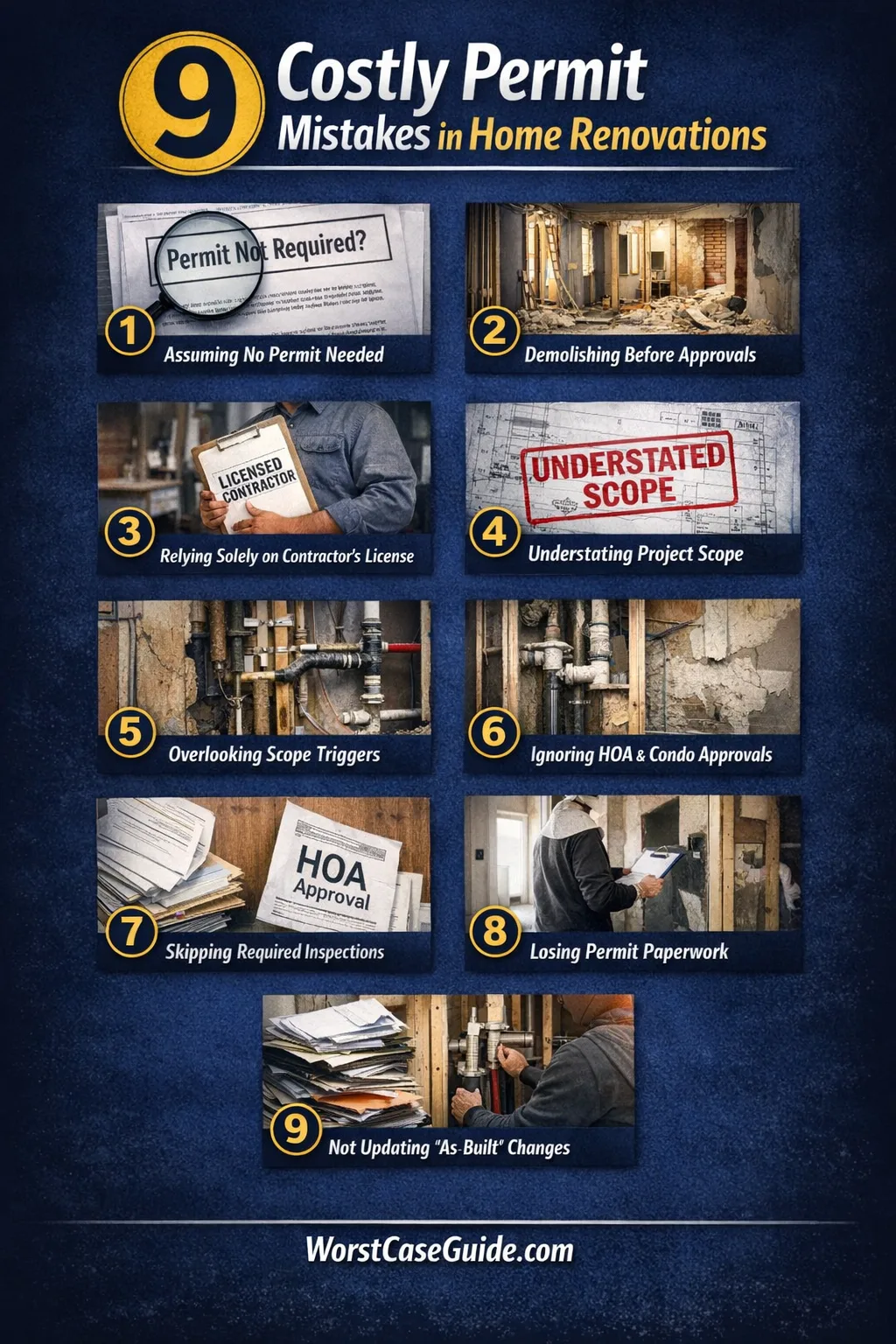
Mistake 1: Treating “Permit Required” As A Yes/No Question
Why it happens: People search “Do I need a permit?” and expect a binary answer. In practice, requirements often depend on scope details: moving a wall vs. changing a door opening, swapping a fixture vs. modifying a circuit, replacing finishes vs. relocating plumbing.
Early warning signs: The project description uses vague language like “minor remodel”, “refresh”, or “just updating”. Different contractors describe the same work differently.
Worst-case result: The permit application is filed under the wrong category, inspections don’t match the real work, and the project becomes stuck midstream—often after demolition but before closing walls.
A safer approach: Thinking in system impacts rather than labels. If you are changing structure, utility paths, or life-safety elements, it usually deserves a more precise scope statement and a permit check aligned to that scope.
Mistake 2: Starting Demolition Before Confirming Permit Path
Why it happens: Demolition feels like “progress,” and it can be scheduled quickly. Sometimes a crew is available now, while permit review feels slow and uncertain.
Early warning signs: The plan relies on “We’ll sort permits next week.” The contractor suggests doing “prep work” while paperwork is pending. Materials are ordered before approved drawings exist.

Worst-case result: Once demolition reveals unexpected conditions (old wiring, hidden plumbing, structural surprises), the permit scope changes. Costs rise, and the home may become partially unusable for longer than expected.
A safer approach: Separating work into phases where early work does not force later decisions. In larger systems, a short “verification phase” that confirms permit pathway and inspection stages can reduce the risk of being locked into a half-finished state.
Mistake 3: Assuming The Contractor’s License Automatically Covers Permits
Why it happens: Licensing feels like a proxy for compliance. Many homeowners assume “licensed” means permits are included and properly filed.
Early warning signs: The contract is unclear about who pulls permits. The contractor talks about permits as an “extra.” There is reluctance to share permit numbers or inspection scheduling details.
Worst-case result: Work proceeds under no permit or under a permit pulled for a different scope, and the homeowner becomes the one carrying cleanup tasks: retroactive approvals, rework, and disclosure issues later.
A safer approach: Clarity about responsibility and proof. In smaller projects, a single permit record with the correct address and scope can be enough to keep accountability visible throughout the job.
Mistake 4: Filing A Permit With An “Understated” Scope To Speed Approval
Why it happens: People want to avoid delays, and they may think a narrower description is harmless as long as the work is “basically the same.” This is one of the fastest ways to create inspection mismatch.
Early warning signs: The permit language is dramatically smaller than the actual plan. Drawings look simplified compared to what contractors discuss. There’s talk of “We’ll just do it once we’re inside the walls.”
Worst-case result: An inspector identifies work outside the permit scope. The project may be paused until revised plans are approved. In more complex remodels, this can cascade into trade scheduling failures and budget spikes.
A safer approach: Treating the permit description as a control document. If you are in a situation where timeline is tight, it can be safer to reduce the real scope rather than submitting an artificially small scope.

Mistake 5: Missing “Trigger” Work That Automatically Expands Requirements
Why it happens: Some work items act like triggers: once they happen, additional requirements or inspections become relevant. People focus on the main deliverable and overlook how one change can affect related systems.
Early warning signs: The project includes moving plumbing, changing panel capacity, altering egress features, or touching shared building elements in a multi-unit property. The contractor mentions “We might have to update that too,” but it’s not reflected in planning.
Worst-case result: The project gets reclassified midstream. Additional design work, specialized trades, or staged inspections are required. The home ends up partially open longer than expected.
A safer approach: Looking for triggers early and treating them as decision points. In larger systems, mapping dependencies between scope items and required approvals can prevent surprise expansions.
Mistake 6: Forgetting About Non-City Approvals (HOA, Condo, Landmark, Utility)
Why it happens: People think “permit” means only the city. Many projects also require private approvals or reviews from entities that can stop work even if a city permit exists.
Early warning signs: The home is part of a HOA or multi-unit building. The project affects exterior appearance, noise hours, shared plumbing stacks, or requires common-area access.
Worst-case result: Work is paused due to a missing approval, and rework is required to meet building rules. In tighter communities, it can also trigger neighbor complaints and ongoing friction.
A safer approach: Separating “public permits” from “private approvals” in planning. If you are in a condo setting, a short checklist of building-level requirements can reduce schedule surprises.
Mistake 7: Treating Inspections As Optional Scheduling Events
Why it happens: Inspections can feel like a bureaucratic visit. When trades are juggling multiple jobs, it’s tempting to keep moving and “catch up” later.
Early warning signs: Work is covered before inspection windows. Photos are taken as “proof” instead of scheduling the right stage. There’s uncertainty about which inspection is needed next.
Worst-case result: Finished surfaces have to be opened to show hidden work. In some situations, inspectors may not accept photos alone, leaving the homeowner with destructive verification and delays.
A safer approach: Treating inspection points as project gates. In smaller projects, a simple schedule that ties “close wall” decisions to inspection completion can prevent expensive backtracking.
Mistake 8: Not Keeping A Permit Paper Trail That Survives Contractor Turnover
Why it happens: Documents are scattered across texts, emails, and portals. If a contractor leaves, a subcontractor changes, or the homeowner travels, the project loses continuity and traceability.
Early warning signs: No single place contains the permit number, approved plans, inspection results, and revisions. The project relies on “someone has it.” Different people use different versions of drawings.
Worst-case result: When a question arises—during inspection, insurance claim, refinance, or sale—there is no clear proof of what was approved and what was done. That can turn a manageable issue into a prolonged dispute.
A safer approach: Keeping a single source of truth: permit identifiers, approved plan sets, revision history, and inspection outcomes. This is less about paperwork and more about maintaining project memory.
Mistake 9: Overlooking “As-Built” Reality When The Work Deviates From Plans
Why it happens: Real homes contain surprises. Field changes happen to solve practical problems. The mistake is assuming that a small deviation doesn’t matter because the original plan was approved.
Early warning signs: “We adjusted it a little” becomes frequent language. Redlines are not documented. The crew improvises around hidden conditions without updating the permit file or inspection plan.
Worst-case result: The final inspection reflects a home that doesn’t match the approved plans, creating a closeout failure. In larger systems, this can delay occupancy or trigger partial demolition for verification.
A safer approach: Treating deviations as documentation events. If you are in a situation with frequent surprises, documenting changes in a consistent way keeps approvals aligned with reality.
Quick Comparison Table: What Breaks First When Permits Go Sideways
| Area That Gets Hit | Typical Early Signal | Why It Matters | Safer Direction |
|---|---|---|---|
| Schedule | Inspection dates keep slipping | Trades stack up and idle time grows | Use inspection gates before covering work |
| Budget | “Small change” fees appear weekly | Rework and revisions compound | Track scope changes as approvals events |
| Quality | Work gets rushed before inspections | Hidden defects become expensive later | Prefer staged verification over speed |
| Resale / Refi | Missing paperwork for major changes | Disclosures and buyer concerns increase | Maintain a permit dossier |
| Insurance | Questions about “who approved what” | Claims can become more complex | Keep records tied to dates and scope |
General Risk Patterns Behind Permit Mistakes
Pattern 1: Scope ambiguity becomes paperwork ambiguity. When the work is described loosely, the permit and inspection sequence becomes loose too. That’s how small projects drift into big problems.

Pattern 2: Speed is purchased with reversibility. Starting early or understating scope often feels like time saved. The cost shows up later as forced rework and stalled closeout.
Pattern 3: Responsibility is assumed, not proven. Projects fail when accountability is implicit. A permit record, inspection schedule, and a clear paper trail are basic ways to keep ownership visible.
Pattern 4: Documentation is treated as admin, not as risk control. In reality, paperwork is how you preserve options. It helps when contractors change, when surprises appear, and when someone asks “What exactly was done?” months later.
FAQ
What counts as “permit-related work” in a typical home project?
It often relates to changes that affect structural elements, electrical, plumbing, gas, or life-safety features. The important piece is whether the work changes how the home’s systems function, not how “small” it feels.
If a contractor says permits aren’t needed, what is the practical risk?
The practical risk is misalignment between what was done and what can be proven later. In some cases, it shows up during inspection. In other cases, it appears at sale or refinance when documentation matters more than intent.
How do permit problems usually surface if nobody complains during the project?
They often surface when someone asks for records: a future buyer, an insurer after a claim, or a lender during a refinance. They can also surface when a later project triggers questions about the home’s existing conditions.
Is it risky to do “just demolition” while waiting on approvals?
It can be, because demolition can reveal unexpected conditions that change scope and approvals. If the demolition step makes the home unusable or forces rapid decisions, it reduces reversibility when paperwork or design needs adjustment.
What is a “permit paper trail” that actually helps in real life?
A helpful trail typically includes the permit identifier, the approved plan set, any revisions, and inspection outcomes tied to dates. The goal is traceability, so that months later the project still has clear memory.