Employee onboarding is one of the few processes where small misses can turn into quiet, lasting decisions. Not dramatic exits. Just a new hire realizing the role is murkier than expected, support is inconsistent, and the day-to-day feels harder than it needs to be.
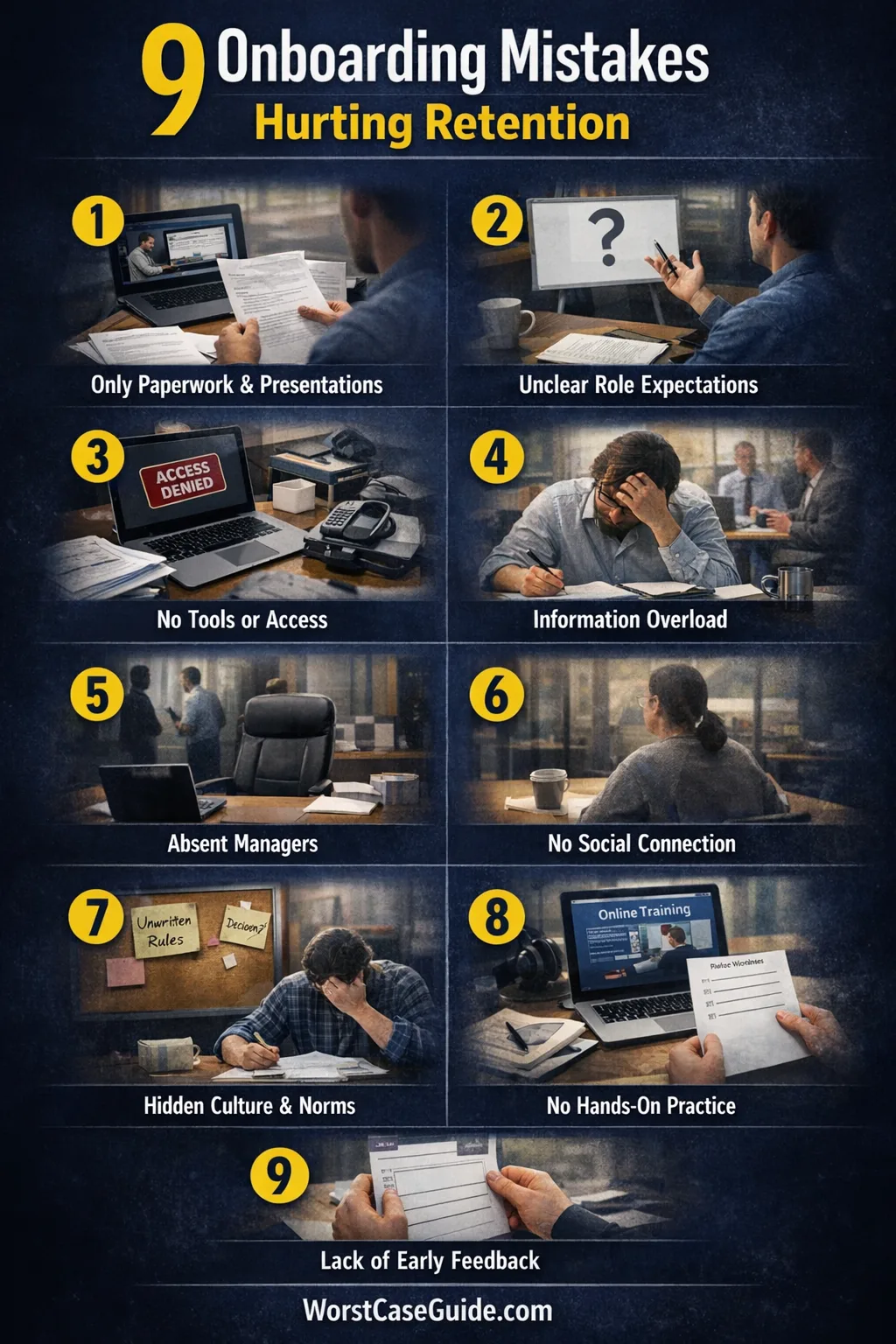
Retention problems often look like “fit” issues later on. Early on, they can be onboarding issues: unclear expectations, weak connections, missing tools, and no safe place to ask “basic” questions. The risk is that these gaps don’t just slow productivity; they reduce confidence and belonging while the relationship is still forming.
Why Onboarding Creates A Retention Point Of No Return
In the first weeks, employees build a mental model of three things: what “good” looks like, how help actually works, and whether the team is safe to be imperfect around. If that model forms around ambiguity and friction, later improvements can feel like exceptions, not the norm.
This is why onboarding is risky in a specific way. It’s not one big failure. It’s often a chain of small oversights that produce a steady drip of uncertainty. Over time, that can translate into lower commitment and earlier “maybe I should look elsewhere” thoughts.
Practical framing: onboarding isn’t only “orientation.” It’s the first operating system update for the employee and the team. If the update is partial, people work around bugs instead of building trust.
Common Assumptions That Create Quiet Risk
Onboarding breakdowns often start with assumptions that feel reasonable. They can still be wrong in practice, especially across different managers, teams, and locations.
- A checklist equals onboarding. The employee may be “processed” but not integrated into how work actually happens in a specific team.
- People will ask for help. Many new hires avoid asking because they don’t want to look unprepared, especially when norms are unclear.
- HR covers the basics, managers cover the rest. If the handoff is implicit, gaps appear right where employees need clarity.
- Early enthusiasm compensates for friction. Motivation can mask confusion for a short time, then it fades.
- Training content is enough. Without practice, feedback, and real context, training can feel like noise.
A Quick Risk Map Before The Mistakes
Some onboarding issues show up as “soft” signals. They’re still useful as early warnings because they predict later disengagement more often than a single big incident does.
| Early Signal | What It Often Means | Retention Risk | Safer Signal To Track |
|---|---|---|---|
| Few questions in week 1 | Low psychological safety or unclear help channels | Silent struggle, later burnout or exit | “Where do you go first when blocked?” answered clearly |
| Lots of busy time, little output | Tool access, role clarity, or priorities are missing | Early confidence drop | One small win delivered by day 10–20 |
| Meeting-heavy days | Onboarding is talk not practice | Slow ramp, lower motivation | Hands-on time with feedback built into the week |
| Repeated “who owns this?” | Ownership and decision paths are implicit | Frustration, political stress | Clear “owner / approver / collaborator” patterns |
Mistakes That Reduce Employee Retention
Below are onboarding mistakes that commonly lead to early dissatisfaction. Each one includes why it happens, what shows up first, the realistic worst-case, and a more stable approach.
Mistake 1: Treating Onboarding As Paperwork And Presentations
This happens when onboarding is measured by completion instead of capability. Forms get signed, videos get watched, and the employee still can’t do the work safely on their own.
Why It Happens
- Compliance needs are real, so they dominate the schedule.
- Content is easier to scale than coaching.
- Teams assume role-specific learning will “just happen” through exposure and osmosis.
Early Warning Signs
- New hires can repeat policies but can’t explain how work flows.
- They attend many sessions yet still feel lost after day 5.
- They keep asking for the “real” docs, not the onboarding slides.
Worst-Case Result
Employees become productive slowly, make avoidable mistakes, and start to question whether the organization is serious about enabling success. That can reduce commitment long before anyone labels it a “retention” problem.
Safer Approach
Onboarding can be framed around “can they do the job” milestones: access in place, a small task completed, feedback received, and a clear path for help. In smaller teams this can be informal; in larger systems it often needs repeatable structure.
Mistake 2: Leaving Role Expectations Vague Until “They Settle In”
Many teams delay clarity because they want to stay flexible. The risk is that flexibility becomes ambiguity, and ambiguity becomes anxiety. New hires fill the gap with their own assumptions, then get corrected later.
Why It Happens
- The role changed recently, so expectations feel unfinished.
- Managers assume “good people figure it out” without needing explicit success criteria.
- Teams avoid hard conversations about priorities and tradeoffs early on.
Early Warning Signs
- New hires ask “what matters most?” more than once.
- Different stakeholders give conflicting directions.
- Feedback sounds like “not like that” instead of “yes, and here’s the target.”
Worst-Case Result
The employee invests energy in the wrong outcomes, then experiences repeated correction. Over time, that can feel like unfair evaluation rather than normal alignment. The role starts to look like a moving target, and leaving feels rational.
Safer Approach
A lighter-weight way to create clarity is a short “first 30–60 days” view: what good work looks like, what not to optimize for yet, and how tradeoffs get decided. It doesn’t have to be rigid; it just needs to be shared and revisited as reality changes.
Mistake 3: Starting Day 1 Without Tools, Access, Or A Working Environment
Nothing signals “you’re on your own” faster than a week of blocked access requests. It’s not only inefficient. It also frames the organization as disorganized, which chips away at confidence.
Why It Happens
- Ownership is split across HR, IT, security, and the manager without a clear coordinator.
- Access depends on approvals that aren’t requested early enough.
- Teams assume provisioning is “standard” while systems are inconsistent across departments.
Early Warning Signs
- First-week tasks revolve around “waiting” and chasing permissions.
- New hires rely on someone else’s login or shared devices (a risk signal).
- Basic communication tools and repositories are still unavailable after day 2–3.
Worst-Case Result
Ramp-up stalls, early momentum disappears, and the employee learns that getting things done requires persistent escalation. In larger organizations, this can become a lasting belief that the system is hard and support is unreliable.
Safer Approach
Safer onboarding treats access as a “pre-start deliverable,” not a day-1 activity. A simple readiness check can focus on essentials: identity, device, core apps, security requirements, and the team’s actual working folders. If access is intentionally limited at first, naming the timeline and reason can reduce uncertainty.

Mistake 4: Overloading The First Two Weeks With Everything At Once
Many onboarding plans try to front-load all knowledge. The result can be a cognitive flood: tools, policies, org charts, and meetings with no place to anchor them. People remember less, feel more behind, and hesitate to admit it.
Why It Happens
- Teams worry they won’t have time later, so they “do it now.”
- Different departments add sessions independently, creating a stacked calendar.
- Onboarding is scheduled around presenter availability, not learning flow.
Early Warning Signs
- Back-to-back meetings leave no time for setup or practice.
- New hires take many notes but can’t explain what to do next.
- They start saying “I’ll rewatch later” for essential material.
Worst-Case Result
The employee begins week three with low retention of basics and rising stress. That stress can look like low performance. Then the relationship becomes “prove you belong” instead of “we’re building you up.” That shift can be hard to reverse without intentional repair.
Safer Approach
A more stable pattern is pacing: fewer concepts per day, earlier hands-on work, and repeated exposure to what matters. In smaller projects, a single “north star” goal can structure the first two weeks. In larger systems, it often helps to separate need-to-know from nice-to-know with clear timing.

Mistake 5: Making Onboarding “HR-Owned” And Leaving Managers Without A Concrete Role
HR can run a strong program and the new hire can still churn if the manager piece is thin. Employees tend to interpret their manager’s involvement as a signal of value, priority, and support.
Why It Happens
- Managers are busy, so onboarding becomes “someone else’s process.”
- There’s no shared definition of what managers do in week 1, 2, and 4.
- The org assumes culture will carry the relationship without structure.
Early Warning Signs
- 1:1 meetings are irregular or purely tactical.
- New hires don’t know what to bring to their manager.
- Performance feedback is absent until something goes wrong.
Worst-Case Result
Employees feel like a ticket in a system, not a person being set up for success. When they struggle, they assume it’s a personal problem, not an onboarding gap. That can accelerate disengagement, especially for people who don’t have strong internal networks yet.
Safer Approach
Manager involvement doesn’t need to be heavy. It can be predictable: a short cadence for check-ins, clear signals for what “good” looks like this week, and explicit permission to surface blockers early. The key is reliability more than volume.
Mistake 6: Skipping Social Integration And Assuming Relationships Will Form Naturally
Many employees leave not because the work is impossible, but because it feels lonely. Social integration is not “fun”; it’s a support system. Without it, small questions stay unanswered, and stress stays internal.
Why It Happens
- Remote and hybrid work reduces accidental connection.
- Teams underestimate how hard it is to enter an established group.
- Onboarding plans focus on org knowledge, not human pathways.
Early Warning Signs
- New hires don’t know who to ask for what, outside the manager.
- They attend meetings but rarely speak.
- They avoid collaborative work because it feels like “interrupting.”
Worst-Case Result
The employee becomes dependent on a single person for help, or stops asking altogether. Both increase error rates and lower engagement. When a better-supported option appears elsewhere, leaving can feel like the safer path.
Safer Approach
Social integration can be made practical: a buddy for day-to-day questions, a small set of introductions tied to real work, and early collaboration on a contained task. In larger systems, mapping “who owns what” is often more valuable than broad meet-and-greets.
Mistake 7: Leaving Culture, Norms, And Decision Rules Unspoken
Culture is not a slogan. It’s the hidden rulebook: how decisions get made, what “fast” means, how disagreement works, and what gets rewarded. When this stays implicit, new hires take social risks without knowing the boundaries.
Why It Happens
- Teams assume norms are obvious because they’re used to them.
- Leaders worry culture conversations feel vague, so they avoid them.
- Organizations have conflicting norms across teams, so no one wants to claim the standard.
Early Warning Signs
- New hires ask “is it okay if…” for basic behaviors.
- They hesitate to make decisions without explicit approval.
- They receive feedback on style or tone that they couldn’t have predicted.
Worst-Case Result
The employee feels socially unsafe and starts to minimize initiative. That can look like low ownership, but it’s often self-protection. Over time, the workplace feels like a place where you can be corrected for rules that were never shared.
Safer Approach
A safer approach is naming norms in concrete examples: how decisions happen, what a good escalation looks like, and what “quality” means in this team. If norms differ across teams, that difference can be stated explicitly so the employee doesn’t assume universality.
Mistake 8: Training Without Practice, Feedback, Or A “First Win”
Training can create the illusion of progress. Confidence usually comes from doing a real task, making small mistakes in a safe setting, and receiving feedback that makes the path feel learnable.

Why It Happens
- Teams don’t want new hires to touch production work early.
- There’s no pre-scoped task that is small and meaningful.
- Feedback loops are delayed because reviewers are busy.
Early Warning Signs
- Weeks pass without a deliverable the new hire can point to.
- They consume documentation but don’t produce anything that gets reviewed.
- They express doubt about whether they’re adding value.
Worst-Case Result
The employee’s narrative becomes “I’m behind” instead of “I’m ramping.” That shift can lead to overwork, withdrawal, or a quick exit to protect their reputation. The organization then interprets it as a hiring mistake rather than an onboarding gap.
Safer Approach
A more stable pattern includes a small real task with guardrails, fast feedback, and a clear definition of “done.” In smaller projects, this might be a single feature, document, or support workflow. In larger systems, a “sandbox” task can still be real if it connects to a broader outcome.
Mistake 9: Collecting Feedback Too Late, Or Not At All
Onboarding often gets evaluated at 90 days, when the most important moments are already gone. Early weeks produce pratik data: what was missing, where people got stuck, and which parts created unnecessary stress.
Why It Happens
- Teams fear feedback will create extra work, so they avoid asking.
- People wait for a formal survey instead of simple check-ins.
- There’s no owner responsible for turning insights into improvements.
Early Warning Signs
- New hires repeat the same questions as the last new hire.
- Managers discover gaps only when performance problems appear.
- Onboarding “works” on paper but feels inconsistent in practice.
Worst-Case Result
Problems persist across multiple hires, and retention declines quietly. People who leave often don’t cite onboarding directly; they cite “lack of growth,” “confusion,” or “not a fit.” Those can be downstream labels for the same early friction.
Safer Approach
Early feedback can be lightweight: a short check-in at week 1, week 3, and around day 60, focused on blockers, clarity, and belonging. The safer part is not collecting feedback; it’s closing the loop so the employee sees that the organization learns and improves.
Risk Patterns That Show Up Across Most Onboarding Failures
Across industries and team sizes, retention-impacting onboarding mistakes often share a few patterns. They’re less about intent and more about system design and ownership.
- Ambiguous ownership: many people “help,” but no one is responsible for the end-to-end experience.
- Invisible expectations: success criteria exist in someone’s head, not in shared form.
- Front-loaded information: lots of content early, not enough practice and feedback.
- Silent struggle: the system rewards looking competent, so real blockers stay hidden.
- Inconsistent manager experience: onboarding quality depends on the manager, not the organization.
A Small But Useful Mental Check
If onboarding feels “fine” but retention still dips, it can help to ask three non-judgmental questions: Where did people lose clarity? Where did they lose support? Where did they lose confidence? Those are often easier to improve than “culture” in the abstract.
FAQ
How long should onboarding last to support retention?
Many teams treat onboarding as a first-week event. Retention risk usually reduces when onboarding covers at least the early period where employees build confidence, relationships, and role clarity. In smaller teams this can be shorter and more informal; in larger systems it often stretches longer because access, norms, and stakeholder maps are more complex.
What is the earliest sign that onboarding is harming retention?
One early sign is when people stop asking questions and start working around problems silently. That can look like independence, but it often indicates low psychological safety or unclear help channels. Another sign is “busy” calendars with little progress because access and priorities aren’t stable yet.
Is a buddy program always worth it?
A buddy program can help when it provides practical navigation, not just friendly chats. The risk is pairing without clarity, which creates inconsistent help. A safer version sets a narrow scope: where to find things, who owns what, and how to get unstuck without escalating everything to the manager.
How can onboarding be consistent without becoming rigid?
Consistency doesn’t require identical experiences. It usually means the essentials are reliable: access, role expectations, manager cadence, and a path to early feedback. Teams can keep flexibility in how they teach and socialize the work while still ensuring the employee doesn’t face preventable friction.
What should be measured in onboarding if the goal is retention?
Measures tied to lived experience tend to be more useful than completion metrics. Examples include time-to-first small win, clarity of success criteria, confidence in help channels, and whether the employee has meaningful working relationships. These indicators can be checked through short, specific questions rather than long surveys.