A meeting rarely “wastes time” in one dramatic moment. It usually leaks minutes through small management choices, unspoken expectations, and unclear outcomes. The risk is subtle: each individual meeting feels tolerable, yet the aggregate cost becomes a weekly tax on focus, follow-through, and trust.
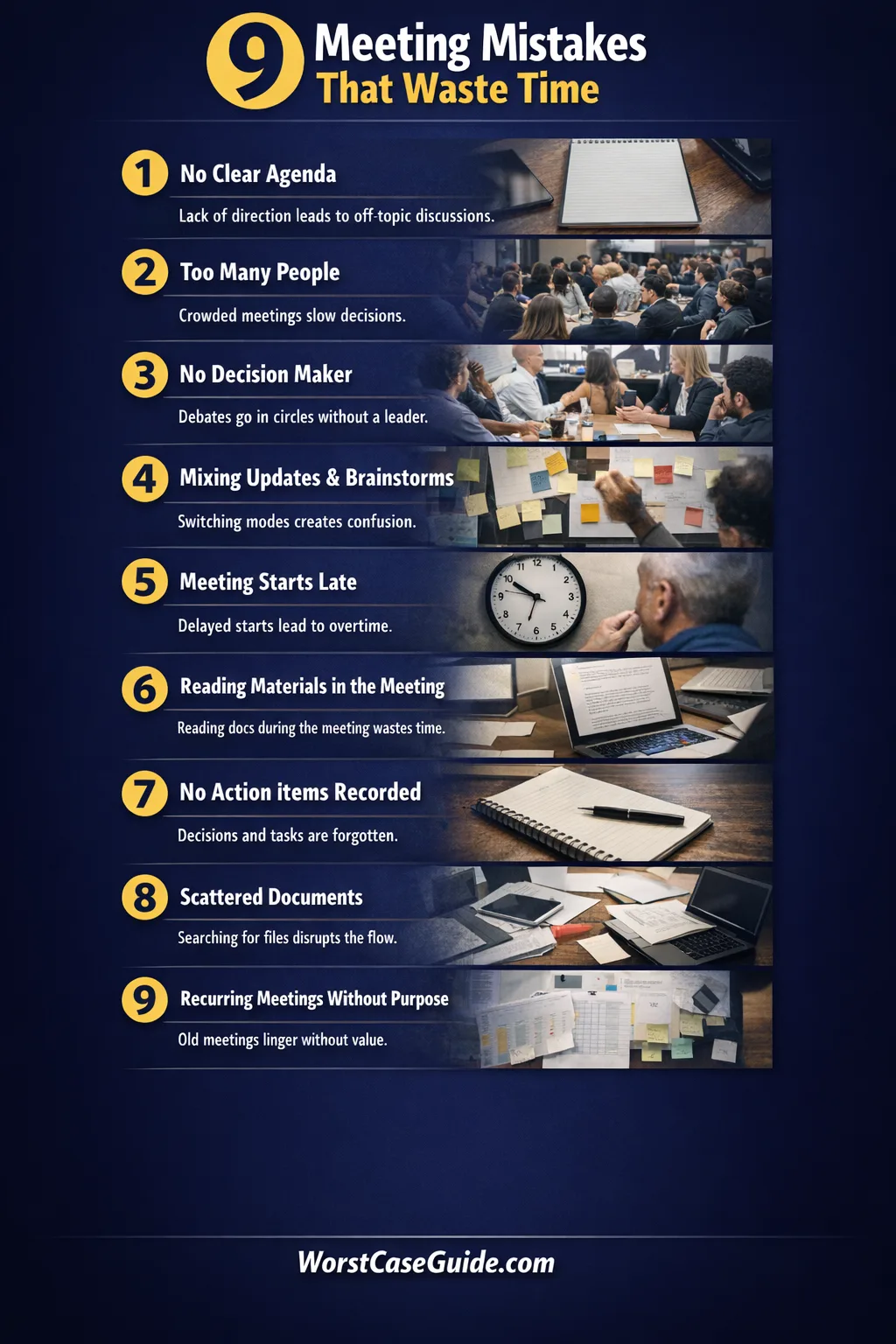
This guide is built for readers who want fewer avoidable mistakes and more predictable meeting outcomes—without turning meetings into rigid theater. The goal is clarity: where time gets lost, what signals show up early, and what a safer approach tends to look like in real teams.
Why Meeting Management Becomes Risky Faster Than People Expect
Meetings compress different needs—alignment, decisions, problem-solving, and social coordination—into a single time box. That compression creates failure modes that do not show up as obvious “errors” until the team is already behind or stuck.
In smaller teams, the cost can look like lost momentum and frustrated people. In larger organizations, the same patterns can turn into decision drift, duplicate work, and quiet escalation across multiple functions.
Common Assumptions That Quietly Break Meetings
- “If it’s on the calendar, it’s necessary.” This assumes a meeting’s purpose remains valid as priorities shift, which often isn’t true. Calendars remember even when teams forget. Context changes.
- “Everyone needs to be in the room.” This assumes inclusion automatically creates speed. In practice, it can create role confusion and longer decisions.
- “We’ll figure it out live.” This assumes real-time conversation will surface structure. Many meetings end up with more complexity and less certainty.
- “Notes are optional; we’ll remember.” This assumes memory is a reliable system. Under workload, memory becomes selective, and interpretations diverge.
Meeting Management Mistakes That Waste Time
Quick diagnostic idea: when a meeting runs long, the cause is often upstream (how it was designed) rather than downstream (how people behaved during it). The mistakes below focus on the design layer that makes wasted time predictable—and therefore easier to avoid. No drama required.

Mistake 1: Treating The Agenda As Optional
Why It Happens
Teams sometimes equate an agenda with bureaucracy. The meeting is created with a vague title, people show up, and the group tries to form a plan mid-conversation. That works occasionally when the topic is simple, but it becomes fragile as soon as the meeting contains trade-offs or dependencies.
Early Warning Signs
- People ask “What are we trying to do today?” in the first five minutes, then repeat it later. Looping starts. Drift shows up early.
- Conversation jumps between topics with no visible prioritization. Side quests appear. Scope creep feels normal.
- Someone says “We should take this offline” multiple times. Rework is brewing. Outcome uncertainty grows.
Worst-Case Result
The meeting consumes the full slot and produces no shared definition of what “done” means. People leave with different versions of the conversation, and the next meeting becomes a replay rather than a step forward. The damage is usually not catastrophic; it’s compounding.
A Safer Approach
A safer agenda is less about formatting and more about constraints. In many teams, agendas that reduce waste include: a single primary goal, a short list of topics in order, and a clear label for each topic (update, decision, brainstorm). When the meeting is complex, it also helps when the agenda shows the expected output in plain language. One sentence can be enough.
Mistake 2: Inviting People Without Clear Roles
Why It Happens
Invites often follow social logic: “better to include everyone.” Without role clarity, attendees arrive unsure whether they are decision-makers, contributors, or passive listeners. That uncertainty makes participation uneven and slows decisions, even when everyone is competent.
Early Warning Signs
- Long stretches of silence, then sudden bursts of opinion from a few voices. Participation skew builds. Social risk rises. Time expands.
- Attendees ask if they’re “needed” or leave early without clarity. Commitment becomes fuzzy. Signals get mixed. Ownership weakens.
- Decision points stall because “someone else should weigh in.” Deferral becomes normal. Consensus pressure grows. Delay looks polite.
Worst-Case Result
The meeting turns into a performance: people speak to be seen, not to move work. Alternatively, the group becomes overly cautious, delaying action until absent stakeholders are consulted. Over time, this can create a meeting culture where nothing is final, and calendar load replaces progress.
A Safer Approach
Role clarity can be lightweight: “Owner,” “Decision,” “Input,” “FYI.” In smaller projects, a simple line in the invite can be enough. In larger systems, teams often reduce waste by making it explicit who is there to decide, who is there to inform, and who can consume outputs asynchronously. The goal is not exclusion; it’s predictability.
Mistake 3: Running A Decision Meeting Without A Decision Owner
Why It Happens
Some meetings assume decisions “emerge” from discussion. That assumption can work in tightly aligned groups, but it often fails when there are competing constraints. Without a decision owner, discussion becomes perpetual negotiation, and accountability diffuses.
Early Warning Signs
- Questions like “Who is deciding?” show up late, after debate is already extensive. Backtracking starts. Frustration rises.
- People default to “we” language without committing to next steps. Collective ambiguity grows. Vagueness spreads. No closure.
- After the meeting, someone escalates because they believed the decision went the other way. Re-litigation begins. Trust takes a hit. Time doubles.
Worst-Case Result
The team spends multiple meetings circling the same choice, and the final decision occurs elsewhere—often in a smaller side conversation. The visible meeting becomes non-authoritative, which leads to more “just to be safe” meetings later. The outcome is decision latency and calendar inflation.
A Safer Approach
A safer pattern is to separate discussion ownership from decision ownership, then name both. If the decision owner is not available, teams often reduce waste by reframing the meeting as an input session and specifying what output will be delivered to the owner. In complex topics, it also helps to define what “decision” means: approval, selection, prioritization, or risk acceptance.
Mistake 4: Mixing Updates, Decisions, And Brainstorms In One Slot
Why It Happens
Meetings often try to “do everything” because time is scarce. The result is a hybrid session where the group alternates between status reporting, ideation, and decision-making. Each mode uses different mental gear. Switching repeatedly creates friction and slows everything.
Early Warning Signs
- People interrupt updates to solve problems immediately. Mode confusion sets in. Interruptions multiply. Time slips.
- Brainstorm ideas arrive before constraints are stated. Idea debt grows. Later pruning becomes painful. Noise expands.
- Decisions are attempted before everyone has the same baseline. Re-explaining starts. Resetting repeats. Momentum breaks.
Worst-Case Result
The meeting produces partial outputs: a few updates, a handful of ideas, and a decision that is either premature or postponed. The worst case is not “bad ideas” so much as unfinished work that forces a second meeting to clean up the first. Double handling becomes normal. Cycle time grows.
A Safer Approach
When topics require multiple modes, waste often drops if the session makes the mode sequence explicit: baseline → options → decision. In smaller projects, the same meeting can work if each segment is time-boxed and labeled. In larger systems, teams frequently separate updates into asynchronous channels and reserve live time for the hard parts: trade-offs, decisions, and conflict resolution.
Mistake 5: Letting Start Times Slip And Time Boxes Dissolve
Why It Happens
Late starts become socially acceptable when no one feels responsible for time. Meetings that regularly run over also train participants to assume that any calendar boundary is soft. That softness invites “one more topic” and erodes schedule reliability. The hidden cost is downstream disruption.
Early Warning Signs
- The first five minutes are consistently used for “waiting.” Low urgency becomes cultural. Attention drifts. Respect erodes quietly.
- People multitask because they expect the meeting to be long. Split focus increases. Repeats rise. Quality drops.
- Key attendees leave early to make other calls, and topics get rehashed later. Fragmentation grows. Context loss spreads. Rework appears.
Worst-Case Result
The calendar becomes unreliable, and people schedule “buffer time” around meetings. That buffer time is often invisible on the calendar, but it is real. The organization ends up paying for meetings plus recovery, which can be more expensive than the meeting itself. Planning confidence falls. Stress rises.

A Safer Approach
Time discipline tends to improve when one person is explicitly responsible for time boundaries, even if they are not the content lead. In teams where lateness is chronic, smaller adjustments can still help: setting realistic scope for the slot, labeling what can be deferred, and leaving a deliberate buffer only when the topic truly warrants it.
Mistake 6: Using The Meeting To Read Materials For The First Time
Why It Happens
Sometimes pre-reads feel risky: people fear others won’t read them, so they allocate meeting time for “going through the doc.” The intention is fairness; the effect can be a slow collective reading session. In complex topics, the meeting ends up spending energy on comprehension rather than decision quality.
Early Warning Signs
- Screen-sharing a long document becomes the core activity. Scrolling dominates. Engagement drops. Silence grows.
- Questions cluster around basic definitions rather than trade-offs. Baseline mismatch shows. Clarifications multiply. Depth is postponed.
- People ask for the link during the meeting. Access friction appears. Context switching increases. Time leaks.
Worst-Case Result
The group spends the majority of the slot reaching a shared baseline, then runs out of time for the actual purpose (decision, alignment, or problem-solving). The same topic must be revisited. The worst-case pattern is permanent pre-read meetings—a stable failure mode where teams meet to prepare for meetings. Momentum suffers. Morale gets brittle.
A Safer Approach
Many teams reduce this waste by narrowing the meeting’s goal: not “review the doc,” but “resolve two open questions.” In smaller projects, a short written context block can replace a full pre-read. In larger systems, it can help when materials include a one-page brief plus a deep link for those who want detail. The live meeting can then focus on trade-offs instead of reading.
Mistake 7: Ending Without Capturing Decisions, Owners, And Deadlines
Why It Happens
When time runs out, teams often skip formal wrap-up to “give people time back.” The intention is good; the effect is uncertainty. Without captured outputs, the meeting’s value becomes fragile, dependent on memory and goodwill. Under load, memory becomes inconsistent. Interpretations split.
Early Warning Signs
- People end with “Let’s sync later” rather than naming outcomes. Loose endings appear. Ambiguity rises. Follow-up becomes unclear.
- After the meeting, multiple people message different “next steps.” Parallel narratives form. Confusion spreads. Work duplicates.
- Next meeting starts by re-litigating what was decided last time. Decision decay occurs. Trust drops. Time repeats.
Worst-Case Result
The meeting produces a sense of progress but not actual progress. Work stalls because people hesitate to act without clarity, or they act and later discover they acted on the wrong assumption. The worst case is a slow-motion rollback: time is spent undoing or renegotiating. Accountability becomes uncomfortable. Speed drops.
A Safer Approach
A safer close usually includes a brief “outputs pass”: decisions made, owners named, and any follow-up deadlines stated as plainly as possible. In smaller teams, a single paragraph note can cover it. In larger systems, a lightweight template helps consistency: Decision / Owner / Due / Risks or dependencies. The goal is not paperwork; it’s shared reality.
Mistake 8: Letting Tools And Documents Become A Scavenger Hunt
Why It Happens
When teams use multiple channels—calendar, chat, docs, tickets—meeting context gets fragmented. People arrive without the same materials or discover mid-meeting that access is missing. This is a classic “small friction” issue that creates large time loss through interruptions and context switching.
Early Warning Signs
- Someone asks “Which doc are we in?” more than once. Confusion recurs. Switching increases. Flow breaks.
- Notes live in multiple places, with no agreed “source of truth.” Fragmentation grows. Searching starts. Misalignment follows.
- Action items get lost between chat messages and documents. Orphaned tasks appear. Follow-up becomes random. Reliability declines.
Worst-Case Result
Meetings become expensive not only because they take time, but because they require setup time, post-meeting cleanup, and repeated searches for artifacts. In larger organizations, this can cause decisions and notes to be effectively lost, forcing teams to re-derive context. Confidence drops. Cycle time stretches.
A Safer Approach
A safer approach often means choosing a consistent “meeting home” for each recurring series: one place where agenda, notes, and decisions live. In smaller projects, the calendar invite can hold the single link. In larger systems, teams often reduce waste by using a stable pattern: one agenda doc, one notes section, and a decision log that is easy to scan later.
Mistake 9: Letting Recurring Meetings Continue After Their Purpose Expired
Why It Happens
Recurring meetings are created to solve a real need—launch coordination, incident review, project alignment. Over time, the original need changes, but the meeting persists because canceling feels socially risky or administratively annoying. The meeting becomes a default container for any topic that lacks a better home. Convenience replaces intent.
Early Warning Signs
- Agenda is frequently empty, or filled minutes before start. Low signal appears. Filler topics rise. Attendance declines.
- Same issues repeat without resolution, week after week. Stagnation forms. Resignation grows. Energy drops.
- People join late, multitask, or treat it as optional. Devaluation happens. Norms weaken. Time waste becomes accepted.
Worst-Case Result
Recurring meetings become a hidden organizational tax: a steady drain on attention that no one actively chooses anymore. This can crowd out deep work and create a culture where “being busy” becomes evidence of progress. The worst case is calendar saturation that makes real emergencies harder to handle because there is no slack. Resilience falls.

A Safer Approach
Recurring meetings tend to stay healthy when they have a visible purpose and a simple “renewal” rule: they continue only if they keep producing a clear output. In smaller teams, a periodic check-in (“what is this meeting for now?”) is often enough. In larger systems, teams sometimes reduce waste by tying recurring meetings to a measurable output like decisions made, risks tracked, or dependencies cleared.
A Table For Spotting Waste Patterns Early
When wasted time is persistent, it helps to identify the pattern rather than blaming “bad meetings.” The table below maps common symptoms to likely causes and a safer check that can reduce repeat failures.
| Symptom | Likely Root Cause | Safer Check |
|---|---|---|
| Meetings run long and still feel unfinished | Agenda drift or mixed modes (update + decision + brainstorm) | Is each topic labeled with an expected output? |
| Same debate repeats across multiple sessions | No clear decision owner or unclear decision type | Is “who decides” visible before discussion starts? |
| Attendance is high but contribution is low | Roles are unclear; invite list optimized for safety | Who is there for input vs decision vs FYI? |
| People spend time searching for docs and links | Tool fragmentation; no stable “meeting home” | Is there one canonical link for agenda + notes + decisions? |
| Recurring meetings feel mandatory but low value | Purpose expired; meeting persists by inertia | What output justifies the slot this week? If none, why meet? |
Risk Patterns That Show Up Across Most Time-Wasting Meetings
Pattern: Output Ambiguity
Meetings waste time when they can’t answer a simple question: what changes because we met? Output ambiguity often hides behind nice conversation. The reliable early signal is no written closure.
Pattern: Accountability Diffusion
When responsibility is unclear, teams compensate with more discussion and more stakeholders. It feels safer, yet it usually slows action. A common symptom is “we” language without owners.
Pattern: Hidden Setup Costs
The meeting is not the full cost. There is preparation, context switching, and recovery. If meetings require scavenger hunts for docs or repeated baseline building, the total time spent can quietly double.
If a team keeps encountering the same failure modes, the issue is often not “meeting discipline” but meeting design: unclear outputs, unclear roles, or unclear decision mechanics. When those are explicit, many smaller behaviors (lateness, multitasking, repetition) tend to improve because the meeting has a stable shape. Structure reduces friction.
FAQ
How can a meeting waste time even if everyone is “aligned”?
Alignment can be real and still be costly if the meeting produces no new output. Teams sometimes re-confirm shared understanding because it feels safe, especially under uncertainty. The waste shows up when the same alignment conversation repeats without moving into decisions or actions.
What is the clearest sign that a meeting should not be recurring?
A common sign is consistent low signal: empty agendas, filler topics, or repeated discussions with no closure. The meeting may still feel socially important, but its purpose is no longer operationally clear. In many teams, the safer check is whether the meeting reliably produces a visible output.
Is it better to have fewer people or more people in a meeting?
It depends on the meeting’s mode. For decisions, clarity of roles tends to matter more than headcount: who decides, who provides input, and who can receive the result asynchronously. In brainstorms, broader perspectives can help, yet it still benefits when participants know whether they are expected to generate ideas or simply observe.
Why do “quick syncs” often become long meetings?
“Quick sync” is a title without constraints. Without an agenda that defines the output, the meeting can drift into updates, decisions, and problem-solving all at once. The slot expands to match the number of unresolved topics, not the intended duration. A stable time box usually needs a stable purpose and clear priorities.
What makes meeting notes actually useful rather than busywork?
Useful notes are decision-focused: what was decided, who owns follow-up, and when the next checkpoint occurs. Notes become busywork when they try to capture everything said. Many teams get better results when notes are short, structured, and easy to scan for outputs.
How can a team reduce meeting time without losing coordination?
Coordination often improves when live time is reserved for the hard interactions: decisions, trade-offs, and conflicts. Updates and baseline context can sometimes move to asynchronous formats. The key is not removing meetings blindly; it’s reducing the specific failure modes that create repeat meetings and rework.