Home renovations feel straightforward until the hidden dependencies show up. One rushed decision can lock in water, wiring, or structure problems behind finished surfaces, where repairs become expensive and disruptive. The risk is rarely the renovation itself—it is the missed constraint that only becomes visible after things are closed up.
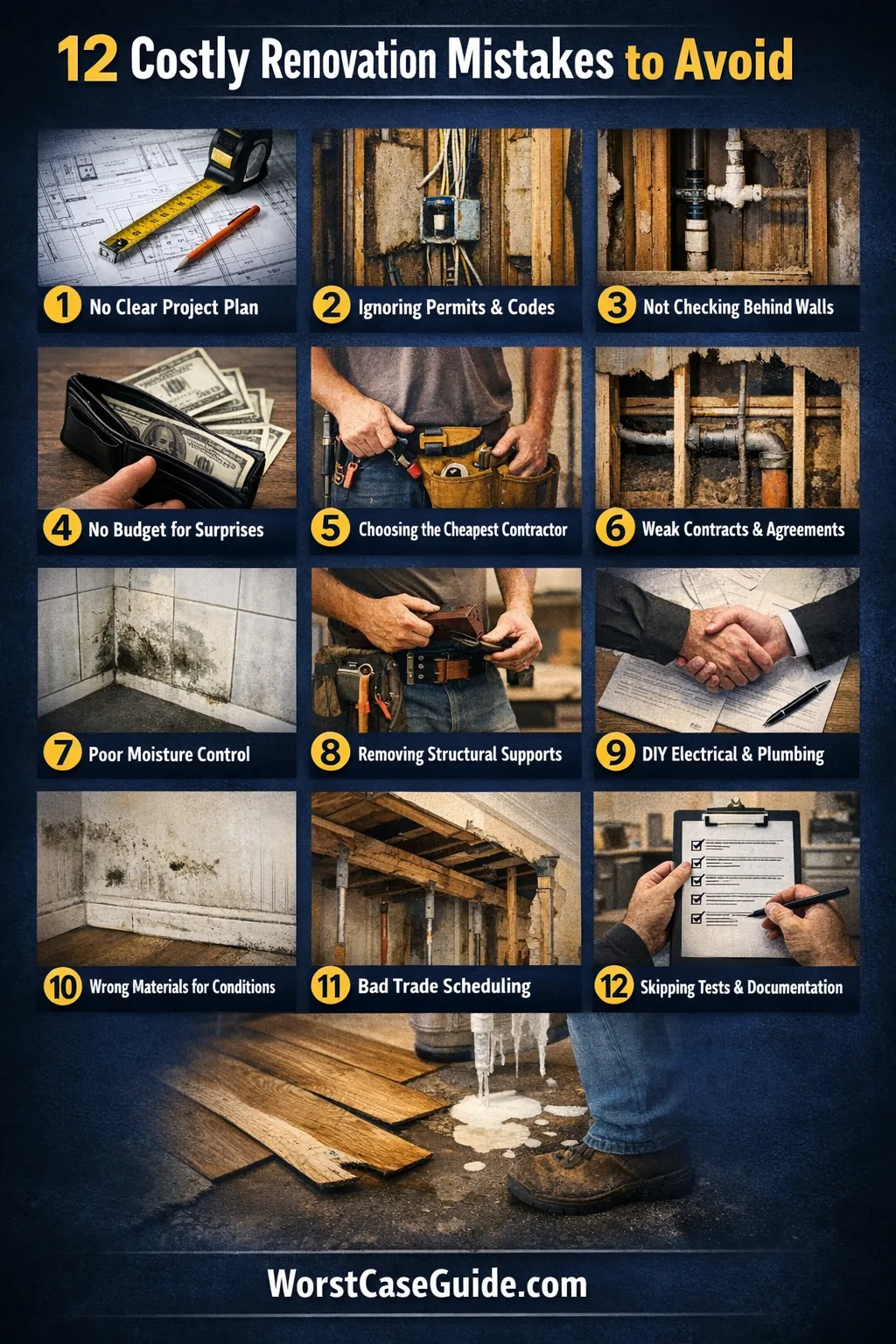
Most costly repair stories start with a normal goal: faster timelines, a cleaner look, or a tighter budget. The “worst case” is usually not dramatic. It is a quiet chain reaction: small errors → hidden damage → rework → lost time, dust, and repeat labor.
Common Home Renovation Mistakes That Lead to Costly Repairs
Why Renovations Are Risky in the First Place
Renovation work happens in layers: framing, utilities, moisture control, insulation, finishes. If an early layer is wrong, later layers can “look finished” while actively trapping problems. The high-cost repairs tend to involve opening walls, disturbing tile or flooring, or undoing new cabinetry—work that repeats trades and materials.

Risk also comes from uncertainty. Many homes have unknowns (past DIY work, aging plumbing, minor leaks, uneven floors). A plan that assumes everything is standard can break when the first wall is opened.
Common Wrong Assumptions
- “It’s cosmetic, so no permits or code issues apply.”
- “If it looks solid, there’s no hidden damage.”
- “The cheapest quote is fine because the work is simple.”
- “Any delay is bad; speed always saves money.”
- “Water problems are obvious. If nothing is dripping, the area is dry enough.”
- “A small change in one room won’t affect other systems (HVAC, electrical load, drainage).”
The Mistakes That Most Often Create Expensive Repairs
Each mistake below includes the typical cause, early warning signs, the realistic worst-case outcome, and a safer approach that reduces regret without slowing everything down.
Mistake 1: Starting Without A Written Scope And Stop-Points
Why it happens: The project begins with a clear visual idea, but not a clear list of what is included, excluded, and “out of bounds.” Small upgrades get added midstream, and no one tracks what changed.
- Early warning signs: frequent “while we’re here” decisions, missing drawings, unclear finish selections, repeated conversations about the same detail.
- Worst-case outcome: partial installs that must be removed because later decisions conflict (cabinet layout vs. plumbing, lighting plan vs. joists), leading to double labor and damaged materials.
- Safer approach: a one-page scope that names fixed choices (layout, major materials, fixture locations) and includes stop-points where changes are intentionally reviewed before work continues.
Mistake 2: Treating Permits And Code As Optional “Paperwork”
Why it happens: It is easy to assume enforcement is inconsistent or that a “small” job does not matter. In reality, the expensive part is not the permit fee; it is what happens if work has to be altered later.
- Early warning signs: contractors avoiding written responsibility for code compliance, vague answers about inspections, “we’ve always done it this way” explanations.
- Worst-case outcome: newly finished areas opened to correct wiring, venting, or structural details, plus delays if the fix requires redesign.
- Safer approach: treating code-sensitive work (electrical, plumbing, structural changes, new windows/doors) as verification items early—what must be inspected, what must be documented, and what must be accessible during checks.
Mistake 3: Skipping A Reality Check On What’s Behind Walls And Under Floors
Why it happens: People plan based on visible surfaces. Older homes can hide past leaks, undersized wiring, patched framing, or subfloor damage that is not obvious until demolition.
- Early warning signs: uneven floors, musty smells, stained baseboards, recurring caulk cracks, doors that stick seasonally.
- Worst-case outcome: new finishes installed over a problem area, then removed again for rot repair, mold cleanup, or reinforcement—turning a “finish job” into a structural or moisture project.
- Safer approach: planning a small discovery phase (targeted openings, moisture readings where relevant, electrical panel review) and budgeting for unknowns that are common in the home’s age category.
Mistake 4: Budgeting For The Build, Not For The Unknowns
Why it happens: It feels rational to allocate every dollar to visible upgrades. Yet the costs that sting are usually not design upgrades—they are surprises and rework.
- Early warning signs: bids with many allowances, frequent “to be determined” line items, no separate line for disposal, protection, or temporary utilities.
- Worst-case outcome: forced shortcuts when an inevitable surprise appears (subfloor repair, plumbing replacement), increasing the chance of failures that require later repair.
- Safer approach: separating “must-have functional work” from “nice-to-have finishes” and holding a modest contingency that is explicitly reserved for hidden condition fixes.
Mistake 5: Hiring Based On Price Or Availability Alone
Why it happens: Schedules are tight, and a low quote feels like a win. The hidden risk is not just quality; it is coordination and accountability if something fails months later.
- Early warning signs: reluctance to provide references, unclear warranty terms, minimal written scope, pressure to decide quickly.
- Worst-case outcome: incomplete or incorrect work that passes visually but fails functionally (leaks, loose tile, overloaded circuits), creating a repair project that costs more than doing it right once.
- Safer approach: matching the contractor to the risk profile: for high-consequence areas (wet rooms, structural changes), prioritizing proof of similar projects, clear documentation, and change-order discipline.
Mistake 6: Weak Contracts And “Handshake” Change Orders
Why it happens: Trust feels faster than paperwork. The problem is that memory drifts. When something is wrong, the dispute becomes about what was agreed, not about how to fix it.
- Early warning signs: scope described verbally, no written timeline assumptions, payments not tied to milestones, unclear responsibility for materials and permits.
- Worst-case outcome: paying twice—once for the initial work, and again for corrections—because accountability is blurred and the project stalls.
- Safer approach: keeping agreements lightweight but specific: scope, exclusions, materials responsibility, inspection expectations, and a simple written process for changes that includes price and time impact.
Mistake 7: Poor Moisture Management In Bathrooms, Kitchens, And Basements
Why it happens: Water control is mostly invisible. It is tempting to invest in tile, paint, and fixtures while assuming waterproofing and ventilation are “standard.” This is one of the most common paths to costly repairs.

- Early warning signs: persistent condensation, soft grout, recurring caulk gaps, swelling trim, faint water staining, mildew smell after showers.
- Worst-case outcome: slow leaks or trapped moisture that damages subfloor, framing, or drywall behind finished surfaces, forcing removal of tile or cabinets for repair.
- Safer approach: treating wet areas as a system: waterproofing layer continuity, correct slope to drains, compatible materials, and adequate ventilation sized for the space.
Mistake 8: Altering Structural Elements Without Proper Engineering
Why it happens: Open-plan layouts and larger openings are popular, and online examples can make structural work look simple. Load paths are not always obvious, and “it’s been fine so far” is not a reliable test.
- Early warning signs: new cracks near openings, doors drifting out of square, bouncy floors after removing walls, improvised beams or posts.
- Worst-case outcome: sagging or shifting that requires retrofitting beams, posts, or footings—often after finishes are installed, leading to major tear-out.
- Safer approach: confirming structural plans before demolition for any wall removal, enlarged openings, or heavy new loads (stone counters, large tubs), so the design and permits align with what the home can carry.
Mistake 9: DIY Electrical Or Plumbing Without Clear Limits
Why it happens: Tutorials are everywhere, and small tasks seem manageable. The expensive repairs often come from hidden mistakes: wrong connections, undersized wiring, or poor venting that only shows symptoms later.
- Early warning signs: breakers tripping, flickering lights, slow drains, gurgling pipes, unexplained dampness, inconsistent water pressure.
- Worst-case outcome: leaks inside walls, damaged finishes, or electrical faults that require opening finished areas to trace and correct the work.
- Safer approach: defining a boundary: cosmetic work and simple replacements may be manageable for some, while hidden-in-wall work (circuits, supply lines, drain venting) is usually safer when handled and inspected as a code-compliant system.
Mistake 10: Choosing Materials That Don’t Match The Space’s Conditions
Why it happens: Material decisions get made based on looks and price. The failure mode shows up later: swelling, cracking, delamination, or corrosion in a space that runs hotter, wetter, or sunnier than expected.
- Early warning signs: finish samples reacting to humidity, noticeable temperature swings, direct sun exposure on flooring, recurring condensation near windows.
- Worst-case outcome: floors buckling, cabinets warping, grout cracking, adhesives failing—often requiring replacement rather than spot repair.
- Safer approach: choosing materials based on conditions first (moisture, heat, sunlight, traffic), then narrowing to the styles that fit. In smaller projects, this can be as simple as checking manufacturer use cases and installation requirements.
Mistake 11: Bad Sequencing And Trade Coordination
Why it happens: When timelines are tight, tasks overlap. Some overlaps are fine. Others cause irreversible damage: paint before dusty cutting, flooring before heavy installs, tile before plumbing is tested.
- Early warning signs: trades arriving without knowing prior work status, rework blamed on “the last guy,” materials stored in active work zones, repeated rescheduling.
- Worst-case outcome: finished surfaces damaged by later work, leading to repairs that look “new” but require sanding, patching, or partial replacement that rarely matches perfectly.
- Safer approach: planning the order around dependencies and verification: test plumbing before closing walls, confirm electrical runs before insulation, complete messy cutting before final finishes, and use clear handoffs to reduce avoidable rework.
Mistake 12: Closing Up Work Without Testing And Documentation
Why it happens: Once it looks finished, energy shifts to cleanup and move-in. The highest leverage moment for catching issues is often right before surfaces are closed and again at final handoff.

- Early warning signs: no photos taken of in-wall work, missing as-built notes, fixtures installed before pressure tests, “we’ll fix it later” punch lists that linger.
- Worst-case outcome: a small leak or wiring issue becomes a tear-out because the location and routing are unknown, and repairs require exploratory demolition.
- Safer approach: simple verification rituals: pressure/leak checks where relevant, functional tests of circuits and ventilation, and a basic documentation pack (photos, model numbers, paint codes, shutoff locations) for future maintenance.
Fast Risk Map
This table helps connect each mistake to the kind of “redo” it tends to trigger. The goal is not to predict exact costs, but to spot where a small oversight can force expensive access work.
| Mistake Area | What It Often Forces You To Reopen | Early Signal Worth Noticing |
|---|---|---|
| Moisture management | Tile, drywall, vanity/cabinets | Recurring caulk gaps, musty odor |
| Structural changes | Ceilings, framing, finished openings | New cracks, sticking doors |
| Electrical/plumbing errors | Walls, floors, access panels | Tripping breakers, gurgling drains |
| Bad sequencing | Floors, paint, trim, fixtures | Repeated surface damage during installs |
| Weak documentation | Exploratory demolition | “No one knows where it runs” moments |
Practical Checkpoint Box
If a project includes any of the items below, the “costly repair” risk tends to rise because fixes require opening finished work. It can help to treat these as slow down moments for extra verification.
- Any water-exposed surface (showers, tub surrounds, sinks, exterior walls).
- Any change to load-bearing walls, beams, or large openings.
- New circuits, panel changes, relocated plumbing, or new vents.
- New windows/doors where flashing and air sealing matter.
- Finish work installed before testing and documentation is complete.
General Risk Patterns To Watch For
- Hidden layers carry most of the risk: waterproofing, venting, structural supports, and in-wall utilities.
- Most expensive fixes are access problems: the issue itself may be small, but reaching it means removing new finishes.
- Projects fail quietly when there is no agreed “definition of done,” especially around tests, inspections, and documentation.
- Speed saves money only when dependencies are respected; otherwise it creates rework loops.
- Low bids become expensive when they depend on vague allowances or unspoken assumptions about what “standard” includes.
FAQ
Which renovation areas most often lead to costly repairs?
Repairs tend to get expensive when problems are hidden behind finished surfaces. Wet areas (bathrooms, kitchens, basements), structural changes, and in-wall electrical/plumbing work often have the highest rework costs because access usually requires removing tile, drywall, flooring, or cabinetry.

Is a low quote always a red flag?
Not always. The risk usually comes from what is missing in the quote: unclear scope, heavy reliance on allowances, or no stated process for changes and code compliance. A low number can be fine when documentation and responsibility are still clear.
What are early signs that a renovation is heading toward rework?
Repeated last-minute decisions, inconsistent answers about permits or inspections, trades arriving without coordination, and work being covered up before tests are completed are common signals. These often point to dependency issues rather than simple delays.
How much contingency is reasonable for hidden issues?
There is no universal number because home age, scope, and existing conditions vary. A safer way to think about it is separating “functional must-haves” from “upgrade wants,” then reserving a buffer specifically for hidden-condition fixes that are common for the property type.
What documentation is actually useful after the project is done?
Photos of in-wall routing before closing, model numbers for fixtures and appliances, paint and grout references, and notes on shutoff locations are typically the most helpful. This kind of documentation reduces future repair time because access and compatibility decisions become clearer.