Budget planning for home improvement is risky because the work is physical, layered, and hard to reverse once it starts. Costs do not behave like a neat shopping list. They behave like a chain reaction: one decision reveals another requirement, and the budget is suddenly funding unknowns, dependencies, and timing pressure.
In smaller projects, the main danger is overpaying or running out of cash mid-way. In larger renovations, the bigger risk is a partial-build scenario where rooms become unusable, schedules stretch, and the “cheap” plan becomes expensive because it needs rework. The goal is not to predict disaster. It is to see where the budget can quietly break without obvious warning.
Many budget problems start from reasonable assumptions that do not hold in real homes. A safer plan often comes from identifying the fragile assumptions first, then treating the budget as a system rather than a spreadsheet.
Why Budget Planning For Home Improvement Is Easy To Get Wrong
Home improvement budgets fail in predictable ways: hidden conditions appear, scope creeps, and timelines create rush costs. Unlike many purchases, the “product” is assembled on-site. That means site conditions, trade coordination, and quality choices shape the final number more than the initial quote.
Budget planning also mixes two different questions that people often treat as one: “What can this cost?” and “What can I afford if it costs more?” The second question is where real safety lives, because it addresses variance, cash flow, and decision points.
Common Wrong Assumptions That Quietly Break Budgets
- Assumption: The quote is the total cost. Reality: quotes often exclude permits, disposal, repairs, and finishes.
- Assumption: “I can decide finishes later.” Reality: late decisions create rush shipping or substitutions.
- Assumption: If one contractor is cheaper, the job is cheaper. Reality: pricing can hide missing scope or quality gaps.
- Assumption: I can DIY the rest if needed. Reality: DIY time has opportunity cost and can stall critical sequencing.
- Assumption: “Contingency” is optional for small projects. Reality: small projects can still hit nonlinear issues (water damage, electrical limits, uneven floors).

The Mistakes That Create Worst-Case Budget Outcomes
Below are the budget mistakes that most often lead to a worst-case outcome: not necessarily catastrophic, but painful, slow to unwind, and expensive to correct.
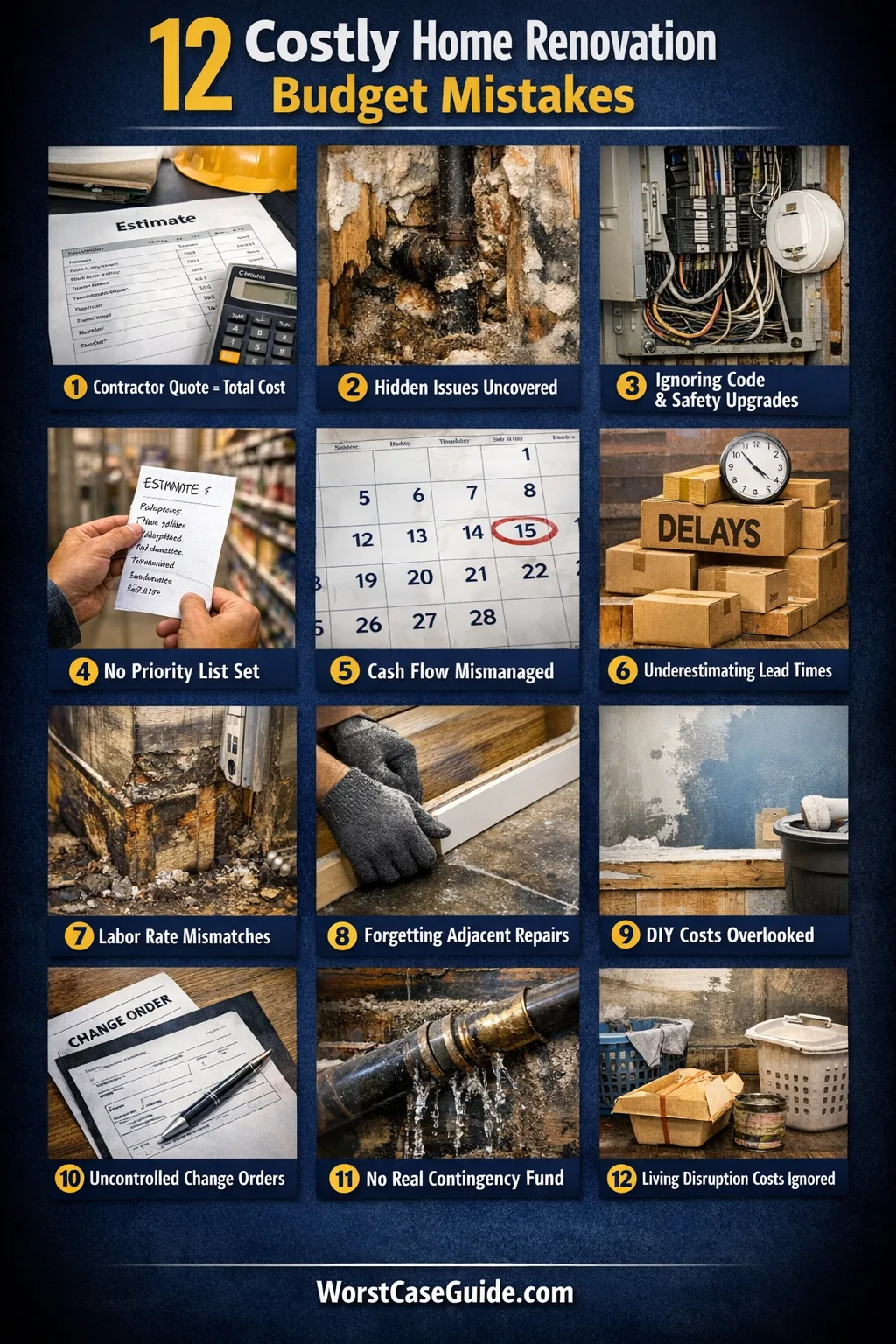
Mistake 1: Treating The Contractor Quote As “All-In”
Why it happens: Quotes feel official. They are written, itemized, and give a sense of closure. People also underestimate how many costs sit outside the main scope, like disposal, patching adjacent areas, and temporary protections. The quote becomes a mental ceiling rather than a starting point.
Early warning signs:
- Line items say “by owner” or “not included” in multiple places.
- There is no detail for prep work, removal, or clean-up.
- Unclear responsibility for permits or inspections.
Worst-case outcome: The project is “on budget” inside the quote but over budget overall. Cash runs short near the end, when the remaining items are the ones that make the space usable: trim, paint, hardware, fixtures. The home becomes half-finished and more costly to complete later.

A safer approach: A separate “project total” bucket can help: quote + known extras (permits, disposal, protection, delivery) + unknowns. If the quote is the core, the total budget is the system boundary. That boundary is what needs protection.
Mistake 2: Underestimating Demolition And Discovery Costs
Why it happens: Demolition looks like subtraction. In real homes, it is often investigation. Opening walls and floors can reveal moisture, rot, outdated wiring, uneven framing, or prior DIY work. These are not “upgrades.” They are requirements.
Early warning signs:
- The home has a history of leaks, odors, or recurring paint/bubbling issues.
- Floors feel springy or uneven.
- Previous renovations show mismatched materials or patchwork fixes.
Worst-case outcome: Discovery work creates a sudden cost spike early in the project. Because it is early, it can drain cash before the visible improvements arrive. That makes every later choice more constrained, often forcing cheap substitutes that do not match the intended durability.
A safer approach: Treat demolition as a decision gate. If you are in a situation where hidden conditions are plausible, budgeting a discovery buffer and planning for “pause and reassess” after demo can reduce the chance of committing to finishes before the underlying condition is known.
Mistake 3: Not Budgeting For Code, Safety, And Compliance Upgrades
Why it happens: People budget for what they can see: cabinets, flooring, fixtures. Code and safety requirements are invisible until a trade points them out. Sometimes the cost appears as a “small” upgrade that actually triggers a chain: panel capacity, grounding, venting, smoke/CO detectors, GFCI/AFCI protection. These add up quickly, especially when access is limited.
Early warning signs:
- Old electrical panel, frequent tripping, or limited circuits.
- Bathrooms/kitchens with weak ventilation or condensation.
- Contractor mentions “we will see what inspection says” instead of a clear plan.
Worst-case outcome: The project is forced into a compliance path mid-stream. Work pauses for approvals or rework. The home is disrupted longer, and costs rise because trades must return, not because materials are expensive. The budget loses predictability.
A safer approach: A compliance line item can be treated like insurance against schedule damage: it exists to prevent surprise stop-work moments. In larger systems (full remodels), it is often safer to treat compliance as a core scope, not an optional add-on.
Mistake 4: Mixing “Must-Haves” And “Nice-To-Haves” In One Undifferentiated Budget
Why it happens: Budgets are frequently built as a single list of items. When costs rise, the easiest way to cope is to reduce quality in random places, not to make planned trade-offs. Without tiers, every cost feels equally important, and decisions get made under pressure.
Early warning signs:
- No written definition of minimum acceptable outcomes.
- Finishes chosen by emotion first, with no fallback.
- The same budget line is expected to cover both functionality and “upgrade” aesthetics.
Worst-case outcome: The project ends with an inconsistent result: critical items were compromised (durability, waterproofing, layout) to protect visible upgrades. Later, repairs are needed, and the “upgrade” becomes a cost amplifier because it sits on top of weak fundamentals.
A safer approach: A tiered budget can reduce panic decisions: “must-have baseline,” “preferred,” and “stretch.” If you are in a smaller project, this can be a short list. In larger renovations, the tiers can be explicit for each room or subsystem.
Mistake 5: Ignoring Cash Flow Timing And Payment Milestones
Why it happens: People plan the total amount but forget the timing. Contractors may require deposits, progress payments, and final payments. Materials might need to be paid upfront. If the cash is tied up elsewhere, the project can stall even when the total budget is technically enough.

Early warning signs:
- Unclear schedule for deposits and draws.
- Large material purchases needed before demolition is complete.
- Relying on “I’ll move money later” without a firm timeline.
Worst-case outcome: Work stops at the worst time: after demolition, before rebuild. Living conditions degrade (dust, noise, unusable spaces). Restarting often costs more because trades re-sequence other jobs and return later. The budget absorbs inefficiency fees rather than progress.
A safer approach: A payment calendar can sit next to the budget. The goal is not complexity; it is avoiding a liquidity trap. If you are using financing, aligning approval timelines with milestone dates can reduce last-minute stress.
Mistake 6: Assuming Availability And Lead Times Will Behave Normally
Why it happens: Planning often assumes materials are readily available and deliveries are predictable. In reality, certain items (custom cabinetry, specialty tile, specific fixtures) can have long lead times. Late arrivals change sequencing. Then the budget takes a hit from temporary solutions, extended labor, storage, or paying to expedite shipping.
Early warning signs:
- Key items are chosen late or “to be decided.”
- Suppliers give ranges instead of firm dates.
- Contractor schedule depends on one critical item.
Worst-case outcome: The timeline expands, and costs rise in a way that feels unfair because nothing “extra” was added. The budget is consumed by time: extra site visits, re-mobilization, and living adjustments (temporary kitchen, storage, alternative lodging in some cases).
A safer approach: Identifying “long-lead” items early can act like risk control. In larger systems, it can help to budget for schedule variance explicitly, because time is a cost multiplier.
Mistake 7: Underpricing Labor By Comparing Apples To Oranges
Why it happens: Labor pricing is hard to compare because scope definitions differ. One bid includes prep, protection, and cleanup; another does not. One includes skilled finishing work; another assumes minimal finish quality. People often compare totals without comparing scope clarity and quality thresholds.
Early warning signs:
- Bids vary widely and nobody can explain why.
- One proposal is very short, with vague language like “install as needed”.
- The cheaper bid has multiple exclusions that feel “minor” but are actually labor-heavy.
Worst-case outcome: The project starts cheap and becomes expensive through change orders. The homeowner loses negotiating leverage because the home is already opened up. The budget then pays a premium for “making it right,” not for improved outcomes.
A safer approach: Comparing bids can be safer when each is mapped to the same scope checklist. If you are in a smaller project, even a one-page checklist can reduce confusion. In larger renovations, scope alignment is often the difference between stable costs and budget drift.
Mistake 8: Forgetting The Cost Of Adjacent Repairs And “Blend Work”
Why it happens: Home improvement rarely touches a perfectly isolated area. New flooring changes baseboards; new cabinets expose wall damage; new paint highlights old trim. Matching existing materials can be harder than replacing them. These “blend costs” are easy to omit because they feel like small details until the end.
Early warning signs:
- Scope assumes “leave the rest as-is” without considering transitions.
- Existing materials are discontinued or hard to match.
- The plan touches multiple surfaces (floor, wall, ceiling) but only budgets one.
Worst-case outcome: The project technically finishes, but the result looks patched. Fixing the look requires additional scope later, often at higher cost because trades must return for small, inefficient tasks. This can also create a “never ends” feeling where the budget is leaking over months.
A safer approach: A transition checklist (edges, trim, paint touch-ups, thresholds, hardware, caulk, finishing) can make these costs visible early. If you are aiming for a consistent look, budgeting for blending may be part of choosing realism over surprise.
Mistake 9: Treating DIY As “Free” In The Budget
Why it happens: DIY is often budgeted as zero because it does not produce an invoice. But DIY consumes time, tools, learning curve, and sometimes rework. It can also affect sequencing: if a professional trade is waiting on a DIY step, the delay turns into paid downtime or rescheduling costs.
Early warning signs:
- DIY tasks are not scheduled, only “whenever I can.”
- Tools or materials are not listed as costs.
- DIY tasks sit on the project’s critical path (drywall finishing, tile waterproofing, electrical terminations).
Worst-case outcome: DIY becomes the bottleneck. The home stays disrupted longer, and professional labor costs rise because trades revisit the site. Sometimes DIY rework is needed after professional inspection or after defects appear. The budget takes double hits: time and correction.
A safer approach: A more realistic DIY budget can include tools, waste, and a buffer for learning mistakes. If you are using DIY to protect the budget, placing DIY tasks off the critical path can reduce the chance that time becomes the hidden cost.
Mistake 10: Not Setting A Clear Change-Order Rule Before Work Starts
Why it happens: Many changes feel small in isolation: move a light, add an outlet, change tile, adjust a cabinet. In construction, “small” changes often trigger rework, extra trips, and material adjustments. Without a rule, changes get approved in the moment and the budget drift is only noticed when the cash is gone.
Early warning signs:
- Decisions are made verbally with no written cost impact.
- There is no threshold for “pause and price it first.”
- Multiple “tiny” changes happen in a week.
Worst-case outcome: The budget is consumed by invisible upgrades. Then the project reaches a point where necessary items must be cut to pay for changes already installed. The result can be a home with upgraded details but compromised fundamentals, or a project that stalls near completion.
A safer approach: A change-order rule can be a simple policy: changes get priced and written before approval, and a running total is maintained. In larger renovations, a dedicated change budget can keep the main scope protected.
Mistake 11: Using A Single Contingency Percentage Without Thinking About Risk Drivers
Why it happens: People hear “add a contingency” and choose a number. But contingency needs context. A cosmetic paint job has different risk drivers than a bathroom remodel involving waterproofing and unknown plumbing conditions. A single percentage can be too small where risks are concentrated, and excessive where they are not.
Early warning signs:
- Contingency is chosen because it “sounds right,” not because risks were identified.
- High-uncertainty areas (demo, mechanicals) have no extra buffer.
- Multiple unknowns exist but the plan assumes only one will occur.
Worst-case outcome: Contingency is spent quickly on early surprises, leaving nothing for later unknowns. Then the budget relies on cutting corners or pausing the project. The plan fails not because contingency was absent, but because it was not aligned to where risk lives.
A safer approach: Contingency can be split: a discovery buffer (demo/unknown conditions) and a decision buffer (changes/finish selections). If you are in a situation with high uncertainty, separating these can reduce the chance that one risk consumes all flexibility.
Mistake 12: Planning Only For The Build Cost And Not For Living Disruption Costs
Why it happens: Budgets focus on construction invoices. Living disruption feels temporary and hard to price: eating out, laundry, storage, pet boarding, time off work, extra cleaning. These are real costs that can strain cash flow even if the construction number stays stable.
Early warning signs:
- The project affects kitchens, bathrooms, or bedrooms but the plan assumes normal routines.
- No plan for dust control, storage, or temporary setups.
- Schedule estimates do not include time for inspections or trade gaps.
Worst-case outcome: Household stress becomes a budget problem. Decisions get rushed to “end it,” leading to expensive short-cuts and mistakes. In some cases, temporary living costs become large enough to force compromises on permanent materials or workmanship.

A safer approach: A parallel “life budget” can help: a small, realistic allowance for disruption costs. If you are in a smaller project, it might be minimal. If the project disables core rooms, this category can be a meaningful part of protecting the main budget.
A Simple Table To Spot Where The Budget Is Most Fragile
| Budget Area | What Makes It Risky | Common Hidden Costs | Safer Planning Signal |
|---|---|---|---|
| Demolition | Reveals unknown conditions | repairs, remediation, structural fixes | A planned “pause point” after demo |
| Mechanical/Code | Triggers mandatory upgrades | panel work, venting, safety devices | Scope includes compliance explicitly |
| Finishes | Late choices create rush costs | expedites, substitutions, rework | Long-lead items selected early |
| Transitions | “Blend work” is easy to forget | trim, paint matching, thresholds | A finishing checklist exists upfront |
| Schedule | Time multiplies cost across trades | remobilization, storage, disruption | Payment + lead time calendar is defined |
Practical “Worst-Case” Framing Without Panic
A useful version of worst-case thinking is: “If one major unknown appears and two minor ones stack on top of it, what part of the budget breaks first?” This keeps the focus on budget fragility, decision timing, and livability, rather than imaginary catastrophes.
General Risk Patterns That Show Up Across Most Renovations
- Hidden-condition risk clusters around demolition, moisture, and older systems. These costs arrive early and feel sudden.
- Time becomes money when sequencing breaks. A delayed item rarely stays isolated; it causes revisits and rescheduling.
- Scope ambiguity creates change orders. Not because anyone is dishonest, but because the plan did not define boundaries clearly.
- Visible upgrades can starve fundamentals when the budget is a single pot with no tiers.
- Cash flow failures are often misread as “budget failures.” The total may be sufficient, but timing breaks the project.
FAQ
How can a budget go over without adding any new features?
Cost increases often come from time expansion and rework, not added features. If lead times slip, inspections delay progress, or scope is unclear, labor costs rise through extra visits, re-mobilization, and inefficient scheduling. The visible outcome looks the same, but the path to reach it became more expensive.
What budget categories are most likely to be forgotten?
Frequently missed categories include disposal, site protection, permits, finishing items (trim, caulk, paint touch-ups), and “blend work” where new and old surfaces meet. Living disruption costs can also be underestimated when kitchens, bathrooms, or bedrooms are affected.
Is contingency always necessary for small home improvement projects?
In very predictable work, contingency may be minimal. It becomes more important when a project involves demolition, waterproofing, older electrical/plumbing, or unknown substrates. The need is less about project size and more about whether costs can jump due to hidden conditions.
How can payment schedules create budget problems even if the total budget is enough?
If deposits, progress payments, and material purchases cluster early, cash can run short at the moment work needs to continue. That can force pauses after demolition, when the home is less usable. The cost impact often comes from stoppage, rescheduling, and inefficient restarts.
What is a realistic way to compare contractor bids without getting tricked by missing scope?
Comparisons are safer when bids are mapped to the same scope checklist: demolition, protection, prep, materials, installation, finishing, cleanup, permits, and inspection handling. Large price gaps often come from differences in scope detail, not just labor rates. A short written scope can reduce misunderstandings and surprise change orders.