Hiring feels reversible until it isn’t. A small business can recover from a slow week, but a bad hire often creates compounding damage: missed deadlines, stressed teammates, and decisions made under pressure. The risk is not “one mistake.” It’s a chain of small assumptions that quietly turns the hiring process into a high-stakes bet.
Most hiring problems in smaller teams come from limited time, unclear roles, and informal decision-making. In a five-person company, one mismatch can shift how everyone works. In a twenty-person company, the same mismatch can normalize low standards and process shortcuts that become harder to unwind.
Why Hiring Is Risky For Small Businesses
Hiring is risky because the cost of being wrong is rarely limited to payroll. A role mismatch can affect customer trust, product quality, and the team’s internal pace. Many small businesses also have fewer “buffers” (extra capacity, HR support, deep bench), so the downside of a wrong decision appears faster and lasts longer.
- Small teams amplify variance — one person can change how work feels day-to-day.
- Responsibilities shift — jobs evolve, but expectations often stay vague.
- Hiring decisions are sticky — undoing them can be slow, awkward, and disruptive.
Common False Assumptions That Create Hiring Mistakes
Many hiring issues begin with reasonable-sounding assumptions that fail under real workload. The goal here is not to be pessimistic; it is to notice when confidence is built on missing information.
- “A good resume means good performance in our environment.”
- “We’ll figure out the role once the person starts.”
- “Culture fit is obvious in a conversation.”
- “Urgency justifies skipping steps.”
- “If it doesn’t work out, it’s easy to reverse.”
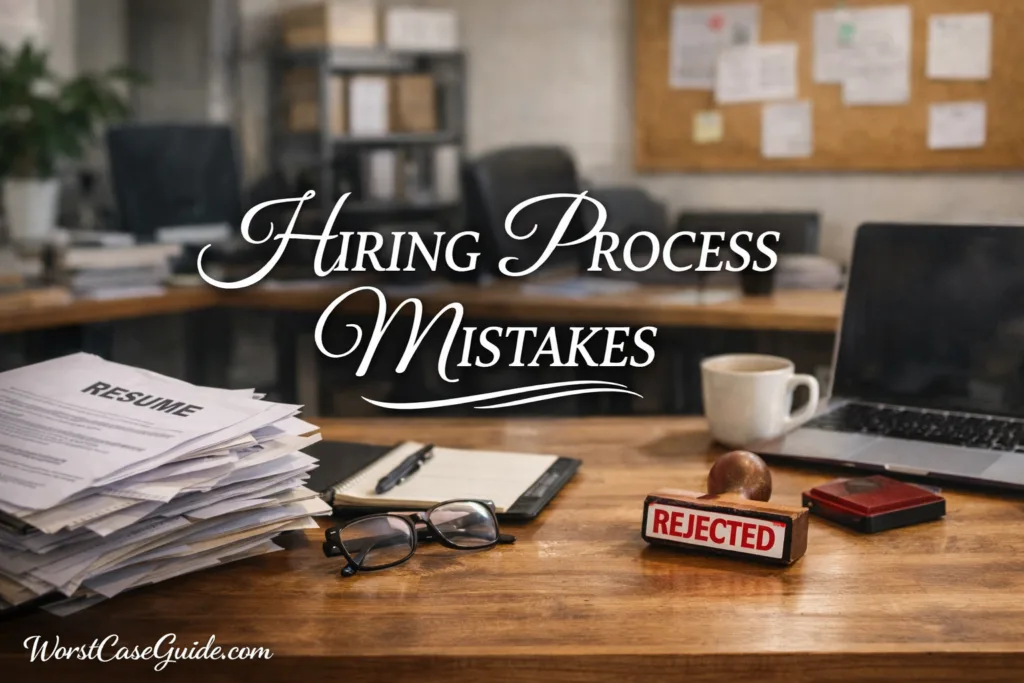
Hiring Process Mistakes That Hurt Small Businesses
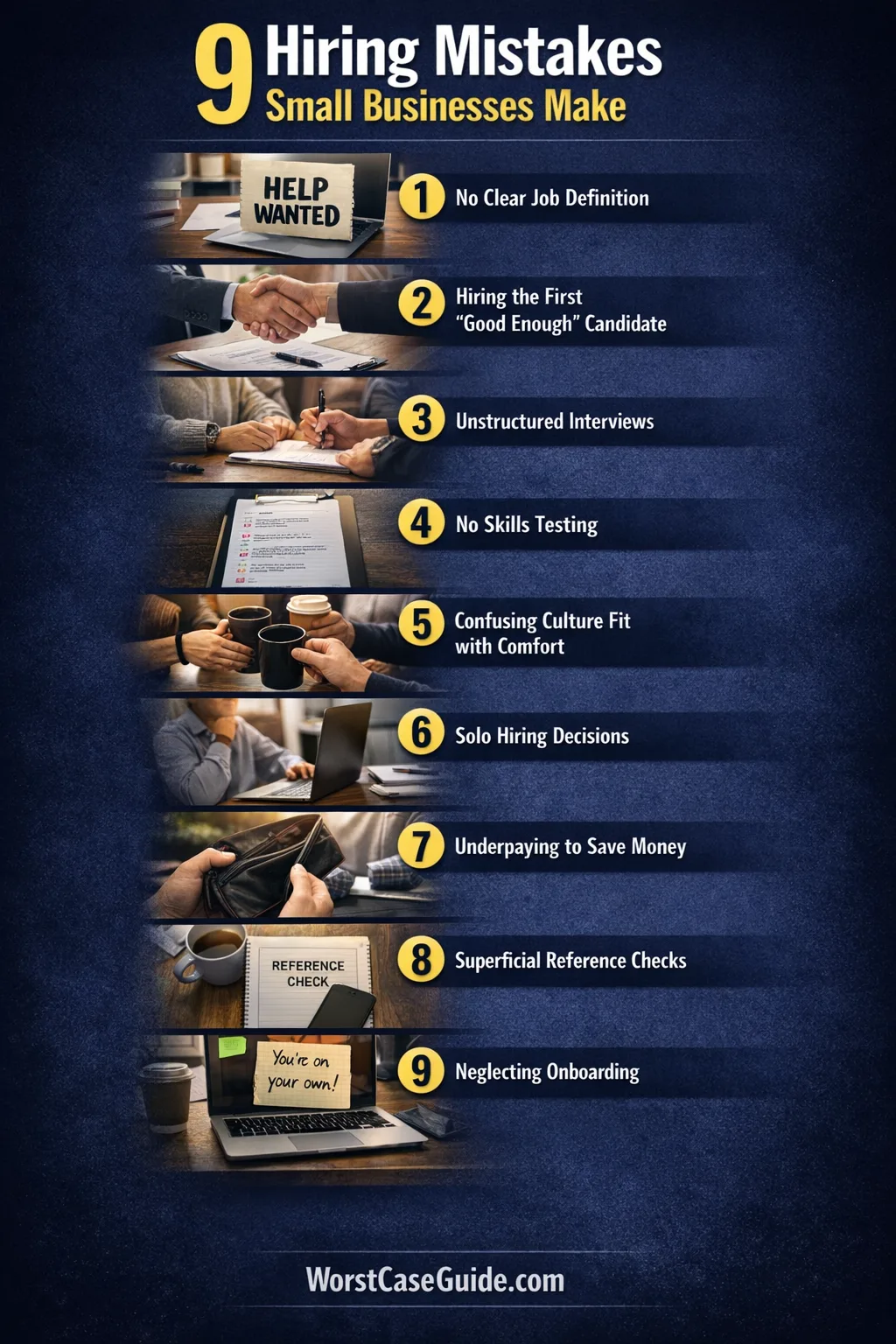
Below are nine common hiring process mistakes that can produce avoidable downside. Each one includes what tends to cause it, early signals, a realistic worst-case outcome, and a safer approach that keeps decisions more testable and reversible.

Mistake 1: Hiring Without A Sharp Problem Statement
When the role is described as “help,” the hiring decision is based on hope rather than a clear problem. That often leads to misalignment on priorities, ownership, and what “good” looks like.
Why It Happens
A workload spike creates time pressure, and the business treats hiring like a capacity plug. The real pain (handoffs, missed QA, slow sales follow-up) stays unnamed, so the role stays fuzzy.
Early Warning Signs
- Job posts contain wide responsibilities with no priorities.
- Interviewers describe success using vibes instead of outcomes.
- Different stakeholders expect different deliverables.
Worst-Case Outcome
The business hires someone who is competent but solves the wrong problem. Work gets done, yet the original bottleneck remains. After a few months, the team is managing confusion and rework on top of the old workload.
A Safer Approach
A safer approach is to define the role as a set of outcomes tied to one or two business constraints (speed, quality, customer follow-up). If the role is new, it can help to treat the first 30–60 days as an explicit discovery period with observable deliverables.
Mistake 2: Treating The First “Good” Candidate As The Answer
Small businesses often stop searching once a candidate feels acceptable. That can turn hiring into a relief purchase instead of a comparative decision.
Why It Happens
When backlog pressure is high, the brain optimizes for closure. The team also may not have a consistent pipeline, so each candidate feels like a rare chance that must be taken.
Early Warning Signs
- Language shifts from evaluation to “let’s just move.”
- Interview questions become lighter over time.
- There is no agreed bar for “yes.”
Worst-Case Outcome
The hire works out “okay” but drags overall performance down through slow execution and extra supervision. Over time, the company pays twice: once in payroll, and again in lost momentum.
A Safer Approach
A safer approach is to keep at least a small comparison set—even two or three candidates—so “good” can be judged against alternatives. In urgent roles, a time-boxed search with a minimum bar can keep speed without sacrificing standards.
Quiet risk: When hiring becomes a race to stop the pain, the process often “feels faster” while becoming less predictive. The damage shows up later, when reversal is socially and operationally harder.
Mistake 3: Using Unstructured Interviews That Reward Confidence
Unstructured interviews often select for storytelling rather than relevant problem-solving. In smaller teams, this can produce high-confidence mismatches that are hard to spot until work starts.
Why It Happens
Structured interviews take preparation, and many small businesses rely on “conversation” as a proxy for fit. Interviewers also vary in experience, so they default to improvised questions that feel natural but have low signal.
Early Warning Signs
- Different candidates get different questions, making comparisons weak.
- Feedback uses personality words more than evidence.
- “They seem smart” replaces job-relevant examples.
Worst-Case Outcome
A persuasive candidate is hired, but daily work reveals gaps in execution, follow-through, or collaboration. The team then spends weeks converting “potential” into results while deadlines keep moving.
A Safer Approach
A safer approach is to use a repeatable set of questions tied to the role’s outcomes, and to record specific evidence rather than overall impressions. Even a simple rubric can make the decision more consistent across interviewers.
Mistake 4: Skipping Work-Sample Tests For “Trust-Based” Hiring
Resumes and interviews show how someone describes work. A work sample shows how they do work. When small businesses skip this step, they often learn about real capability only after onboarding.
Why It Happens
Teams worry about effort burden, fairness, or timeline. There may also be a belief that a work sample is only for technical roles. In practice, most roles have a representative task that can be tested in a bounded way.
Early Warning Signs
- Final decisions hinge on references and “gut feel.”
- Interviewers disagree but have no shared proof.
- Role-critical skills are assumed to be “learnable later.”
Worst-Case Outcome
The new hire cannot deliver the work at the expected level, creating hidden rework and missed commitments. The team then compensates by over-functioning, which can lead to burnout patterns.
A Safer Approach
A safer approach is a short, role-relevant work sample with clear instructions and a defined time window. It can be framed as a way to reduce uncertainty for both sides, and to align expectations on quality and decision-making.
Mistake 5: Confusing Culture Fit With Comfort Fit
Culture fit becomes risky when it means “someone we instantly like.” Comfort fit can exclude candidates who would raise standards, ask better questions, or work differently in a productive way. In small companies, this can lock in narrow thinking.
Why It Happens
Hiring decisions are social, and small teams want harmony. When there’s stress, “easy to talk to” can be mistaken for effective under pressure. Without explicit values, culture fit becomes a personality filter.
Early Warning Signs
- Feedback emphasizes “we clicked” more than role evidence.
- Disagreement is seen as negative instead of informative.
- “Not our vibe” appears without clear criteria.
Worst-Case Outcome
The company builds a team that feels cozy but avoids conflict, feedback, and accountability. Over time, performance issues become socially untouchable, and the business struggles to scale beyond a friend-group operating model.
A Safer Approach
A safer approach is to define culture as behaviors that matter for the work (ownership, candor, reliability), not as shared tastes. If the role requires healthy debate, it can help to notice how a candidate handles disagreement and ambiguity.
Mistake 6: Making Hiring A One-Person Decision
When a single person owns the decision end-to-end, the process becomes vulnerable to blind spots. In small businesses, that often means the founder’s preferences substitute for role reality and team needs.
Why It Happens
There may be no HR function, and leaders feel responsible for speed and quality. In practice, speed can also push toward centralized control, especially when the role touches multiple functions and the business wants “one clear owner.”
Early Warning Signs
- Others are asked for “thoughts” but not structured feedback.
- The decision-maker dominates interviews, limiting signal variety.
- Trade-offs are not written down, so the “why” stays implicit.
Worst-Case Outcome
The hire fits the decision-maker but clashes with the day-to-day collaborators. The team then spends energy navigating friction and politics, and the business quietly loses execution speed.
A Safer Approach
A safer approach is a small panel with defined roles: one person evaluates core skills, another checks collaboration, another checks operational reliability. It can help when the final decision is still owned by one person, but based on consistent inputs and written criteria.
Mistake 7: Optimizing Compensation For Cost Instead Of Risk
Small businesses often have real budget limits. The risk appears when compensation is treated as a simple expense rather than a risk-control lever. Underpaying can invite candidates who accept quickly but leave when expectations collide with reality.
Why It Happens
Cash management is tight, and there is pressure to keep fixed costs low. Sometimes the business also assumes that mission or “growth opportunities” will compensate for below-market offers. That assumption is not stable when workload is heavy and the learning curve is steep.
Early Warning Signs
- Strong candidates decline quickly without negotiating.
- Accepted candidates ask repeated questions about scope and hours.
- Hiring relies on “we’ll adjust later,” without a clear path.
Worst-Case Outcome
The business hires someone who is under-qualified for the role’s real demands, or who leaves once they see the workload. Either way, the company loses time, incurs re-hiring churn, and risks a reputation hit among candidates.
A Safer Approach
A safer approach is to connect compensation to role risk: urgency, responsibility, and the cost of failure. If budget is limited, it can help to make the trade-offs explicit (scope, seniority, timeline) so the agreement is clear rather than optimistic.
| Hiring Choice | Hidden Risk It Often Adds | What It Can Look Like Later |
|---|---|---|
| Lower pay to “save budget” | Higher churn and weaker candidate pool | Re-hiring, delayed projects, team fatigue |
| Over-broad role for one person | Burnout and unclear ownership | Work stalls, priorities shift weekly |
| Fast acceptance as a positive signal | Low evaluation and quick regret | Performance issues emerge after onboarding |
Mistake 8: Weak Reference Checks That Confirm What You Already Believe
Reference checks are often treated as a formality. When they are vague, they mainly confirm a decision that has already been made. In small businesses, this increases the chance of missing pattern-level issues like reliability, conflict style, or follow-through.
Why It Happens
People feel awkward asking hard questions, and references tend to be positive by default. Under time pressure, the business asks for general feedback instead of role-specific signals, then interprets politeness as endorsement.
Early Warning Signs
- Questions are broad (“How were they?”) instead of behavioral.
- References are all chosen by the candidate, with no attempt to balance.
- Negative hints are brushed off as “just one person.”
Worst-Case Outcome
Known issues (missed commitments, poor collaboration, inconsistent output) show up again. The business then has to manage a problem that could have been anticipated, while the team feels misled and less trusting of leadership judgment.
A Safer Approach
A safer approach is to ask role-linked questions that surface patterns: reliability under pressure, response to feedback, ownership boundaries. It can also help to listen for what isn’t said, and to treat unclear answers as a prompt for more signal, not as reassurance.
Mistake 9: Onboarding As “Here’s Slack, Good Luck”
A strong hire can still fail inside a weak system. When onboarding is informal, the business leaves performance to personal improvisation, and then misreads confusion as incompetence. For small teams, this is an expensive way to discover process gaps.
Why It Happens
Everyone is busy, documentation is thin, and the company expects the new hire to “figure it out.” Sometimes leaders also avoid onboarding structure because they worry it feels corporate. In reality, basic structure often protects speed and clarity.
Early Warning Signs
- No written “first 2–4 weeks” expectations exist.
- Access, tools, and approvals are handled reactively.
- Feedback shows up only when something goes wrong.
Worst-Case Outcome
The new hire builds the wrong mental model, delivers work that doesn’t match standards, and begins to disengage. The business then faces quiet underperformance or early turnover, while the team’s trust in hiring decisions weakens.
A Safer Approach
A safer approach is a lightweight onboarding plan with named owners, key processes, and a few early deliverables that reveal how work is done. Short check-ins can keep assumptions visible and reduce the chance that small confusion becomes systemic drift.
Risk Patterns That Show Up Across These Mistakes
Different hiring mistakes often share the same underlying shape: uncertainty gets replaced with confidence too early. The business then learns the truth later, when the cost of adjustment is higher.
- Speed without signal: faster steps, fewer facts, more regret.
- Vibes over evidence: pleasant conversations stand in for job performance.
- Ambiguity debt: unclear scope becomes conflict, rework, and stalled ownership.
- Single-point judgment: one perspective dominates, blind spots widen.
- Late feedback loops: onboarding lacks checkpoints, so issues compound quietly.
FAQ
How many interview rounds are “enough” for a small business?
It depends on role risk and how much can be learned per step. Many small teams aim for a small number of rounds that each produce different signal: role skills, collaboration style, and reliability. If the rounds feel repetitive, that often signals low structure rather than high confidence.
What is a fair work-sample test without overburdening candidates?
A fair test is usually short, role-relevant, and easy to understand. It can mirror a real task but remain bounded in time and scope. Clarity helps both sides: the candidate knows what “good” looks like, and the business gets comparable output rather than impressions.
Is “culture fit” always a bad idea?
Culture fit can be useful when it means alignment on work behaviors (ownership, communication norms, reliability). It becomes risky when it means comfort or similarity. The safer version tends to describe culture using observable behaviors and examples, not personal taste.
What if hiring has to happen fast due to a sudden workload spike?
Speed usually improves when the process is simpler and more structured, not when it is looser. A time-boxed search with a clear minimum bar can preserve urgency while reducing avoidable risk. The key is to keep at least one step that produces job-relevant evidence.
How can a small team reduce bias if there is no HR function?
Bias often shrinks when decisions rely on consistent criteria and shared evidence. A simple rubric, a small interview panel, and written notes can reduce reliance on first impressions. The goal is not perfect objectivity, but a process that is repeatable and easier to audit later.