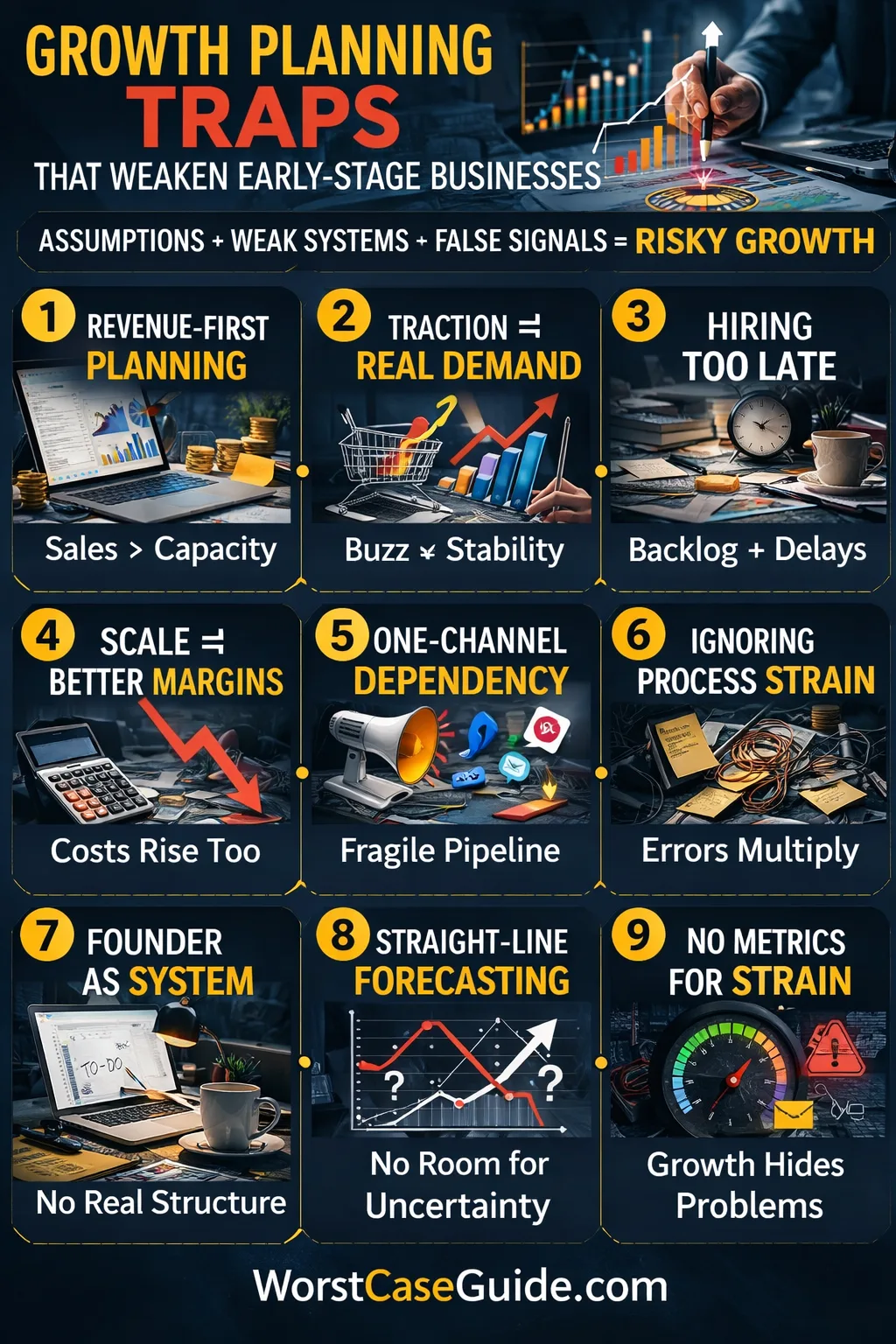
Growth planning in an early-stage business can look tidy on a spreadsheet and still fail in real life. That gap appears when assumptions harden into plans, when capacity is guessed, or when a team starts treating early traction as proof of repeatable demand. The risk is rarely one dramatic decision. It is usually a chain of small planning errors that quietly stack up until cash, service quality, team focus, or customer trust starts to slip.
Some founders plan for growth as if speed alone will solve weak systems. Others stay too cautious and miss the moment when their business needs more structure. Both can create the same problem: growth arrives in a shape the business was not built to handle.
Why This Topic Gets Risky Early
Early-stage businesses often make plans with limited data, uneven staffing, and a product that is still changing. That is normal. The issue starts when uncertainty is treated like certainty (a small but expensive switch in thinking).
Common Assumptions That Distort Growth Planning
- If demand rises, operations will somehow catch up. Demand and delivery do not scale at the same pace.
- If revenue is growing, margins will stay healthy. Growth can hide rising service costs, refunds, or support load.
- If one channel works now, it will keep working later. Early wins are often narrow and fragile.
- If the team is coping, the system is fine. Sometimes people are carrying weak processes on their backs.
- If a forecast looks realistic, it must be grounded. A neat model can still be built on soft numbers.
| Planning Mistake | What It Usually Looks Like Early | Where Damage Often Appears First |
|---|---|---|
| Planning From Revenue Only | Sales targets rise faster than delivery capacity | Service quality, customer wait time, team fatigue |
| Hiring Too Late | Founders keep covering specialist work themselves | Execution delays, errors, missed follow-up |
| One-Channel Dependency | A single acquisition source drives most leads | Pipeline volatility, sudden slowdowns |
| Ignoring Process Strain | Manual work grows in the background | Ops failures, inconsistent customer experience |
| Treating Early Demand As Stable | Short-term interest is modeled as durable demand | Inventory, staffing, budget allocation |
9 Growth Planning Mistakes in Early-Stage Businesses
Mistake 1: Planning Growth Around Revenue Instead of Capacity
Why it happens: Revenue is visible, exciting, and easy to model. Capacity is messier. It includes team time, tools, onboarding speed, fulfillment limits, support workload, and founder attention. Many early-stage teams build growth plans around the number they can see and not the system that has to absorb it.

Early warning signs: Delivery times start drifting. Support tickets sit longer. Founders step in to patch small issues every day. New customers arrive, but the team begins whispering the same sentence: “We can manage for now.”
Worst-case result: The business keeps selling while quality quietly drops. Refunds rise, retention weakens, and growth turns into a leaky bucket. Not a collapse, maybe, but a very avoidable loss of trust.
A safer approach: A growth plan tends to hold up better when it ties revenue targets to real operating limits. In smaller teams, that may mean mapping founder bottlenecks. In larger early systems, it often means checking support, fulfillment, and handoff load before pushing demand higher.
Mistake 2: Treating Early Traction as Proof of Repeatable Demand
Why it happens: Early traction feels like validation because sometimes it is. Still, not all traction is stable. It may come from novelty, founder networks, one-off referrals, launch timing, or a narrow customer group that is easier to win than the next one.
Early warning signs: New sales depend on a few unusually responsive sources. Conversion rates vary a lot from month to month. The team can describe what worked, but not why it worked again and again.
Worst-case result: Hiring, spend, or stock decisions get built on demand that does not repeat. The business grows its fixed costs first, then discovers the market signal was thinner than it looked.
A safer approach: Growth plans become more durable when they separate interest from repeatable demand. If you are in a product-led model, that may mean watching retention and usage before scaling spend. If you are in a service business, it often means checking whether demand survives beyond personal relationships or launch buzz.
Mistake 3: Hiring Only After the Team Is Already Overloaded
Why it happens: Early-stage businesses try to stay lean. Fair enough. The problem shows up when “lean” slowly becomes late. By the time a role feels fully justified, the backlog, customer delay, and internal stress may already be shaping bad habits.
Early warning signs: Work gets reassigned every week. Founders keep doing tasks they meant to hand off months ago. New hires, when they finally join, land in confusion because processes were never made visible.
Worst-case result: The business hires reactively into chaos. People arrive, but productivity does not rise fast enough because the role is unclear, the tools are messy, and knowledge is still trapped in one or two heads.
A safer approach: It often helps to plan around role pressure points, not just budget. In smaller projects, a part-time or specialist support layer may ease the strain. In larger systems, the better question is often whether work is ready to be handed over at all.
Mistake 4: Assuming Unit Economics Will Improve Automatically With Scale
Why it happens: There is a common belief that more volume will smooth everything out. Sometimes it does. Sometimes scale adds more support burden, more exceptions, more software costs, and more customer acquisition pressure. Growth can act like a magnifying glass. It makes the faint lines easier to see.
Early warning signs: Revenue rises while margins stay flat or slip. Support costs per customer do not fall. Discounts become easier to offer than process improvements.
Worst-case result: The business celebrates growth that looks healthy from the top line and weak from almost every other angle. Cash gets tighter at the exact moment the company believes it is moving forward.

A safer approach: Growth assumptions are more reliable when they include a few grounded cost scenarios. Not one. A few. That matters even more when the business has high service touch, custom work, or complicated onboarding.
Mistake 5: Building the Plan Around One Acquisition Channel
Why it happens: One channel works, so the business leans harder into it. That is understandable. Early-stage teams do not have time to spread themselves across everything. Still, a single-channel growth plan can be brittle in ways that stay hidden until performance shifts for reasons outside the team’s control.
Early warning signs: Most leads come from one source. Reporting focuses on volume, not resilience. A small dip in channel performance changes the whole monthly picture.
Worst-case result: Pipeline instability starts controlling planning decisions. Hiring pauses, spend gets cut too fast, and the business begins reacting to noise because it has no second signal to compare against.
A safer approach: In an early-stage context, “diversified” does not need to mean wide. It may simply mean one main channel, one supporting channel, and one slower channel that helps test whether demand is broader than the first data suggests.
Mistake 6: Ignoring Process Debt While Chasing New Demand
Why it happens: Process work can feel less urgent than growth work because it rarely produces an immediate visible win. So teams postpone it. A little more demand first, then tidying later. That sounds efficient until the business becomes a house with neat paint and loose wiring.
Early warning signs: The same manual fixes appear every week. Customer information lives in too many places. Handoffs depend on memory. People ask each other for status updates that the system should already show.
Worst-case result: Growth multiplies errors faster than the team can correct them. Customers see inconsistency. Staff spend more time chasing details than doing actual value-adding work.
A safer approach: A steadier plan usually leaves room for process repair before the next growth push. In service businesses, that may mean documenting handoffs and exceptions. In digital systems, it often means tightening tracking, permissions, and ownership before volume rises.
Mistake 7: Confusing Founder Effort With Business Capacity
Why it happens: Founders often bridge the gap between what the business can do and what it promises. That is normal early on. The planning mistake appears when those extra hours get treated as part of the system rather than a temporary patch.

Early warning signs: Important relationships, approvals, or fixes still depend on one person. Time off feels risky. The plan assumes the same intensity can continue for another quarter, then another.
Worst-case result: The business looks scalable on paper and remains founder-dependent in practice. One illness, one personal disruption, or one bad month can expose how little capacity was actually built.
A safer approach: Plans tend to be more honest when founder effort is treated as unstable capacity. If you are in this situation, the useful question is not only “Can this be done?” but also “Can this be done without the same person holding every thread together?”
Mistake 8: Forecasting in One Straight Line
Why it happens: Linear forecasts are neat. Real growth is not. Early-stage demand can stall, jump, flatten, or arrive in bursts that stress operations unevenly. A single-line projection can make uncertainty look tidier than it is.
Early warning signs: Plans assume stable conversion, stable sales cycles, and stable delivery times even though recent data swings around. Targets get revised often, but the model structure never changes.
Worst-case result: The business ends up underprepared for one kind of pressure and overcommitted for another. Too much stock, too little support, too much hiring, too little cash buffer — the mix varies, but the planning weakness is the same.
A safer approach: Growth planning is usually more grounded when it includes a base case, an upside case, and a strained case. That does not remove uncertainty. It simply stops the plan from pretending uncertainty is not there.
Mistake 9: Measuring Growth Without Measuring Strain
Why it happens: Early dashboards often track leads, revenue, and maybe conversion. Useful, yes. Still, those numbers can rise while the business is getting harder to run. Without strain indicators, leadership sees motion but not friction.
Early warning signs: Customer wait time rises. Rework becomes common. Churn discussions happen late. Staff keep solving “small” recurring issues that never enter the reporting layer.
Worst-case result: The business reaches a point where growth is technically happening and operational health is quietly deteriorating. By the time the damage appears in retention or reputation, repair is slower and more expensive.
A safer approach: A stronger plan usually pairs growth metrics with strain metrics: response time, backlog age, implementation delays, support burden, error rate, or founder dependency. The exact mix changes by business model, but the principle holds up well.
Patterns That Show Up Across Most Growth Planning Errors
- Visibility bias: teams focus on what is easy to count and miss what is harder to see.
- Timing drift: a needed change is noticed, then postponed, then postponed again.
- Local success distortion: one working area gets mistaken for broad business readiness.
- Human patching: people compensate for weak systems until the weakness becomes expensive.
- False stability: short-term patterns get treated as durable planning signals.
A Useful Reading of “Worst Case”
Worst case in growth planning does not always mean failure. Often it means expanding in a way that makes the business harder to run, harder to trust, and harder to fix later. That is the quieter version of risk — and usually the one worth spotting early.

FAQ
Why do early-stage businesses often misread growth signals?
Because early data is often narrow. A few strong months, a founder-led sales push, or a short-term channel win can look like stable demand even when it is not yet repeatable.
Is slow growth safer than fast growth?
Not always. Slow growth can reduce pressure, but it can also delay necessary hiring, process repair, or channel testing. The safer path usually depends on whether the business can see and manage strain as it grows.
What is the most common planning blind spot in a young business?
A common blind spot is treating founder effort as if it were permanent business capacity. That can make a plan look stronger than the system really is.
Can a business grow and still become less healthy?
Yes. Revenue, leads, or customer count can rise while service quality, margins, delivery speed, or team resilience weaken in the background.
How can growth planning become more realistic without becoming overly cautious?
It often becomes more realistic when the plan includes multiple demand scenarios, operating limits, and strain measures rather than relying on one optimistic path.
{
“@context”: “https://schema.org”,
“@type”: “FAQPage”,
“mainEntity”: [
{
“@type”: “Question”,
“name”: “Why do early-stage businesses often misread growth signals?”,
“acceptedAnswer”: {
“@type”: “Answer”,
“text”: “Because early data is often narrow. A few strong months, a founder-led sales push, or a short-term channel win can look like stable demand even when it is not yet repeatable.”
}
},
{
“@type”: “Question”,
“name”: “Is slow growth safer than fast growth?”,
“acceptedAnswer”: {
“@type”: “Answer”,
“text”: “Not always. Slow growth can reduce pressure, but it can also delay necessary hiring, process repair, or channel testing. The safer path usually depends on whether the business can see and manage strain as it grows.”
}
},
{
“@type”: “Question”,
“name”: “What is the most common planning blind spot in a young business?”,
“acceptedAnswer”: {
“@type”: “Answer”,
“text”: “A common blind spot is treating founder effort as if it were permanent business capacity. That can make a plan look stronger than the system really is.”
}
},
{
“@type”: “Question”,
“name”: “Can a business grow and still become less healthy?”,
“acceptedAnswer”: {
“@type”: “Answer”,
“text”: “Yes. Revenue, leads, or customer count can rise while service quality, margins, delivery speed, or team resilience weaken in the background.”
}
},
{
“@type”: “Question”,
“name”: “How can growth planning become more realistic without becoming overly cautious?”,
“acceptedAnswer”: {
“@type”: “Answer”,
“text”: “It often becomes more realistic when the plan includes multiple demand scenarios, operating limits, and strain measures rather than relying on one optimistic path.”
}
}
]
}