Goal setting often looks harmless. It feels organized, rational, even mature. Yet many stalled projects begin with a goal that sounded clear on day one and became fuzzy, heavy, or quietly unworkable by week three. What makes this tricky is simple: progress can stop long before failure becomes visible. The work still looks active. The calendar still fills up. The result just does not move.
That is why goal mistakes matter. In personal planning, team work, and home projects, a weak goal can create the same pattern: wasted effort, false confidence, and late correction. The damage is usually slow, not dramatic. Slow damage is easy to excuse.

Quiet risk: A bad goal does not always look bad at the start. It can look ambitious, well-intended, and still push work in the wrong direction.
Why This Topic Creates Hidden Risk
People usually notice broken tools, missed deadlines, and obvious mistakes. Broken goal design is harder to spot because it sits underneath the work itself. If the goal is too vague, too crowded, or detached from real constraints, effort keeps flowing into a container that cannot hold it. It feels like movement. It is not always progress.
In smaller projects, this can lead to delay and frustration. In larger systems, it can create misalignment, extra meetings, reporting noise, and repeated resets. The goal was supposed to reduce friction. Instead, it becomes the friction.
Common Assumptions That Create Blind Spots
Many stalled goals begin with a few reasonable-sounding assumptions. They sound normal. They are also where trouble often starts.
- “A bigger goal will create bigger effort.” Sometimes it creates avoidance.
- “If the goal feels inspiring, the method can stay loose.” Inspiration fades faster than expected.
- “One clear outcome is enough.” Often it is not enough without an operating rhythm.
- “If progress slows, the problem is discipline.” The design may be the real issue.
- “All goals can sit side by side.” Some goals quietly compete with each other.
| Assumption | What Often Happens | Hidden Cost |
|---|---|---|
| More goals means more momentum | Attention gets split across too many tracks | Slow progress everywhere |
| A goal is clear because it sounds clear | Different people picture different end states | Rework and drift |
| Motivation will carry the hard weeks | Routine is missing when energy drops | Stop-start effort |
| Review can happen later | Problems stay invisible for too long | Late correction |
| Progress will be obvious | Only outcomes are watched, not leading activity | False sense of control |
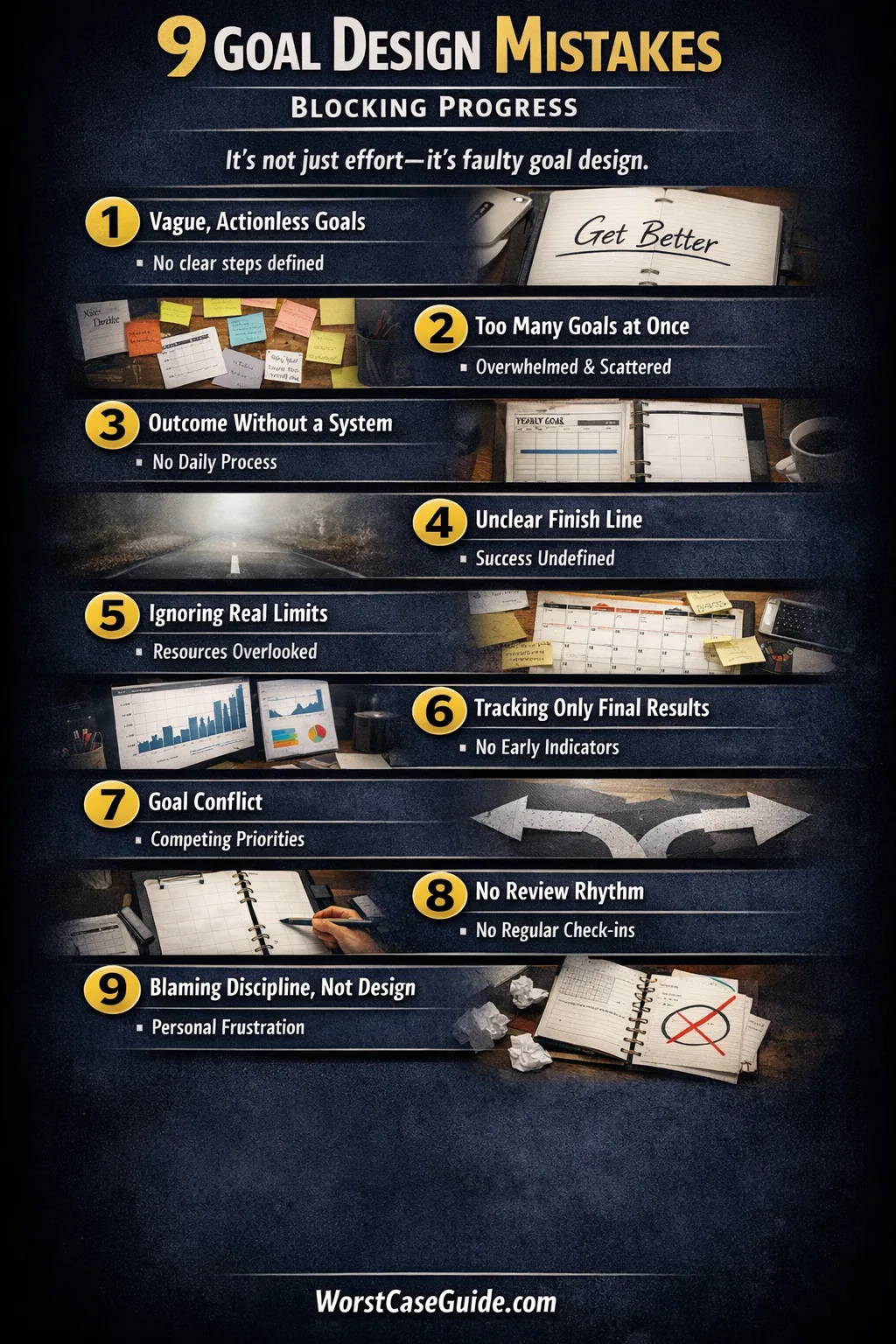
9 Goal Setting Mistakes That Stall Progress
Mistake 1: Writing A Goal That Sounds Good But Does Not Describe Action
Goals like be healthier, grow the business, or get organized can feel clean and polished. They also hide the work. A goal that names an identity or a hope, but not a visible pattern of action, gives the brain too much room to improvise. That usually means delay.
- Why it happens: Broad wording feels flexible and motivating. It avoids the discomfort of choosing one real path.
- Early warning signs: Different days produce different interpretations of the same goal. Progress notes start sounding vague.
- Worst-case result: Weeks pass with effort scattered across tasks that look useful but do not add up to a measurable shift.
- Safer approach: A more stable goal usually describes what will be done, how often, and what counts as progress in visible terms.
Mistake 2: Chasing Too Many Goals At The Same Time
This is one of the most common planning errors because it looks ambitious, even responsible. More goals can feel like more control. In practice, they often compete for the same time, attention, money, and decision energy. A calendar can hold many intentions. A week usually cannot.
- Why it happens: People confuse priority with inclusion. They keep adding instead of ranking.
- Early warning signs: Frequent context switching, unfinished tasks piling up, and the feeling of being busy without one area clearly moving.
- Worst-case result: Nothing fully fails, yet nothing reaches traction. Every line stays half-built.
- Safer approach: In smaller projects, a narrow set of active goals often protects momentum. In larger systems, staged timing tends to reduce collision.
Pattern to notice: When three goals depend on the same evening hours, the issue is usually not willpower. It is overlap.
Mistake 3: Treating A Yearly Goal Like A Daily System
A yearly target and a daily routine are not the same thing. One points to an outcome. The other carries the weight. People often write a yearly result and then expect daily behavior to organize itself around it. That gap matters. A goal without an operating pattern tends to stay theoretical.
- Why it happens: Outcome language is easier to celebrate than process design.
- Early warning signs: The goal is repeated often, but the weekly routine changes constantly or never settles.
- Worst-case result: Progress depends on mood, spare time, or bursts of urgency. When life gets noisy, the goal vanishes first.
- Safer approach: A healthier design often separates the destination from the repeatable pattern that supports it.
Mistake 4: Using A Finish Line That Is Too Vague To Test
Some goals stall because nobody can tell whether the work is truly done, merely started, or moving in the right direction. That sounds small. It is not. If the finish line is soft, reviews become opinion-based. Teams debate. Individuals drift. The goal starts behaving like fog instead of a map.
- Why it happens: People want freedom later, so they leave the target open now.
- Early warning signs: Meetings spend more time defining success than checking it. Personal projects keep being “almost there.”
- Worst-case result: Work expands without closure, and effort keeps getting poured into something already misread.
- Safer approach: A clearer end state usually names what completed looks like, not just what improved feels like.
Mistake 5: Ignoring Real Resource Limits
Goals are often written in a clean mental space, then carried into a messy real one. Time is fragmented. Energy changes. Money, tools, family demands, team dependencies, and admin work all take their share. A goal that ignores constraints can look smart on paper and fail in ordinary life.
- Why it happens: Planning usually happens when motivation is high and interruption is low.
- Early warning signs: Repeated rescheduling, skipped steps, or a plan that only works on unusually good days.
- Worst-case result: The goal becomes a quiet source of guilt, then gets abandoned and misread as a character flaw.
- Safer approach: If you are in this situation, the better design is often the one that survives average weeks, not ideal ones.
Mistake 6: Tracking Only Final Outcomes
Outcome metrics matter, but they arrive late. By the time the final number looks weak, the behavior behind it may have been off for weeks. This is where people feel blindsided. Were they not working? They were. They just were not watching the signals that show whether the work is feeding the result.
- Why it happens: Final outcomes are simpler to explain and easier to celebrate.
- Early warning signs: Reviews happen, but they focus on lagging results with little discussion of repeatable input.
- Worst-case result: Problems stay hidden until options narrow and recovery becomes expensive in time or morale.
- Safer approach: A steadier setup often tracks both result measures and leading activity that can still be adjusted early.
Mistake 7: Overlooking Conflict Between Goals
Not all goals fail on their own. Some fail because another goal quietly blocks them. A goal to move faster may clash with a goal to reduce errors. A goal to cut costs may weaken a goal that depends on quality or support. This is common in teams, and it also shows up in personal planning more than people expect.
- Why it happens: Goals are often approved one by one, not tested as a set.
- Early warning signs: Progress in one area repeatedly creates stress, delay, or reversal in another.
- Worst-case result: People work hard, hit one target, and accidentally damage the condition needed for another target to succeed.
- Safer approach: In larger systems, checking for trade-offs early can reduce hidden collision. In personal plans, fewer active priorities usually make conflict easier to see.
Mistake 8: Setting The Goal And Skipping The Review Rhythm
A goal without review is easy to admire and easy to forget. Many people assume the plan itself will keep attention alive. It rarely does. Once daily noise picks up, the goal slides into the background. Not because it stopped mattering. Because nothing was built to bring it back into view at the right interval.
- Why it happens: The setup phase gets attention; the maintenance phase feels less exciting.
- Early warning signs: Long gaps between check-ins, unclear next steps, and surprise when progress is lower than expected.
- Worst-case result: Drift goes unnoticed until deadlines are near, at which point the only remaining response is rushed correction.
- Safer approach: A simple review rhythm often works better than a detailed plan with no built-in return point. Small, regular checks can catch more than grand resets.
Mistake 9: Treating Stalled Progress As A Personal Failure Instead Of A Design Problem
This mistake tends to arrive late, after the others have already done their work. Progress slows. Frustration rises. The story becomes personal: I am inconsistent, I lack discipline, I always do this. Sometimes that story is partly true. Often it hides a weaker truth that matters more: the goal was badly built.
- Why it happens: Personal explanations feel immediate and familiar. Design flaws are less visible.
- Early warning signs: Shame language replaces diagnosis. The review becomes emotional but not specific.
- Worst-case result: The same broken pattern gets reused in the next cycle because the cause was misidentified.
- Safer approach: When a goal stalls, it often helps to inspect the structure first: clarity, limits, sequencing, measures, and review timing.
General Risk Patterns Behind Stalled Goals
Across all nine mistakes, a few patterns appear again and again. Stalled progress usually comes less from laziness and more from mismatch. The goal does not match the task, the time available, the way progress is measured, or the real conditions around the work.


- Abstraction replacing clarity: the goal sounds neat but leaves too much undefined.
- Ambition outrunning capacity: the target assumes resources that are not reliably there.
- Measurement arriving too late: the only signals being watched appear after drift has grown.
- Multiple priorities colliding: one goal quietly steals from another.
- Review happening too rarely: problems stay small, then suddenly feel large.
That pattern matters because it changes the response. If the stall came from weak design, adding pressure may not help much. It may only make the same system noisier. A better question is often this: what part of the goal made predictable progress harder than it needed to be?
FAQ
Why do well-written goals still fail in real life?
Good wording is not always enough. Goals often fail when they do not fit real limits, lack a review rhythm, or rely too heavily on motivation. A polished sentence can still produce weak execution.
Is setting fewer goals always better?
Not always, but fewer active priorities often make progress easier to protect. The issue is not just the number of goals. It is whether they compete for the same resources or attention.
What is the difference between a goal and a system?
A goal points to an outcome. A system describes the repeatable pattern that supports it. Stalls often appear when the goal exists but the weekly or daily operating pattern is missing.
How can someone tell whether progress is truly stalled?
If effort stays high but visible movement stays low for a sustained period, the issue may be structural. Repeated rescheduling, vague reviews, and unstable routines are common early signals.
Does a stalled goal always mean poor discipline?
No. Sometimes discipline is part of the picture, though many stalled goals trace back to design errors: unclear finish lines, overloaded priorities, weak measurement, or ignored trade-offs. That is why diagnosis matters.