A foundation crack rarely matters only because of the line in the concrete. It matters because of the movement, moisture, pressure, or soil change behind that line. Many homeowners ignore cracks for ordinary reasons: the house still feels solid, the doors still close, the basement is mostly dry, and the crack does not look dramatic. That is exactly why this topic is risky. Small-looking damage can be part of a much larger pattern, and the cost usually comes from delay, misreading, or fixing the symptom before the cause.
Search intent around this topic is mostly informational. People are trying to answer a practical question: Is this crack harmless, or is it the start of a structural and moisture problem? The most useful angle is not panic. It is clear sorting. Which mistakes make ordinary cracks harder to read? Which early signs tend to show up before repairs become messy, disruptive, and expensive?

Useful context: A crack can be cosmetic, moisture-related, settlement-related, or structural. The trouble starts when those categories get blended together. A harmless-looking crack may be carrying water. A sealed crack may still be moving. A wide crack may be old and stable. A thin crack may be new and active. Context matters more than first impressions.
Why This Problem Gets Misread So Often
Foundation cracks trigger two bad instincts at once. One group assumes every crack means structural danger. Another assumes concrete always cracks and nothing needs attention. Real houses sit between those extremes. Soil type, drainage, freeze-thaw cycles, expansive clay, plumbing leaks, grading, downspouts, additions, and age all shape what the crack actually means.
There is also a timing problem. Early warning signs tend to arrive as a group, not as a headline event: one sticky door, one stair-step crack in masonry, one damp corner after rain, one gap that looks unchanged until older photos say otherwise. That is how people miss the pattern. It does not announce itself. It accumulates.
Common Assumptions That Lead Homeowners Off Course
- “If it is thin, it is harmless.” Thin cracks can still carry water or show active movement.
- “If the house is old, the crack must be old too.” New movement can appear in older homes after drainage changes, drought, nearby excavation, or repeated wet-dry cycles.
- “If I fill it, I fixed it.” A filled crack may look better while the wall, slab, or soil keeps moving.
- “If I do not see water, moisture is not part of the issue.” Dampness often starts as odor, staining, salt deposits, or seasonal humidity.
- “One estimate is enough.” A repair proposal is not always the same thing as a diagnosis.
- “No sloping floors means no foundation problem.” Some houses show the first signs in masonry, drywall, trim gaps, or sticking openings long before floor slope becomes obvious.
| Crack Pattern Or Condition | What It May Suggest | What People Often Ignore | Safer Reading |
|---|---|---|---|
| Hairline vertical crack | Normal shrinkage or light settlement | Whether it changes size, leaks, or appears with new indoor symptoms | Monitor, photograph, and compare over time before dismissing it |
| Diagonal crack | Settlement or differential movement | Nearby sticking windows, trim separation, exterior brick cracking | Read it as part of a house-wide pattern, not a single wall issue |
| Horizontal crack | Lateral pressure on the wall | Soil saturation, drainage failure, wall bowing | Treat as a higher-concern signal, especially in basement walls |
| Stair-step crack in masonry | Movement through mortar joints | Whether the crack is widening or offsetting | Look for settlement, moisture, and repeated movement |
| Crack with dampness or staining | Water entry or persistent moisture | Seasonal odor, efflorescence, mold-prone finishes | Focus on moisture source, drainage, and grading, not sealant alone |
| Repaired crack that returns | Ongoing movement or wrong repair method | The original cause was never identified | Re-open the diagnosis instead of repeating the same cosmetic fix |
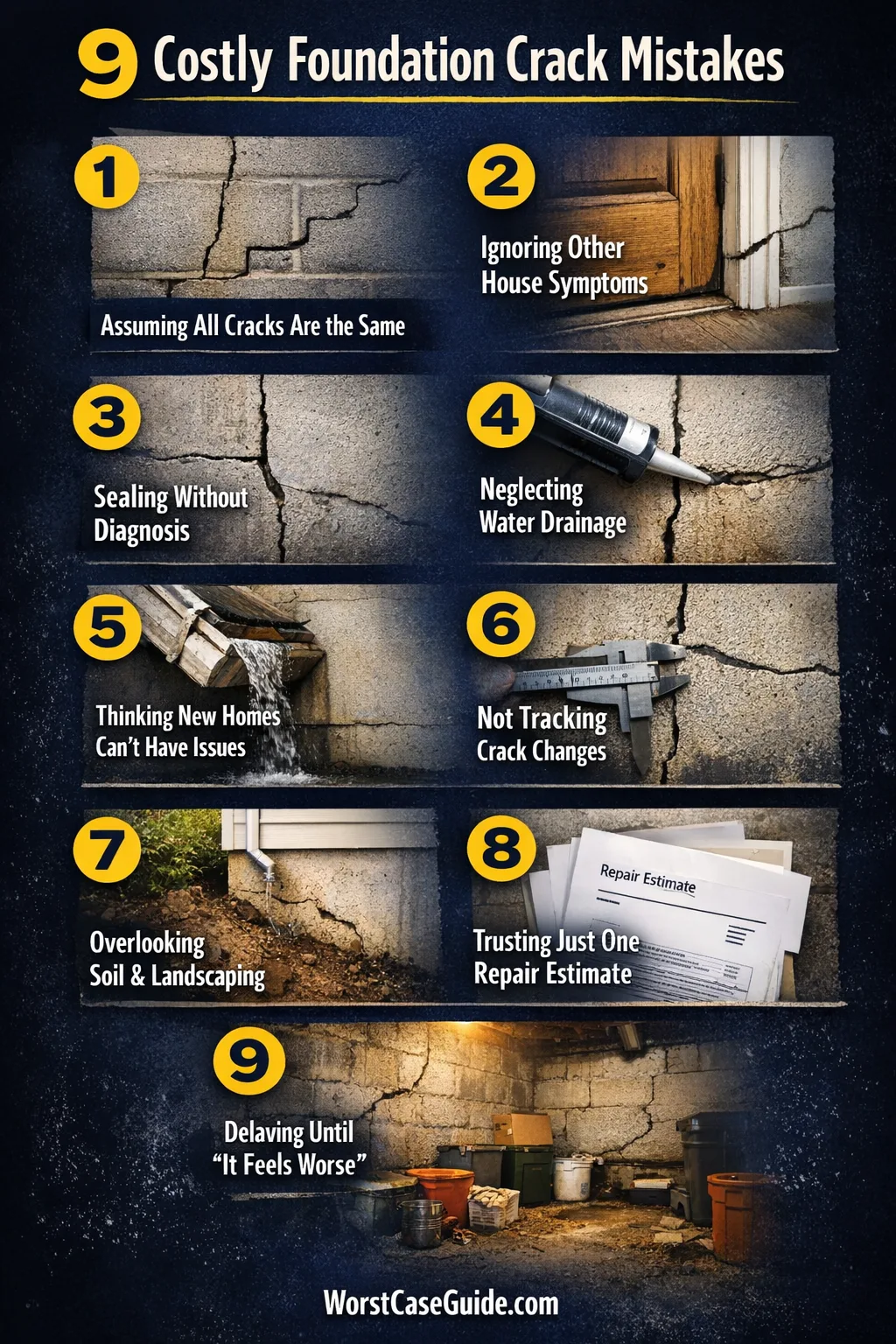
9 Foundation Crack Mistakes Homeowners Ignore
Mistake 1: Treating Every Crack As The Same Problem
This is the first mistake because it creates the rest. A crack is not a diagnosis. It is a symptom. Vertical, diagonal, stair-step, horizontal, slab-edge, and wall-to-floor cracks do not carry the same level of concern. Neither do dry cracks and damp cracks. A basement wall and a slab-on-grade floor also behave differently.
Why It Happens
Homeowners often look at size alone. If the line looks small, the mind labels it “minor.” If it looks dramatic, the mind labels it “structural.” Concrete does not cooperate with that shortcut. A narrow active crack can matter more than a wider stable one. Shape, location, moisture, repeated movement, and related symptoms usually tell more than width by itself.
Early Warning Signs
- The crack changes shape or length over a season
- There is offset, bowing, or bulging nearby
- Water staining or white mineral deposits appear at the crack
- More cracks show up in drywall, brick, tile, or trim at the same time
Worst-Case Outcome
The danger is not just repair cost. It is misclassification. A homeowner may seal a moisture path and miss ongoing wall pressure, or panic over a shrinkage crack and spend money in the wrong place. In the worst case, lateral pressure, settlement, or washout continues while the visible crack becomes the least important part of the problem.
A Safer Approach
Read the crack in context: type, location, moisture, related house symptoms, and whether it is stable. In basements, horizontal cracking and wall movement deserve more caution. In slab homes, crack patterns near flooring changes, interior wall separation, or plumbing trouble need a wider look.
Mistake 2: Looking At The Crack But Not The Rest Of The House
A foundation issue often speaks through secondary symptoms first. The crack may be outside, while the clue shows up in a sticking back door, a sloping hallway floor, or a gap opening above a window. Many people inspect the concrete and stop there. That is like reading one sentence and assuming the whole chapter is fine.
Why It Happens
Cracks are visible. House-wide patterns are slower and more annoying to check. They also feel unrelated at first. A little drywall separation upstairs does not obviously connect to a damp foundation wall downstairs, so the signs stay mentally separated.
Early Warning Signs
- Doors or windows begin to stick, rack, or drift open
- Cracks appear above door frames or window corners
- Tile or rigid flooring starts separating
- Trim gaps open where walls meet ceilings or floors
- Exterior brick shows stair-step cracking
Worst-Case Outcome
The crack gets treated as a local repair while the system-wide movement keeps spreading. By the time the pattern becomes obvious, the repair may involve more than crack filling: drainage correction, structural support work, interior finish repair, and possibly plumbing checks in the same cycle. The project gets wider. Fast.
A Safer Approach
When a foundation crack appears, a broader walk-through is usually more useful than another close-up photo. Check interior walls, openings, floors, masonry, damp corners, crawl spaces, and the exterior grade. If several small symptoms are arriving together, that matters more than one dramatic-looking line.
Mistake 3: Sealing The Crack Before Understanding Why It Formed
Many cracks do get sealed. That part is not wrong by itself. The mistake is using sealant as a substitute for diagnosis. Cosmetic closure and cause correction are different jobs. Sometimes they overlap. Often they do not.
Why It Happens
The crack is visible, easy to photograph, and often easy to fill. Water management problems, soil movement, or wall pressure are not as tidy. So the visible symptom gets the attention first. The sealant becomes makeup on a moving surface.
Early Warning Signs
- A repaired crack reopens
- The same wall develops new cracking nearby
- Dampness returns after heavy rain
- The indoor symptom pattern keeps expanding even after the repair
Worst-Case Outcome
Water still gets in. Soil still moves. The wall still takes pressure. The homeowner loses time, and the later repair becomes harder because finishes, storage areas, insulation, or basement plans were built around a problem that never really stopped.
A Safer Approach
If the crack appears stable, dry, and clearly minor, sealing may be part of a reasonable response. If it is returning, widening, leaking, or paired with movement elsewhere, the safer path is to treat the crack as evidence, not closure. In older basements, repeated dampness often points back to drainage and soil saturation rather than to the crack alone.
Mistake 4: Ignoring Water Management Around The Foundation
This is one of the most overlooked errors in search results and in real houses. Water is often the hidden driver. Overflowing gutters, short downspouts, poor grading, hardscapes that slope toward the house, clogged drains, and chronic roof runoff can keep soil too wet near the foundation. In dry periods, the same area may swing the other direction and shrink. That cycle is rough on walls and slabs.
Why It Happens
Drainage failures rarely feel urgent until there is visible water. Yet foundation trouble often starts before puddles show indoors. The issue may be outside: water pooling after rain, soil erosion near the footing line, mulch hiding low spots, or gutters spilling at one corner. Homeowners tend to notice the crack first because the drainage story is spread across the whole perimeter.
Early Warning Signs
- Water pools near the house after rain
- Soil slopes toward the foundation, or settled backfill creates a trough
- Downspouts discharge too close to the wall
- Basement smells musty even when no leak is obvious
- Efflorescence, damp patches, or peeling finishes show up below grade
Worst-Case Outcome
Persistent wet soil can increase pressure on below-grade walls, carry water through weak points, soften support conditions, and expand the repair from a crack issue into a drainage, waterproofing, and structural movement problem. In slab homes, poor drainage may also contribute to uneven support and floor cracking.
A Safer Approach
Before assuming the concrete is the main problem, it helps to look at the water path: roof runoff, grading, gutters, downspouts, splash areas, paved surfaces, and low spots. In smaller homes with one problem corner, drainage correction may change the trajectory early. In larger homes or sites with clay soil, repeated moisture swings can affect more than one side of the structure.
Mistake 5: Assuming New Homes Only Get Harmless Settling Cracks
It is true that some newer homes show shrinkage or settling-related cracks. The mistake is turning that fact into a blanket excuse. New does not always mean harmless. Old does not always mean stable. Soil preparation, drainage, backfill settlement, weather swings, and construction sequencing all influence what a “normal” crack really is.
Why It Happens
People hear a familiar phrase—“houses settle”—and apply it too widely. That can be partly true and still misleading. A small early crack may be ordinary. A widening pattern, repeated moisture entry, or floor and opening misalignment deserves more than the word “settling.”
Early Warning Signs
- Cracks continue to grow months after they first appear
- There are several new cracks rather than one isolated mark
- Exterior grading sinks after the first rainy season
- A basement or crawl space starts showing dampness soon after occupancy
Worst-Case Outcome
The homeowner loses the easiest repair window. What could have been a monitored warranty issue, a grading correction, or an early drainage fix becomes a dispute over responsibility after finishes crack, doors bind, or basement moisture damages stored items and materials.
A Safer Approach
In newer homes, it helps to separate stable cosmetic settling from active movement. The question is not whether the house is new. The question is whether the crack is changing, leaking, multiplying, or showing up with other house symptoms.
Mistake 6: Failing To Track Change Over Time
One of the clearest content gaps in many articles is this simple point: movement over time often matters more than one-time appearance. A crack snapshot is useful. A crack history is far better. Without dates, photos, and comparisons, homeowners are left debating memory.
Why It Happens
Cracks become background noise. People see them daily and stop seeing them at all. Months later, the only question is, “Was it always like that?” Memory is weak on slow changes. Houses know this. They take advantage of it.
Early Warning Signs
- The crack reappears after a prior repair
- Rainy periods or drought seem to change its size
- Seasonal door and window issues keep returning
- Small alignment changes appear in trim, tile, or masonry over time
Worst-Case Outcome
When professional help is finally needed, the homeowner has no clean record of what changed and when. That weakens diagnosis, makes repair timing harder to judge, and can complicate warranty or transaction conversations. A stable old crack and an active recent crack do not belong in the same decision bucket.
A Safer Approach
Photos from the same angle, simple measurements, dates, weather context, and notes about sticking openings or moisture create a clearer picture. Patterns are easier to trust when they are recorded. This is especially helpful where cracks are near the common “watch” thresholds or where the house behaves differently in wet and dry seasons.
Mistake 7: Overlooking Soil, Landscaping, And Hardscape Changes
Foundation cracks are often blamed on “the house” when the real change happened in the ground around it. Tree growth, removed trees, new patios, redirected runoff, irrigation changes, flower beds built against the wall, and soil that pulls away in dry weather can all alter support and moisture patterns.
Why It Happens
Landscaping feels cosmetic. Foundation behavior is structural. Homeowners naturally separate those topics. Yet soil moisture does not care about that distinction. In expansive clay areas, repeated wet-dry swings can be hard on foundations. In colder regions, freeze-thaw cycles add another layer. After tree removal or nearby excavation, support conditions may also change in ways that are easy to miss at first.
Early Warning Signs
- Soil pulls away from the foundation during dry periods
- One side of the house is much wetter or drier than the others
- Cracking appears after major landscaping or paving work
- Erosion channels or washed-out spots form near the perimeter
- Irrigation keeps one foundation section constantly damp
Worst-Case Outcome
The homeowner keeps repairing surfaces while the support conditions under and around the house keep changing. In the worst case, that leads to recurring movement, repeated finish damage, and repairs that chase symptoms instead of stabilizing the environment around the foundation.
A Safer Approach
If cracking appeared after site changes, that timing matters. In smaller projects, correcting runoff or moisture imbalance may calm the problem early. In larger properties, mixed grades, retaining areas, or wide roof runoff zones may require a more coordinated look at drainage and soil behavior rather than one isolated crack repair.

Mistake 8: Confusing A Repair Proposal With An Objective Diagnosis
This is another gap many homeowners wish they had understood earlier. A repair company may offer a workable repair. That does not automatically mean the initial diagnosis is neutral. When the situation is unclear, diagnosis and repair are different roles. One identifies cause and scope. The other performs the work.
Why It Happens
People want one phone call and one answer. That is understandable. Yet foundation problems are not always simple sales-floor problems. When movement is uncertain, water is involved, or multiple symptoms are present, a repair-first conversation can lock the homeowner into one story too early.
Early Warning Signs
- The proposed fix focuses on the crack but not on water, grading, or house-wide signs
- Different contractors describe very different causes
- The crack was not measured, compared, or tied to broader symptoms
- The proposal arrives before anyone explains why the crack formed
Worst-Case Outcome
The homeowner pays for a repair that may be partial, premature, or unrelated to the main cause. A second round of work then follows. The extra cost is painful, but the deeper problem is uncertainty: the house becomes a chain of fixes rather than a solved problem.

A Safer Approach
When the crack is clearly minor and stable, the decision may stay simple. When it is wider, returning, leaking, or paired with movement signs, a more independent assessment can reduce guesswork. If a homeowner is in a sale, purchase, or remodel situation, clear diagnosis matters even more, because the crack affects scope, timing, disclosure, and negotiation at the same time.
Mistake 9: Waiting Because The House Still Feels Fine
This may be the most human mistake of the list. People live in houses through familiarity, not through measurements. If the space still feels safe and daily life still works, delay seems rational. Yet foundation-related damage often grows in the background. By the time the house feels different, more systems may already be involved.
Why It Happens
Foundation problems rarely begin like an emergency movie scene. They look ordinary. One damp smell. One wall crack. One stubborn window in humid weather. Then the pattern settles in and becomes normal. That is the trap.
Early Warning Signs
- The crack has been ignored for months because it did not seem urgent
- Indoor finishes are being repaired again and again
- Basement storage areas stay slightly damp or musty
- There is hesitation because repair decisions feel expensive or unclear
Worst-Case Outcome
The issue widens from concrete into water intrusion, indoor finish damage, resale friction, and larger structural correction. In some cases, a homeowner also loses the easier moment to separate drainage work, monitoring, and targeted repair. Later, everything arrives at once.
A Safer Approach
Delay is less risky when there is evidence that a crack is minor and stable. Delay is more risky when the crack is changing, leaking, or tied to secondary symptoms. The more the house is speaking in several places at once, the less useful “it still feels fine” becomes as a decision tool.
Risk Patterns That Show Up Again And Again
Across almost every foundation crack case, the same patterns keep appearing:
- Symptom-first thinking: the visible crack gets attention before drainage, soil, or movement is understood.
- Single-point inspection: one wall is examined while the rest of the house is ignored.
- Time blindness: no one tracks whether the crack is stable, seasonal, or growing.
- Water neglect: gutters, grading, downspouts, and runoff paths are treated as separate maintenance issues rather than part of foundation behavior.
- Scope drift: a small repair becomes a larger project because the original issue was narrowed too quickly.
The recurring lesson is simple: foundation cracks are easier to manage when they are treated as part of a pattern, not as a cosmetic nuisance and not as automatic structural failure. A calm reading is usually the safer reading. Not a dismissive one. Not an alarmist one.
What A More Careful Reading Usually Includes
- Crack type and location
- Moisture evidence inside and outside
- Change over time, including seasonal behavior
- Related house symptoms such as sticking openings, floor changes, masonry cracks, and trim separation
- Site conditions like grading, downspouts, paving slope, irrigation, and soil pull-away
FAQ
Are all foundation cracks a sign of structural failure?
No. Some cracks are cosmetic or linked to ordinary shrinkage and settling. The more useful question is whether the crack is changing, leaking, or appearing with other signs such as sticking doors, sloping floors, wall movement, or repeated moisture issues.
Which foundation crack patterns usually deserve more caution?
Horizontal cracks, stair-step masonry cracks, cracks with displacement, and cracks that widen or return after repair tend to deserve a closer look. A crack that appears with bowing, dampness, or broader house movement is harder to dismiss as minor.
Can a small crack still be a real problem?
Yes. A narrow crack can still carry water or show active movement. Size matters, but change over time, location, moisture, and related symptoms often matter more than width alone.
Should a homeowner seal a foundation crack right away?
That depends on what the crack is doing. A clearly minor, stable, dry crack may be sealed as part of maintenance. A crack that is leaking, widening, or returning after prior repair is better treated as a sign that the cause still needs attention.
Can poor drainage really cause foundation crack problems?
Yes. Water that collects near the house can saturate soil, increase pressure on below-grade walls, soften support conditions, and worsen moisture intrusion. Short downspouts, negative grading, and runoff aimed toward the house are common contributors.
What secondary signs often appear with foundation movement?
Common related signs include sticking doors or windows, cracks above openings, trim separation, uneven floors, tile cracking, musty basement odors, and stair-step cracks in exterior masonry.
When is it smarter to get a more independent diagnosis first?
That becomes more useful when the crack is wide, recurring, leaking, or tied to multiple symptoms, or when the home is being bought, sold, remodeled, or evaluated after drainage changes. In unclear cases, diagnosis and repair are not always the same step.