Electrical DIY work often looks simple on the surface. A switch, an outlet, a light fixture, a new breaker—many jobs seem tidy, logical, almost mechanical. The risk is that fire hazards are usually hidden. A circuit can keep working while a loose connection heats inside a box, while insulation dries out behind a device, or while a breaker stops being the last line of defense it was meant to be. That is why electrical fire risk is rarely about one dramatic mistake. It is usually a chain of smaller ones.
What makes this topic easy to misread? A lot of unsafe DIY electrical work still “works.” The lamp turns on. The receptacle has power. The breaker does not trip. That can create a false sense of safety, and false confidence is where many fire paths begin.
Why This Topic Is Risky
Electrical fires do not need a dramatic failure. They can begin with heat, arcing, overload, resistance, or damaged insulation. In practical terms, that means a weekend project can go wrong even when nothing looks obviously broken. A wire that is too small for the breaker, a backstabbed receptacle that loosens over time, a junction buried behind drywall, a power strip feeding loads it was never meant to carry—these are ordinary mistakes, not movie-scene disasters. That is exactly why they matter.
There is also a second problem. Many DIYers treat electrical work as if all risk is shock risk. Fire risk is different. A system may expose no one to a shock and still create a hot spot, an arc fault, or a slow insulation failure. In smaller projects, that may stay local to one outlet box. In larger systems, especially older homes with added loads, the same pattern can spread across several circuits.

Common Wrong Assumptions
- If the breaker is off, the circuit is dead. Labels are often wrong, and shared boxes can still contain live conductors.
- If a breaker trips, the breaker is the problem. Sometimes it is. Often it is reporting overload, a short, or a wiring fault.
- If the outlet works after replacement, the job is fine. Function is not the same as safety.
- GFCI and AFCI protection are basically the same thing. They are not. One deals mainly with shock conditions; the other helps address arcing conditions that can start fires.
- Old wiring can be treated like new wiring. Brittle insulation, worn receptacle contacts, aluminum branch wiring, heat damage, and loose terminations change the risk profile.
- A small load here and there does not matter. In real homes, “small loads” add up fast: garage freezer, treadmill, heater, air fryer, dehumidifier, EV charger, holiday lighting, all layered onto an older system.
Quick Risk Map
| DIY Choice | Hidden Mechanism | What Often Gets Missed |
|---|---|---|
| Replacing a breaker with a larger one | Overcurrent protection no longer matches conductor capacity | The wire, not the appliance, may be the first thing that overheats |
| Using backstab connections | Resistance rises as the connection loosens | The device may still work while heat builds behind it |
| Adding a new receptacle to an old circuit | Circuit load climbs beyond what the branch was handling before | Shared loads elsewhere on the same run |
| Burying a splice | Faults and heat are trapped where they cannot be inspected | No access for repair, tightening, or diagnosis |
| Treating GFCI as full fire protection | Arcing conditions may remain | Shock protection and fire protection are not the same thing |
| Leaving loose device screws or weak splices | Micro-arcing and heat at the termination point | A warm faceplate is already a warning |
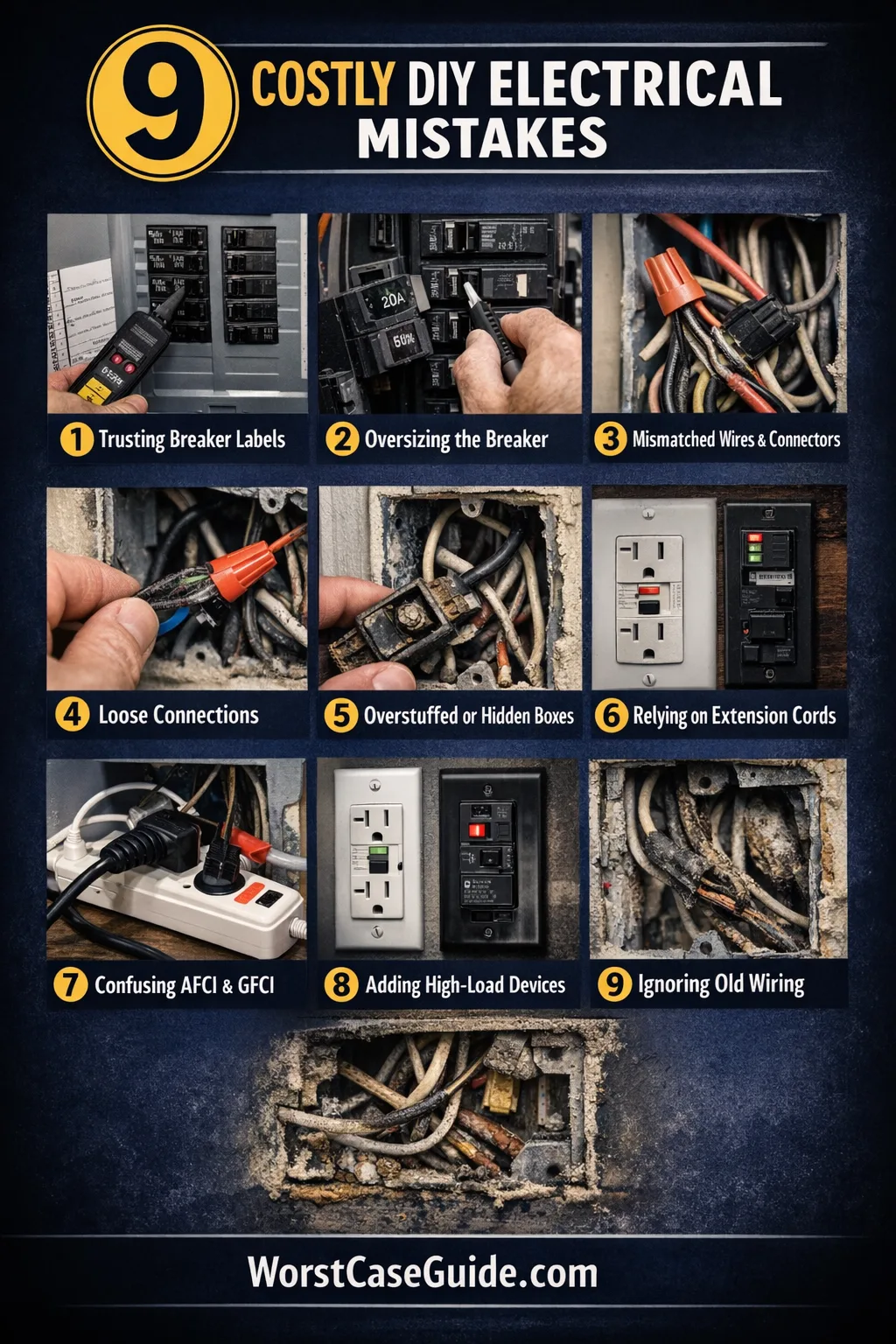
9 Electrical DIY Mistakes That Create Fire Hazards
Mistake 1: Trusting Breaker Labels Instead of Testing for Live Power
Many DIY electrical jobs begin with a perfectly human shortcut: the panel says “kitchen outlets” or “bedroom lights,” so the circuit must be dead. In real houses, panel directories are often outdated, vague, or flat-out wrong. Remodels, split receptacles, multi-wire branch circuits, shared neutrals, and mixed boxes make this worse. Assumption becomes exposure, and exposure can lead to rushed reconnections, damaged conductors, or an energized wire touching metal where it should not.
Why It Happens
Breaker labels drift over time. People add circuits, move loads, swap rooms, and rarely update the panel map carefully. The problem is not just shock. When a person believes the box is dead, they may loosen conductors, nick insulation, or leave a partially secured connection in place because the whole job rhythm changes. That is where fire risk enters the picture.
Early Warning Signs
- The device is off, but another cable in the same box still tests live
- Breaker labels use room names only and not circuit details
- One breaker seems to turn off only part of a receptacle or fixture
- There are extra capped conductors in the box that do not match the expected setup
Worst-Case Outcome
A live conductor can be loosened or damaged during the job and then re-energized with a weak termination, exposed copper, or compromised insulation. The danger is not always immediate. Sometimes the failure shows up later, after the plate is back on and the wall looks normal.
A Safer Approach
If the project involves opening a box, the more reliable path is to treat testing as part of shutoff, not as an optional extra step. In homes with messy panel labeling, mixed circuits, or older remodel work, that matters even more. A breaker directory can be helpful. It is not proof.
Mistake 2: Upsizing a Breaker or Fuse to Stop “Nuisance” Trips
This is one of the most dangerous DIY patterns because it feels practical. A breaker trips, a fuse blows, the circuit seems annoying, and the easy story becomes: the protective device is too sensitive. Sometimes the real issue is a temporary overload. Sometimes it is a damaged appliance. Sometimes it is a wiring fault. Replacing a 15-amp protector with a 20-amp one on the wrong conductor does not solve that story. It changes who gets hurt first.
Why It Happens
Trips interrupt a day, so people start seeing the breaker as the problem instead of the messenger. That is understandable. Still, overcurrent protection has to match conductor size and circuit design. Once that match is broken, wiring may carry more heat than it was meant to handle before the breaker reacts.
Early Warning Signs
- A breaker that trips after adding heaters, countertop appliances, or garage equipment
- Old fuse panels with mismatched fuse sizes
- A recently “fixed” circuit that now runs but smells warm under load
- Discoloration at receptacles, switches, or breaker connections
Worst-Case Outcome
The conductor becomes the weak point. Insulation can overheat slowly, especially inside walls, attics, or crowded boxes, until arcing or ignition begins. A breaker is a safety device, not permission to ask more from a circuit than the wiring can carry.
A Safer Approach
If a circuit trips after a new load appears, the safer reading is that the circuit may be giving useful information. In smaller homes, the fix may involve load distribution. In larger updates—workshop tools, bathroom heaters, EV charging, added kitchen equipment—the issue may be that a dedicated circuit or a fuller load review is needed.
Mistake 3: Mixing Wire Gauge, Connector Type, and Device Rating
Electrical DIY goes wrong when parts are treated as interchangeable. They are not. Wire gauge, conductor material, connector type, device rating, and breaker size are part of one system. A connector meant for one conductor type may not grip another correctly. A device rated for one amperage may be placed on a circuit whose wiring tells a different story. A repair can look neat and still be structurally unsound at the electrical level.
Why It Happens
Home centers make electrical parts look modular. Same shelf, same aisle, same packaging rhythm. That visual similarity hides the fact that compatibility matters. Copper and aluminum do not behave the same way. Twelve-gauge and fourteen-gauge conductors are not a cosmetic difference. Neither are device ratings.
Early Warning Signs
- A box contains different wire gauges on what appears to be the same branch circuit
- Connectors are chosen because they “fit” physically, not because they are listed for the conductor
- A replacement device has a different amp rating from the one removed, with no other circuit review
- There is uncertainty about whether the home has copper, copper-clad aluminum, or aluminum branch wiring
Worst-Case Outcome
Mismatch creates excess resistance, heat, weak clamping pressure, or terminal failure. The fire risk may stay hidden until the circuit sees sustained load. That is why “it fits” is one of the least reliable tests in electrical work.
A Safer Approach
If the wiring details are uncertain, the safer path is to identify the conductor, the branch rating, and the device rating before assuming the replacement is routine. In older homes, this step matters more than many people expect (sometimes much more). Small uncertainty in materials can lead to large uncertainty in heat behavior.
Mistake 4: Creating Loose Terminations, Weak Splices, or Backstab Connections
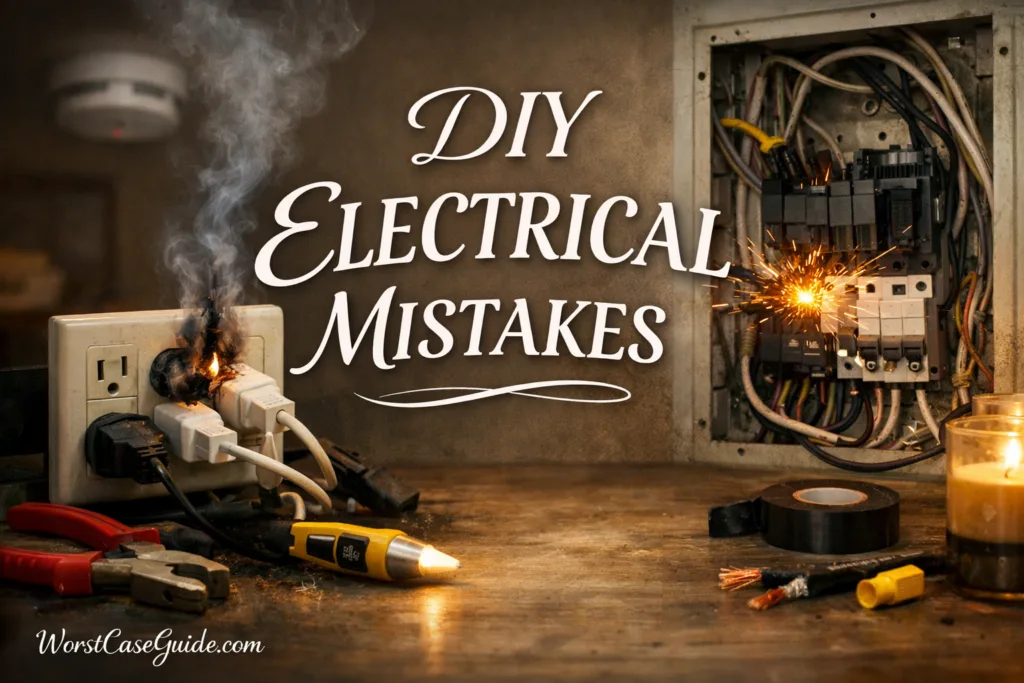
Loose electrical connections are classic fire starters because electricity does not need a dramatic gap to create heat. A slightly poor connection can raise resistance, and rising resistance means heat at exactly the point where conductors, terminals, and insulation meet. This is why backstabbed receptacles, half-tightened terminal screws, undersized wirenuts, poorly twisted splices, and untorqued lugs deserve far more respect than they usually get.
Why It Happens
DIY work often focuses on layout—where the new light goes, which switch controls what, how the finished wall will look. The hidden craft is in the terminations. That part feels less visible, so people rush it. Then the device works, which makes the connection feel good enough. It may not be.

Early Warning Signs
- Warm switch or receptacle faceplates
- Buzzing, faint crackling, or intermittent flicker under load
- Plugs that feel loose in the receptacle
- Darkening around terminal screws, device ears, or wire insulation
- A receptacle that works until a high-draw appliance is plugged in
Worst-Case Outcome
Heat or micro-arcing forms at the connection point, carbonization builds, the metal degrades further, and the failure feeds itself. The box becomes a small oven. Dry dust, wood framing nearby, and aged insulation do not need much encouragement.
A Safer Approach
In device replacement work, the safer habit is to treat termination quality as the real job, not the last minute of the job. Screw-terminal connections, properly matched connectors, clean conductor preparation, pigtailing where needed, and correct tightening pressure are the details that keep a routine repair from becoming a heat source.
Mistake 5: Overfilling Boxes or Hiding Splices Where They Cannot Be Reached
Electrical boxes are not just containers. They provide space, protection, and access. When too many conductors, devices, or splices are forced into one box, wires bend sharply, insulation gets damaged, connector pressure changes, and heat management worsens. A related mistake is even riskier: making a splice and then burying it behind drywall, paneling, cabinets, or insulation where no one can inspect it later.
Why It Happens
People add one more cable, one more switch leg, one more receptacle, and the box still seems able to close. Or they move a fixture and decide the old splice point is easier to hide than rework. That is a tidy finish on the surface and a poor finish underneath. A wall should not become a cover plate.
Early Warning Signs
- Conductors are heavily compressed just to install the device
- The box cover or device yoke resists seating normally
- Insulation is nicked where conductors bend into the box
- There are known hidden junctions from earlier remodel work
- A problem seems to exist somewhere in a wall, but there is no accessible box to inspect
Worst-Case Outcome
A cramped box can produce damaged insulation, loose splices, and localized heat. A buried splice adds a second layer of risk: once something degrades, there is no clean way to inspect, tighten, replace, or isolate the fault without opening finished surfaces.
A Safer Approach
If the number of conductors has grown, a larger box, a different layout, or a revised routing plan is often the calmer option. In remodel work, accessible junctions may feel less elegant for ten minutes and far safer for ten years.
Mistake 6: Using Extension Cords, Cube Taps, or Power Strips as Permanent Wiring
This one often starts with convenience. One outlet is in the wrong place, the garage needs a freezer and a charger, the office setup grew, the holiday lighting stayed up a bit longer than planned, the treadmill moved, the air fryer found a new home. Temporary solutions harden into routine. That is when portable wiring starts doing fixed-wiring work, and portable wiring is not designed for that life.
Why It Happens
Extension cords and strips remove friction. They solve layout problems fast, so they become silent infrastructure. The issue is that cords can be pinched, covered, overheated, coiled, abraded, or overloaded. Power strips can also be asked to feed devices with high or sustained current draw far beyond ordinary electronics.
Early Warning Signs
- A cord runs under a rug, through a doorway, behind furniture, or across garage storage
- One strip feeds heaters, cooking appliances, tools, chargers, or several motor-driven items
- Connectors feel warm to the touch
- The setup is described as temporary, but it has been there for months
- Outdoor or damp-area use relies on indoor-rated cords or devices
Worst-Case Outcome
Cord insulation fails, plug blades loosen, connections arc, or the strip overheats under sustained load. In garages, workshops, and media corners, nearby combustibles can make the spread faster than expected.
A Safer Approach
If a temporary setup keeps surviving from weekend to weekend, that is useful information. It may mean the space needs a proper receptacle layout, a dedicated circuit, or a rethought load plan. Temporary wiring is not a harmless substitute for permanent design just because it has been quiet so far.
Mistake 7: Confusing Shock Protection With Fire Protection
A common DIY misunderstanding is treating all modern protective devices as one category. They are not. GFCI protection is associated with conditions that can cause dangerous shock, especially where water may be involved. AFCI protection is associated with arcing conditions that can lead to fire. The confusion matters because a project can feel “upgraded” while still leaving a fire pathway in place.
Why It Happens
The acronyms sound similar, and both are sold as safer outlets or breakers. Many DIY explanations stop at that level. The result is predictable: a person adds the device they have heard of, not the one the situation actually calls for. This shows up in kitchens, bathrooms, basements, bedrooms, finished attics, garage conversions, and outdoor additions.
Early Warning Signs
- New receptacles are installed in wet or damp areas with no thought to location-specific protection
- AFCI and GFCI are used interchangeably in conversation
- A project adds new receptacles or modifies bedroom or living-area circuits but only shock protection is considered
- There is uncertainty about line/load connections or which device protects what downstream
Worst-Case Outcome
The circuit appears modernized, yet arcing conditions remain unaddressed or location-specific hazards are left open. That can produce the most misleading version of safety: visible upgrades with an incomplete protection strategy.
A Safer Approach
If the project changes wiring, adds receptacles, or touches areas with moisture, sleeping spaces, or long branch runs, it helps to think in terms of what hazard is being managed, not just what device is fashionable or easy to buy. In many homes, the real question is not “Which safer outlet should be used?” It is “What kind of fault is this area most exposed to?”
Mistake 8: Adding High-Load Equipment Without Checking Circuit and Service Capacity
Modern houses accumulate electrical demand in a very ordinary way. A garage gets a freezer. Then a treadmill. Then battery chargers. Then maybe an EV charger. A bathroom gets a stronger fan and a heater. A kitchen gets another countertop appliance that draws more current than the old one. DIY work often treats each addition as small in isolation. The system feels that total load, not the individual story.
Why It Happens
People think in objects; electrical systems react in totals. A branch circuit that once fed lamps and phone chargers may now see sustained appliance loads. An older service panel may also be carrying layers of additions from several decades of “small” changes. On paper, each one sounded modest.
Early Warning Signs
- Breakers trip when several normal household devices run together
- Lights dim when a large appliance starts
- Garage, basement, or kitchen circuits have become catch-all circuits for new equipment
- There is no clear dedicated circuit for a high-draw load
- The service panel is full or nearly full, and new work is being squeezed into existing capacity
Worst-Case Outcome
Conductors, terminals, receptacles, and devices run hotter for longer periods than the original circuit expected. That heat may not trigger an obvious immediate failure. It may instead age the system faster, weaken connections, and create a better environment for arcing later on.
A Safer Approach
When the project involves a heater, charger, cooking device, motor load, workshop tool, or any equipment with sustained draw, the safer view is to treat it as a system question, not just a placement question. In larger homes, a busy panel can hide the problem. In smaller homes, the same issue shows up faster through nuisance trips and warm devices.
Mistake 9: Treating Older Wiring and Tired Devices as If They Are Neutral Background Conditions
Old electrical systems are not just “less modern.” They can behave differently under new DIY work. Brittle insulation, worn receptacle contacts, older service equipment, loose neutral paths, heat-damaged devices, aging switches, and aluminum branch wiring can turn a basic replacement into something far less predictable. The project may be small. The existing condition is not.
Why It Happens
Many DIY articles assume a fairly clean, modern baseline. Real homes are messier. A receptacle swap in a recent build and the same swap in an older house are not the same task. Once conductors start cracking at the insulation, once the outlet no longer grips plug blades firmly, once prior repairs have left mixed materials in the box, the risk changes shape.

Early Warning Signs
- Two-prong receptacles, brittle insulation, or cloth-like wiring appearance
- Plugs that slide out too easily
- Discolored device bodies or burned odor near switches and outlets
- Evidence of past overheating at breaker terminations or receptacle screws
- Old repairs with mixed devices, taped splices, or unexplained conductor colors
Worst-Case Outcome
A “simple” replacement disturbs fragile conductors or worn contacts, and a latent weakness becomes an active one. That can lead to loose connections, damaged insulation, or heat at the very point a person believed they were making the system better.
A Safer Approach
If the existing wiring shows age, wear, uncertainty, or prior heat damage, the safer reading is that the project may no longer be routine. This is one of the clearest dividing lines in home electrical work: the task description can stay small while the risk context gets much larger.
A quiet warning worth noticing: electrical fire hazards often show up as warmth, odor, intermittent operation, or a breaker that “acts annoying.” Those are not always dramatic symptoms. They are still symptoms.
General Risk Patterns
Across all nine mistakes, the same patterns repeat. The parts change. The pattern does not.
- Function is mistaken for safety. The device works, so the job feels finished.
- Protection is misunderstood. A breaker, GFCI, or modern-looking receptacle is treated as a blanket solution.
- Load is viewed one appliance at a time. The circuit experiences the total, not the narrative.
- Hidden conditions are ignored. Old wiring, worn contacts, mixed materials, and prior repairs stay in the background when they should be part of the decision.
- Access and inspection are sacrificed for tidy finishes. Buried splices and cramped boxes make later diagnosis harder and failure more likely.
- Small shortcuts stack. One loose termination, one mislabeled breaker, one old receptacle, one overloaded strip—by themselves each may seem minor. Together they can behave like dry tinder.
FAQ
Which DIY electrical mistake creates the most hidden fire risk?
Loose connections are among the most deceptive because the circuit can keep working while resistance, heat, and micro-arcing build behind the device. The problem often stays invisible until discoloration, smell, buzzing, or failure appears.
Is replacing an outlet always a low-risk DIY job?
No. In a newer, clearly identified circuit with known conductor type and healthy device box conditions, the task may stay relatively contained. In an older home with brittle insulation, mixed wiring, worn receptacle contacts, or uncertain protection, the same outlet swap carries a different risk profile.
Can a breaker that keeps tripping simply be replaced with a larger one?
That is one of the most dangerous responses. A repeated trip often points to overload, a device problem, or a wiring fault. A larger breaker can remove protection from conductors that were never meant to carry that extra heat.
Are AFCI and GFCI devices interchangeable?
No. They address different hazard types. Confusing them can leave a circuit partially protected while still feeling upgraded.
When does a small electrical project stop being small?
That shift usually happens when the existing wiring is old or uncertain, when the new load is sustained or high draw, when the box is crowded, when protection type is unclear, or when the work touches more than a direct like-for-like replacement.
{
“@context”: “https://schema.org”,
“@type”: “FAQPage”,
“mainEntity”: [
{
“@type”: “Question”,
“name”: “Which DIY electrical mistake creates the most hidden fire risk?”,
“acceptedAnswer”: {
“@type”: “Answer”,
“text”: “Loose connections are among the most deceptive because the circuit can keep working while resistance, heat, and micro-arcing build behind the device. The problem often stays invisible until discoloration, smell, buzzing, or failure appears.”
}
},
{
“@type”: “Question”,
“name”: “Is replacing an outlet always a low-risk DIY job?”,
“acceptedAnswer”: {
“@type”: “Answer”,
“text”: “No. In a newer, clearly identified circuit with known conductor type and healthy device box conditions, the task may stay relatively contained. In an older home with brittle insulation, mixed wiring, worn receptacle contacts, or uncertain protection, the same outlet swap carries a different risk profile.”
}
},
{
“@type”: “Question”,
“name”: “Can a breaker that keeps tripping simply be replaced with a larger one?”,
“acceptedAnswer”: {
“@type”: “Answer”,
“text”: “That is one of the most dangerous responses. A repeated trip often points to overload, a device problem, or a wiring fault. A larger breaker can remove protection from conductors that were never meant to carry that extra heat.”
}
},
{
“@type”: “Question”,
“name”: “Are AFCI and GFCI devices interchangeable?”,
“acceptedAnswer”: {
“@type”: “Answer”,
“text”: “No. They address different hazard types. Confusing them can leave a circuit partially protected while still feeling upgraded.”
}
},
{
“@type”: “Question”,
“name”: “When does a small electrical project stop being small?”,
“acceptedAnswer”: {
“@type”: “Answer”,
“text”: “That shift usually happens when the existing wiring is old or uncertain, when the new load is sustained or high draw, when the box is crowded, when protection type is unclear, or when the work touches more than a direct like-for-like replacement.”
}
}
]
}