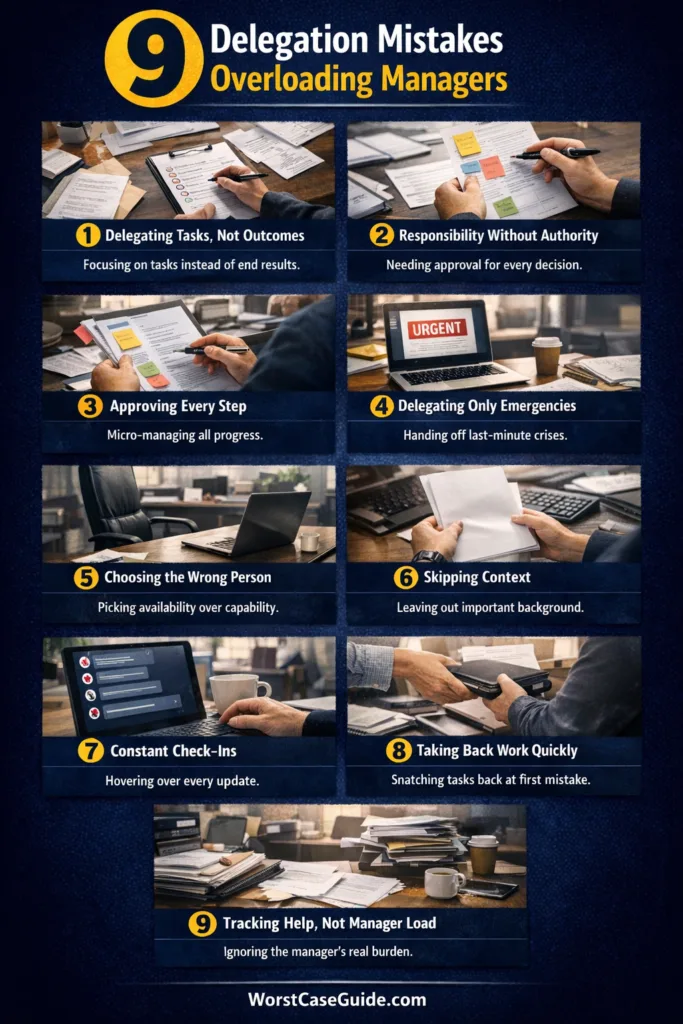
Delegation looks simple from the outside. A manager passes work to someone else, the workload should lighten, and the team should move faster. Yet manager overload often starts here. When work is handed off without the right context, authority, or boundaries, the manager does not really step back; they become the backup processor for every loose end.
That is why delegation can feel confusing. It is supposed to create capacity, but in many teams it creates more check-ins, more rework, and more hidden decisions. What looks like relief on Monday can turn into a crowded inbox, a damaged timeline, and a manager whose calendar starts to feel like Tetris by Thursday.
What makes this risky? Delegation errors rarely fail in a loud, obvious way at first. They fail quietly. The task moves, but the manager still owns the confusion, the escalation path, and the final clean-up.
Why Delegation Can Quietly Overload Managers
In smaller projects, poor delegation often shows up as delay and frustration. In larger systems, it can spread much further. A few unclear handoffs may create duplicate work, approval bottlenecks, and team members who stop acting without the manager’s signal. The damage is rarely dramatic on day one. It builds through tiny repeated returns of work.
There is also a psychological side to it. Many managers were promoted because they were reliable problem-solvers. That history can make letting go feel risky, even when holding on creates its own risk. So the manager delegates on paper, keeps control in practice, and ends up carrying both jobs.
Common Assumptions That Make Delegation Harder
- If a task is assigned, ownership is clear. In many teams, the task moves but the real decisions do not.
- If someone is capable, they need very little context. Capability helps, yet missing context still creates avoidable loops.
- If the manager stays close, quality stays high. Sometimes close support helps; constant hovering often shifts work back upward.
- If something is urgent, it can be delegated quickly. Fast handoffs with vague scope may save ten minutes now and cost days later.
- If a team member asks many questions, they are not ready. Sometimes the issue is not readiness. It is unclear expectations.
A Fast View of Where Delegation Breaks
| Area | Healthy Delegation | Overload Pattern |
|---|---|---|
| Goal | Outcome is clear. | Task is named, but the finish line is fuzzy. |
| Authority | Decision rights match responsibility. | Manager still approves every small move. |
| Context | Trade-offs and constraints are visible. | Team member works around missing history. |
| Follow-Up | Check-ins are timed and specific. | Manager reacts to every update in real time. |
| Failure Response | Problem is corrected without taking work back. | Manager rescues the task and keeps doing that. |
9 Delegation Mistakes That Overload Managers
Mistake 1: Delegating Tasks Instead of Outcomes
Why It Happens
Managers often delegate the activity because it is easier to describe than the result. “Prepare the update,” “talk to the vendor,” or “draft the plan” sounds clear enough. Still, the team member may not know what a good finish looks like, what trade-offs matter, or what level of detail is expected. The work starts moving, yet the thinking stays with the manager.

Early Warning Signs
- Questions keep arriving about format, tone, or depth.
- The manager rewrites outputs that are technically done but not usable.
- People complete steps without moving the actual result forward.
Worst-Case Result
The manager becomes the translator of unfinished work. Instead of saving time, they now review, reframe, and reconnect pieces that never aimed at the same outcome. In larger teams, this can spread confusion because others start copying the same vague handoff style.
A Safer Approach
If the situation allows, the handoff works better when the outcome, success signal, and boundaries are visible from the start. In smaller projects, that may be one sentence and two constraints. In larger systems, it may need examples, trade-offs, and a clear definition of done. The point is simple: delegate the finish line, not only the motion.
Mistake 2: Giving Responsibility Without Decision Rights
Why It Happens
This mistake often grows from good intentions. A manager wants the team member to own the work, but still keeps small approvals “just in case.” That sounds cautious. It often creates split ownership. One person carries the task, while another person still controls the important calls.
Early Warning Signs
- Work pauses for permission on routine choices.
- People say they own the task but wait for the manager’s signal.
- Approvals pile up in chat, email, or meeting notes.
Worst-Case Result
The manager becomes a daily bottleneck. Team members look delegated, but the manager still carries the pace of the whole system. A single absence, busy week, or travel day can then slow multiple workstreams at once.
A Safer Approach
Delegation holds better when authority matches responsibility. That does not mean total freedom in every case. It means the handoff makes clear which decisions the team member can make alone, which need review, and which are off-limits. Without that line, overload tends to drift back upward.
Mistake 3: Keeping Every Approval Step
Why It Happens
Some managers keep approvals because they fear visible errors. Others inherit a culture where every output must pass through them. Over time, this turns delegation into a thin layer of prep work before the real decision returns to the same person anyway. That is not full ownership. It is staged assistance.
Early Warning Signs
- Many reviews happen on items with low risk.
- The same manager signs off on wording, timing, and small execution details.
- Team members stop deciding because approval seems safer.
Worst-Case Result
The team may look busy while speed drops. The manager spends large parts of the week reviewing low-impact choices, then has less time for hiring, planning, coaching, or issue prevention. Pressure climbs, but not where it should.
A Safer Approach
One practical shift is to reserve approvals for high-cost, high-risk, or hard-to-reverse decisions. In lower-risk work, review may still happen, though it does not need to block progress. This keeps quality control where it matters without turning the manager into a permanent gatekeeper.
Mistake 4: Delegating Only the Urgent Leftovers
Why It Happens
When managers are already overloaded, they often delegate in a rush. The work handed off is usually what they no longer have time for, not what is best suited for transfer. So the team member receives fragmented, late, or messy work with little context and a tight deadline. The handoff is real, though the setup is weak.
Early Warning Signs
- Delegation happens near deadlines.
- The brief starts with “I just need help with this one thing.”
- Ownership changes after the work is already half-shaped.
Worst-Case Result
Urgent leftovers often come back as urgent clarifications. The manager then spends the same day answering questions, correcting assumptions, and explaining history under pressure. It feels like help. In practice, it can be a second workload layered on top of the first.
A Safer Approach
If delegation happens earlier, even a little earlier, the transfer usually holds better. In recurring work, stable ownership often reduces overload more than last-minute rescue handoffs. Predictable delegation gives people a chance to learn the terrain before the clock gets loud.
Mistake 5: Choosing the Most Available Person Instead of the Right Owner
Why It Happens
Availability is visible. Suitability is not always visible at first glance. So managers under pressure may hand work to the person who seems free, rather than the person with the right judgment, context, or working relationships. That can look efficient for a moment. Then the coordination cost starts showing up.

Early Warning Signs
- The new owner depends on several others just to move basic steps.
- Work is technically assigned but socially unsupported.
- The manager keeps stepping in to fill knowledge gaps.
Worst-Case Result
The task may stay alive, yet the manager now manages both the work and the relationships around the work. In cross-functional settings, this becomes expensive fast. The manager turns into the human router for context, approvals, and conflict repair.
A Safer Approach
A better transfer usually considers fit as well as free time: domain knowledge, trust with stakeholders, judgment level, and room to absorb follow-up questions. In smaller teams, one person may still wear many hats. Even then, the work tends to land better when the owner can carry more than the surface task.
Mistake 6: Skipping Context to Save Time
Why It Happens
This is one of the most common errors because it feels rational. The manager is busy, so they try to keep the handoff short. They share the task, maybe the deadline, maybe one file, and move on. What gets lost is the why behind the work: prior decisions, stakeholder sensitivities, known constraints, and what failed last time.
Early Warning Signs
- The team member asks questions that feel obvious to the manager.
- Old mistakes return in a slightly different form.
- Progress looks fine until late-stage friction appears.
Worst-Case Result
Work gets done on the wrong assumptions. That can lead to rework, stakeholder frustration, or promises the team did not mean to make. The manager then spends extra time repairing trust as well as fixing the output. A short handoff becomes a long repair cycle.

A Safer Approach
Not every handoff needs a long meeting. What usually helps is a minimum useful context set: what matters, what must not break, what others care about, and what “good enough” looks like. Context is not decoration. It changes decisions.
Mistake 7: Replacing Ownership With Constant Check-Ins
Why It Happens
Managers who worry about drift often compensate with frequent status requests. The intention is understandable. The effect can be the opposite. When every update gets an immediate reaction, the team member learns that the manager is still mentally carrying the task. Ownership softens, and dependency hardens.
Early Warning Signs
- Status messages become more frequent than actual progress.
- People wait for feedback on small choices they could handle.
- The manager feels unable to step away for even a few hours.
Worst-Case Result
The team member stops developing independent judgment, and the manager carries a stream of tiny interruptions all day. This is where overload often feels oddly busy and oddly unproductive at the same time. There is motion. There is not much relief.
A Safer Approach
Check-ins usually work better when they are timed, scoped, and tied to decision points. If a project has genuine risk, the answer may be clearer milestones rather than nonstop contact. In that setup, support stays available without pulling the work back to the manager every hour.
Mistake 8: Taking Work Back at the First Sign of Wobble
Why It Happens
Managers often step in because they care about outcomes, and sometimes the wobble is real. Still, if every rough draft, missed nuance, or early delay leads to a rescue, the team learns a strong lesson: the manager is the final owner no matter what was delegated. That creates rescue-based delegation, which is hard to escape.
Early Warning Signs
- The manager frequently says, “I’ll just do it.”
- People stop pushing through ambiguity.
- Delegated tasks return to the manager before completion.
Worst-Case Result
The manager becomes the team’s safety net for ordinary friction, not only real emergencies. Over time, this can erode confidence on both sides. The team trusts itself less, and the manager trusts delegation less. The overload then becomes self-reinforcing.
A Safer Approach
If the situation is recoverable, support may work better than retrieval. That could mean narrowing scope, clarifying a trade-off, or helping with one blocked decision while leaving ownership in place. Correcting without reclaiming often protects both capacity and learning.
Mistake 9: Tracking Helpfulness Instead of Manager Load
Why It Happens
Some delegation efforts are judged by whether team members feel helpful or whether tasks got distributed. Those measures are not useless, though they can miss the real question: did the manager’s decision load, interruption rate, and review burden actually fall? Without that lens, teams may celebrate delegation that still leaves the manager underwater.
Early Warning Signs
- The manager delegates more but works just as late.
- Review, escalation, and clarification volume stay high.
- Delegation is discussed in activity terms, not load terms.
Worst-Case Result
The organization believes the fix is working while the manager keeps absorbing complexity behind the scenes. That creates a quiet credibility problem. Burnout risk rises, planning quality drops, and the team may not understand why the manager still looks stretched after “sharing more work.”

A Safer Approach
Delegation becomes more reliable when it is judged by what stays off the manager’s plate, not just what moved away for a few hours. If a handoff still pulls the manager into repeated clarification, approval, and correction, the load did not really leave. It only changed shape.
General Risk Patterns Behind Manager Overload
Across different teams, the same patterns show up again and again. The language changes. The structure does not. A handoff becomes risky when ownership is partial, when context is thin, when approvals stay centralized, or when the manager rescues too early. These patterns are common because they look safe in the moment.
- False delegation: the task moves, the decisions do not.
- Context debt: time is saved at handoff, then paid back through rework.
- Approval gravity: routine choices drift upward until the manager slows everything.
- Rescue loops: each save makes the next save more likely.
- Hidden overload: the manager carries review and correction work that nobody counts.
A useful test is simple: after a handoff, does the manager still hold the real decisions, the hidden context, and the emergency clean-up path? If yes, the work may be shared, yet the load is still concentrated.
FAQ
What is the difference between delegation and dumping work?
Delegation includes outcome, boundaries, and enough context to act well. Dumping work usually transfers the task without the support structure around it. The first can reduce manager load. The second often pushes confusion back upward.
How often should a manager check in after delegating?
There is no single number that fits every team. In lower-risk work, fewer, clearer check-ins may protect ownership better than constant contact. In more sensitive work, check-ins tied to milestones or decision points often work more smoothly than open-ended monitoring.
Why do managers still feel overloaded after delegating more?
Because activity transfer is not the same as load transfer. A manager may delegate tasks while still carrying approvals, escalations, reviews, and correction work. If those parts stay centralized, overload often stays too.
Does delegation work differently in small teams?
Yes, a bit. In smaller teams, roles may be less formal and people may switch context more often. That can make delegation faster, though it also raises the risk of fuzzy ownership. Clear outcomes and decision boundaries still matter, even when the team is small and informal.
What is an early sign that delegation is failing?
One of the earliest signs is repeated return traffic: the work keeps coming back for clarification, approval, or rescue. When that pattern appears, the task may be delegated, but the true ownership model may still be unsettled.