Client communication can feel like a stream of small messages, yet trust often gets built or weakened in those details. A “fine” email today can create uncertainty next week if it leaves room for different interpretations. The risk is not drama. The risk is misalignment that becomes expensive to correct once decisions, timelines, and expectations harden.
In many projects, the work itself is not what damages relationships. The damage shows up when a client feels surprised, ignored, or “managed” instead of informed. A team can be competent and still lose confidence if communication patterns create predictability gaps—those moments where nobody is sure what is true, what is next, and who owns what.
What makes this topic risky: trust damage is often quiet. A client may keep meetings polite while internally reducing scope, budget, or future work. By the time feedback becomes explicit, the relationship can already be operating with lower tolerance for ambiguity.
Common Wrong Assumptions In Client Communication
- “No news is good news.” Silence can read as avoidance or loss of control.
- “They’ll ask if they need details.” Many clients don’t want to chase; they want reliable visibility.
- “We agreed verbally, so it’s understood.” Verbal alignment can drift under pressure.
- “Speed matters more than clarity.” Fast messages can create slow confusion.
- “One stakeholder represents everyone.” Internal client dynamics can be non-linear.
- “A change is small, so it won’t matter.” Small changes can break planning and approvals.
- “Being upbeat keeps things positive.” Over-optimism can feel like spin.
- “They know our constraints.” Constraints that are not stated can look like excuses later.
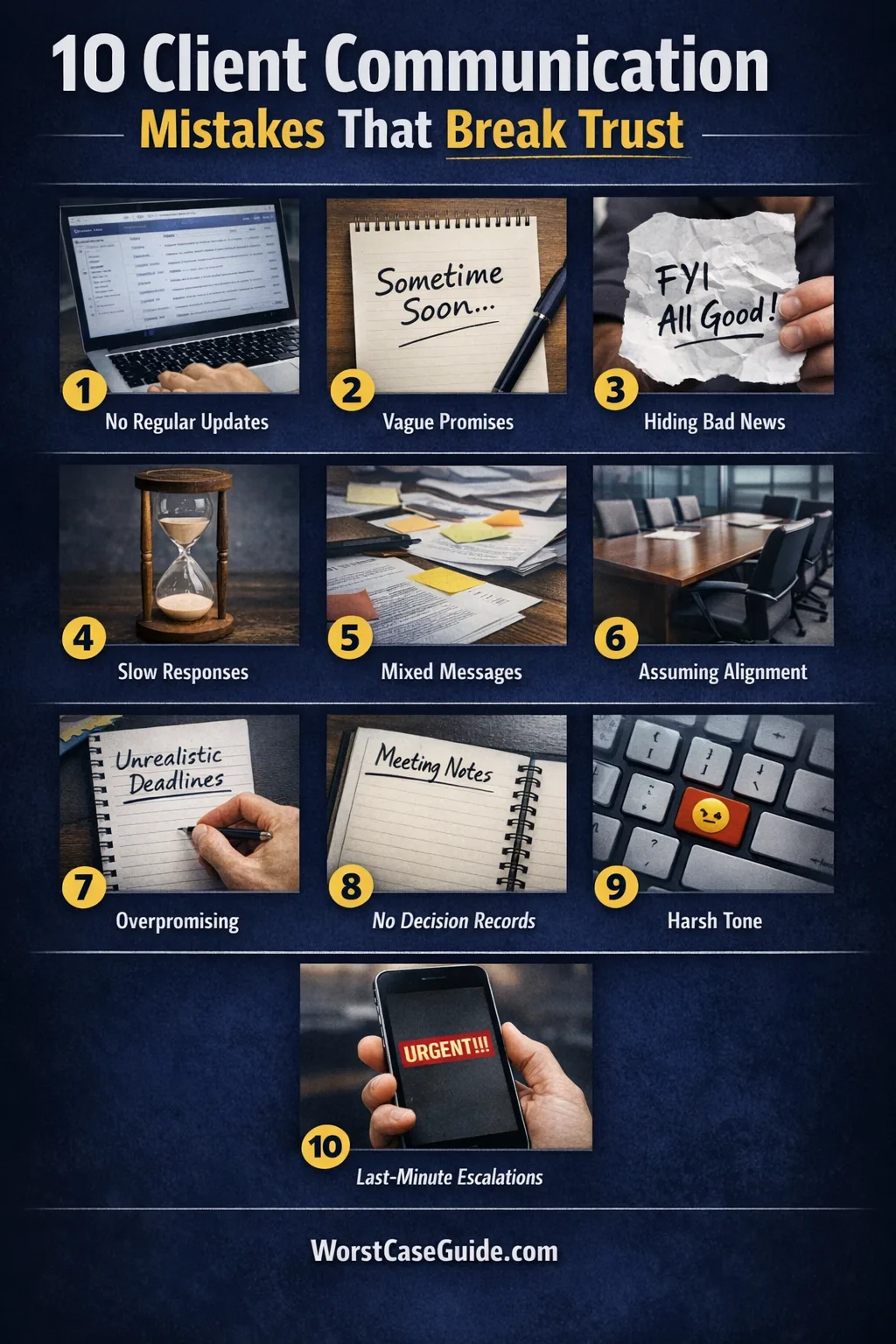
Client Communication Mistakes That Damage Trust
Reading tip: each mistake below includes early warning signs and a safer approach. The goal is not perfection; it is reducing avoidable misreads and expectations drift.
Mistake 1: Treating Updates As Optional
Why It Happens
Teams often assume the client only wants “real” news. When work is in progress, updates can feel premature, so communication becomes event-based instead of cadence-based.
Early Warning Signs
- Meetings start with status fishing rather than decision-making.
- The client asks “Where are we?” more than once per cycle.
- Stakeholders request separate check-ins with different people.
Worst-Case Result
The client fills the silence with their own narrative: delay, risk, or lack of control. Trust declines without a clear “incident,” and future messages get read with skepticism and low patience.
A Safer Approach
A predictable update rhythm can work even when there is no milestone. In smaller projects, a short note that clarifies what changed, what didn’t, and what’s next can protect trust better than occasional long reports.
Mistake 2: Using Vague Language To Stay Flexible
Why It Happens
People use soft phrasing to avoid commitment: “soon,” “should,” “we’ll try.” It can feel diplomatic, yet it often creates interpretation gaps and timeline illusions.
Early Warning Signs
- Different stakeholders repeat different versions of the same promise.
- The client asks “Does that mean Friday?” after reading an update.
- Delivery dates appear in the client’s plan that nobody on the team recognizes.
Worst-Case Result
Ambiguity becomes a perceived broken promise. The team may feel misunderstood, while the client feels misled. That mismatch can trigger escalation even if progress is real.
A Safer Approach
Language that separates confidence level from timing often reduces conflict. For example: “Current estimate is X; biggest unknown is Y; next confirmation point is Z.” It preserves flexibility without hiding uncertainty.
Mistake 3: Burying Bad News Inside “Good” Updates
Why It Happens
Teams often try to keep morale high by sandwiching problems between positive points. The intent is care; the effect can look like minimization, especially when the “bad” item affects scope, timing, or approvals.
Early Warning Signs
- The client reacts more strongly later, after “processing” the message.
- Follow-up questions focus on what was not said.
- Stakeholders ask for raw numbers or direct access to the team.
Worst-Case Result
The client starts reading updates as sales language rather than operations. That shifts the relationship from collaboration to defense, where each side prepares arguments instead of solving the problem.
A Safer Approach
A clearer structure can help: lead with what changed, state impact plainly, then list options. In larger systems, it can be safer to add a simple impact frame: “This affects A; it does not affect B; decision needed by C.”
Mistake 4: Letting Response Time Drift Without Saying Why
Why It Happens
When workload spikes, replies get delayed. Without context, the delay can feel like avoidance or loss of priority. Even a good reason can fail if it stays invisible.
Early Warning Signs
- Clients start writing “Just checking in…” repeatedly.
- They bypass the usual contact and message a leader directly.
- Questions turn into statements: “We’ll assume X unless we hear otherwise.”
Worst-Case Result
The client makes decisions without the team’s input. That can create rework, missed constraints, and a sense that the team is not dependable under pressure.
A Safer Approach
When response speed changes, a lightweight expectation reset can reduce anxiety: what the new response window is, what channel is urgent, and what gets handled in the next scheduled update. It’s less about apology, more about predictability.
Mistake 5: Mixing Decisions, Questions, And FYI In One Message
Why It Happens
Long updates feel efficient. They also overload attention. When action items are hidden among context, the client may miss what needs a decision, creating accidental delays.
Early Warning Signs
- You receive replies that only address the first paragraph.
- The client asks questions that were answered in the same message.
- Decisions get pushed to meetings because the email thread is unclear.
Worst-Case Result
Important choices remain unmade until they become urgent. The client may feel the team is disorganized, while the team feels the client is unresponsive. That mutual frustration can harden into blame patterns.
A Safer Approach
Separating messages by intent often reduces friction: one section for Decisions Needed, one for Open Questions, one for FYI. If you are in a high-stake phase, a short “reply with A/B/C” format can lower the cognitive load without sounding forceful.
Mistake 6: Assuming Stakeholder Alignment Inside The Client Organization
Why It Happens
A single client contact often acts as the “voice” of the organization. In reality, internal alignment may be partial. When messages only go to one person, others may feel surprised later, even if the team did everything “right.”
Early Warning Signs
- New stakeholders appear late and ask for “background.”
- Approvals slow down with no clear reason.
- You hear “That’s not what we agreed” from someone who was not in the thread.
Worst-Case Result
Decisions get reopened, and the project becomes a cycle of re-selling the same plan. Trust decreases because the team looks inconsistent, even though the inconsistency is inside the client’s system.
A Safer Approach
In larger organizations, it can be safer to confirm who needs to know and what “approved” means in practice. A short recurring “alignment snapshot” (scope, timeline, risks, decisions) can help the client circulate consistent truth internally.
Mistake 7: Over-Promising To Reduce Tension
Why It Happens
When a client is anxious, it’s tempting to calm things by promising speed or certainty. The promise can buy short-term relief, but it also sets a future trap if it was not grounded in capacity or unknowns.
Early Warning Signs
- Dates are shared before dependencies are confirmed.
- People say “We’ll make it happen” without explaining how.
- Internal notes show “hope” rather than plan.
Worst-Case Result
The client experiences a “double hit”: first the original problem, then a broken reassurance. After that, even accurate updates can feel like spin, and the relationship operates in permanent doubt.
A Safer Approach
Promises can be replaced by commitment points: what will be known by when, what will be delivered by when, and what might move. If you are in a tight timeline, it can be safer to state the trade-offs openly rather than implying magic.
Mistake 8: Not Documenting Decisions While The Context Is Fresh
Why It Happens
After a meeting, everyone wants to move. Writing the decision record can feel like overhead. Later, memory becomes selective, and the project pays for the missing paper trail with re-litigation.
Early Warning Signs
- People say “I thought we agreed…” in the next call.
- Scope discussions restart after a stakeholder change.
- Approvals depend on personal recollection, not shared reference.
Worst-Case Result
Disputes become about who said what, not what the best next step is. That can create defensiveness and delayed decisions, especially when budgets or deadlines tighten.
A Safer Approach
A lightweight “decision note” can be enough: decision, date, participants, and the assumptions behind it. In complex work, adding “what would change this decision” can prevent future arguments by making conditions explicit.
Mistake 9: Using Tone That Reads As Dismissive Under Stress
Why It Happens
When pressure rises, messages get shorter. Short can sound sharp. Even correct information can land badly if the tone implies “this is obvious” or “this is your fault.” Trust is sensitive to respect cues, especially in written channels.
Early Warning Signs
- The client’s tone shifts from collaborative to formal.
- They begin copying more people on emails.
- Feedback mentions “communication style” rather than the technical work.
Worst-Case Result
The relationship becomes transactional. The client stops sharing early concerns, which removes the chance to solve issues while they are small. Problems then arrive late, as surprises.
A Safer Approach
Under stress, communication that separates facts from interpretation can protect tone: “Here’s what we see; here are two plausible causes; here is what we will learn next.” It keeps the message neutral without being cold.
Mistake 10: Escalating Too Late Or Too Suddenly
Why It Happens
Teams often try to solve issues quietly before “bothering” the client. Then, when the issue becomes unavoidable, the first time it is raised is already severe. That sudden jump can feel like withholding, even if the intent was responsibility.
Early Warning Signs
- Risks are discussed internally but never appear in client updates.
- People use phrases like “Let’s wait one more day.”
- Mitigations are attempted without clarifying the impact range.
Worst-Case Result
The client feels blindsided and starts asking for control mechanisms: more reporting, more approvals, tighter oversight. That can slow delivery and create a feedback loop where communication becomes heavier and less trusted.
A Safer Approach
Early “risk flags” can be framed as probabilities, not certainties: what might happen, what would trigger it, and when a clearer answer will be available. In smaller projects, even a short note like “watch item” can reduce surprise. In larger systems, a simple risk register style update can keep escalation gradual.
A Table For Spotting Trust-Damaging Communication Early
This table is not a scorecard. It is a way to notice patterns before they harden into reputation. If you are in a situation with multiple stakeholders, the “early sign” column often matters more than the mistake name.
| Mistake | Early Sign | Safer Signal To Send |
|---|---|---|
| Optional updates | “Just checking in…” loops | Cadence + next checkpoint |
| Vague language | Different people quote different dates | Confidence level + unknowns |
| Buried bad news | Later reaction feels “bigger” than expected | Plain impact + options |
| Response drift | Bypassing to leadership | New response window stated |
| Mixed intents | Replies ignore key questions | Decisions Needed separated |
| Assumed internal alignment | Late stakeholder surprise | Shared “alignment snapshot” |
| Over-promising | Dates before dependencies | Commitment points, not reassurance |
| No decision record | “I thought we agreed…” | Decision note + assumptions |
| Stressful tone | Client becomes formal | Facts vs interpretation separation |
| Late escalation | Risks only internal | Early watch items + triggers |
General Risk Patterns Behind These Mistakes
Across industries, trust damage often follows a few recurring mechanics. The surface issue may be an email or a meeting, but the underlying pattern is usually about predictability, interpretation, and decision flow.
- Ambiguity compounds: small unclear statements create future “facts” in someone else’s plan.
- Silence gets filled: clients don’t stay neutral; they build an explanation.
- Trust is asymmetrical: it can take many steady cycles to build, and one surprise to reduce.
- Written tone carries extra weight: without voice and body language, messages get interpreted through stress.
- Misalignment hides: stakeholders can disagree internally while the team believes there is one truth.
A Practical “Trust Clarity” Check
- What is true right now? (facts, not wishes)
- What changed since the last update? (even if small)
- What is next? (a checkpoint, not a vibe)
- What needs a decision? (who, by when, options)
- What is the biggest unknown? (and when it becomes known)
In calmer phases, these questions may feel obvious. In high-pressure phases, they reduce guesswork and help both sides stay oriented around shared reality.
FAQ
What does “trust damage” look like before a client complains?
It often shows up as behavior changes: more people copied, more formal tone, more requests for approvals, or fewer candid comments. These can be early signals that confidence is decreasing even if meetings stay polite.
How can progress be communicated when there is no visible milestone yet?
Progress can be framed as movement in uncertainty: what was learned, what was validated, what risks were reduced, and what will be confirmed next. That structure can feel real without overstating certainty, and it supports predictability.
Is it safer to communicate bad news immediately, even if details are incomplete?
There are scenarios where early notice reduces surprise, especially when a risk could affect timelines or approvals. Many teams use a “watch item” frame: what might happen, what would trigger it, and when a clearer update arrives. That can keep the client informed without turning uncertainty into alarm.
How can ambiguity be reduced without sounding rigid or overly formal?
Clarity can come from separating facts, estimates, and unknowns. For example: “Current estimate is X; unknown is Y; next confirmation is Z.” It reads human, while still preventing multiple interpretations.
What if different client stakeholders ask for conflicting things?
That can be a sign of internal misalignment. It may help to reflect back the conflict neutrally: “We’re hearing A and B; these lead to different outcomes; which direction should we treat as primary?” The goal is not to pick sides, but to create one decision that the client can socialize internally.