Time management problems in business operations rarely look dramatic at first. A late approval here, a crowded calendar there, a team that seems busy all day but still misses the handoff that mattered. That is why these mistakes are easy to normalize. The risk is not just lost time. It is operational drift: deadlines slip, small delays stack up, and people start working around the system instead of through it.
In smaller companies, the damage may show up as owner fatigue and reactive work. In larger systems, it often appears as approval lag, meeting overload, and work that keeps moving without real priority control. Time management in operations is not only personal productivity. It is also scheduling logic, process design, decision timing, and how work crosses teams.
Why This Topic Turns Risky Fast
Time mistakes spread quietly. One weak planning habit in operations can affect purchasing, staffing, customer response times, reporting, and vendor coordination. It moves like a slow leak in a pipe. Not loud at first. Expensive later.
Common Assumptions That Create Time Risk
- “Busy means productive.” Activity can hide poor sequencing and weak priorities.
- “We can fix delays later.” In operations, late fixes often cost more because they affect multiple teams.
- “If everyone works harder, the backlog will clear.” Sometimes the problem is workflow design, not effort.
- “Meetings keep work aligned.” Some do. Many simply move decision-making into larger rooms.
- “Urgent work is the same as important work.” That confusion is behind many timing failures.
| Mistake | How It Usually Looks | Operational Risk |
|---|---|---|
| No real priority rules | Teams react to the loudest request | Core work gets delayed by noise |
| Calendar overload | Back-to-back meetings reduce execution time | Decisions stay pending and follow-ups get shallow |
| Weak handoff timing | Tasks move without readiness checks | Rework spreads across departments |
| No buffer time | Schedules assume ideal conditions | One delay disrupts the full chain |
| Chasing speed alone | Teams shorten review or planning steps | Errors return later as bigger delays |
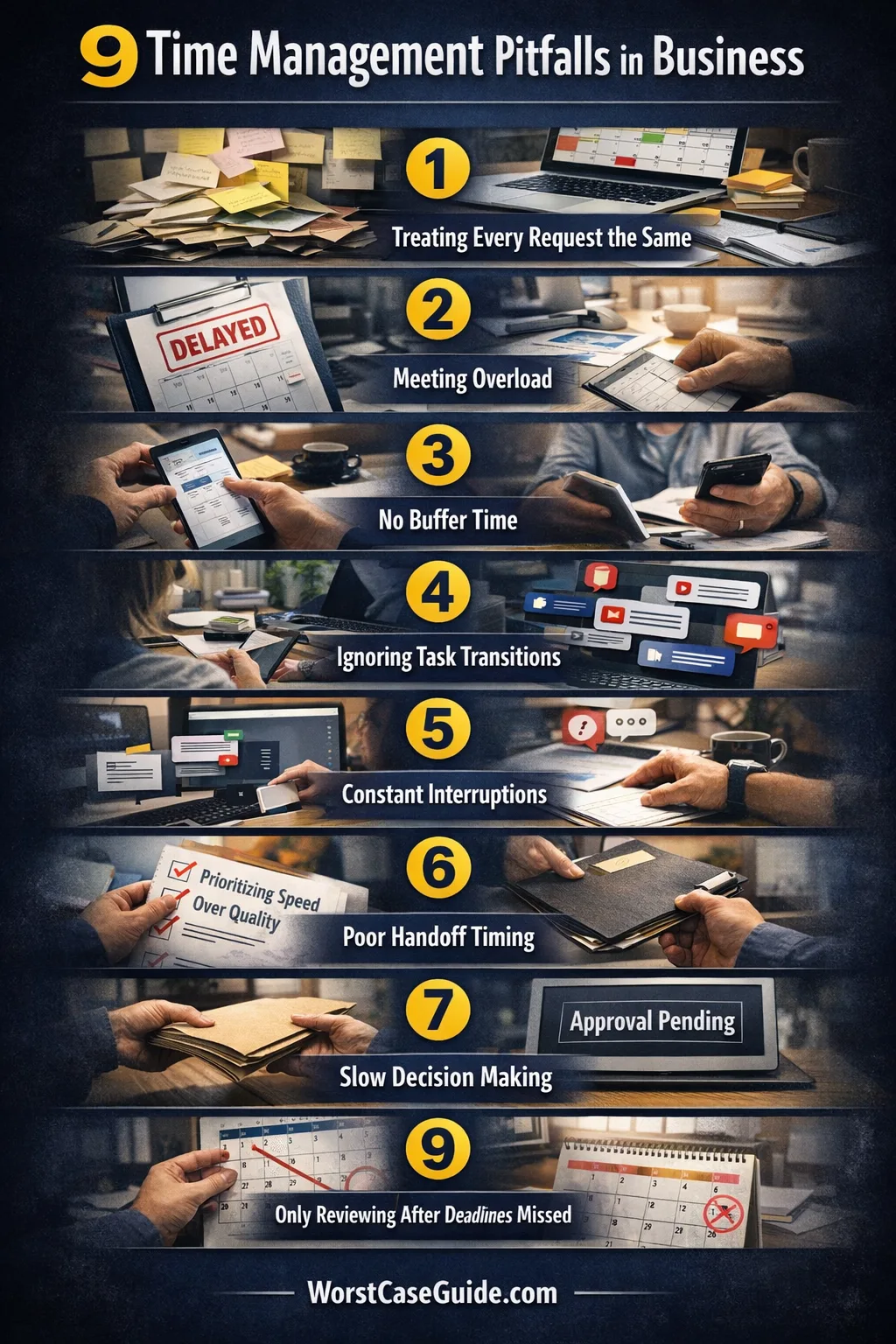
9 Time Management Mistakes in Business Operations
Mistake 1: Treating Every Request as Equal
Why It Happens
Many operations teams work inside a constant stream of requests from managers, customers, vendors, and internal departments. Without a clear priority model, the loudest message often wins. That feels responsive, but it weakens control over what actually keeps the business stable.

Early Warning Signs
- Teams change focus several times a day.
- Planned work gets pushed by unplanned work almost every week.
- People ask, “Which one is really due first?” more than they should.
- Important but quiet tasks stay open too long.
Worst-Case Result
A business can look active while its most sensitive operational work falls behind: billing reviews, stock checks, compliance steps, customer escalations, or payroll inputs. Then the team faces a backlog with hidden age, not just visible volume. That is a rough place to discover it.
A Safer Approach
If requests come from many directions, a simple ranking rule often helps more than a long policy document. In smaller projects, this may be a short list of decision rules. In larger systems, it may need service levels, owners, and cut-off times. Clarity beats intensity.
Mistake 2: Filling the Calendar Without Protecting Work Time
Why It Happens
Meetings feel like progress because people are present, updates are shared, and calendars look full. Yet operations work needs uninterrupted execution time for scheduling, checking exceptions, resolving issues, and closing loops. When the calendar becomes the main workplace, actual task completion starts to shrink.
Early Warning Signs
- Follow-up work happens mostly before 9 a.m. or after normal hours.
- Recurring meetings continue even when the agenda has become thin.
- People attend status calls, then send separate clarification messages anyway.
- Decision notes are vague because discussion replaced ownership.
Worst-Case Result
Work gets talked about more than it gets completed. Teams become slower, not because they lack effort, but because their day is sliced into fragments too small for deep operational tasks. What starts as coordination ends as time debt.
A Safer Approach
If a team depends on live coordination, some meetings are useful. Even so, protected execution windows often reduce delay more than another check-in does. In larger operations, meeting reviews by function or by decision type can reveal where time is being consumed without output.
Mistake 3: Planning Around Ideal Conditions
Why It Happens
Many schedules are built as if every approval, handoff, delivery, and response will happen on time. That is understandable. People want clean plans. Still, operations rarely move in a straight line, and even well-run teams deal with absences, supplier lag, tool issues, and competing requests.
Early Warning Signs
- Timelines break after one minor delay.
- Teams rely on the phrase “assuming everything goes smoothly.”
- There is little or no slack between dependent tasks.
- Rescheduling becomes normal, not rare.
Worst-Case Result
One late input can trigger a chain of missed slots, rushed approvals, overtime, and avoidable conflict between teams. In customer-facing operations, the damage can reach service levels and trust, even when the original delay looked small.
A Safer Approach
Schedules tend to hold better when they include buffer time around dependencies and known risk points. If you are in a high-variance environment, the safer question is not “What is the fastest path?” but “What holds when one step slips?”
Mistake 4: Ignoring Transition Time Between Tasks
Why It Happens
Operations schedules often count the time needed to do a task, but not the time needed to switch context, gather missing information, reopen systems, or confirm the status of the previous step. On paper, the work still fits. In practice, it does not.
Early Warning Signs
- Tasks seem short individually but the day still overruns.
- People lose time re-reading notes or locating files.
- Handoffs require extra messages because context was not carried forward.
- Small delays keep repeating in the gaps between tasks.
Worst-Case Result
Teams start stacking unfinished work across the day. That raises error risk because each return to a half-done task comes with memory loss, missing details, and more chances to skip a check. It is the operational version of dropping plates one by one.
A Safer Approach
In process-heavy work, transition cost deserves planning space. Grouping similar tasks, reducing tool switching, and making handoff details easier to see can recover more time than pushing individuals to move faster.
Mistake 5: Running Operations Through Constant Interruptions
Why It Happens
Chat tools, email, calls, and internal pings create the feeling that fast response equals good service. Sometimes it does. Yet constant interruption can turn routine operations into reactive work, especially when no one distinguishes real exceptions from ordinary questions.
Early Warning Signs
- People check messages while completing sensitive tasks.
- Teams struggle to finish one process before starting another.
- Notification traffic keeps rising without fewer problems.
- Interruptions become the default workflow.
Worst-Case Result
Important operational steps get skipped because attention is split. In settings with approvals, reconciliation, order handling, or scheduling dependencies, this can lead to duplicate work, missed updates, or incorrect downstream actions. The first mistake is not always the costly one; the unnoticed second one often is.

A Safer Approach
If a team handles both routine work and real-time exceptions, separate channels or time windows often reduce confusion. In smaller teams, even a light rule for what counts as urgent can lower noise. Not every ping deserves the same level of access.
Mistake 6: Measuring Speed More Than Completion Quality
Why It Happens
Operations leaders often watch throughput, response time, and volume. That makes sense. Still, when speed becomes the main signal, teams may shorten review steps, skip verification, or close tasks before the work is truly settled. Fast is useful only when the work stays closed.
Early Warning Signs
- Closed tasks reopen often.
- Teams celebrate output counts while rework quietly rises.
- People feel pressure to finish before the details are stable.
- Completion metrics look good but complaint patterns do not.
Worst-Case Result
The business gains apparent speed but loses time overall. Rework comes back through support tickets, missed corrections, vendor disputes, or internal cleanup. That loop is expensive because it hides inside future workloads instead of today’s report.
A Safer Approach
A healthier operational view often balances time metrics with reopen rates, exception rates, and downstream corrections. In larger systems, this can show whether fast completion is real or merely early closure with delayed consequences.
Mistake 7: Letting Handoffs Happen Without Timing Rules
Why It Happens
Many business processes cross functions: sales to operations, operations to finance, purchasing to receiving, support to fulfillment. Trouble starts when handoffs happen whenever someone is “done,” rather than when the next team is ready and the needed information is complete. Timing matters as much as content.
Early Warning Signs
- Teams send work forward, then send extra clarification later.
- Receiving teams ask basic status questions again and again.
- Deadlines are missed at department boundaries, not inside one team.
- Ownership becomes blurry during transfer.
Worst-Case Result
Work enters the next stage half-ready. That creates idle time, duplicate checks, queue confusion, and blame between departments. In larger systems, weak handoffs can make a business feel slower than it is, because delay grows in the seams rather than in the visible process steps.
A Safer Approach
If you are in a process with multiple teams, handoff timing rules often help more than extra reminders. Readiness criteria, cut-off windows, and visible owners reduce the chance that work arrives too early, too late, or half-formed.
Mistake 8: Forgetting That Decision Delays Are Time Management Problems Too
Why It Happens
Time management is often treated as a task-level issue, but operational slowdowns frequently come from decision lag: approvals wait, escalations sit, exceptions remain unresolved, and teams keep working around missing calls. This is common in companies where responsibility is spread wide but authority is not.

Early Warning Signs
- Teams say “We are waiting for approval” too often.
- Minor issues rise to senior people because no one else feels able to decide.
- Projects keep moving, but only on reversible tasks.
- Bottlenecks gather around a few names.
Worst-Case Result
Work slows, queues thicken, and teams start making informal workarounds to keep operations moving. Those workarounds may help for a week or two. Then they create inconsistency, hidden risk, and disputes about who approved what (or did not).
A Safer Approach
In smaller operations, a short decision map may be enough. In larger systems, escalation thresholds and response windows can lower idle time without pushing every choice upward. Decision timing is part of operational timing.
Mistake 9: Reviewing Time Problems Only After a Missed Deadline
Why It Happens
Many teams examine time use only when something fails badly enough to demand attention. By then, the pattern has usually been present for a while: hidden queue growth, repeated small delays, overloaded approvers, or rising rework. Late review creates late learning.
Early Warning Signs
- There is no routine review of delay sources.
- Teams discuss missed dates but not delay patterns before the miss.
- Reporting focuses on finished work, not aging work.
- People sense friction before leaders can see it in reports.
Worst-Case Result
The business keeps solving symptoms while the same timing failures return in new forms. One quarter it appears as customer delay. Next quarter it shows up as staff strain, weak forecasting, or vendor friction. The surface changes. The pattern stays.
A Safer Approach
Regular review tends to work better when it looks at queue age, reopen work, approval wait time, handoff friction, and interruption load rather than just headline deadlines. Why wait for the visible failure if the earlier signals are already there?
General Risk Patterns Behind These Mistakes
- Visibility without control: teams can see work, but they cannot rank or shape it well.
- Speed without stability: output rises while rework and confusion rise with it.
- Coordination without ownership: meetings and messages increase, yet decisions remain slow.
- Schedules without realism: plans assume perfect flow and collapse after ordinary disruption.
- Handoffs without readiness: work moves between teams before the next step can use it properly.
Across different business sizes, the pattern is fairly consistent: time problems in operations are often design problems first, discipline problems second. That distinction matters. When the system creates friction, asking people to push harder may only hide the weak spots for a little longer.
FAQ
Is time management in operations mostly a personal productivity issue?
Not usually. Individual habits matter, but many operational delays come from priority confusion, slow approvals, weak handoffs, overloaded calendars, and unrealistic scheduling. The issue often sits in the workflow, not only in the person doing the work.
What is the earliest sign that time management is breaking down in business operations?
One early sign is aging work that stays open even when teams look busy. Another is when people keep switching priorities during the day because no ranking rule is clear. That usually appears before the missed deadline does.
Can more meetings solve operational timing problems?
Sometimes a short decision-focused meeting helps. Still, a larger meeting load often reduces execution time and creates shallow follow-up. Meeting volume and coordination quality are not the same thing.
Why do small delays create outsized operational problems?
Operations usually depend on sequences, not isolated tasks. A small delay at one point can affect staffing, approvals, inventory actions, customer updates, and reporting windows. The effect grows because work is connected.
Does a faster team always have better time management?
Not always. A team may finish quickly but create more reopen work, more exceptions, or more downstream correction. Healthy operational timing usually combines pace with stable completion.